
Facebook Ads Manager, Google Analytics, and your CRM report three different conversion numbers for the same campaign on the same day. When your paid media team operates offshore and reports monthly, that mismatch compounds silently into thousands of dollars of unaccountable spend. These six rules prevent it.
TL;DR: Ad spend transparency breaks down when platform data lives in silos and reporting cadences are too slow. Require raw platform access, weekly CPA/ROAS snapshots, and a three-layer reporting structure that separates spend, performance, and attribution data. Contractual escalation thresholds catch waste before it accumulates.
The underlying problem is structural. As Cometly’s research on marketing spend accountability documents, most marketing teams have data trapped in silos where Facebook shows one set of conversions, Google Analytics shows another, and the CRM shows actual customers. The numbers rarely match, creating confusion and undermining accountability. When you add a 12–14 hour time-zone offset and a reporting cycle measured in months, you’ve built a system where problems hide until they’re expensive.
Organizations that actively track and analyze their campaign performance metrics are 2.3x more likely to exceed their revenue goals, according to AI Digital’s 2026 analysis. The gap between teams that track weekly and teams that review monthly is where budgets quietly bleed. Here’s how to close it.
Require raw platform access on day one
Why does this need stating? Because a surprising number of outsourced PPC arrangements start with the agency or team creating ad accounts under their own business manager. Your first transparency rule: every ad account, every pixel, every Google Ads MCC lives under your business manager with your payment method attached. The offshore team gets operator access, not ownership.
This matters for paid media reporting because screenshots and PDF exports can be selectively filtered. Platform-level access lets you verify spend figures directly against your credit card statements. It also means you can run your own campaign performance audits at any time without requesting data exports.
If your outsourced PPC management partner resists this, that resistance is itself diagnostic. Teams confident in their work don’t need to control the data pipeline.
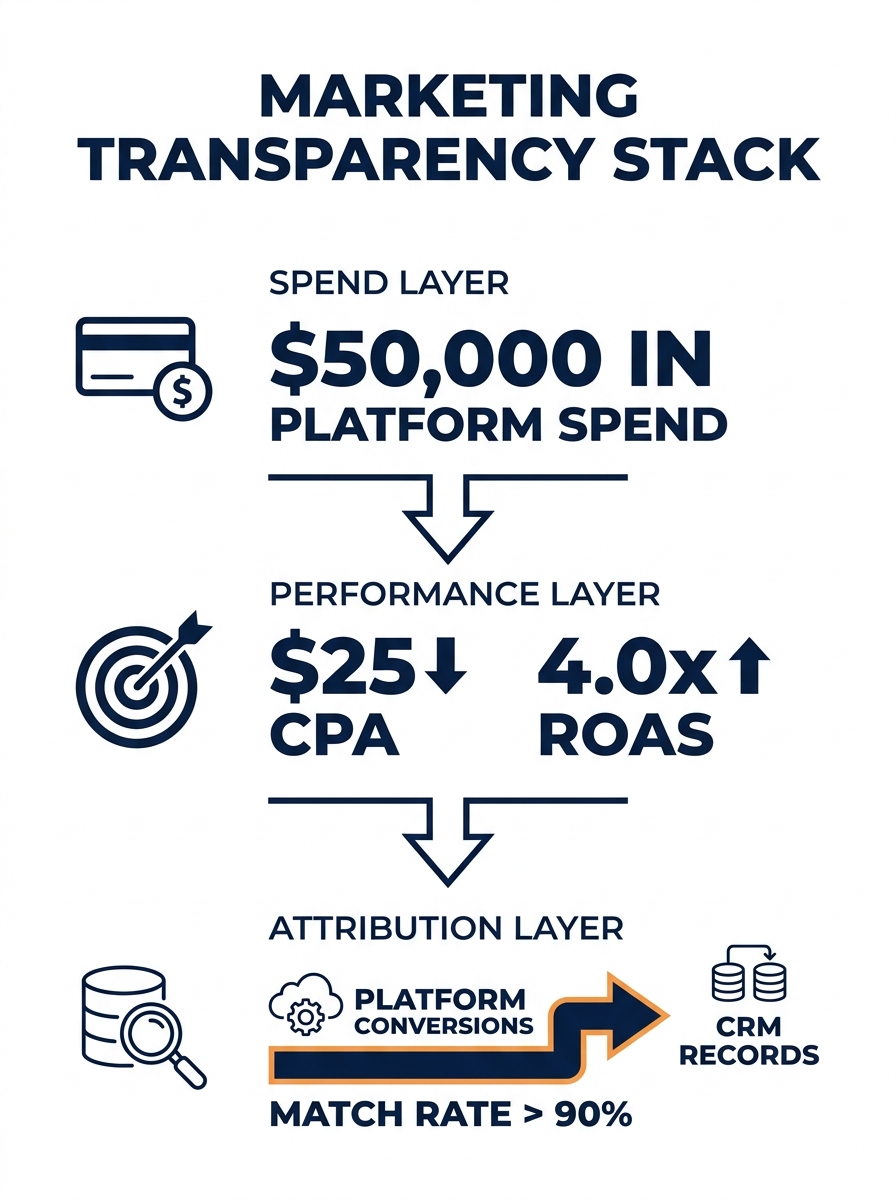
Split every report into spend, performance, and attribution layers
A single “campaign report” that mixes impressions, spend, clicks, conversions, and revenue into one document creates the appearance of transparency while obscuring the relationships between numbers. The fix is structural separation using what we call the Three-Layer Transparency Stack.
The spend layer answers one question: where did the money go? Break this down by platform, campaign, ad set, and day. Every dollar should map to a specific placement. The performance layer tracks efficiency metrics: CPC, CPA, conversion rate, and ROAS. As Improvado’s 2026 ad spend tracking guide puts it, ROAS is the ultimate measure of campaign profitability, and effective tracking directly links ad spend to revenue. The attribution layer reconciles platform-reported conversions against your CRM or e-commerce backend.
When these three layers live in the same spreadsheet tab, the team can hide a 40% CPA increase behind a 15% impression lift. Separate them, and each layer stands on its own.
If you’ve already started building a quality-first dashboard for your outsourced team, add these three layers as distinct tabs or views rather than blending them into a single report card.
Demand weekly CPA and ROAS snapshots
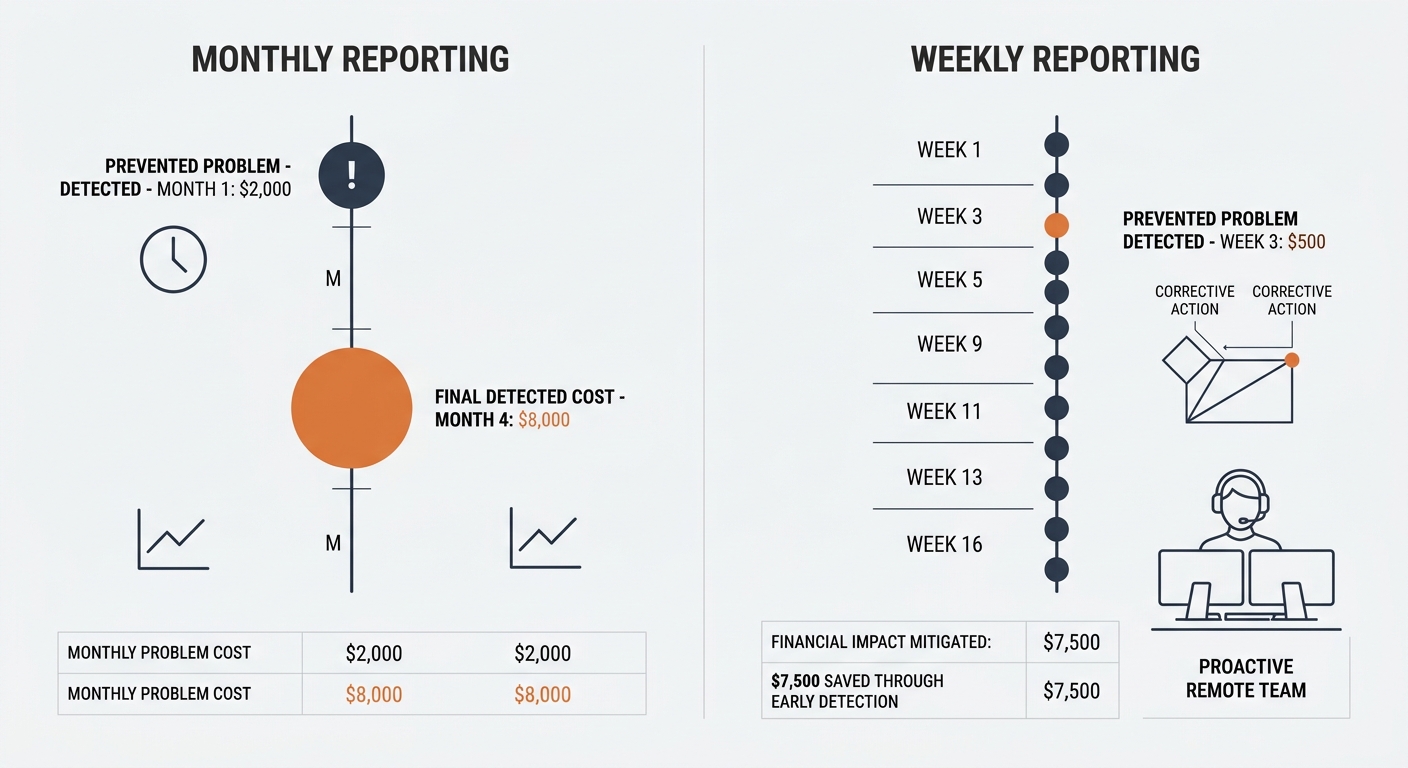
Monthly reporting is the default cadence for most offshore marketing engagements. It’s also the cadence at which $2,000 problems become $8,000 problems.
According to Newage Agency’s framework for advertising metrics that matter, weekly reviews should focus on optimization metrics like CPA, conversion rate, and engagement, while monthly analysis centers on strategic performance indicators tied to business objectives. This distinction is critical for Philippine digital marketing KPIs because it means the weekly check isn’t a strategy meeting. It’s a 15-minute health check on three numbers: CPA trend (up, down, flat), ROAS trend, and total spend against budget.
A concrete weekly cadence for outsourced social media management and paid campaigns looks like this: the team submits the snapshot by 10 AM their time every Monday. You review before your workday starts. Questions get logged in a shared doc. Answers come back within 4 hours. The entire loop closes in one business day.
Tip: Set the weekly snapshot deadline for Monday mornings Philippine time. Weekend ad performance data will have settled by then, and you’ll catch Monday-morning budget allocation issues before they compound through the week.
Audit the gap between platform conversions and CRM conversions
Platform-reported conversions run 30–60% higher than CRM-verified conversions in most B2B campaigns. This isn’t fraud. It’s a measurement architecture problem where each platform claims credit for the same conversion through different attribution windows and tracking methodologies.
SmartBug Media’s marketing audit framework recommends periodic audits precisely because problems shouldn’t only surface once deviations become self-evident. Conducting recurring audits enables your team to discover problems early and solve them quickly.
Your offshore team needs to report both numbers side by side every week. Column A: platform-reported conversions. Column B: CRM-verified conversions. Column C: the gap expressed as a percentage. When that gap widens beyond your historical baseline by more than 10 percentage points, something changed in tracking, attribution, or campaign targeting. Your team should flag the shift and explain it before you ask.
This practice connects directly to tracking pipeline quality over volume metrics. If you’re running campaigns where the dashboard tracks lead quantity but ignores pipeline quality, the platform-to-CRM gap is the first number that exposes the disconnect.
A report that blends platform conversions and CRM conversions into one number is a report designed to look good, not a report designed to be useful.
Name every dollar that doesn’t touch media
Ad spend transparency demands answering a straightforward question: of every $1,000 you send to your offshore marketing team, how many dollars actually become ad impressions? The remainder goes to management fees, tool subscriptions, creative production, reporting overhead, and margin. All of those costs are legitimate. The problem starts when they’re unnamed.
Philippine specialist rates run $15–25/hour compared to $90–120/hour for US-based generalists handling the same platforms. That cost advantage is real and well-documented. But if your $5,000 monthly retainer includes $1,200 in unstated management overhead, you’re not saving as much as the rate card suggests. Require a line-item breakdown: media spend, management hours at agreed rate, tool costs, and creative production costs. Four categories, updated monthly.
This level of accountability pairs naturally with the strategy-execution split in Philippine ad operations where the US-side client owns strategy and budget allocation while the offshore team owns execution and reporting.
Set contractual thresholds that trigger automatic alerts
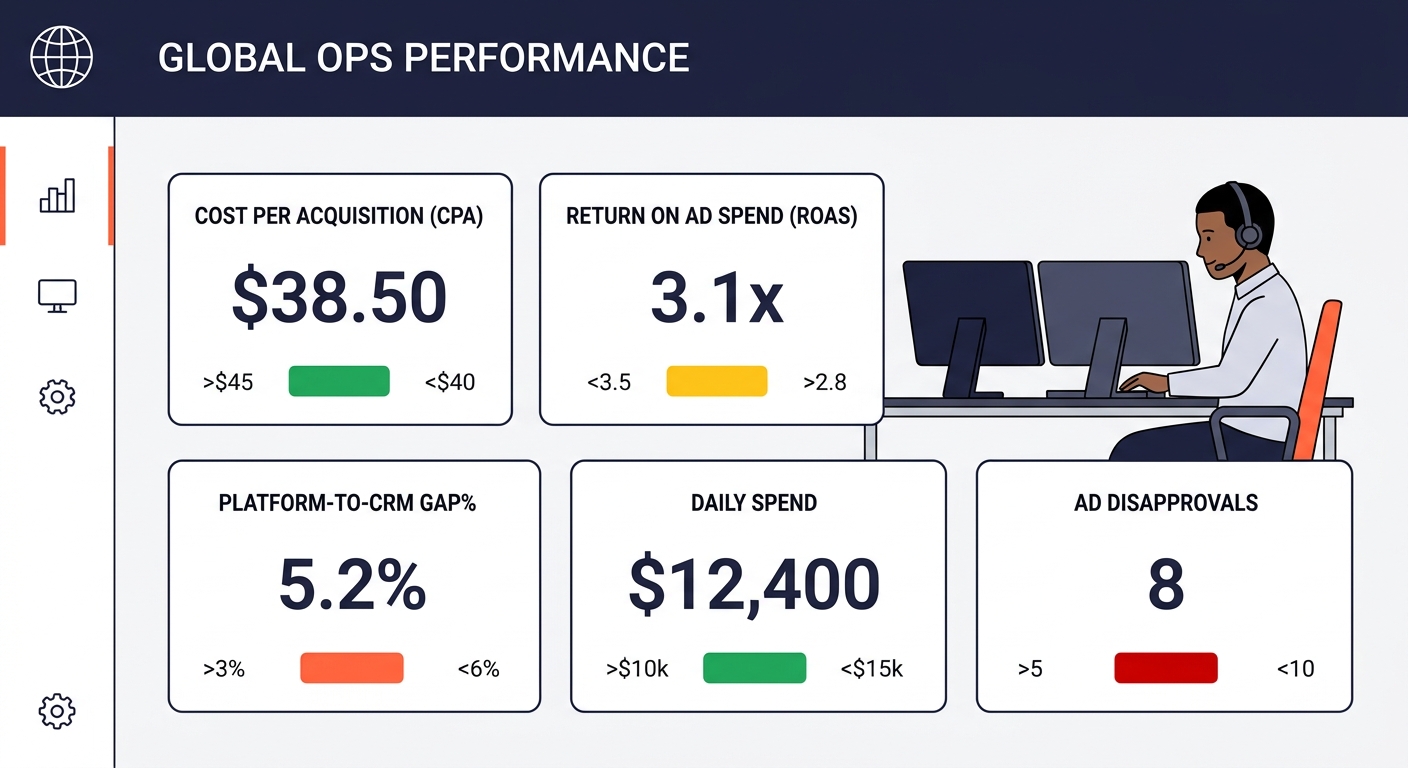
Rules 1 through 5 depend on human discipline. Rule 6 builds the guardrails into the agreement itself. Define three to five metric thresholds in your service agreement that trigger mandatory notification within 24 hours.
| Metric | Threshold | Required Action |
|---|---|---|
| Weekly CPA | Rises 25%+ above 4-week average | Written explanation + optimization plan within 24 hours |
| Weekly ROAS | Falls below 2.0x for 2 consecutive weeks | Budget pause on underperforming campaigns + review call |
| Platform-to-CRM gap | Exceeds 50% for any campaign | Tracking audit within 48 hours |
| Daily spend | Exceeds 120% of daily budget cap | Same-day notification + spend adjustment |
| Ad disapprovals | More than 3 ads disapproved in one week | Root cause analysis + creative review |
As Wallester’s research on multi-client ad spend management emphasizes, monitoring spend gives teams the chance to react in real time, shift resources, and fix issues early. Contractual thresholds turn that principle from good intention into enforceable practice.
These thresholds shouldn’t feel adversarial to a competent offshore team. Good operators already track these numbers internally. Writing them into the agreement simply aligns internal monitoring with client expectations.
When These Rules Create Friction
Every rule above assumes a mature offshore engagement with clear role boundaries. They can backfire in three scenarios.
Early-stage relationships with less than 90 days of baseline data don’t have meaningful averages against which to set thresholds. During the first quarter, track everything but hold off on contractual escalation triggers. Use the period to establish baselines.
Low-spend accounts under $3,000/month generate so little data that weekly CPA swings of 40–50% are normal variance, not signals. At these budget levels, biweekly snapshots with monthly deep-dives are sufficient. The Three-Layer Transparency Stack still applies, but the cadence relaxes.
Creative-heavy campaigns where the team is producing 20+ ad variations per week sometimes need room to experiment with higher short-term CPAs. Build an explicit “testing budget” line that sits outside the threshold triggers. Cap it at 15–20% of total monthly spend and require a separate performance summary for test creatives.
The broader principle underneath all six rules: offshore marketing accountability isn’t about surveillance. It’s about building the data infrastructure that lets both sides identify problems early enough to fix them cheaply. When you catch a CPA spike at $400 of wasted spend instead of $4,000, the weekly reporting cadence paid for itself fifty times over. And the Philippine team that helped you catch it becomes the team you keep on retainer for the next three years.