
Data quality research pegs the figure at 20–30%: that’s the share of a marketing budget wasted when campaigns run on inaccurate assumptions. Add an outsourced team working 8–13 hours ahead of your office, and the brief becomes the most expensive single point of failure in the entire engagement.
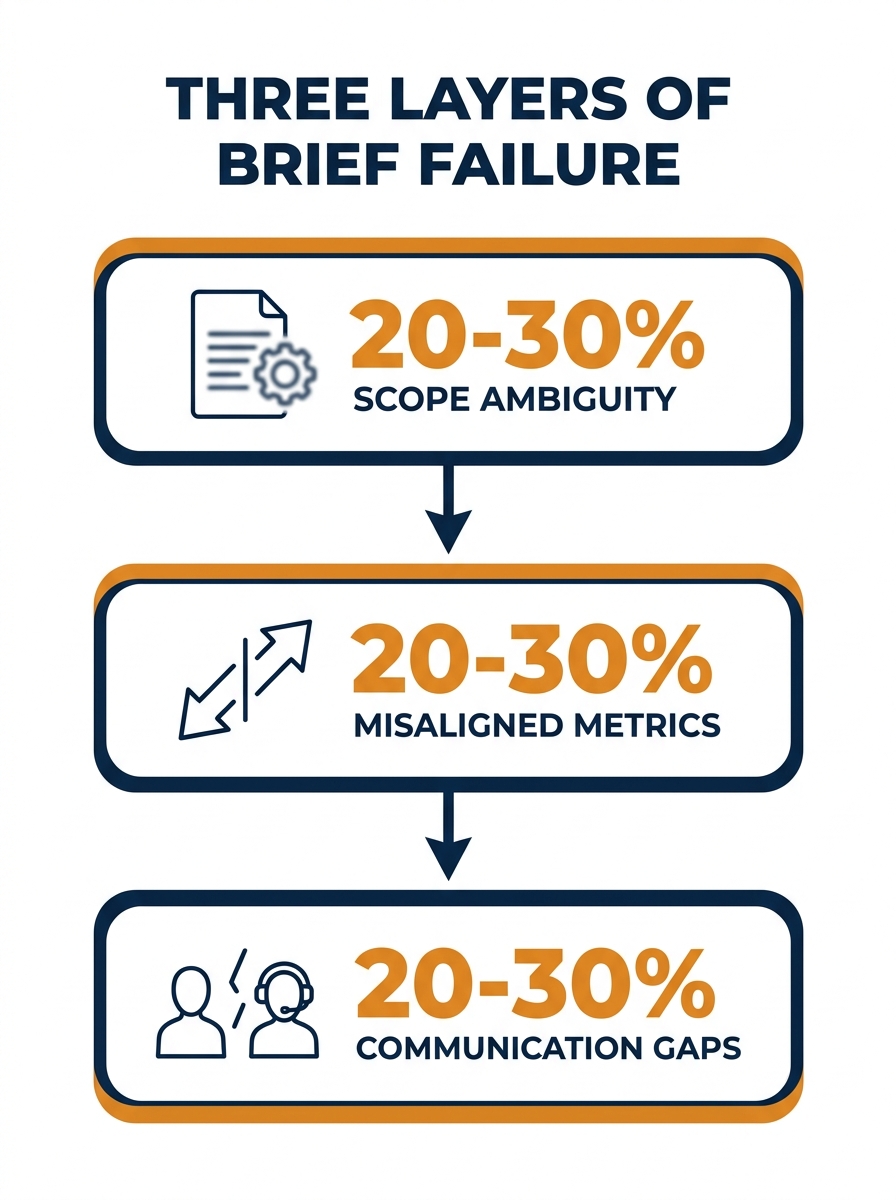
TL;DR: Outsourced marketing campaigns don’t fail at execution. They fail at the brief. The Scope-Signal-Cadence framework addresses the three structural gaps—undefined deliverable boundaries, unaligned success metrics, and missing async response protocols—that cause 20–30% of outsourced marketing spend to evaporate before work begins.
The Budget Leak No One Audits
Why do outsourced marketing campaigns underperform? The instinct is to blame talent, time zones, or cultural fit. The data points somewhere else entirely: the brief document both parties signed off on before any work started.
Organizations lose 12–15% of total revenue to poor data quality across all functions. In marketing departments, that revenue leak manifests as campaigns built on wrong audience segments, outdated competitive positioning, or misread buyer intent. The problem gets worse in outsourced engagements because the brief has to do double duty. It’s the strategy document and the communication bridge. When either function breaks, the other goes with it.
Consider a documented case from offshore outsourcing research: a marketing firm hired an outsourced creative agency for a seasonal campaign. Both teams agreed on scope and budget. But a single miscommunicated launch date threw the entire project off track. The deliverables arrived on time—for the wrong deadline. The brief had 14 pages of brand guidelines and zero clarity on the one date that mattered most.
This pattern repeats across industries and geographies. As one analysis of outsourcing failures found: “When companies chase the lowest price, skip proper vetting, or fail to set clear expectations, they open the door to costly mistakes.” The brief is where those expectations either get locked in or left dangling. And in 70%+ of cases, they’re left dangling.
The fix isn’t a longer brief. It’s a structurally different one. That’s where the Scope-Signal-Cadence framework comes in—three layers that address the three distinct ways briefs collapse in outsourced marketing engagements.
Part One: Scope Lock
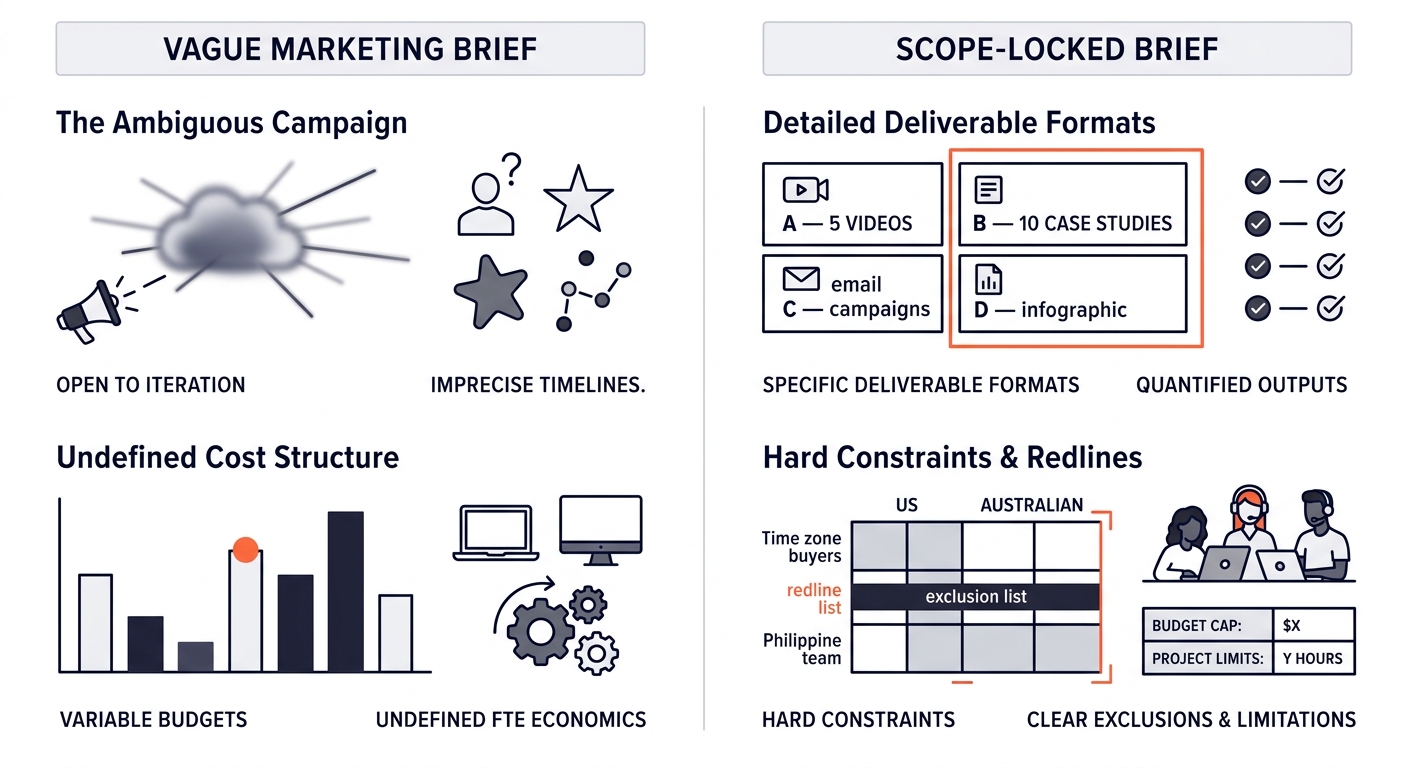
The first layer of the Scope-Signal-Cadence framework eliminates ambiguity about what the outsourced team will actually produce, in what format, and with what constraints.
A typical marketing brief lists campaign objectives and target audience. That’s necessary but insufficient for a team sitting 8–13 time zones away. When your Philippine marketing team reads “create social media content for Q3 product launch,” they’re interpreting 6 variables simultaneously: platform mix, post frequency, content format (static vs. video vs. carousel), copy length, approval workflow, and asset sourcing. If even 2 of those 6 are unspecified, the first round of deliverables will miss the mark.
Scope Lock means spelling out 4 non-negotiable elements in every brief:
- Deliverable inventory with format specs. Not “social content” but “12 Instagram carousel posts, 1080×1080px, 5–7 slides each, with copy under 150 characters per slide.”
- Exclusion list. What the team should not produce. If you don’t want TikTok content, say so. Assumptions travel badly across time zones.
- Source material package. Brand assets, previous campaign files, competitor references, and tone-of-voice documents—bundled in one shared folder, not scattered across 4 email threads.
- Hard constraints. Budget ceiling per deliverable (e.g., $35 maximum stock photo spend per post), turnaround window (72 hours per batch, not “ASAP”), and compliance requirements.
Brafton’s marketing brief guide identifies 9 essential elements for any campaign brief, but for outsourced engagements you need to pressure-test each element against a single question: would a skilled marketer with zero context about your company know exactly what to produce from this sentence alone? If the answer is no, the scope isn’t locked.
The difference between a good in-house brief and a good outsourcing brief structure is specificity at the deliverable level. Your in-house team can walk down the hall and ask a clarifying question. Your Philippine marketing team can’t—and a 13-hour round trip on a Slack message means every ambiguity costs you a full business day.
Part Two: Signal Map
The second layer addresses marketing expectations alignment between client and outsourced team. This is where most engagements quietly go wrong without anyone noticing until month 2 or 3.
A Signal Map is a shared document—separate from the brief—that defines 3 things:
- Success metrics with numeric thresholds. Not “improve engagement” but “increase Instagram engagement rate from 1.2% to 2.0% within 60 days.” Not “generate leads” but “deliver 40 MQLs per month at under $85 cost-per-lead.” Every KPI gets a number, a timeframe, and a measurement source.
- Escalation triggers. At what point does the outsourced team flag a problem versus solve it independently? If ad spend exceeds budget by 10%, do they pause the campaign or notify you? If a landing page conversion rate drops below 1.5%, do they A/B test on their own or wait for direction? These decision boundaries matter enormously when your teams overlap for only 3–4 working hours per day.
- Reporting cadence and format. Weekly performance breakdowns beat monthly summaries every time. We’ve covered why weekly transparency in paid media reporting prevents the slow bleed of underperforming campaigns going undetected for 30+ days.
The brief tells your outsourced team what to build. The Signal Map tells them what success looks like—and at what point they should stop and call you.
Without a Signal Map, your outsourced team defaults to their own interpretation of “good.” That interpretation might be perfectly reasonable and still completely wrong for your business. A Philippine digital marketing team running Facebook ads for a US-based SaaS company might optimize for click-through rate (a standard quality metric) when you actually care about demo bookings (a pipeline metric). Both are valid optimization targets. The Signal Map is what makes sure everyone is rowing toward the same one.
The async decision tax compounds this problem. Every misaligned metric creates a decision loop: the team produces work, you review it, you redirect, they adjust, you review again. Each loop costs 24–48 hours in an async workflow. Three misaligned metrics running simultaneously can burn 15–20 hours per month in pure coordination overhead.
Part Three: Async Cadence
The third layer is the async communication framework that governs how information flows between your team and the outsourced partner.
Communication breakdowns are the single most cited reason for outsourcing failure. Research on outsourcing failures identifies language differences and time zone discrepancies as primary barriers to project execution. But the real culprit isn’t the time zone gap itself—it’s the absence of a structured communication protocol that accounts for it.
An Async Cadence defines 5 operational parameters:
| Parameter | What It Specifies | Example |
|---|---|---|
| Primary channel | Where daily work communication happens | Slack (dedicated client channel) |
| Response window | Maximum time to acknowledge a message | 4 business hours |
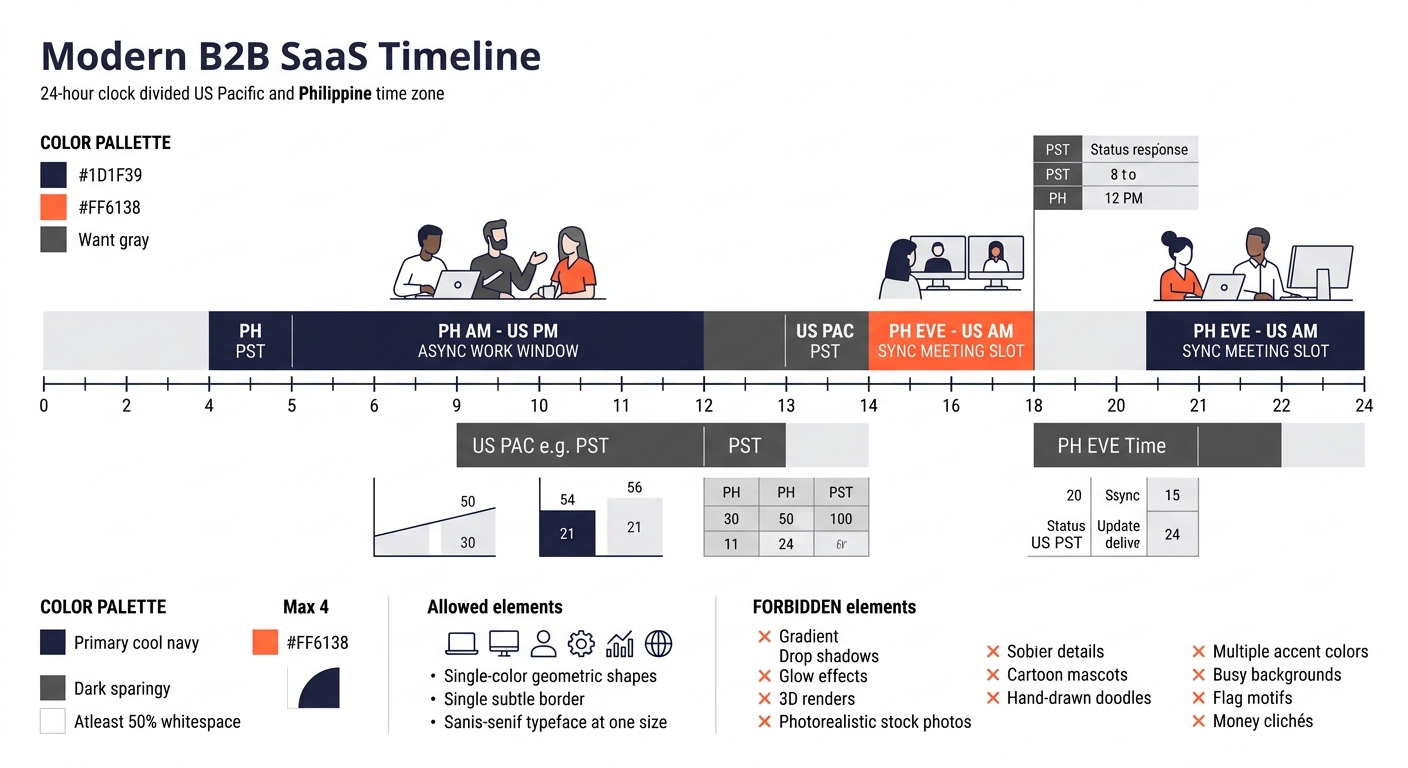
| Sync meeting frequency | Live overlap sessions | 2× per week, 30 min, during 8–10 AM PST / 11 PM–1 AM PHT overlap |
| Status update format | Structured async updates replacing ad-hoc check-ins | Loom video + bullet summary every Tuesday and Thursday |
| Decision escalation path | How urgent decisions get routed outside response windows | Text/WhatsApp to project lead for anything blocking spend over $500 |
The response window parameter deserves special attention. A 4-hour business-hour response window means that a message sent at 3 PM in Los Angeles (6 AM in Manila) will get acknowledged by 10 AM Manila time. That’s predictable. Predictability reduces anxiety on both sides and eliminates the “are they even working on this?” doubt that erodes trust in outsourced relationships.
Teams that build this structure into their engagement from day one report measurably fewer revision cycles. When generalist Philippine marketing teams have clear communication rails, they can make judgment calls independently on routine tasks and reserve the sync sessions for strategic decisions that actually require real-time discussion.
Tip: Set your Async Cadence before you finalize the brief. Communication infrastructure should shape the brief’s structure—tight async windows allow for more iterative briefs, while limited overlap hours demand more front-loaded specificity in the Scope Lock.
Even organizations that start with a virtual assistant handling basic marketing coordination can apply this framework. The Async Cadence scales from a single VA managing your social calendar to a 5-person offshore content team running multi-channel campaigns. The parameters stay the same; only the frequency and channel complexity change.
Where the Scope-Signal-Cadence Framework Falls Short
The 20–30% budget waste figure captures what’s measurable. Plenty of outsourcing failure prevention depends on factors the Scope-Signal-Cadence framework can’t fully control.
Cultural context is one. A brief can specify tone of voice down to adjective-level preferences and still miss the gap between how humor, urgency, or formality land across cultures. The $500-per-ad sensitivity review cost cited in marketing risk research hints at the scale of this problem, but most SMBs aren’t spending at that threshold—they’re absorbing the friction in small, invisible ways.
Team continuity is another. The framework assumes a stable outsourced team reading and executing against the same documents. When turnover hits an outsourced engagement—and retention challenges are real in BPO environments—the Scope Lock and Signal Map need to function as onboarding documents for the replacement, which adds a documentation burden the framework doesn’t explicitly address.
And there’s the question of brief evolution. A Scope Lock written in January for a Q1 campaign shouldn’t still be governing Q3 work without revision. The data suggests that teams who revisit their brief structure quarterly waste 10–15 fewer hours per month on misaligned deliverables, but the discipline to actually schedule those reviews is an organizational habit, not a framework feature.
The numbers tell us that outsourced marketing campaigns fail predictably and at the brief stage. The Scope-Signal-Cadence framework gives you the structural repair. What it can’t give you is the willingness to spend 4–6 hours building a brief that’s genuinely specific enough to survive a 13-hour time zone gap—and to rebuild it every 90 days. That part is on you.