
Multi-channel campaigns run by dedicated teams achieve 2x higher ROI than single-channel efforts. For SMBs paying $5,000 to $15,000 per month on US agency retainers where senior strategists split time across six to ten accounts, that number raises an uncomfortable question about whether the agency model itself is the bottleneck.
TL;DR: Philippine marketing teams that combine generalist breadth with specialist depth deliver stronger SMB marketing ROI than narrowly-focused US agencies. The cost structure ($1,200 to $2,200 per month per specialist) lets you staff three to four dedicated people for the price of one US generalist, and cross-industry exposure drives better creative campaign innovation.
The Budget Equation That Changes Everything
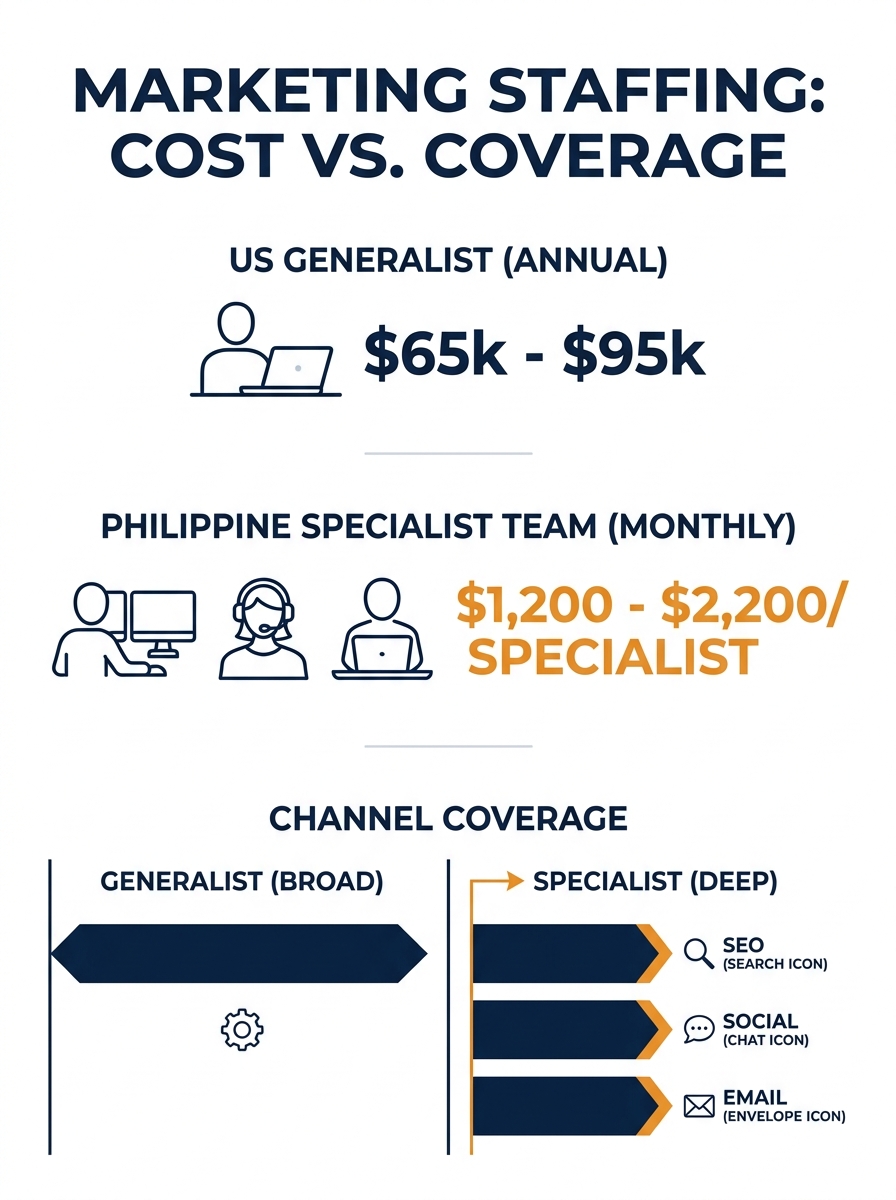
A US marketing generalist costs $65,000 to $95,000 per year. That person handles one or two channels well. Stretch them across SEO, paid media, email, social, and content, and quality drops fast. The math is clear: for that same annual spend, you can hire three to four dedicated Philippine specialists at $1,200 to $2,200 per month each. Every channel gets someone who works on it for eight hours a day.
According to AMW’s agency comparison data, an integrated agency might charge $20,000 per month covering five channels while two specialist agencies charge comparable totals. The difference is attention. An integrated Philippine digital marketing agency distributes that attention across your campaigns daily, while a US agency account manager splits focus across six to ten clients.
If you’ve already looked at the true ROI comparison between Philippine and US teams, these numbers will look familiar. The cost gap keeps widening as US salaries climb.
Narrow Agencies Lose the Cross-Channel Picture
Here’s the structural problem with US specialist agencies. They optimize brilliantly inside one silo. Your paid search agency crushes Google Ads. Your SEO firm builds strong organic rankings. Your social agency runs great creative. But nobody connects the dots between them.
Rey Lugtu, Founder of Hungry Workhorse, has argued that marketers need to understand systems at a deep level and that “execution benefits from specialists” who deliver “daily consistency that platform algorithms reward.” The tension he identifies matters: you need both breadth and depth. Specialist agencies give you depth in one area and leave gaps everywhere else.
Research from Semrush on the generalist-specialist divide found that marketing generalists stay versatile and responsive, aligning their tools with various projects and challenges. Specialists, by contrast, maintain long-term subscriptions to deeply understand tools within their narrow focus. Philippine digital marketing agencies have figured out how to combine both modes inside one team.
When platforms shift their algorithms (and they shifted dramatically through 2025 and into 2026), teams that see all channels simultaneously adapt faster than siloed specialists who only see one piece of the puzzle. A paid media specialist might miss that a Google algorithm change tanked your organic traffic, sending your blended cost-per-lead up 30% even though their ad metrics look fine.
How Cross-Industry Work Sharpens Campaign Thinking
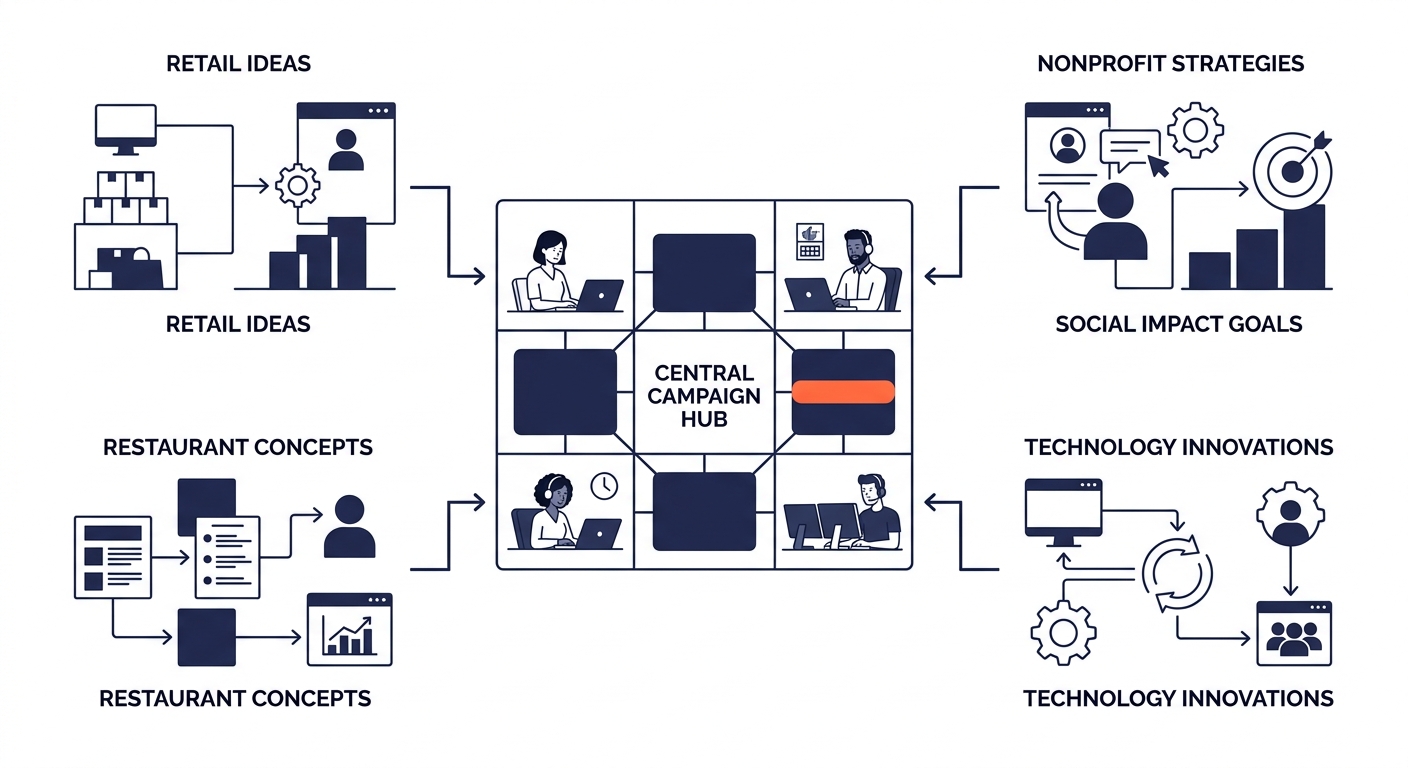
The real advantage of Philippine teams working across multiple clients and industries is accumulated creative range. LICERA Growth Marketing Group, ranked among the top Philippine agencies on Clutch, serves clients across nonprofit, media, retail, restaurants, and supply chain. That cross-industry marketing expertise produces something a single-vertical US agency can’t replicate: pattern recognition across categories.
A team that ran a donor acquisition campaign for a nonprofit brings different targeting instincts to your e-commerce launch. A team that optimized restaurant local SEO thinks about geo-targeting differently than someone who has only worked in SaaS. These connections show up in creative campaign innovation, in ad copy variations, in audience segmentation strategies that a narrowly-focused agency would never test.
LeapOut, the only Philippine agency combining GEO, technical SEO, Shopify Plus development, and full-funnel performance marketing under one team, has delivered work for brands including Under Armour PH, SM Retail, Holcim, and Belo Medical. The breadth of their client roster forces their strategists to think across verticals every single week.
A team that ran a donor acquisition campaign for a nonprofit brings different targeting instincts to your e-commerce launch. These connections show up in ad copy, audience segmentation, and channel strategies that narrowly-focused agencies would never test.
Outsourced Team Flexibility Solves the Accountability Problem
SMBs often pick a single specialized US agency because they want one point of accountability. That logic makes sense until you realize what you’re trading away. With one agency, you get one perspective, one set of playbooks, and one team’s blind spots.
ClickUp’s analysis of marketing career paths notes that “marketing generalists often have a broader view of marketing, can communicate effectively across departments, promote collaboration, and ensure everyone is working toward the same goals.” This is exactly what happens when you build a Philippine team with outsourced team flexibility built in. You get one team (one Slack channel, one project manager, one weekly call) that contains multiple skill sets.
The Flourish consulting group makes a related point: agencies working with multiple industries bring broader perspective and prevent the tunnel vision that in-house teams sometimes develop. Philippine teams inherit this advantage structurally. A five-person team in Manila running your paid media, content, SEO, and email marketing shares a physical office. They talk to each other about your campaigns in real time. That organic coordination beats the quarterly strategy call you get from your US agency.
If you’re thinking about which marketing services to delegate first, start with the ones where cross-channel visibility matters most. Paid media and content marketing are the usual starting pair because they feed each other directly.
Where Specialists Still Win (And How Philippine Teams Absorb That)
The data isn’t one-sided. According to Staffing Partners research, businesses in niche areas find that working with specialists offers a stronger return on investment. Specialist appointment-setting agencies deliver higher ROI through better qualified leads and reduce internal management overhead, per DemandZen’s analysis. These findings hold in contexts where a single channel dominates the business model.
If 90% of your revenue comes from Google Ads, a world-class PPC specialist makes sense. If your entire pipeline runs through LinkedIn outbound, a specialist there delivers. The paradox shows up when SMBs try to grow beyond one channel. And almost every SMB eventually does.
Philippine teams absorb this reality by stacking specialists within a generalist structure. You get the dedicated PPC person AND the content strategist AND the SEO analyst, all coordinating under one roof. The 79% of top companies now using AI for marketing orchestration still see 58% struggling with cross-channel alignment. The coordination problem is harder than any individual channel problem.
| Factor | US Specialist Agency | US Generalist Hire | Philippine Generalist Team |
|---|---|---|---|
| Monthly cost | $5,000–$15,000 | $5,400–$7,900 | $3,600–$8,800 (3–4 people) |
| Channels covered well | 1–2 | 1–2 | 4–5 |
| Daily optimization hours on your account | 1–3 | 8 | 24–32 (combined team) |
| Cross-channel coordination | None (siloed) | Limited bandwidth | Built in |
| Client accounts per strategist | 6–10 | 1 (yours) | 2–3 |
| Cross-industry exposure | Low (vertical focus) | Low (your industry only) | High (multi-client roster) |
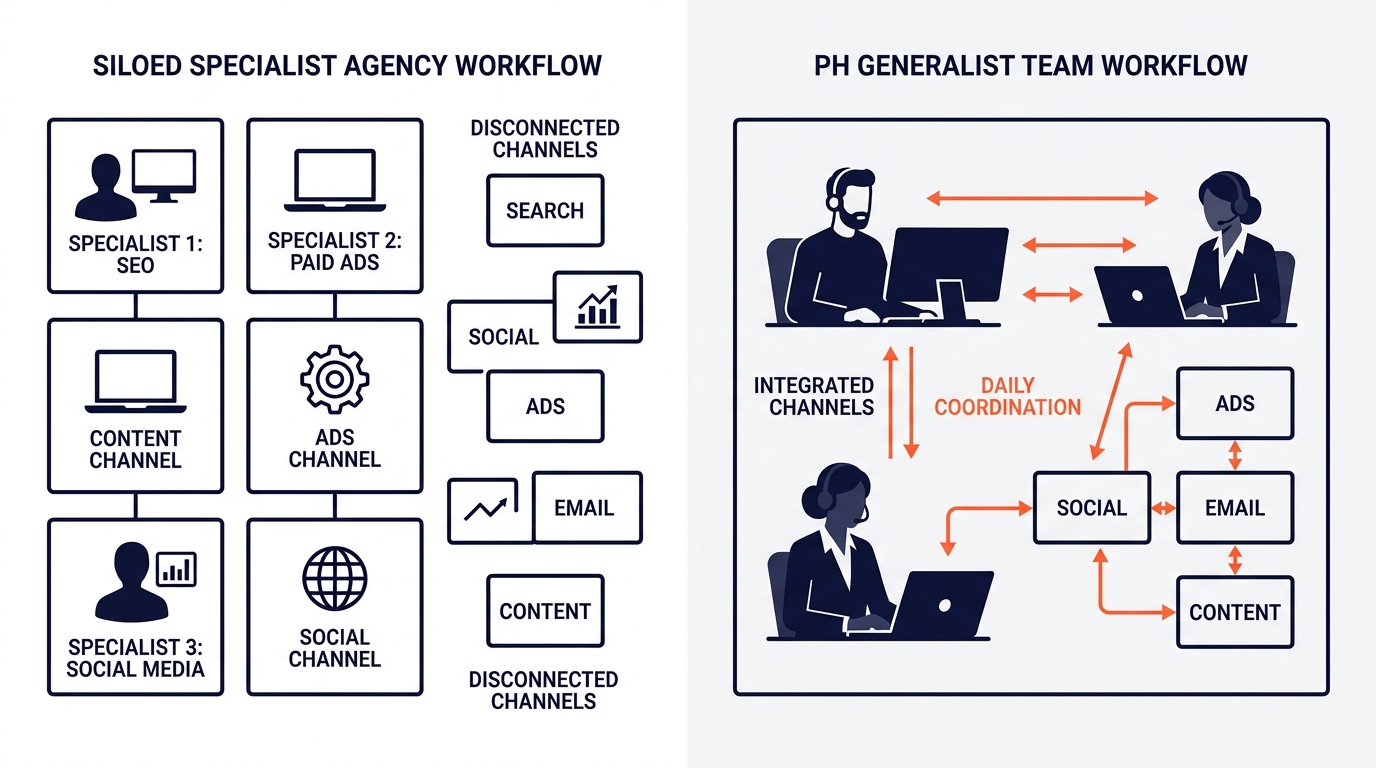
The attention economy challenge in Philippine digital marketing works in your favor here. Because these teams are built to manage focus across channels, they develop coordination habits that US agencies, organized around account silos, typically lack.
Tip: When evaluating Philippine marketing teams, ask how many industries their current client roster spans. Teams serving five or more verticals bring stronger pattern recognition to your campaigns than those focused on a single niche.
What The Numbers Still Can’t Measure
The ROI data, cost comparisons, and channel coverage stats paint a clear picture on paper. Philippine generalist teams deliver more marketing output per dollar, cover more channels with daily attention, and bring cross-industry thinking that single-vertical agencies miss.
But the data doesn’t capture one thing well: learning speed. There’s no clean metric for how quickly a Manila-based strategist spots a declining Facebook CPM trend because they noticed the same pattern in a different client’s account two weeks earlier. There’s no benchmark for how a content writer who worked on healthcare, e-commerce, and B2B SaaS in the same month develops a faster instinct for which messaging frameworks work across audiences.
The cost case and the coverage case are proven. The creative compounding, the accumulated instinct from working across industries and channels every day, shows up in your results around the six-month mark. Campaigns start performing in ways your brief didn’t explicitly request. That’s the variable no spreadsheet captures yet, and the one worth tracking as more SMBs shift to this model.