
MarTech declared the email newsletter “back and winning the inbox” this week, citing a consumer shift toward curated content over algorithmic feeds. For US agencies paying $1,000 to $10,000+ monthly on email campaigns, Philippine digital marketing teams convert outsourced newsletter production from a margin problem into a recurring content advantage.
The Philippine IT-BPM sector is targeting $42 billion in exports and 1.97 million jobs for 2026, according to IBPAP’s latest projections released this week. A growing share of that workforce handles content-layer tasks for Western agencies, including the unglamorous but essential work of content curation outsourcing: sourcing articles, writing editorial summaries, assembling send-ready newsletters, and managing the content calendars that keep campaigns on schedule. The argument for Philippine teams handling newsletter production goes beyond labor arbitrage. It rests on a specific editorial skill set, a favorable time-zone overlap for overnight production, and a curation model that research shows doubles reader engagement compared to original-only content.
The Economics Behind a $1,000-to-$10,000 Monthly Line Item
Agencies outsourcing email marketing to US-based specialists pay $1,000 to $10,000+ per month depending on list size, send frequency, and campaign complexity, according to Nutshell’s 2026 pricing guide. That range covers strategy, template design, copywriting, scheduling, A/B testing, and reporting. For a mid-market agency managing newsletters for five to eight clients simultaneously, the math gets uncomfortable fast. A single junior email marketer in a tier-one US metro costs $55,000 to $70,000 annually before benefits, and they can realistically manage three to four client newsletters at quality before output drops.
A case study published by The Marketing Folks documents a US agency that saved 70% in monthly costs by outsourcing to the Philippines, hiring 27 senior-level professionals across content, design, and marketing roles. The newsletter function was part of that package, and the savings weren’t driven by paying people less for identical work. They came from the difference in fully-loaded cost per FTE: office space, health insurance, payroll taxes, and benefits that run 30% to 40% on top of US base salaries evaporate when you move the production layer offshore. A dedicated email specialist in Cebu or Manila earning $1,200 to $1,800 per month, fully loaded, produces the same Mailchimp or Klaviyo output as a $5,500-per-month US counterpart because the platform interfaces are identical and the editorial judgment is comparable.
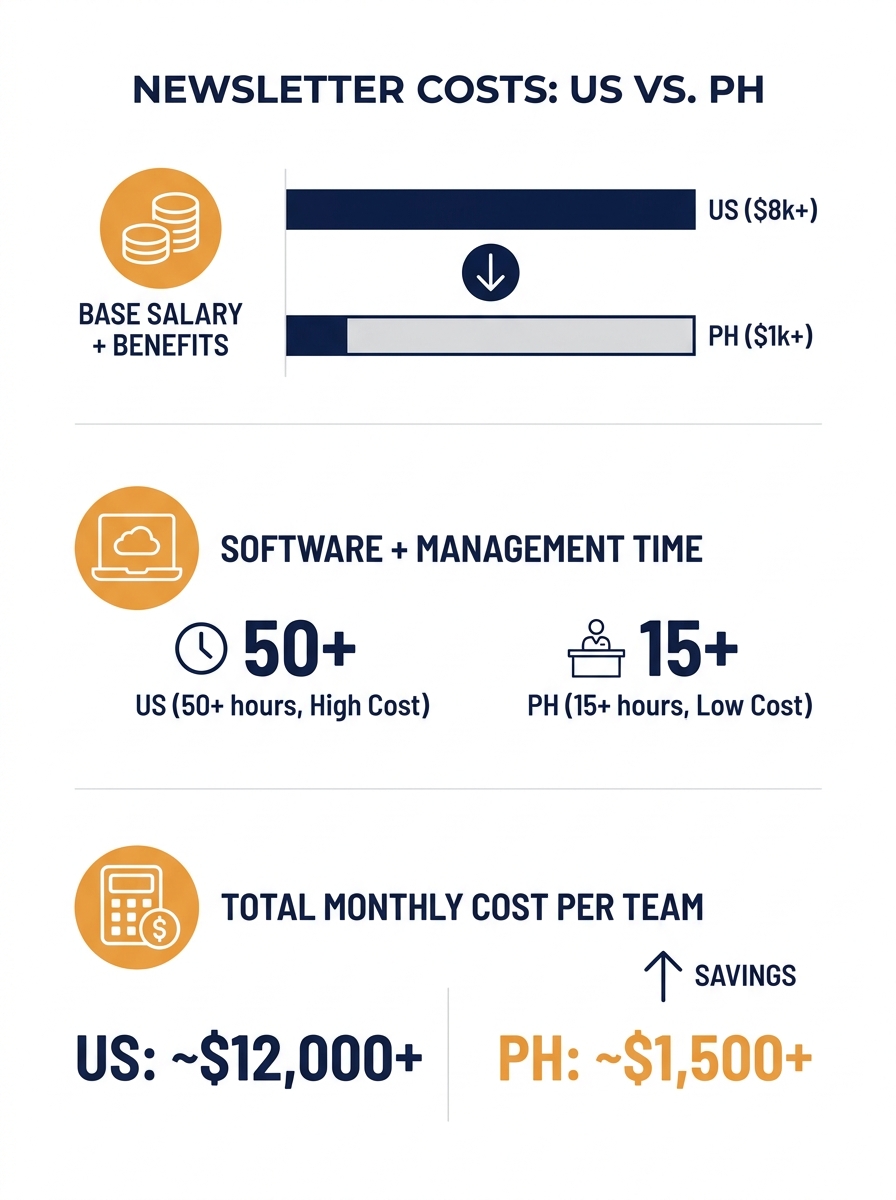
The real savings aren’t visible on a rate sheet. They appear in the agency’s capacity model. When your outsourced marketing skill stack includes newsletter production, your US-side strategists spend their time on campaign architecture and client communication instead of hunting for articles to link in a Tuesday send. That’s where the ROI compounds: not in the direct labor savings, but in what your expensive domestic team gets to do instead.
Why Curation Is the Skill That Translates Best
The common objection to email marketing delegation runs something like this: our clients’ newsletters require deep brand knowledge, industry-specific insight, and a voice that an offshore team can’t replicate. That objection assumes newsletters should be 100% original content. Research from UpContent tells a different story. Newsletters blending 50% to 75% curated third-party content with original editorial commentary increase customer engagement more than twofold compared to all-original newsletters. Readers want a filter, not a monologue. They want someone who reads 40 articles so they only have to read the best four.
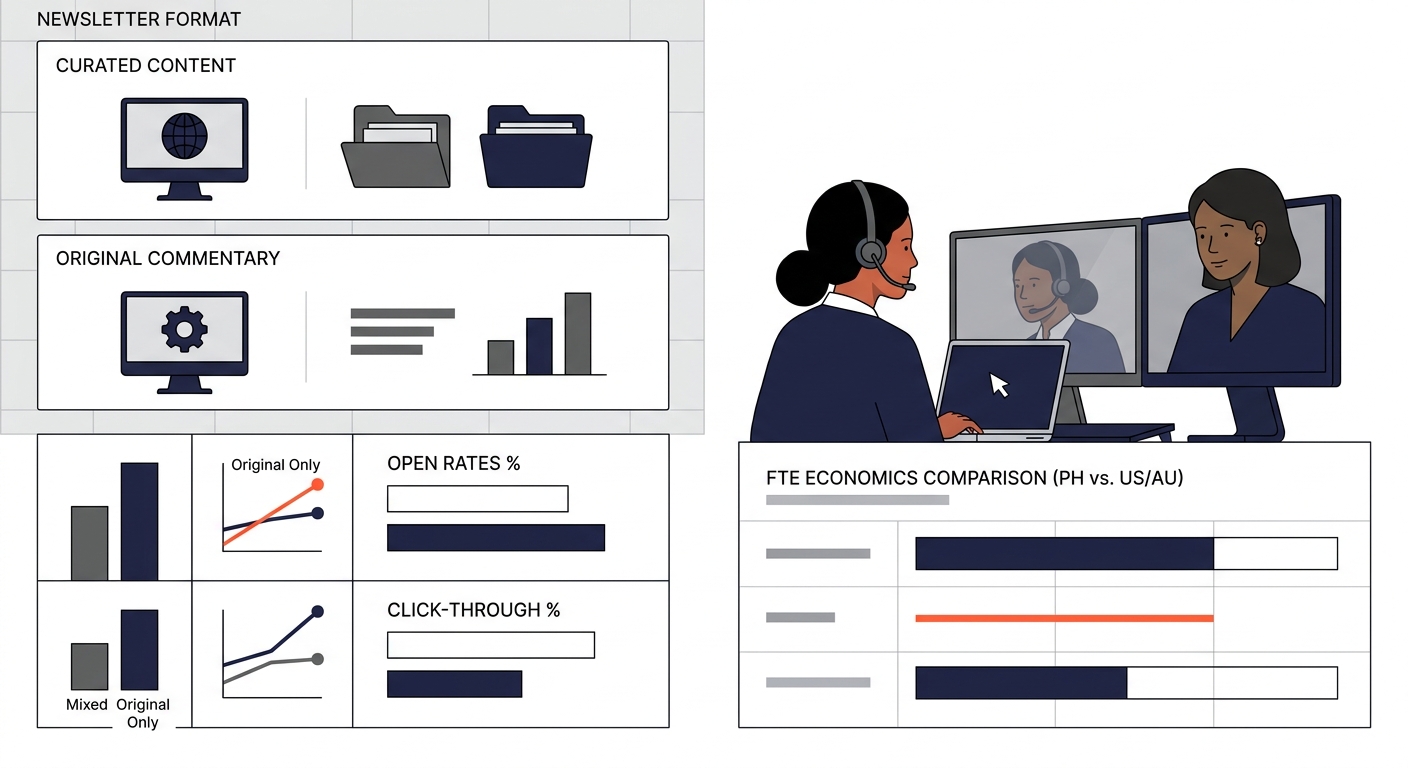
Philippine teams excel at this curation layer for a structural reason that has nothing to do with cost. English-language media consumption in the Philippines runs deep. Filipino professionals grow up reading American publications, watching US-produced content, and writing in American English conventions as a default. When you ask a Manila-based content specialist to scan TechCrunch, HBR, and industry blogs for the three most relevant stories for a B2B SaaS newsletter, they’re reading those sources with genuine comprehension and editorial instinct. They’re making judgment calls about relevance, recency, and audience fit. The voice they write editorial summaries in defaults to American English without the syntax artifacts you’d see from teams where English is a third or fourth language.
This is where content curation outsourcing diverges from generic content mills. A good newsletter curator doesn’t just find links. They write the two-sentence summary that frames why the link matters to a specific audience, they sequence the stories to create narrative flow across the email, and they match the tone of the agency’s brand guide. The structured intake process that sets up this work correctly covers brand voice, audience segmentation, editorial priorities, and approval workflows. Without it, you get a link dump. With it, you get a curated editorial product that reads like the agency’s own strategist assembled it.
Readers want a filter, not a monologue. They want someone who reads 40 articles so they only have to read the best four.
Agency Content Calendar Management Across Time Zones
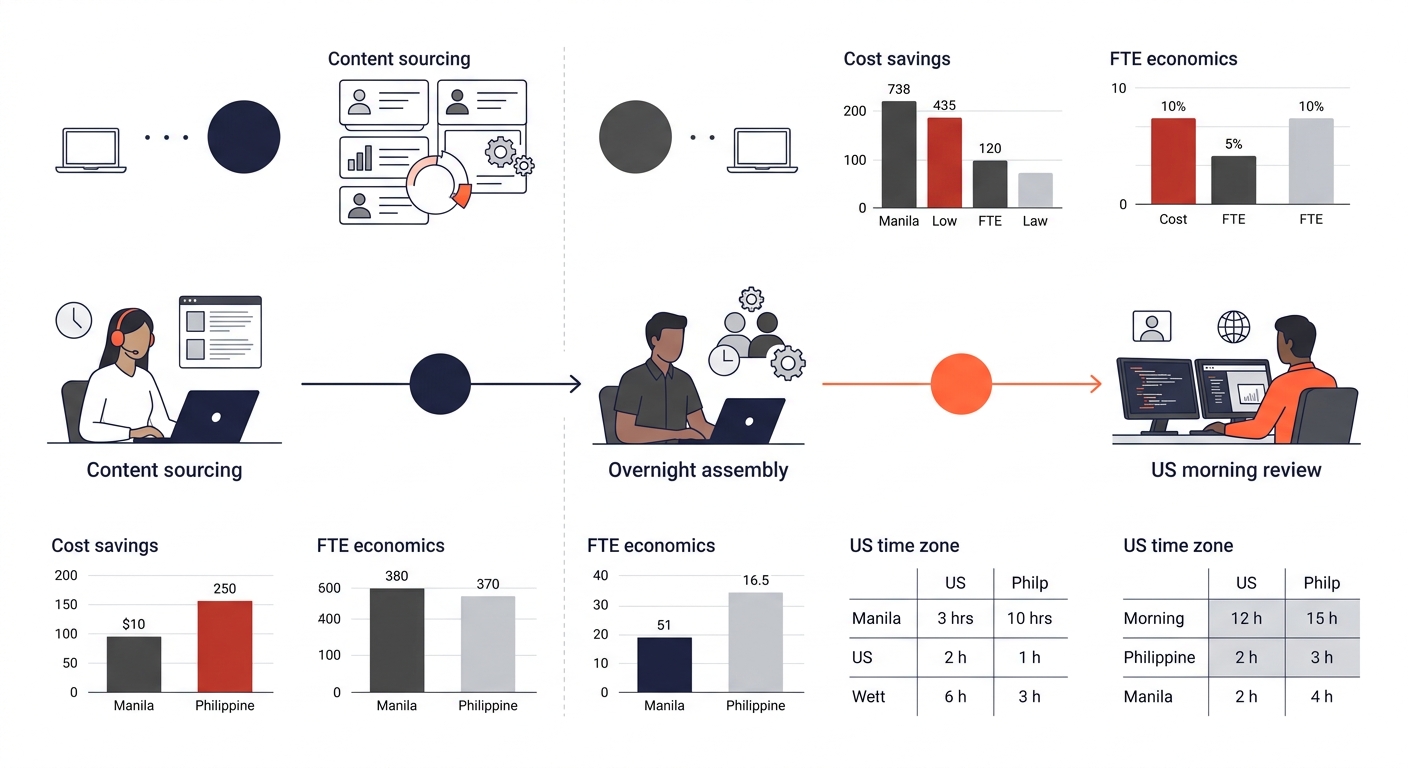
The operational layer of outsourced newsletter production breaks down into three overlapping workflows: sourcing and curating content, assembling and scheduling sends, and managing the editorial calendar that governs both. Averi’s B2B email newsletter benchmarks, published this week, reinforce that consistency drives list growth and engagement. Sporadic sends kill subscriber trust. Agencies managing newsletters for multiple clients need a system that produces on a predictable cadence regardless of whether someone in the US is sick, on vacation, or buried in a pitch deck.
Philippine digital marketing teams sitting 12 to 13 hours ahead of US Eastern time turn this time-zone gap into an advantage for agency content calendar management. When your US team logs off at 6 PM Eastern, your Manila team is starting their morning. They source articles, write editorial summaries, build the email in Mailchimp or HubSpot, and drop it into the approval queue. By the time your US strategist opens their laptop at 8 AM, the newsletter is assembled and waiting for a 10-minute review. Mailchimp’s own content calendar guidance emphasizes that clear task delegation is crucial for smooth production. The right platform should manage hundreds of content pieces without becoming overwhelming, which means the people running the calendar need to know how to use project management tools like Asana, Monday, or ClickUp at a production level.
The workflow integration patterns that prevent campaign failures between US clients and Philippine teams apply directly here. Newsletter production requires shared access to brand asset libraries, editorial calendars with clear status columns (sourcing, drafting, review, scheduled, sent), and a communication cadence that doesn’t rely on synchronous meetings. A Philippine virtual assistant handling newsletter operations works in a shared Notion workspace or Google Sheet where the US-side account manager can see what’s queued, what’s in review, and what shipped. Multi-channel campaigns run by dedicated teams achieve 2x higher ROI than single-channel efforts, and newsletters are the connective tissue that ties blog posts, social campaigns, and product updates into a coherent narrative for subscribers.
The Question This Raises About Agency Margins
The economic case is solid and the operational model works, but the harder question is whether agencies that outsource newsletter production should pass the savings to clients or keep them as margin. An agency charging a client $3,000 per month for newsletter management and paying a Philippine team $1,500 fully loaded (including platform costs, management overhead, and the specialist’s compensation) is running a 50% margin on that service line. That’s healthy and defensible. But the transparency question lingers, especially as clients become more aware of offshore economics. The expectation-setting work in the first 90 days matters enormously here, because the value proposition to the client should center on output quality and strategic oversight, not on where the keyboard is located.
There’s also a quality ceiling that pure curation can’t break through. Newsletters that build genuine audience loyalty combine curated content with original analysis, proprietary data, or editorial perspective that requires deep domain expertise. A Philippine team can curate brilliantly and write clean editorial summaries, but the original insight that makes a newsletter indispensable typically comes from someone living inside the industry. The best model pairs a US-side strategist who contributes one original section per send with a Philippine production team that handles everything else. Whether that hybrid approach scales across 10 or 15 client accounts without the US strategist becoming the bottleneck again is the operational puzzle most agencies haven’t solved yet. The economics point clearly toward outsourced newsletter production as a margin-positive service line, and the engagement data supports curation as the right editorial model. But agencies that treat this as a pure delegation play, stripping out all domestic editorial involvement, will eventually produce newsletters that read like competent summaries rather than essential reads. The distinction between those two outcomes determines whether subscribers open the next send or let it sit.