
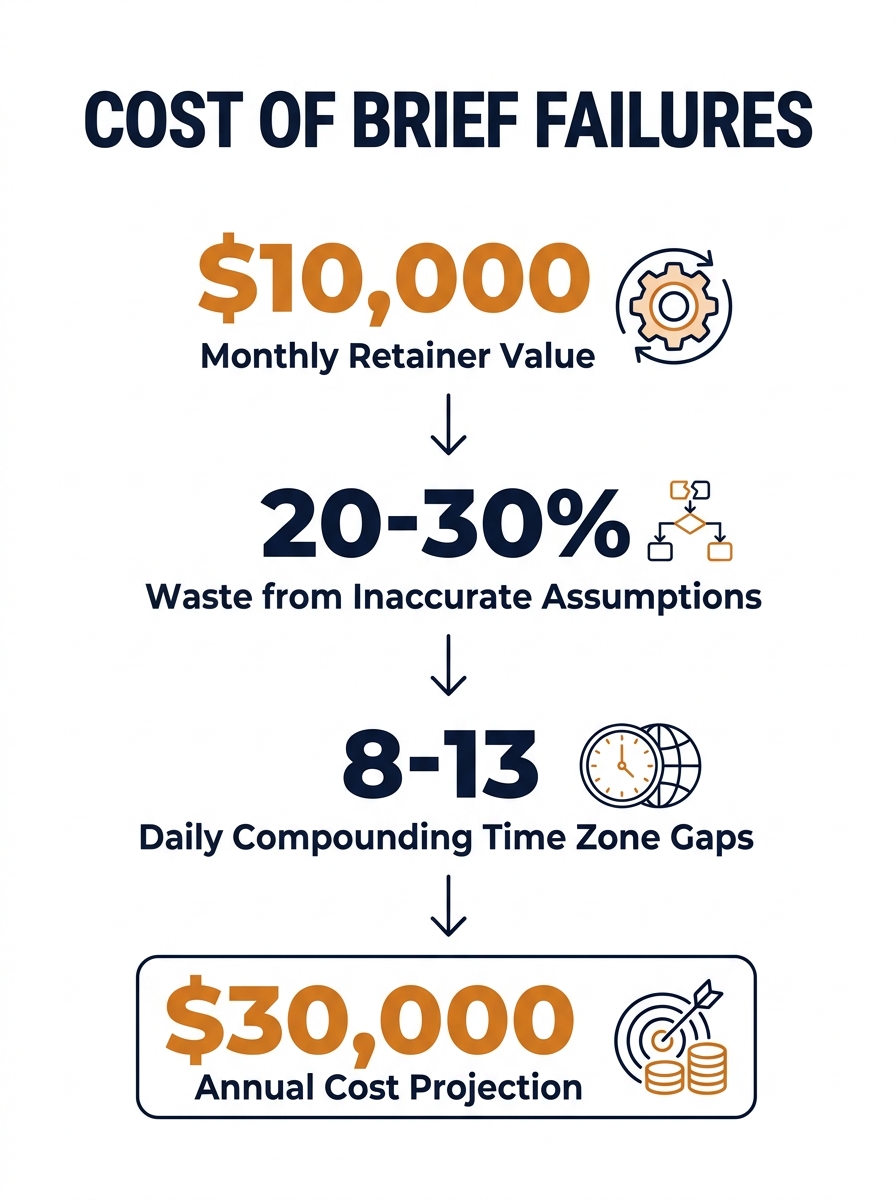
Campaigns built on defective briefs waste 20–30% of their marketing budget on inaccurate assumptions before any deliverable ships, according to data quality research across outsourced engagements. An offshore marketing partner operating 8–13 time zones ahead has no mechanism to self-correct a broken brief in real time.
TL;DR: Outsourced marketing fails at the brief, not at execution. A structured Philippine BPO intake process covering scope, success signals, and async protocols eliminates the 20–30% budget waste that hits campaigns built on vague handoffs. The intervention is diagnosis before day one, not course-correction after.
The Budget Leak Nobody Audits
Why does the brief fail more often than the team? Because 59% of businesses outsource primarily to cut expenses, according to industry survey data. Cost fixation crowds out the intake work that prevents rework.
That 20–30% budget waste figure from data quality research on outsourced marketing failures compounds in offshore contexts. When your Philippine team starts executing at 8 AM Manila time (7 PM Eastern the night before), the brief is the only source of truth available. Every ambiguity in it produces a full business day of misdirected work before you even see the output.
The math is direct. A $10,000/month retainer leaking 25% to brief-related rework costs $2,500/month, or $30,000/year. For a mid-size US agency outsourcing 3–4 marketing functions, that annual leak can exceed the salary of a full-time project coordinator who could have prevented it.
And the picture gets worse at the program level. In the travel vertical alone, 60% of BPO programs failed in 2026 due to what HotelSpeak’s analysis called “Specialization Dilution,” meaning teams were paired with generalists who treated their vertical as a secondary concern. The pattern holds outside travel. When briefs don’t specify vertical-specific constraints (regulatory language, audience segments, competitive positioning), generalist execution is all you get.
What Actually Breaks Inside a Digital Marketing Outsourcing Brief
The failure points cluster into three categories. Each one tends to be invisible in standard intake documents.
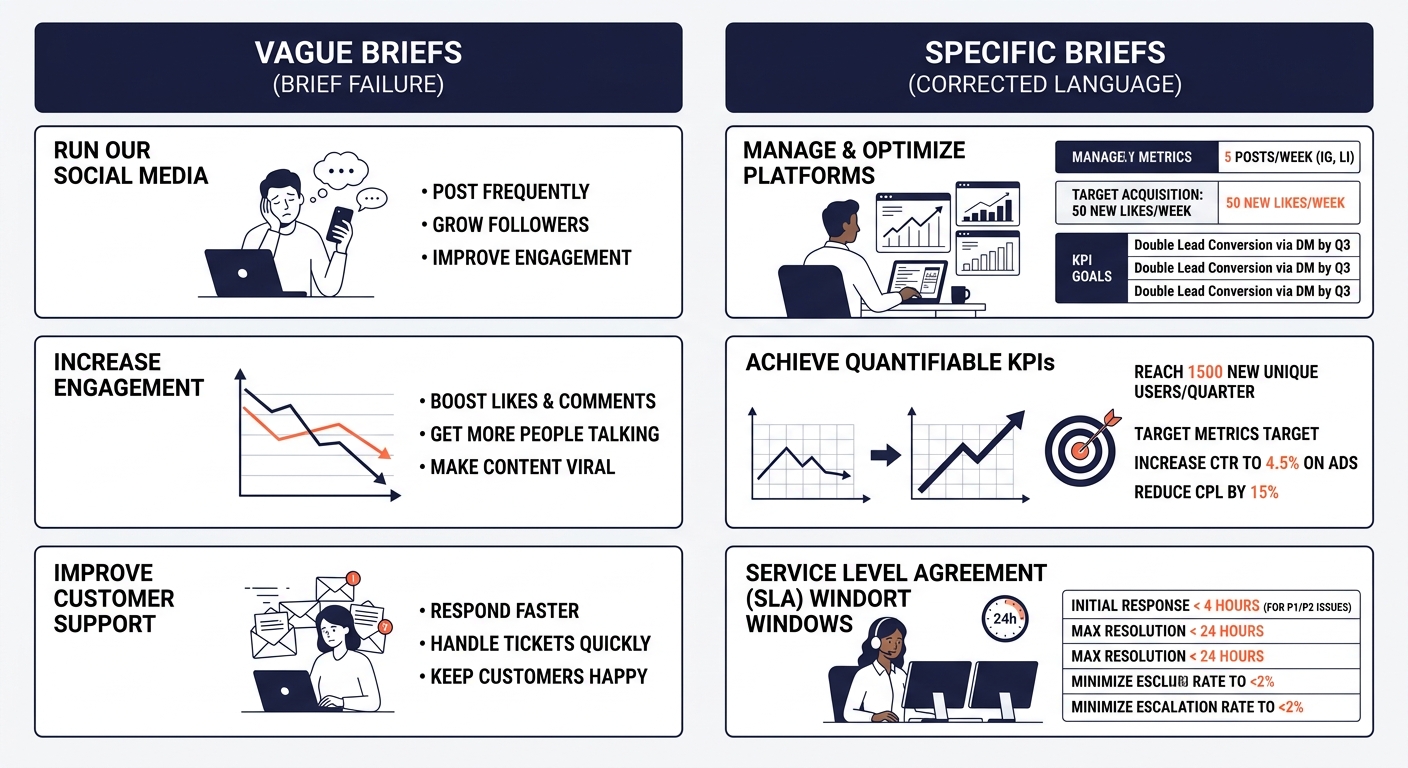
Undefined deliverable boundaries. A brief that says “run our social media” without specifying platform count, post frequency, asset formats, approval workflows, and exclusion lists (topics, competitors, hashtags the brand avoids) produces scope creep within the first week. Stackmatix’s analysis of offshore marketing integrations found that proper onboarding requires 2 to 4 weeks covering knowledge transfer, tool access provisioning, baseline audits, and strategy alignment across 4 sequential stages. Skipping those stages because “we already have a brief” is the single most common shortcut that leads to outsourcing failure prevention conversations three months too late.
Unaligned success metrics. Your Philippine team will optimize for whatever number you hand them. If the brief lists “increase engagement” without defining whether that means comments, shares, saves, or click-throughs, and without setting a numeric threshold (3.2% engagement rate on Instagram Reels within 60 days, for example), the team optimizes for the cheapest metric to move. Vanity metrics are the default output of vague briefs.
Missing async protocols. The 8–13 hour time zone offset between US offices and Philippine teams means every unresolved question costs a minimum of 16–24 hours in round-trip communication. Research on async decision delays in outsourced marketing shows teams lose 15–20 hours per month in misaligned revision loops when communication cadence isn’t pre-defined. That’s roughly 10% of a full-time employee’s working hours burned on waiting.
The Five-Field Intake Framework
A structured intake process for Philippine digital marketing teams replaces the typical “send over your brand guidelines” handoff with a five-field diagnostic that covers the gaps most briefs leave open.
| Field | What It Captures | Typical Brief Gap |
|---|---|---|
| Brand Context | Voice guidelines, competitor list, content the brand has rejected before, brand-adjacent topics to avoid | “See attached brand guide” (a 2-year-old PDF nobody updated) |
| Audience Parameters | ICPs with demographic and psychographic detail, buying triggers, objection patterns, customer language samples | “Our target is SMB owners” (no segmentation) |
| Channel-Specific Rules | Platform-by-platform deliverable specs, posting cadence, format requirements, paid vs. organic split | “We’re on Facebook, Instagram, and LinkedIn” (no execution detail) |
| Performance Benchmarks | Numeric KPI targets per channel per month, reporting format, escalation triggers for underperformance | “We want more leads” (no baseline, no target) |
| Async Protocols | Response windows (e.g., 4-hour business-hour SLA), escalation paths, tools for handoff (Loom, Slack, project management board links) | “Just message us on Slack” (no structure) |
This framework isn’t optional decoration. It’s the structural minimum for any offshore marketing partner expectations conversation. As Penbrothers’ analysis of Philippine outsourcing risk factors concluded, “most outsourcing failures are structural”, rooted in onboarding artifacts and intake processes rather than in the talent doing the work.
A brief that says “run our social media” without specifying platform count, post frequency, asset formats, and exclusion lists produces scope creep within the first week.
Why Proactive Diagnosis Beats Reactive Correction
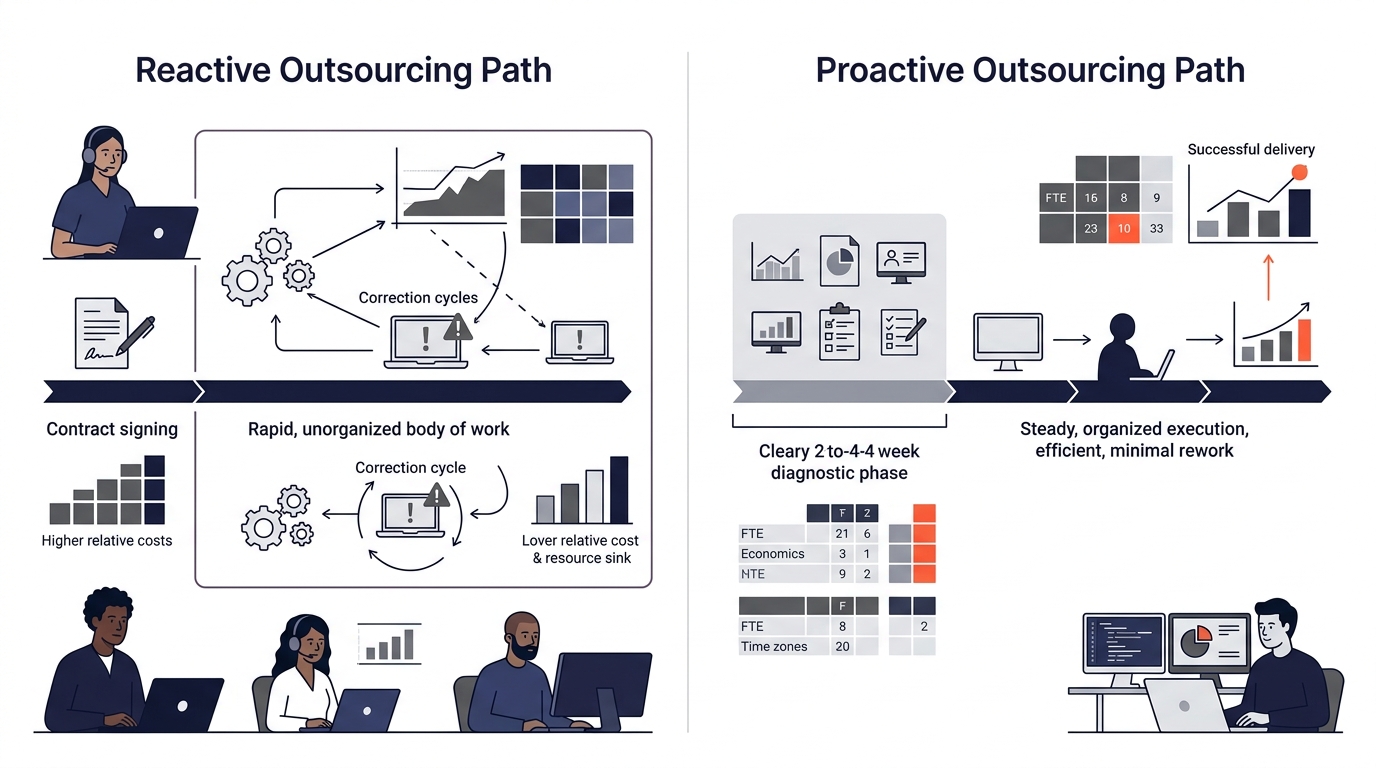
The standard outsourcing sequence runs: sign contract, send brief, start work, discover misalignment, course-correct. Each course-correction after day one carries a cost multiplier because the team has already built workflows, scheduled content, or allocated resources based on the original (broken) brief.
Proactive diagnosis flips the sequence. Before day one, the offshore marketing partner runs a structured audit of the brief against the five-field framework and flags every gap. This is where the 2-to-4-week integration window from Stackmatix’s model earns its ROI. During those weeks, the Philippine team isn’t idle. They’re conducting baseline audits of your existing performance data, provisioning tool access, mapping your approval workflows, and stress-testing the brief against real campaign scenarios.
The creator-first outsourcing model takes this one step further with a listening phase built around social listening data, UGC performance benchmarks, and creator-audience alignment scoring. That pre-work replaces guesswork with evidence before any content brief gets written.
For agencies that also outsource web development alongside marketing functions, the diagnostic phase matters even more. When a single offshore partner handles both site builds and campaign execution, misalignment in the marketing brief cascades into landing page specs, tracking implementation, and conversion architecture. A flawed brief doesn’t break one workstream. It breaks all of them.
Tip: Set realistic expectations based on chosen services rather than expecting immediate results across all channels, as [NeoWork’s outsourcing guide](https://www.neowork.com/insights/digital-marketing-outsourcing-guide) recommends. Build the 2-to-4-week diagnostic window into your timeline before any campaign work begins.
The 59% Problem and What It Hides
Cost savings are a rational motivation. Philippine digital marketing teams cost 40–60% less than equivalent US hires for comparable skill sets. But that 59% figure reveals something about how buyers prioritize. When cost is the primary decision driver, intake quality gets compressed. An agency that signs a Philippine partner on Monday and expects campaign output by the following Monday hasn’t budgeted time for the diagnostic. The team makes assumptions to fill the gaps, and those assumptions compound across every deliverable for the engagement’s duration.
The agencies that build a 2-to-4-week diagnostic window into their onboarding timeline report fewer revision cycles, lower monthly rework costs, and longer partner retention. Those that skip it cycle through 2–3 offshore partners per year, spending more on repeated onboarding than they saved on labor arbitrage. If your service provider experiences internal issues, financial instability, or fails to deliver, as KDCI’s analysis of Philippine outsourcing risks notes, a weak brief makes every downstream disruption worse because there’s no documented baseline to hand off to a replacement team.
What The Data Doesn’t Tell Us
The 20–30% waste figure, the 60% BPO failure rate, and the 15–20 hour monthly async tax all point in the same direction: the digital marketing outsourcing brief is the most under-engineered document in most agency operations. Every data point says diagnosis before day one reduces downstream cost and increases partner longevity.
What the data doesn’t capture is the quality threshold for that diagnosis. How much pre-work is enough? The five-field framework and the 2-to-4-week integration window provide structure, but no study has isolated how much diagnostic depth correlates with outcome improvement on a per-field basis. We know that briefs with all five fields outperform briefs with one or two, but the marginal return of deepening any single field (adding psychographic detail to audience parameters, say, or expanding the competitor exclusion list from 5 brands to 15) remains unmeasured.
There’s also no reliable benchmark for how diagnostic quality varies across Philippine BPO providers of different sizes. A 500-person operation with a formal intake team and a 15-person boutique with a single project manager run different processes at different cost points, and the literature treats them as interchangeable. Until those gaps close, the best available approach remains structural: treat the brief as a diagnostic artifact rather than a formality, run it through the five-field audit before any scope of work gets signed, and protect the 2-to-4-week window against the cost-driven pressure to start shipping on day one. The numbers we have justify that investment. The numbers we still need are the reason to keep measuring once work begins.