
Hiring a “full-stack developer” to cover React, Node.js, Laravel, Django, and Vue.js at production quality is a fiction. The framework specialization cost of assembling that coverage in a single US-based hire runs $86,000 to $192,000 per year, while a three-person Philippine specialist team delivers deeper expertise across the same frameworks for roughly the same loaded hourly rate.
TL;DR: Modern web projects touch 4-6 specialized frameworks. US polyglot developers cost $43-$96/hr and rarely go deep in more than two. Philippine dev teams let you hire three specialists for the price of one generalist, reducing both cost and the technical debt that generalist hiring creates.
The Framework Math No Job Posting Acknowledges
A typical mid-market SaaS product in 2026 touches React or Vue.js on the frontend, Node.js or Python on the backend, a CSS framework like Tailwind, an ORM layer, a testing framework, and at least one deployment pipeline tool. That’s six distinct specializations before you add mobile or data concerns.
ZipRecruiter listings for polyglot programming roles show US employers paying $43 to $96 per hour for developers “that can quickly adapt to different technologies and can quickly resolve roadblocks for the team.” Those postings require proficiency in Python, JavaScript/TypeScript, Golang, or Rust, plus leadership capability. A single hire at that rate, assuming 2,000 billable hours per year, costs between $86,000 and $192,000 annually before benefits, equipment, and management overhead.
Now consider what you actually get for that spend. The r/ExperiencedDevs community on Reddit discussed polyglot developer hiring at length, and the consensus was direct: “Large companies know that it’s generally more efficient to hire specialists” for specific positions rather than banking on generalists who claim broad capability. Non-tech companies (what the thread calls the “dark matter” of the developer hiring market) overwhelmingly seek specific skill sets because they’ve learned that breadth without depth creates maintenance nightmares.
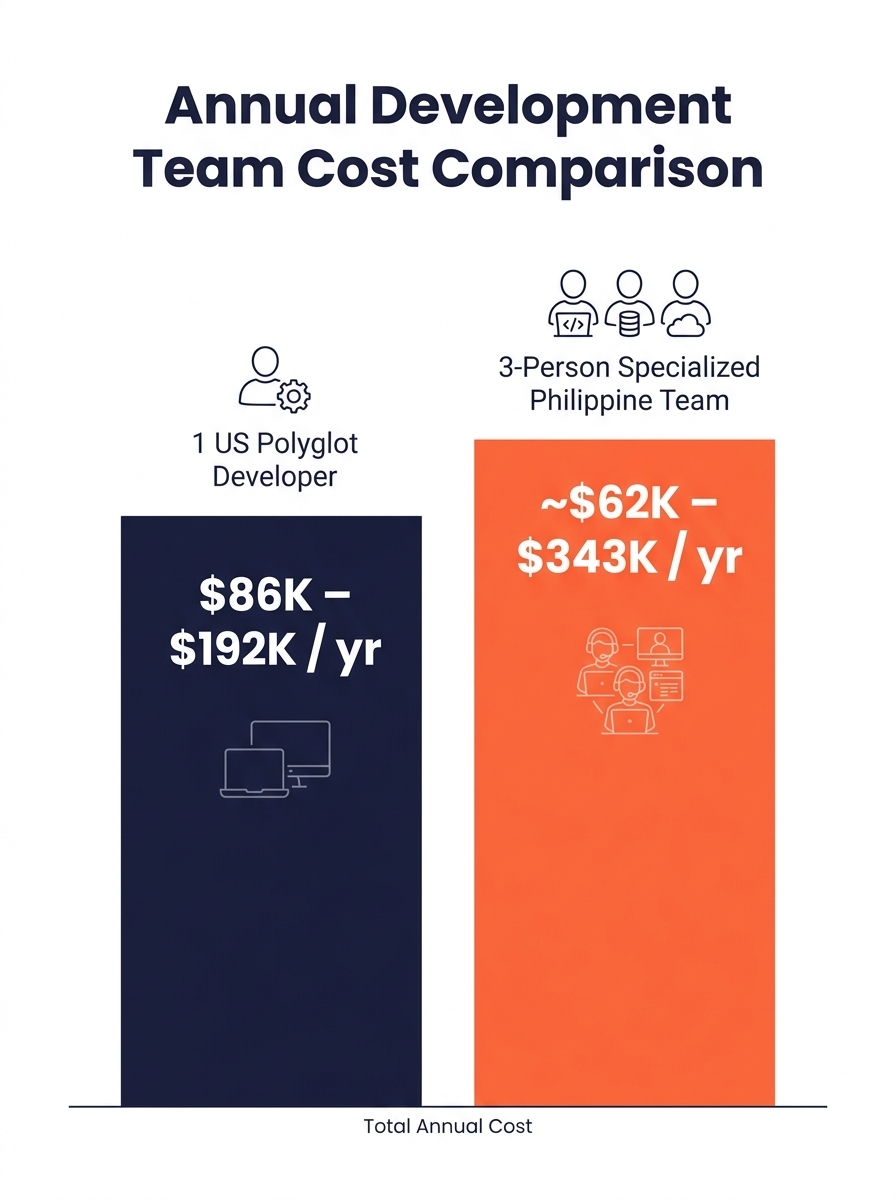
Philippine web developers charge between $10 and $55 per hour depending on experience and specialization, according to Second Talent’s April 2026 rate card. That range means you can hire three specialists (a React frontend developer, a Laravel backend developer, and a Node.js API engineer) for the loaded cost of one US polyglot generalist. The web dev team composition shifts from “one person doing everything adequately” to “three people doing three things at production depth.”
Backend capabilities across the Philippine talent pool span PHP, Node.js, Python, and Ruby, with framework-level specialization in Laravel, Express, Django, and Rails. That coverage exists because the Philippine IT and BPO sector produces enough volume for developers to build entire careers around a single framework rather than diluting their expertise across five.
Generalist Hiring Produces the Debt You’re Trying to Avoid
Ward Cunningham coined the term “technical debt” in 1992 and described it this way: “Shipping first time code is like going into debt. A little debt speeds development so long as it is paid back promptly with a rewrite.” That metaphor has aged well, and generalist hiring is one of the fastest ways to accumulate the kind of debt that never gets repaid.
A generalist developer who lists React, Angular, Vue, Node, Python, and PHP on their resume has probably shipped production code in two of those six. The rest sit at tutorial-project depth. When that developer builds your authentication layer in a framework they last touched during a weekend course, the code works. It passes QA. And twelve months later, when you need to extend it, the patterns are non-standard, the dependencies are pinned to obsolete versions, and nobody (including the original author) can refactor it without risk.
Technical debt from generalist hiring compounds in a specific, predictable pattern. The generalist picks the framework they know best regardless of fit, writes idiomatic code for that framework but non-idiomatic code for the project’s actual stack, and leaves behind patterns that the next developer must decode before they can extend anything. Production bugs from this kind of mismatch cost 4x to 15x more to fix post-deployment than catching them during the build phase. Philippine teams that build applications with maintainability baked in from the start avoid this by assigning each component to the developer who specializes in that component’s framework.
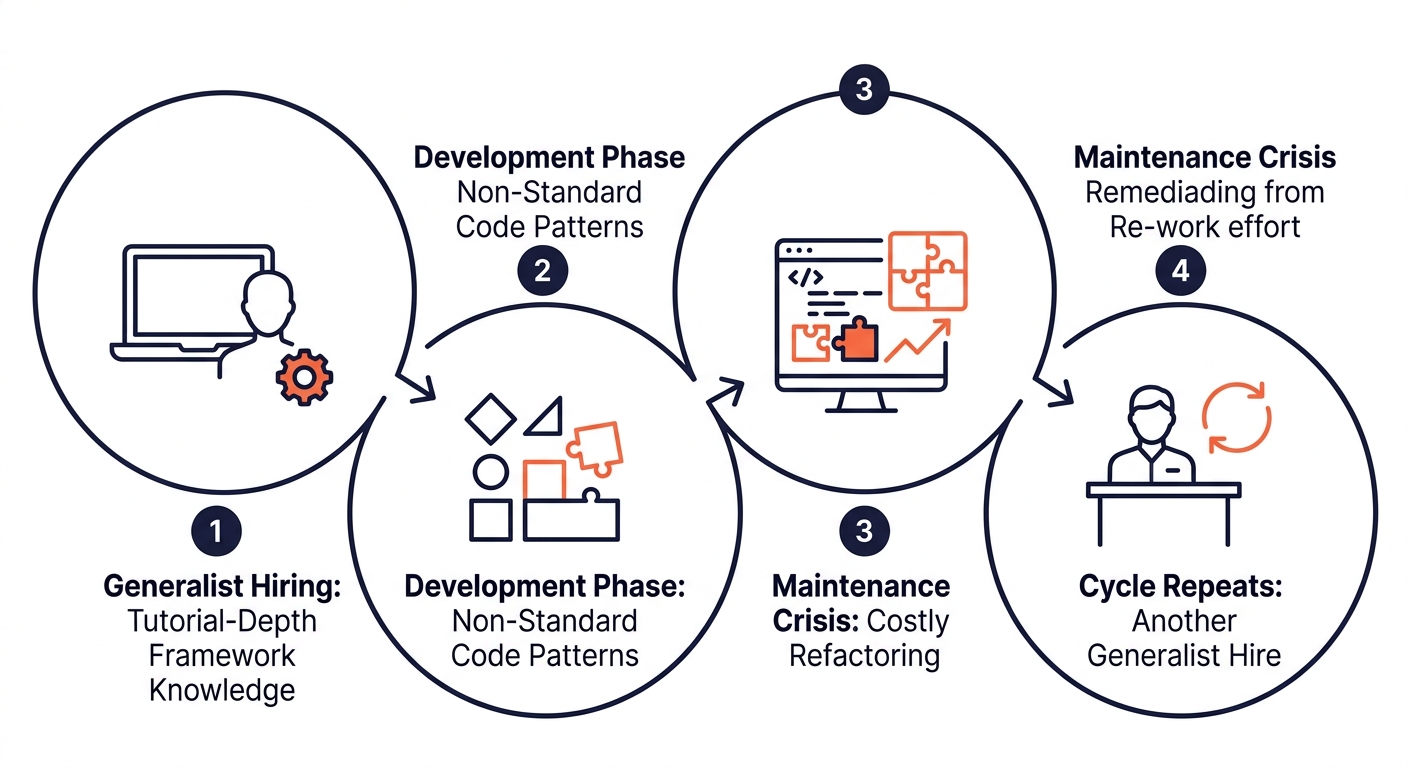
Warning: A developer listing 6 frameworks on their resume typically has production-depth knowledge in 2. The other 4 become sources of technical debt the moment they write code in those frameworks for your project.
The specialist versus generalist debate in development circles keeps circling back to the same conclusion: specialist developers bring deep expertise in specific technologies, while generalists offer breadth. You need both to handle complex projects. But hiring both in-house, at US rates, doubles your headcount cost. Offshore skill diversity solves this by making the per-specialist cost low enough to actually staff both roles.
The Philippine Talent Pool Aligns with How Modern Stacks Work
Why does this work better offshore than onshore? The economic incentives align differently. A developer in Manila who goes deep on Laravel doesn’t need to pad their resume with React and Vue expertise to hit a salary threshold. They can build a stable career as a Laravel specialist, which means their Laravel code reflects thousands of hours of focused practice rather than scattered exposure across half a dozen ecosystems.
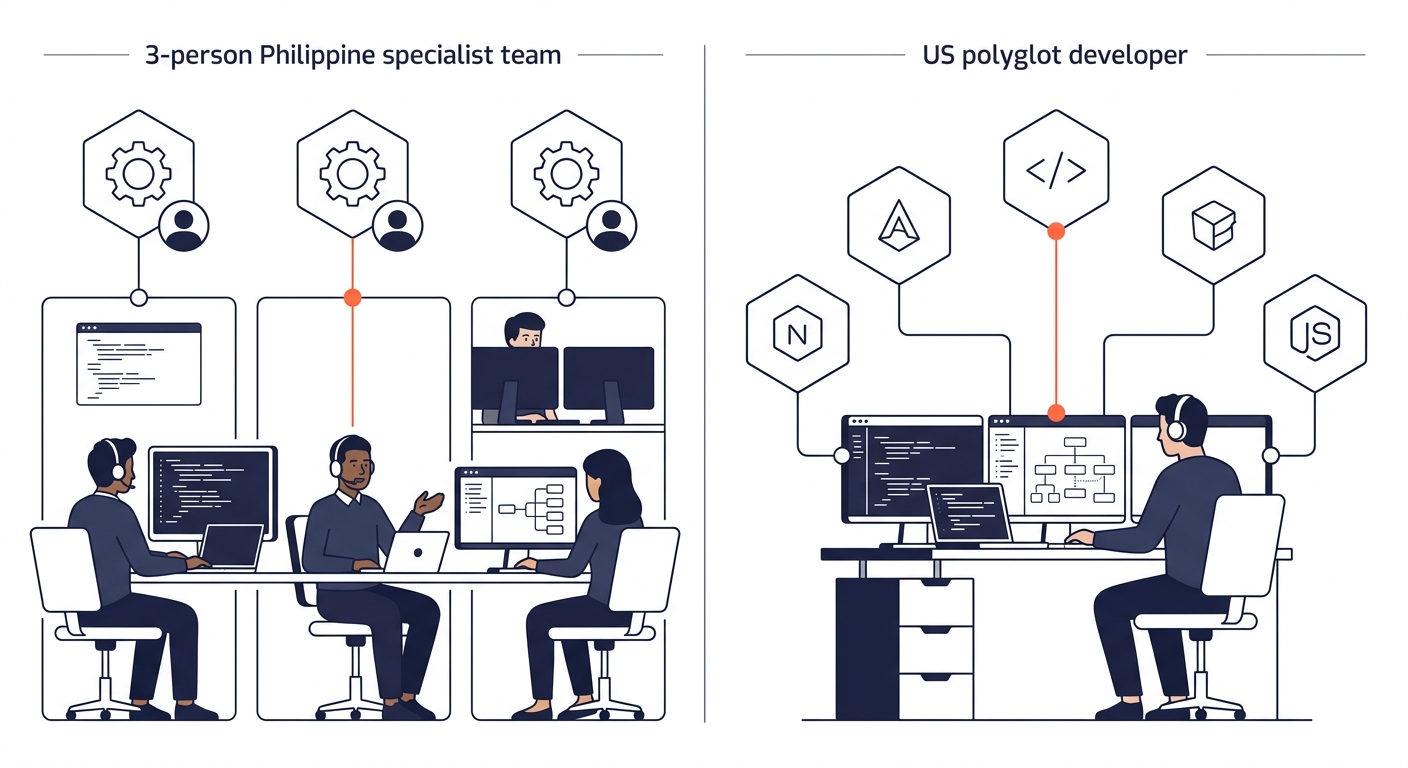
Developer and technical writer IO DevBlue put it well in a widely-read analysis of polyglot programming: “Larger teams let developers specialize. A data science team might love Python, while a backend team thrives in Go or Java and frontend devs live in TypeScript.” The Philippine outsourcing model operationalizes this principle. Instead of asking one developer to be adequate at everything, you compose a team where each member owns their lane.
The practical economics: a senior full-stack engineer in the Philippines tops out around $55/hr. A mid-level specialist in React or Laravel runs $20-$35/hr. For the cost of one US polyglot hire at $75/hr (the midpoint of ZipRecruiter’s range), you field a three-person Philippine squad. A $35/hr frontend specialist, a $25/hr backend specialist, and a $15/hr junior DevOps engineer managing CI/CD. Total: $75/hr for three specialists versus $75/hr for one generalist.
For the cost of one US polyglot hire, you can field a three-person Philippine squad where each member owns their framework at production depth.
This model also addresses a concern that comes up whenever companies evaluate the right revenue threshold for outsourcing versus in-house builds: management overhead. Structured workflows are easier to implement when each developer has clear ownership of a specific technology layer than when a generalist is context-switching between frontend, backend, and infrastructure throughout the day. As we’ve documented, async decision-making in offshore engagements requires discipline, but that discipline compounds into cleaner codebases when each developer is responsible for a defined scope.
The scalability angle matters too. When your project adds a mobile component or migrates a service to a new framework, you add a specialist to the team for the duration of that work. You don’t retrain your generalist and hope they ramp fast enough. And because outsourced digital marketing teams at agencies face the same breadth-versus-depth tradeoff with platform specialization, the pattern applies beyond code. Wherever skill diversity matters, the specialist-team model outperforms the generalist-hero model.
The Claim, Revisited
The standard objection to offshore skill diversity goes like this: “I’d rather have one great developer who knows our stack than three offshore developers I have to manage.” That objection contains a hidden assumption worth examining. It assumes you can find, afford, and retain that one great developer.
US developer turnover averages 13-15% annually. When your solo polyglot leaves, they take institutional knowledge of every system they touched (all six frameworks, remember) with them. Replacing that person takes 3-6 months of recruiting, interviewing, and onboarding. The outsourcing market hit $618 billion partly because companies tired of rebuilding institutional knowledge every time a key developer left for a 15% raise.
A Philippine specialist team distributes that risk across multiple people. If your React developer leaves, your Laravel backend and Node API layer remain staffed by people who built them. You replace one specialist, not an entire knowledge base. Onboarding time for the replacement drops from months to weeks because the scope of their role is bounded by framework, not by the whole product.
The framework specialization cost argument comes down to arithmetic, and the arithmetic favors distributed expertise over concentrated generalism. Three specialists at $25/hr each give you 75 person-hours of focused, framework-appropriate development per week. One generalist at $75/hr gives you 40 hours of context-switching, some of which produces code that the next developer will need to rewrite. Polyglot developer hiring at US rates made sense when a typical web application ran on one backend language and jQuery. Today’s stack demands are too broad, too specialized, and too fast-moving for any single hire to cover at depth. Philippine dev teams, structured as specialist squads, match the shape of the problem. The conventional playbook does not.