
Google’s March 2026 core update elevated information gain to the dominant ranking signal, penalizing derivative content across every vertical. Within the same quarter, Meta restructured Reels distribution logic, and TikTok shifted from hashtag targeting to vector-based semantic matching. Three major platform changes in 90 days, each demanding a different tactical response from marketing teams already stretched thin.
TL;DR: Platform algorithms now shift faster than individual marketers can track, creating digital marketing skill gaps that compound quarterly. Philippine marketing teams close this gap through distributed specialization, continuous learning programs, and AI-first workflows at 40–60% lower cost than US in-house equivalents.
That velocity creates what the industry calls the algorithm outpacing problem: platforms rewrite their rules faster than any single marketer or two-person in-house team can absorb, test, and respond to. The expertise gap isn’t about hiring bad people. It’s about hiring too few of them to cover the surface area that 2026 digital marketing actually requires. AI-driven discovery channels like ChatGPT, Google AI Overviews, and Perplexity now account for 9.7% of B2B revenue and 11.4% of B2C revenue through higher purchase intent. The old model of one generalist managing SEO, paid, social, and email simultaneously falls apart when each channel runs on different algorithmic logic that updates monthly.
Distributed Specialization Absorbs Algorithm Velocity
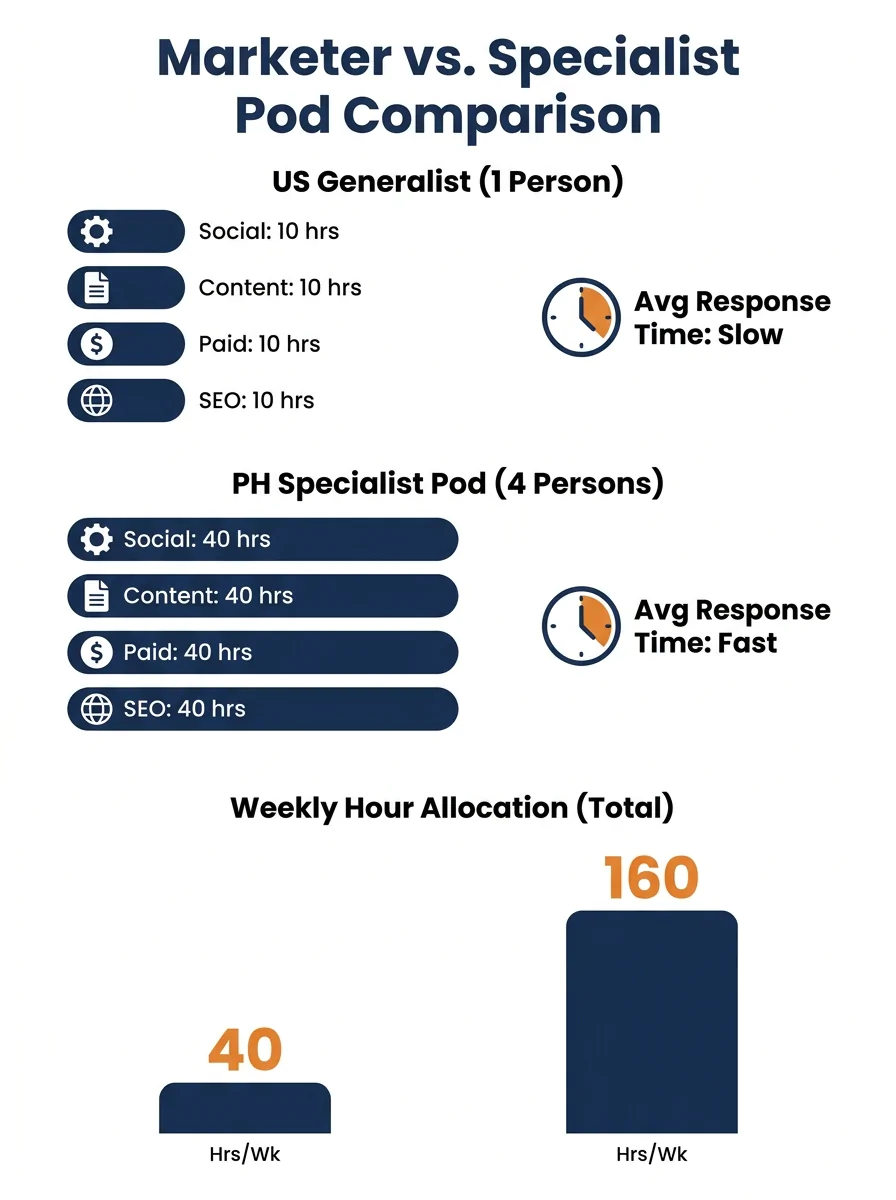
Specialized Philippine marketing squads cost between US$15 and $25 per hour, which means a 4-person pod covering SEO, paid media, social content, and analytics runs at roughly the same fully loaded cost as one senior US digital marketer billing $90–$120/hr. The math alone changes the coverage equation, but the structural advantage matters more than the arithmetic.
When Google’s March update hit, a dedicated SEO specialist inside a Philippine pod could spend 15–20 hours that week reading documentation, running test queries, and adjusting content structures. The paid media specialist on the same pod kept campaigns running without interruption. A solo US generalist trying to do both would have deprioritized one channel, losing 2–3 weeks of optimization on whichever one they triaged last.
This distributed model reduces marketing operational overhead by up to 60%, according to Piton Global’s 2026 analysis of e-commerce brands using Philippine marketing teams. The overhead reduction is a side effect, though. The primary value of algorithm expertise outsourcing is putting a specialist on each platform shift simultaneously, instead of queuing changes behind one person’s calendar.
If you’re evaluating which marketing services to delegate first, platform-specific algorithm tracking is the highest-return starting point because it’s the function most damaged by generalist bottlenecks.
Continuous Learning as Competitive Infrastructure
The algorithm outpacing problem would crush outsourced teams too, if those teams operated on a train-once-and-deploy model. Philippine BPO-origin marketing operations avoid this by building continuous learning into their production rhythm. Conexus Solutions documented the pattern directly: outsourced teams that implement continuous learning programs to enhance skills and adapt to market changes consistently outperform teams trained once and left to execute on stale playbooks.
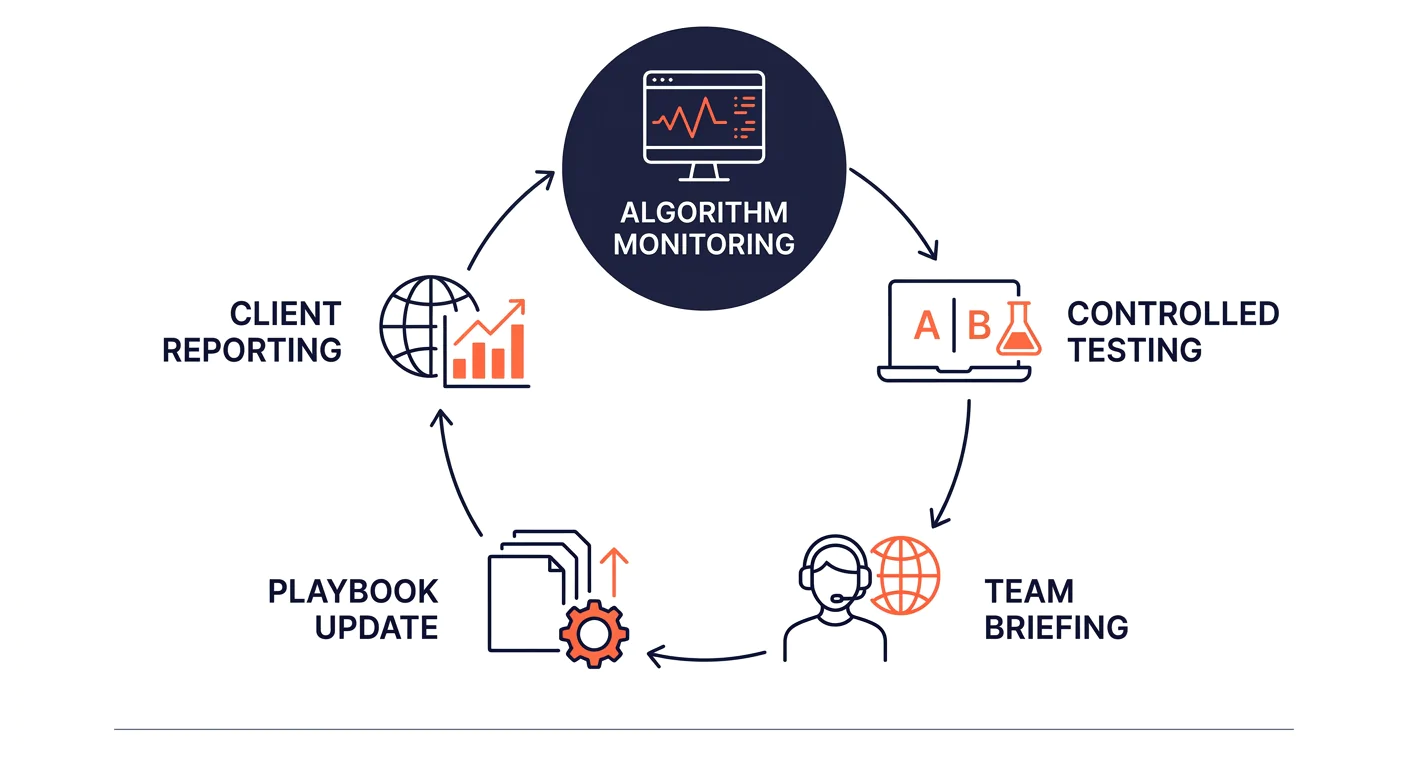
Concretely, this looks like weekly algorithm briefings. The SEO specialist on a pod monitors Google Search Central, runs controlled tests on a handful of client sites, and briefs the team on what changed and what the data shows. The paid media specialist does the same with Google Ads and Meta Ads Manager changes. These aren’t optional professional development sessions. They’re production meetings where the deliverable is an updated playbook.
TrueLogic, the first agency to bring outsourced SEO and digital marketing to the Philippines, runs a version of this model across its teams. Institutional knowledge doesn’t sit in one person’s head. It circulates through structured documentation, and when one specialist leaves, the replacement inherits a written system rather than starting from zero. That’s where the continuous learning outsourcing model diverges from simply hiring affordable labor: knowledge transfer becomes infrastructure, built into every sprint cycle.
Warning: Research from Park, Lee, and Morgan found that [outsourcing can negatively influence the learning process](https://www.researchgate.net/publication/254322412_A_Negative_Side_of_Outsourcing_Marketing_Functions_and_Market-based_Learning_Process) and cause learning loss when the client completely hands off a function. The teams that beat this failure mode maintain strategic oversight on the client side while the outsourced team handles tactical execution.
AI Tools Inside Philippine Marketing Operations
The World Economic Forum has flagged a vast shortage of AI professionals globally, with the ASEAN region experiencing a significant deficit in fields like AI, cybersecurity, and cloud computing. That shortage is real at the model-building and research level. But for applied AI in marketing operations, Philippine teams have moved faster than the talent-gap headline suggests.
“Maybe we can utilize the positive sentimentality that the Filipino population has towards AI to catapult us into progress like we’ve never seen before,” said San Juan of TrueLogic in a recent podcast. That cultural receptiveness toward AI shows up in adoption patterns. AI could unlock $79 billion in productivity in the Philippines, according to TrueLogic’s analysis of current trajectories, and marketing teams are at the front of that wave.
What does AI-first marketing look like at the pod level? Philippine teams use generative AI to draft content at 2–3x the speed of manual workflows, then route that content through human editors who apply brand voice and local market nuance. Predictive analytics tools handle bid adjustments in paid media campaigns that previously required manual monitoring every 4–6 hours. And the shift to Generative Engine Optimization means content teams now structure articles specifically for extraction by ChatGPT, Perplexity, and AI Overviews, building statistic density, quote attribution, and direct-answer ledes into their standard operating procedures.
Teams using AI-powered tools alongside human specialists report 2.4x productivity gains over unassisted headcount, fundamentally changing the economics of outsourced marketing. Each specialist applies AI within their domain rather than one generalist trying to figure out AI applications across four unrelated platforms.
The expertise gap isn’t about hiring bad people. It’s about hiring too few of them to cover the surface area that 2026 digital marketing actually requires.
The Cost Structure That Funds Depth
Philippine marketing teams’ competitive advantage isn’t the hourly rate in isolation. It’s what the rate enables: depth of specialization that most SMBs and mid-market agencies can’t afford domestically.
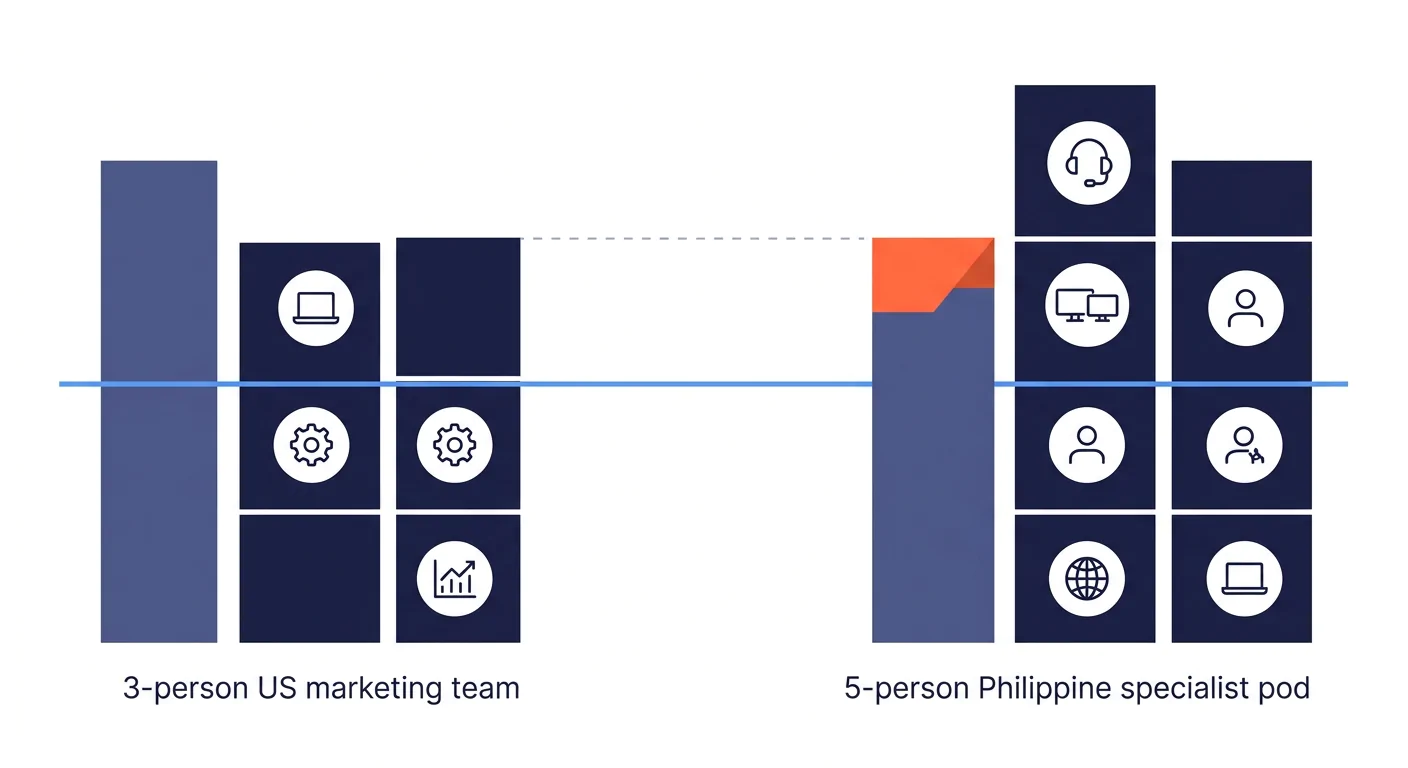
A US-based agency paying three specialists ($75–$110/hr each for SEO, paid media, and content) faces a monthly cost of $36,000–$52,800 at 40 hours per week per role. A Philippine pod of five specialists (SEO, paid media, social, content, analytics) at $15–$25/hr runs $12,000–$20,000/month. The Philippine team fields two more specializations for 40–60% less total spend. And the savings free up budget for the tools, training, and AI subscriptions that keep the team’s digital marketing skill gaps from reopening.
When Gemini reshaped Google Ads workflows, teams with budget slack could immediately subscribe to new testing tools and allocate specialist hours to learning the changes. Teams running lean couldn’t. The continuous learning outsourcing model depends on a cost structure that makes ongoing investment in skill development financially viable, month after month, without requiring a new budget approval cycle for each platform change. You can dig deeper into the full cost comparison between Philippine and US in-house models to see where the savings land in practice.
Managing the Knowledge Migration Risk
Algorithm expertise outsourcing carries a documented risk that the Park, Lee, and Morgan research confirmed: when a brand fully hands off platform expertise and stops developing internal understanding of channel performance, institutional knowledge migrates entirely outside the organization. The client loses the ability to evaluate marketing performance or switch providers without a painful ramp-up period.
The Swiss Institute of Artificial Intelligence made a related argument about the broader ASEAN talent landscape: “Low-cost agents and copilots already handle much of what entry-level coders do, and their subscriptions cost less than a team lunch.” The same dynamic applies to marketing. If your outsourced team uses AI tools you don’t understand, and you can’t read the dashboards they build, you’re dependent on their interpretation of your own data.
The fix is structural. The client retains strategic decision-making authority and platform access credentials. Weekly or biweekly reporting includes explanations of why performance shifted, tied to specific algorithm changes, so the client team builds literacy alongside the outsourced pod. The outsourced team documents processes in a shared knowledge base the client owns. If the relationship ends, the playbooks stay with the client. Building a quality-first dashboard with shared visibility is the single best hedge against learning loss.
And for brands building link authority alongside content and paid efforts, pairing an outsourced link building function with a content pod ensures the SEO specialist isn’t splitting time between outreach and on-page work, which is where specialization breaks down first under resource pressure.
What Still Isn’t Settled
The algorithm outpacing problem will intensify. Google has signaled more frequent core updates. Meta’s ad auction logic continues evolving toward AI-generated creative optimization. TikTok’s algorithm remains opaque, and regulatory pressure in multiple markets could force structural changes to its recommendation engine without warning.
Whether the continuous learning outsourcing model scales beyond 5–8 person pods into larger 20+ person operations without losing knowledge-transfer speed remains an open question. The Swiss Institute of Artificial Intelligence has argued that Southeast Asia needs a pipeline of AI scientists capable of building models and designing algorithms, not teams that only consume AI tools downstream. Marketing teams that treat AI as a black-box productivity boost without understanding the models underneath them will eventually hit a ceiling where the tools change faster than the team can adapt.
For now, the Philippine marketing teams competitive advantage holds because the combination of specialist depth, continuous learning infrastructure, AI tool adoption, and favorable cost structure produces more responsive marketing operations than any similarly priced alternative. Competitors in India, Vietnam, and Eastern Europe are building similar capabilities on similar cost curves. The real variable is whether Philippine teams deepen their lead in algorithm expertise and institutional knowledge systems before the rest of the market reaches parity.