
Architecture firms pull 60–80% of revenue from referrals, but over 90% of search clicks go to page-one results where most firms don’t appear. That gap between referral dependence and search invisibility creates a reputation problem that no single in-house hire can fix fast enough.
TL;DR: Architecture firms lose qualified prospects during the online credibility check that follows every referral. Outsourced digital marketing teams with AEC experience close that gap faster and cheaper than a new in-house hire, especially for SEO, site speed, and lead generation.
Referrals Work Until Prospects Google You
The referred prospect doesn’t call right away. They visit your website first. Research from DevOptiv shows prospective clients review 3–5 firm websites and form a credibility judgment within eight seconds. Your online reputation lives or dies in that window.
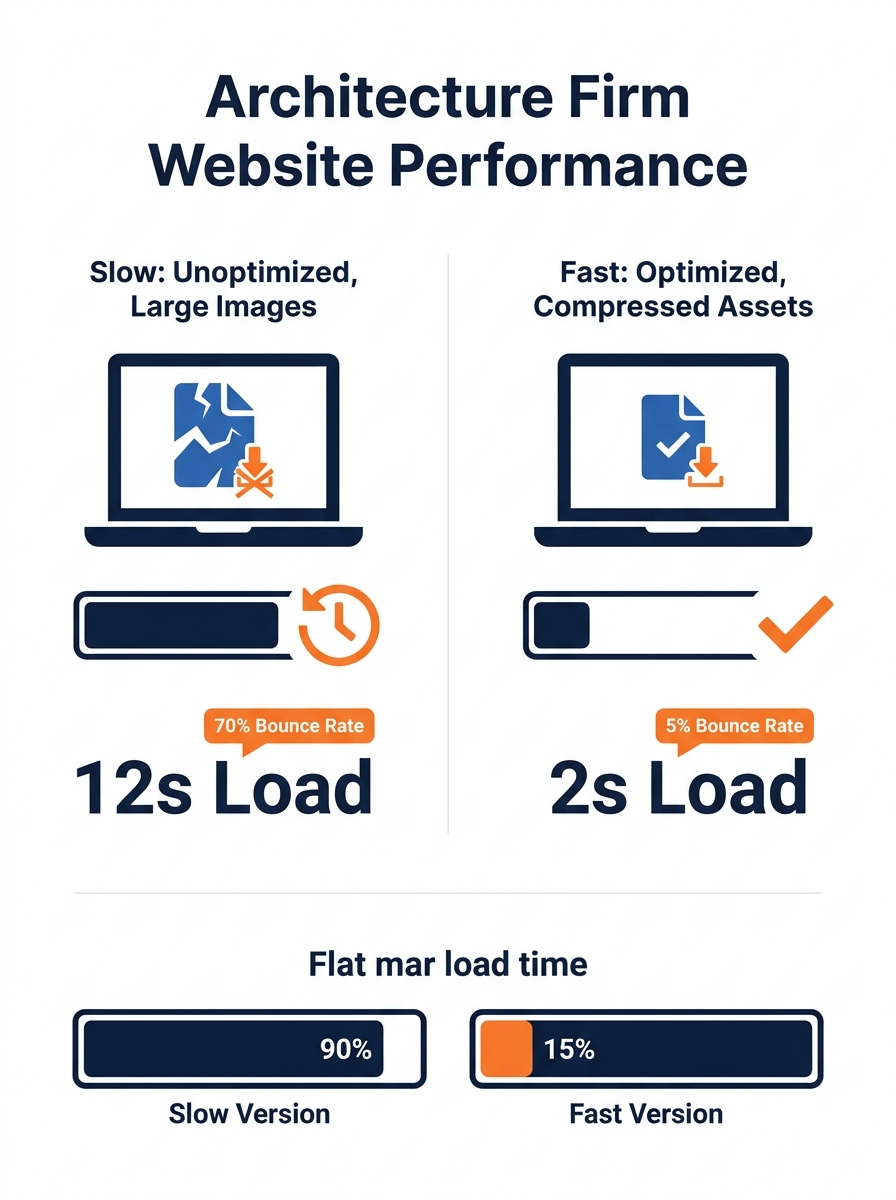
Here’s where most architecture firms fail the test. The average firm homepage loads in 6–12 seconds. Image files run 10–40 MB uncompressed. Each extra second of load time costs roughly 7% in conversions. A prospect who waited through a 9-second load already doubts your attention to detail before they see a single project photo.
Conveyor Marketing Group, which serves small and mid-sized AEC firms, describes the typical scenario: “If you’re a small to mid-sized AEC firm, the benefits of outsourcing are huge if you currently have no in-house marketing staff, have a dual role vice president of marketing and sales, or you’re the business owner who’s taken the lead on marketing.”
That “dual role VP” profile covers a surprising share of the industry. The person responsible for marketing is also closing deals, managing client relationships, and reviewing construction documents. Digital marketing gets whatever scraps of time remain, which is usually none.
The In-House Hire Math Doesn’t Add Up for Most Firms
A full-time digital marketing manager in a mid-tier U.S. metro costs $65,000–$90,000 in salary alone. Add benefits, software subscriptions, training, and management overhead, and you’re looking at $95,000–$130,000 per year, all-in. That buys you one person who needs to handle SEO, paid ads, content, social media, email, analytics, and website maintenance.
No single person excels at all of those. The AEC agency SEO strategy alone requires keyword research, on-page optimization, technical audits, local listing management, link building, schema markup, and content production. As Sixth City Marketing notes, firms with multiple offices across different states need both local SEO and national marketing strategies running at the same time.
An outsourced team splits those tasks across specialists. The cost structure is different too. You pay for services delivered, not for someone sitting at a desk during slow months. When your firm wins a large project and marketing takes a back seat for six weeks, you’re not burning $10,000 in salary for idle capacity.
A prospect who waited through a 9-second load already doubts your attention to detail before they see a single project photo.
The framework for figuring out what to keep and what to hand off is worth thinking through carefully. As we’ve covered in our breakdown of keeping the right digital marketing work in-house, brand identity, messaging architecture, and relationship management should stay internal. Execution, especially technical SEO, paid media, and content production, transfers well to an outside team.
What Outsourced AEC SEO Actually Involves
Architecture firms tend to rank for their own name and nothing else. They don’t show up for “commercial architect in Dallas” or “healthcare facility design firm Phoenix.” That means every prospect who searches by service type or location finds your competitors instead.
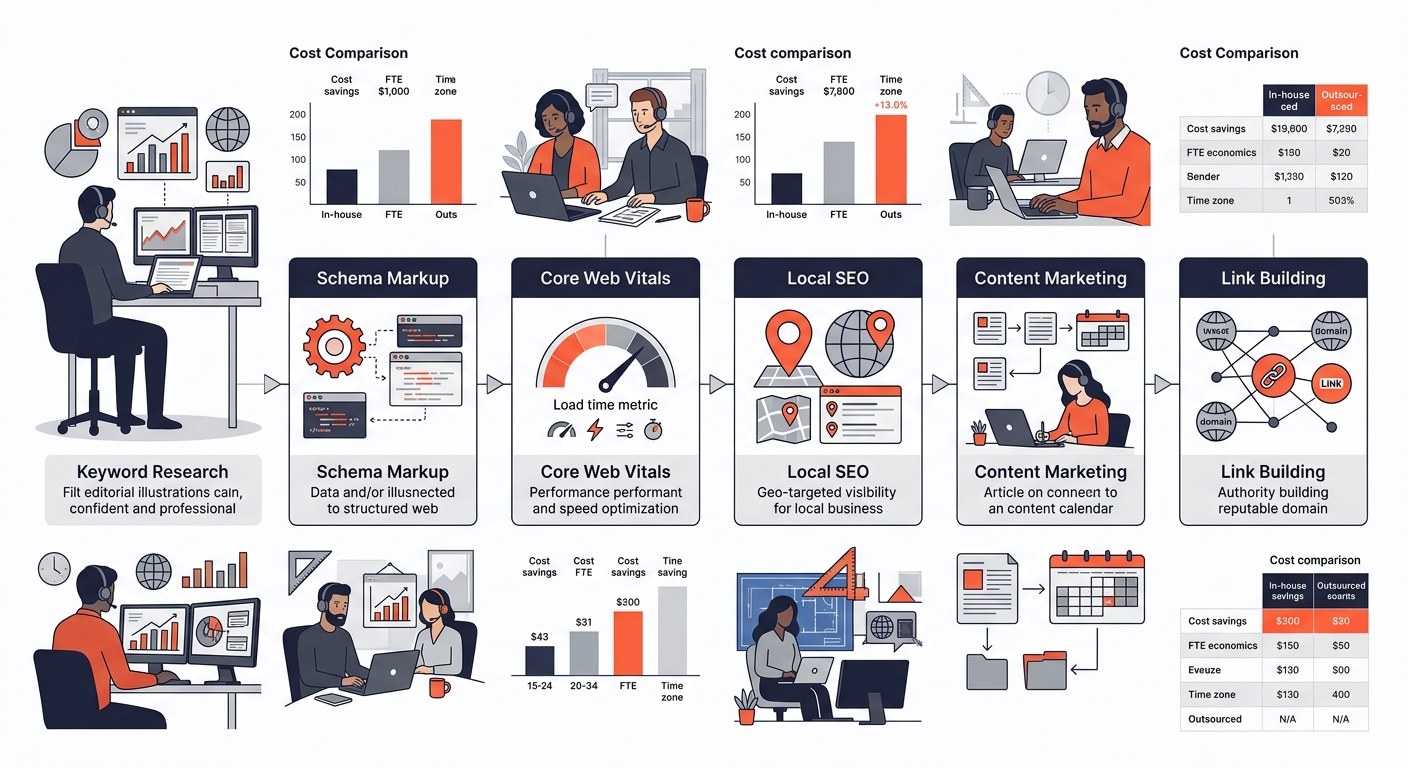
An effective AEC agency SEO strategy covers six areas: keyword research targeting project types and geographies, on-page optimization for service pages, technical SEO fixes (site speed, mobile responsiveness, crawl errors), local SEO across each office location, content marketing tied to project types clients actually search for, and link building from industry directories and publications.
| SEO Component | Typical In-House Gap | Outsourced Team Approach |
|---|---|---|
| Keyword research | Done once, never updated | Quarterly refresh with search volume data |
| Schema markup | Missing entirely | Implemented for local business, services, projects |
| Core Web Vitals | Images uncompressed, no caching | Image optimization, CDN setup, code minification |
| Local SEO | One Google Business listing, incomplete | Optimized listings per office, review management |
| Content | Portfolio pages only | Service pages, blog posts targeting client questions |
| Link building | None | Industry directory submissions, guest content |
Architecture website optimization Philippines teams handle much of this execution work at 40–60% lower cost than U.S.-based agencies. Philippine SEO specialists working in the same time zone overlap as Australian firms (and overlapping U.S. Pacific hours) can run technical audits, produce content briefs, manage local listings, and report on rankings weekly. We’ve written about how Philippine SEO teams preserve traffic during platform changes, and the same skill set applies to building search visibility from scratch.
Professional Services Lead Generation Through Outsourcing
Referral networks are unpredictable. A firm that landed three projects through referrals this quarter might land zero next quarter. Digital marketing creates a pipeline you can measure and adjust.
According to Martal Group’s 2026 analysis of outsourced lead generation, outsourcing lets sales teams “reduce wasted labor hours and focus more intently on the prospects that have already been vetted and nurtured by the outsourced team.” For architecture firms, this means your principals spend time on qualified prospects who already understand your firm’s work, instead of chasing cold leads.
Professional services lead generation outsourcing typically runs on one of two models. Pay-per-lead pricing means you pay only for qualified inquiries, with costs varying by market and lead quality. Monthly retainer models charge a fixed fee for ongoing pipeline building. Most architecture firms start with a retainer model because AEC sales cycles run 6–18 months, and lead quality matters far more than volume.
The reputation angle matters here too. Every piece of content your outsourced team publishes, every search result you appear in, every review you respond to on Google Business Profile builds the online credibility that converts referrals into signed contracts. When a prospect searches your firm name and finds a thin website with no blog, no case studies, and a 2019 copyright date, that referral weakens. When they find recent project stories, helpful articles about their building type, and a site that loads in under two seconds, the referral strengthens.
Siana Marketing’s 2026 review of top agencies serving architecture firms highlights this model: firms positioning themselves as “outsourced marketing departments and CMO-level partners for firms that lack internal marketing resources but need consistent, strategy-led execution.”
The Reputation Compounding Problem
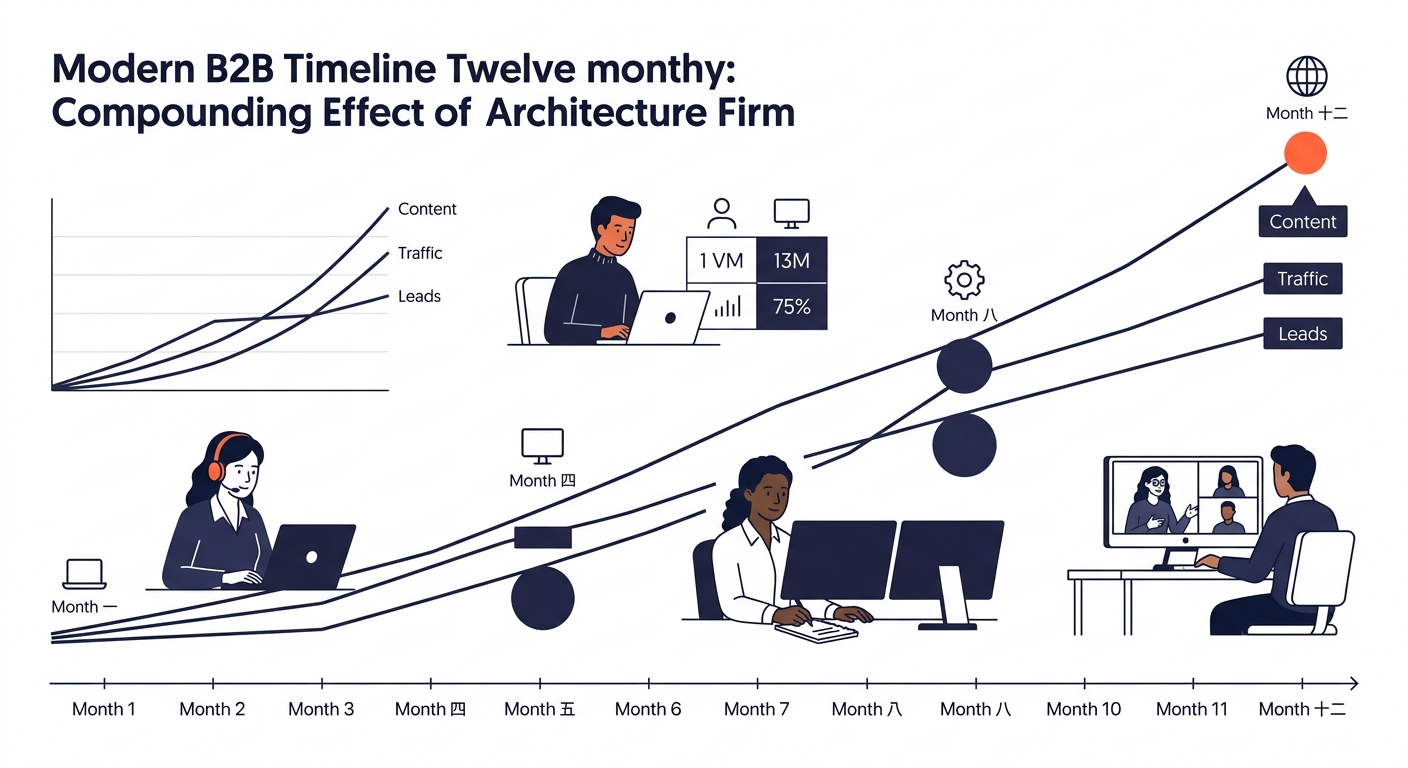
Digital marketing for architecture firms compounds over time. A blog post written today about healthcare facility design trends keeps generating search traffic for years. A well-optimized service page climbs rankings month over month. Review responses and case studies build a body of proof that no competitor can replicate overnight.
The flip side is also true. Every month you delay, competitors who started earlier pull further ahead. Search rankings are relative. If three competitors in your market are publishing content and building links while your site sits static, the gap widens each quarter.
YouTube, the world’s second-largest search engine, remains almost entirely unused by architecture firms. Optimized project walkthrough videos can rank for local queries within 90 days and generate traffic from prospects who prefer video to reading. An outsourced team can produce, optimize, and distribute these videos as part of a content calendar, something your dual-role VP of marketing will never find time for.
Getting the first 90 days right with an outsourced partner is critical. Our guide on how Philippine digital marketing teams win the first 90 days covers the expectation-setting process that prevents misalignment before it starts.
What Still Isn’t Settled
The biggest open question for architecture firms considering outsourced digital marketing is ownership. Who controls the brand voice when an outside team writes your content? Who approves project photography selection? Who decides which prospects to target with paid campaigns?
The firms that succeed with outsourcing answer those questions before signing a contract, not after. Brand identity and messaging stay in-house. Technical execution, production work, and data analysis move to the outsourced team. The line between the two needs a structured intake process that documents brand guidelines, audience definitions, and approval workflows upfront.
There’s also the question of measurement. Pay-per-lead sounds clean until you realize that “qualified” means different things to different people. A lead that fills out a contact form asking about a $200,000 residential addition isn’t the same as one inquiring about a $15 million mixed-use development. Architecture firms need to define lead quality criteria before outsourcing, not after the first invoice arrives.
The model works. The economics favor it for firms under 50 people. But the firms that get the most value from architecture firm digital marketing outsourcing are the ones that treat their outsourced team like a department, not a vendor. They share project wins, provide feedback on lead quality, and invest time in the relationship. The ones that hand off a login and disappear for three months get exactly the results they’d expect from that level of involvement.