
Scope creep in web development carries a specific mechanical signature: a requirement that was never written down gets interpreted differently by the client in Los Angeles and the development team in Cebu, and by the time anyone notices, two weeks of build time have gone in the wrong direction. The common assumption is that scope creep means clients keep asking for new features. That happens, sure. But the more destructive version is quieter. Ambiguity in the original project scope definition bakes disagreement into the project from day one, and the 13-to-16-hour time zone gap between US clients and Philippine teams gives that ambiguity room to compound before anyone can course-correct in real time.
Your website is your most visible brand asset. When scope creep stretches the build from 12 weeks to 24, your outdated site stays live twice as long, representing your brand to every prospect who Googles you. When budget overruns force you to cut corners on design, content, or performance optimization, the site that eventually launches underwhelms visitors and search engines alike. The reputation cost shows up in bounce rates, search rankings, and lost conversions.
The Ambiguity Gap: Where Scope Creep Actually Starts
Scope creep doesn’t start when someone emails “can we also add a blog?” three weeks into development. It starts in the web development brief itself, in the sentences that seem clear to the person writing them but leave room for multiple valid interpretations.
“The homepage should feel modern and professional.” What does that mean to a front-end developer in Manila? It could mean a full-bleed hero video, a minimalist type-driven layout, or a component-heavy dashboard-style interface. Each of those interpretations leads to different wireframes, different component libraries, and different build timelines. When the client sees the first deliverable and says “that’s not what I meant,” the team hasn’t failed. The brief failed.
According to Adobe’s project management research, scope creep refers to features, requests, and requirements increasing beyond the initial scope throughout the project lifecycle. But in outsourced web development, the expansion often isn’t new scope at all. It’s the original scope finally being understood by both parties, three or four weeks too late.
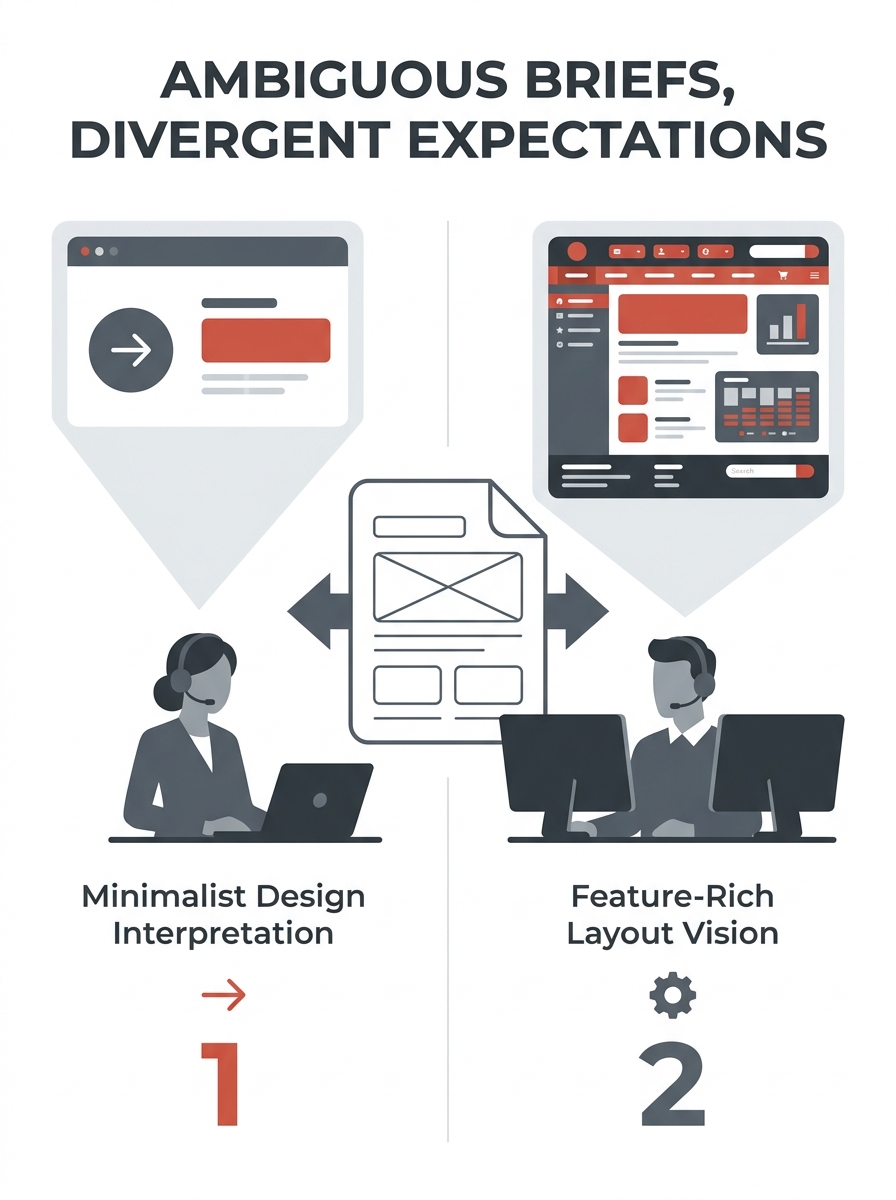
This is where scope management and online reputation intersect concretely. If your brief says “e-commerce functionality” without specifying whether that means 15 products with Stripe checkout or 2,000 SKUs with inventory management, shipping calculators, and tax automation, you’ll spend weeks in revision cycles. Those weeks come directly out of your launch timeline, which means your competitors’ sites are earning trust and rankings while yours sits in staging.
How the Approval Loop Compounds Delay
In a colocated team, a developer can walk to the product owner’s desk, ask “did you mean X or Y?”, get an answer in 30 seconds, and keep building. In a Philippine outsourcing engagement, that same question enters a queue.
The developer in Makati writes the question at 3 PM PHT. The client in Chicago reads it at 7 AM CT the next morning, maybe responds by noon. The developer picks it up at 1 AM the following PHT day. Best case: 24 hours for a single clarification. Worst case, if the client needs to check with a stakeholder or the question spawns a thread: 48 to 72 hours.
Now multiply that by every ambiguous line in the brief. A poorly defined scope document with ten vague requirements can generate 30+ clarification cycles across a build. At 24-48 hours each, that’s 30 to 60 business days of cumulative delay baked into the project before a single “extra” feature gets requested.
We’ve written about how communication costs create hidden expenses in outsourced web development, and scope creep is the single biggest source of those costs. The fix isn’t faster communication tools. It’s fewer questions that need asking in the first place.
A poorly defined scope document with ten vague requirements can generate 30+ clarification cycles across a build. That’s 30 to 60 business days of cumulative delay before a single “extra” feature gets requested.
The Cultural Accommodation Factor
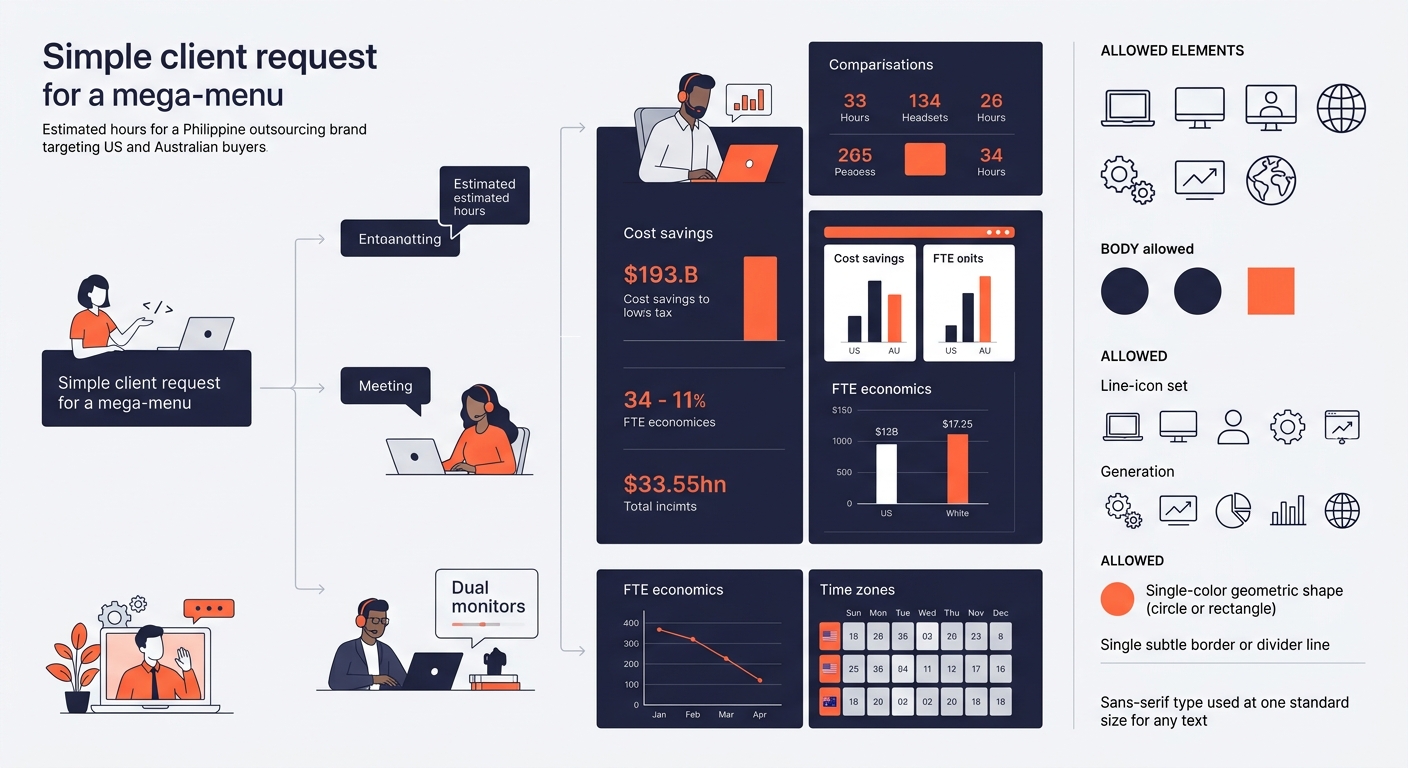
Filipino development teams are, by professional training and cultural inclination, accommodating. When a client says “can we tweak the navigation to also include a mega-menu?”, the instinct is to say yes and figure out the timeline implications later. This is a genuine professional strength in many contexts, and it’s one reason Philippine teams earn high client satisfaction scores. For scope creep prevention, though, it creates a vulnerability.
The accommodation pattern works like this: the client makes a request that sounds small. The dev lead agrees because refusing feels confrontational and the individual change genuinely is small. But “small” changes have dependencies. A mega-menu requires new content architecture. New content architecture means the CMS templates need restructuring. Restructuring the templates means the existing QA testing is partially invalid. Each yes cascades.
Research from Atarim’s analysis of web design projects confirms that scope creep usually stems from unclear project goals that leave room for misunderstanding and gradual expansion. The cultural accommodation factor doesn’t cause scope creep. It removes the friction that would otherwise slow the expansion down enough for someone to notice.
The teams that handle this well build change control into their workflow explicitly. Every request above a defined threshold (say, 4 hours of development time) triggers a written change order with timeline and cost impact stated upfront. The client sees the tradeoff before saying yes. This approach is how effective Philippine dev teams structure stakeholder workshops to keep both sides aligned throughout the entire build.
What a Complete Web Development Brief Contains
The gap between a brief that prevents scope creep and one that invites it is surprisingly specific. Both might be five pages long. The difference is in what those pages cover.
A brief that works for outsourcing timeline management needs to answer these questions with enough precision that a developer who has never spoken with you can build from it:
- Functional requirements by page or section. Not “the site needs a contact form” but “the contact page includes a form with fields for name, email, phone (optional), project type (dropdown with five options), budget range (dropdown), and message (textarea, 500 character max), submitting to the client’s existing HubSpot account via API.”
- Content inventory. How many pages, how many blog posts at launch, who’s writing the copy, what’s the approval workflow for content, and what’s the fallback if content isn’t ready by the development deadline.
- Integration map. Every third-party service the site connects to: payment processors, CRMs, analytics platforms, email marketing tools, scheduling software. Each integration needs an owner (client-side or dev-side) and a status (API access confirmed, credentials pending, needs research).
- Performance and compliance targets. Target load time, accessibility standard (WCAG 2.1 AA or AAA), browser support matrix, mobile breakpoints.
- Explicit exclusions. What the project does NOT include. This section does more for scope creep prevention than any other single element. “This project does not include: custom illustration, copywriting, SEO keyword research, ongoing maintenance, or A/B testing setup.” When a client asks for one of those items mid-build, you point to the exclusions list and have a clean conversation about a change order instead of an uncomfortable negotiation.
We’ve covered in detail how project scope definition determines whether a custom web app ships in 3 months or 6. The brief is the mechanism that makes the difference.
Warning: If your project scope document doesn’t include an explicit exclusions section, you don’t have a scope document. You have a wish list. And wish lists generate change orders.
The Reputation Math
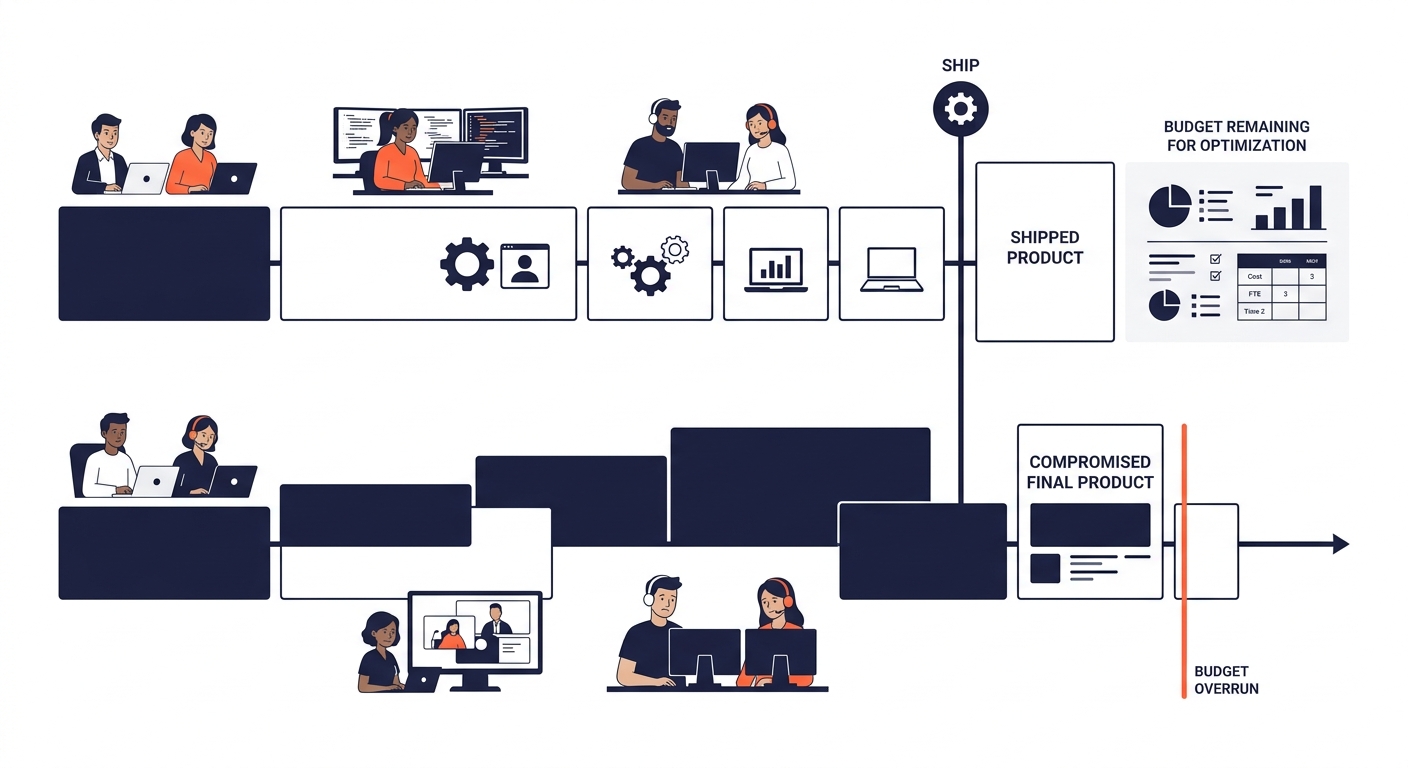
Here’s where this connects to your actual business outcomes. A website that launches 8 weeks late because of scope creep means 8 additional weeks your outdated or placeholder site is representing your brand to every prospect who searches for you. It means 8 weeks of lost organic search equity from the new site’s content and technical improvements. It means a reduced budget for post-launch optimization because the overrun ate into the total project investment. And it means a development team that’s fatigued and less meticulous on the final 20% of the build, which is exactly where polish, performance, and user experience live.
Organizations with mature project management processes are 2.3 times more likely to prevent scope creep, according to PMI’s Pulse of the Profession research. That maturity shows up in the delivered product, which shows up in how your brand is perceived online.
Your site’s load time, visual consistency, mobile experience, and content quality are all reputation signals. Search engines quantify them. Visitors judge them in under three seconds. When scope creep forces tradeoffs, those reputation-critical details are the first things that get compromised because they sit at the end of the development cycle, right where the budget ran out.
Why This Mechanism Works Despite Looking Fragile
The whole system described above depends on a document. A brief. That sounds fragile, and in one sense it is: no brief survives first contact with reality perfectly intact. Requirements will shift. Business conditions change. You’ll discover during development that a planned integration doesn’t work the way the documentation promised.
The brief’s value isn’t that it prevents all changes. It’s that it creates a shared reference point for evaluating changes. When a client asks “can we add user authentication?”, the team doesn’t have to guess whether that was implied in the original scope. They check the brief. It either says “user authentication with OAuth via Google and email/password” or it doesn’t. If it doesn’t, that’s a change order with a defined cost and timeline impact.
This is the mechanism that keeps Philippine web dev teams on track, and it’s the same mechanism that protects your online reputation from the downstream effects of a chaotic build. The brief makes tradeoffs visible before they become permanent. Teams that invest in cross-cultural training alongside strong documentation get both the accommodation and the accountability, because the change control process gives them a professional framework for saying “yes, and here’s what that costs” instead of just “yes.”
52% of all projects experience scope creep, and those projects see an average 27% budget overrun. For a $40,000 web build, that’s $10,800 in unplanned spending that could have gone toward content strategy, conversion optimization, or paid acquisition to drive traffic to the new site. The scope document doesn’t cost anything to write. Its absence costs roughly a quarter of your budget and delays the moment your brand gets the online presence it actually needs.