
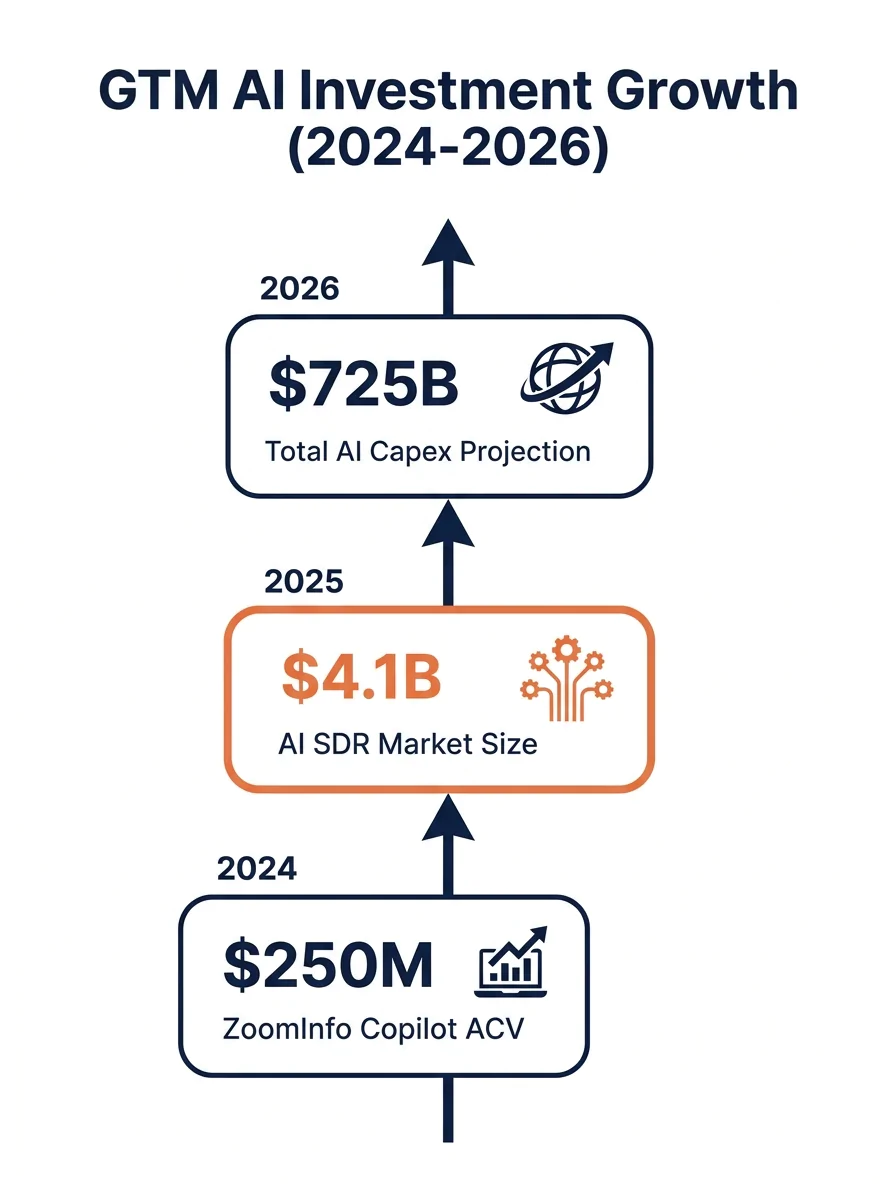
ZoomInfo shipped Copilot in early 2024. Eighteen months later, the product was generating $250 million in annual contract value — faster monetization than most SaaS companies see across their entire lifecycle. That trajectory sits inside a broader explosion: the AI SDR market hit $4.1 billion in 2025 according to The AI Corner’s GTM playbook breakdown, GTM-AI funding in 2026 is tracking past $2.7 billion, and the major tech firms have committed a projected $725 billion in AI capital expenditure this year alone.
ZoomInfo Copilot’s arc — from launch to quarter-billion-dollar product — illustrates exactly how AI GTM tools are reshaping the economics of sales and marketing execution. And if you’re running an outsourced marketing team or evaluating one, every phase of this story rewrites the math you’re working from.
The Copilot Ramp: Zero to $250M ACV in Eighteen Months
ZoomInfo didn’t build Copilot as a side experiment. The product integrates directly into existing CRM workflows, pulling from ZoomInfo’s proprietary B2B contact database to automate prospecting, lead qualification, and outreach sequencing. The pitch to sales leaders was blunt: your SDRs spend fewer hours on manual research and more hours closing.
What made it work wasn’t the AI model underneath — it was distribution. ZoomInfo already had tens of thousands of paying accounts. Copilot bolted onto existing contracts, which meant adoption didn’t require a new vendor evaluation cycle or a six-month pilot. Sales teams already paying for data started paying for AI-powered actions built on top of that data.
The $250M ACV milestone matters because it proves a specific thesis: GTM AI funding in 2026 is producing real revenue, not vapor. Gartner predicted that by end of 2025, over 70% of B2B organizations would rely heavily on AI-powered GTM strategies. ZoomInfo’s numbers suggest that prediction landed close to the mark.
But here’s the part most people skip: those AI-powered GTM tools still need human operators. They need someone to configure the ideal customer profile. Someone to review AI-generated outreach before it becomes what the industry has started calling “AI slop.” Someone to interpret pipeline data and adjust targeting weekly. The tools are fast. They are not autonomous.
The GTM Engineering Layer Nobody Staffed For
ZoomInfo Copilot is one product inside a new discipline that’s emerged alongside it: GTM engineering. Platforms like Clay, Apollo.io, and ZoomInfo now form an interconnected stack where data enrichment, AI agents, and CRM automation talk to each other through APIs and workflow builders. Three years ago, this stack didn’t exist. Now it requires dedicated operators.
GTMfund, a venture firm focused specifically on go-to-market startups, has been tracking this shift in their 2026 predictions. They see a cohort of entrepreneurs pushing AI applications into pipeline generation, outreach personalization, and deal intelligence. The AI GTM agents now available from companies like 11x can automate prospecting, outreach, lead qualification, and analytics — tasks that previously occupied two or three full-time SDRs per account executive.
For companies running outsourced PPC management alongside their inbound strategy, this shift creates a direct operational question: which tasks stay with your offshore team, and which tasks migrate to an AI agent?
The answer depends on what the AI can actually do reliably versus what it can do in a demo. Enterprise AI marketing case studies from Pragmatic Digital show 30% reduction in content costs, 50% faster campaign turnaround, and 35% higher engagement when AI handles certain repetitive production processes. Those numbers are real. But they come from companies that kept humans in the loop for strategy, quality control, and the final editorial pass — not from companies that handed everything to an agent and walked away.
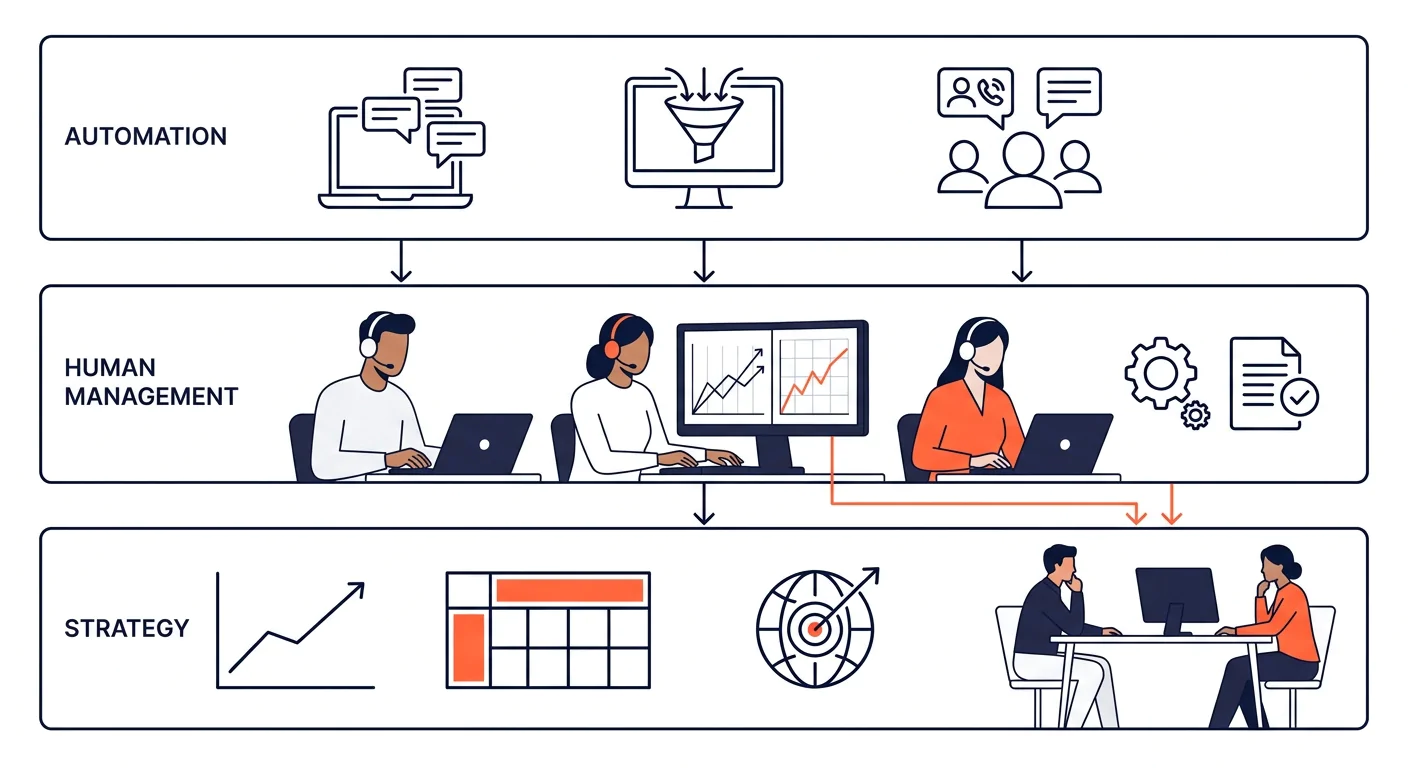
This is where AI-powered digital marketing outsourcing enters the picture in a genuinely different way than it did even twelve months ago. The value of an outsourced marketing team in 2026 isn’t the same as it was in 2023. Back then, you hired offshore specialists to do the work. Now you hire them to operate the AI tools that do the work, and to catch the errors those tools inevitably produce.
The Seven-Week Deprecation Window and Its Hidden Tax
Here’s the piece of the ZoomInfo Copilot story, and the broader GTM AI story, that doesn’t make it into the funding announcements. These AI tools depend on underlying models from OpenAI, Google, Anthropic, and others. Those model providers deprecate versions on their own timeline.
OpenAI gave users seven weeks between announcing GPT-4o’s deprecation and the actual cutoff. Seven weeks to rework prompt chains, re-validate QA processes, and test output quality on the replacement model. If you’re running marketing automation offshore with a five-person team and their entire workflow depends on specific model behavior, that seven-week window becomes an operational emergency.
And the release cadence is accelerating. Peterson Technology Partners documented in their April 2026 AI roundup that Claude Mythos, GPT-5.5, Gemma 4, and Muse Spark all dropped within weeks of each other. Each release means potential changes to the AI marketing tools your team depends on daily.
We’ve covered how AI spending from OpenAI and Google affects outsourcing stacks in detail before. The practical takeaway hasn’t changed: any outsourced marketing team that ties its processes to a single model version is carrying risk that compounds with every deprecation cycle. Smart operators are building dual-sourcing strategies, keeping prompt libraries that work across at least two providers so a deprecation notice doesn’t turn into a two-week productivity crater.
The value of an outsourced marketing team in 2026 isn’t doing the work. It’s operating the AI tools that do the work — and catching the errors those tools produce.
This model lifecycle management problem is genuinely new. It didn’t exist when marketing automation offshore meant scheduling social posts and running A/B tests on email subject lines. Now it means your virtual assistants and marketing specialists need to understand AI tool versioning the way developers understand software dependencies. And if you’ve structured your outsourcing relationship as a fixed-scope arrangement, you’re exposed — because the scope of “run our marketing campaigns” changes every time a model deprecates.
How the Outsourced Marketing Team Actually Recomposes
So what does a properly structured outsourced marketing team look like after $2.7 billion in GTM AI funding has reshaped the tooling landscape?
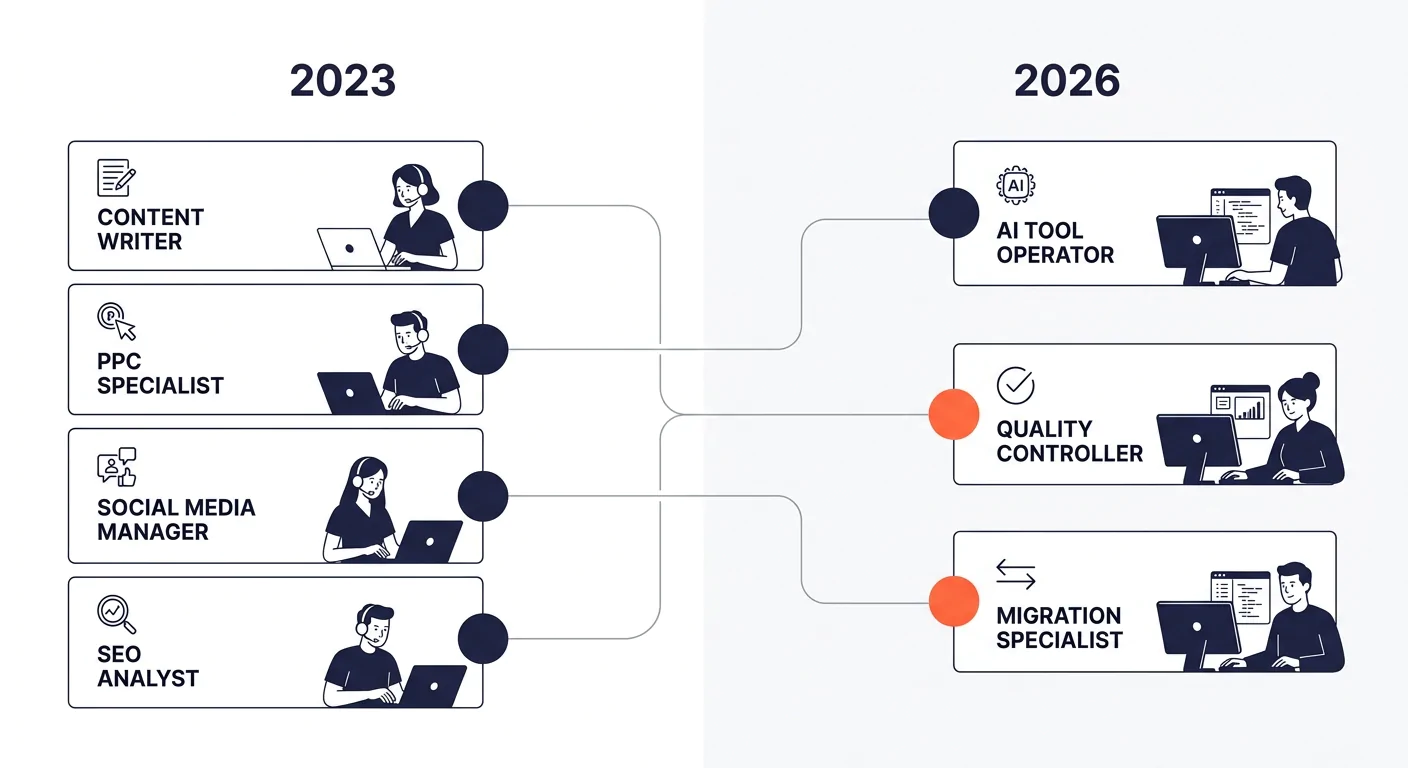
The old model was straightforward: hire offshore specialists for content writing, PPC management, social media scheduling, and SEO execution. Each person handled their functional area. The new model splits along different lines.
AI tool operators handle the day-to-day configuration and monitoring of platforms like ZoomInfo Copilot, HubSpot’s AI features, and whatever GTM agents your stack includes. These people need to understand prompt engineering, output evaluation, and model-specific behavior. They’re running campaigns through AI, not running campaigns by hand.
Quality controllers review AI-generated content, outreach sequences, and ad copy for accuracy, tone, and brand consistency. HubSpot’s 2026 State of Marketing report found that 80% of marketers now use AI for content creation, but persistent concern about AI slop means someone has to serve as the editorial filter. The challenge of maintaining quality at high content velocity applies here with even more urgency, because AI-generated volume can outpace human review capacity within days of deployment.
Migration specialists monitor model deprecation schedules, test new versions against existing workflows, and maintain fallback configurations. This role barely existed eighteen months ago. Now it’s a requirement for any team running AI marketing tools at scale.
The AI marketing tools ROI calculation has shifted accordingly. You’re no longer measuring cost-per-article or cost-per-campaign in isolation. You’re measuring how many AI-powered workflows one operator can manage, how fast they can adapt when the underlying model changes, and how much revenue those workflows generate per dollar of team cost. For companies working with offshore SEO services or a dedicated social media team, this recomposition has a direct budget impact. You might need fewer people total, but the people you need carry different skills and command a different rate.
A virtual assistant who can configure and monitor three AI outreach tools is worth considerably more per hour than one who manually sends connection requests on LinkedIn. The economics of outsourced marketing team AI adoption favor smaller teams with higher capability over larger teams doing repetitive tasks that an agent can now handle.
ZoomInfo’s Copilot Problem Runs Through Every Outsourcing Contract
The ZoomInfo Copilot case crystallizes something that applies across the entire GTM AI funding wave: the tools are getting better, faster, and cheaper on a quarterly cycle. The human work isn’t disappearing — it’s transforming in ways that demand different team compositions than what most outsourcing contracts were designed around.
Stanford’s 2026 AI Index Report found that 77% of AI implementation challenges stem from change management and data architecture rather than the technology itself. That finding maps directly onto what we see with outsourced teams. The primary risk isn’t that AI replaces your offshore marketing specialists. The primary risk is that you don’t retrain them to work with AI tools, and they spend six months doing manually what a configured agent could handle in minutes, while your competitor’s team operates three times as many campaigns with the same headcount.
Agentic AI delivers 71% median productivity gains where deployed — but only 20% of enterprises are currently using it. That gap represents a window. If you’re in the 80% that hasn’t deployed agentic AI in your GTM workflows and your competitor has, the productivity difference compounds every quarter. The companies that built flexibility into their outsourcing relationships — treating them as evolving partnerships rather than static SOWs — are already retooling their virtual assistants as AI operators, their content writers as quality reviewers, and their campaign managers as the GTM engineers that this new funding wave actually demands.
That retooling, more than any individual AI product, is where the real return on outsourcing investment sits for the rest of 2026 and beyond.