
Outsourcing account management to the Philippines is a cost-effective solution that combines affordability, skilled professionals, and strong English proficiency. Businesses can save 50%–70% on labor costs while accessing a workforce trained in customer-facing roles. With over 500,000 college graduates annually and a thriving BPO industry, the Philippines offers reliable account management services tailored to meet Western business needs.
Key Benefits:
- Cost Savings: Account management roles in the Philippines cost 50%–70% less than in the U.S.
- Skilled Workforce: Over 1.7 million professionals in the BPO sector, supported by government training programs.
- English Proficiency: Ranked 22nd globally, with a neutral accent suited for voice-based services.
- Scalability: Flexible team sizes to match business needs, backed by a 24/7 service model.
- Data Security: Compliance with international standards like GDPR and ISO 27001.
Businesses looking to reduce costs and improve customer satisfaction can benefit from outsourcing to the Philippines, leveraging its strong workforce and operational advantages.
The 7 Benefits of Outsourcing to the Philippines
Why Outsource Dedicated Account Management?
Outsourcing dedicated account management can cut costs, tap into specialized expertise, and provide flexibility that’s hard to achieve internally. For example, hiring a full-time customer service representative in the Philippines costs around $400 per month, compared to nearly $5,000 per month for the same role in the United States. These savings make outsourcing an attractive option for businesses aiming to reduce labor and operational expenses.
Beyond salary differences, outsourcing eliminates many hidden costs. You won’t have to cover employee benefits like health insurance, 401(k) contributions, or paid time off. Plus, there’s no need to pay for office space, equipment, or recruitment efforts. One cost analysis showed that an in-house operation could cost around $70,000 annually, factoring in office rent ($10,000), equipment ($5,000), salaries ($50,000), and training ($5,000). In contrast, outsourcing the same work came in at just $26,000.
The benefits go beyond just saving money. Outsourcing lets your in-house team focus on strategic growth while skilled professionals handle client relationships and support tasks. Time zone differences also enable a 24/7 "follow-the-sun" service model without the added expense of night shift premiums. According to Bain and Company, high-quality customer experiences delivered by specialized teams can increase revenues by 4% to 8% above market averages. This level of operational efficiency also makes it easier to scale quickly during market shifts.
Scalability is another major advantage. Outsourcing allows you to adjust your account management team size to meet changing market demands without the administrative headaches of recruiting and onboarding staff. While hiring an in-house employee can be time-consuming, outsourcing removes that burden entirely.
Location-specific factors also play a critical role in outsourcing’s effectiveness. Not all destinations offer the same mix of cost savings, English proficiency, and operational support. Factors like infrastructure reliability, strong data privacy laws, and access to educated talent vary by region, directly influencing customer satisfaction and business continuity. The Philippines stands out in this regard, offering a skilled workforce, excellent English proficiency, and a business-friendly environment. Companies like 365Outsource take full advantage of these strengths to provide dedicated account management that improves operational efficiency.
1. Philippines
Cost-Effectiveness
The Philippines stands out as a cost-efficient outsourcing destination, with labor costs typically 50% to 70% lower than those in Western markets. For specialized roles like IT support or technical account management, salaries range from $800 to $1,500 per month. On top of that, government incentives from the Philippine Economic Zone Authority (PEZA) – such as tax holidays, duty-free imports, and simplified business registration – help businesses cut costs even further. Another unique advantage is the billing system, where companies pay for 85% of an hour, saving around 15% compared to hiring full-time in-house staff. The BPO industry in the Philippines contributes approximately $30 billion annually to the economy and holds 10% to 15% of the global outsourcing market share. These financial benefits set the stage for delivering consistently high-quality services.
Service Quality and Expertise
The Philippines combines affordability with a highly skilled workforce, ensuring top-notch service. With a literacy rate exceeding 98% and a steady stream of college graduates, the country has a deep talent pool. As of 2025, over 1.8 million professionals work full-time in the BPO sector. Filipino agents are particularly valued for their "empathy edge" – a natural ability to connect emotionally with clients, thanks to a cultural emphasis on warmth, patience, and hospitality.
"Filipino agents know how to read tone, sense frustration, and turn friction into trust." – Outsource Asia
The country also prioritizes data security. With the Data Privacy Act of 2012 (aligned with international standards like GDPR) and certifications such as ISO 27001 and PCI-DSS, the Philippines ensures global compliance in account management services.
Language and Communication Skills
Ranked 22nd globally and 2nd in Asia on the English Proficiency Index, the Philippines boasts a workforce fluent in English, often with a neutral American accent. This reduces communication barriers and helps streamline interactions. Filipino professionals also have a strong understanding of Western business practices, idioms, and even pop culture, making it easier to build rapport with clients.
Beyond English, the Philippines supports operations in over 40 languages, including Spanish, French, German, and several Asian languages. This multilingual capability allows businesses to centralize global account management functions. In fact, some analysts point out that the Philippines often wins voice contracts over India due to its clearer accent comprehension.
Scalability and Flexibility
The Philippines’ BPO industry is well-equipped to handle both growth and change. In 2024, the sector grew by 7%, significantly outpacing the global average of 3.5%. This capacity for rapid scaling – whether for small teams or large operations – makes it ideal for businesses with fluctuating demands. For instance, in 2020 alone, the industry added 120,000 full-time employees, proving its ability to manage sudden hiring needs.
Flexibility is another hallmark of the Philippine BPO sector. Providers can scale down operations during slower periods without the complications of layoffs. Additionally, a culture of round-the-clock shifts ensures 24/7 availability across time zones. Programs like "Next Wave Cities" have expanded outsourcing hubs beyond Metro Manila to areas like Cebu and Davao, offering broader talent pools and cost management options.
"Flexibility and scalability are Filipinos’ secret weapons for exemplary performance. They can quickly adapt to changing business strategies and policies." – Unity Communications
Companies like 365Outsource leverage these strengths to deliver dependable account management services that grow alongside your business, all while maintaining high standards of quality.
sbb-itb-5665bbf
2. Other Outsourcing Destinations
The Philippines may offer a balanced mix of cost, quality, and scalability, but other global outsourcing destinations bring their own set of advantages and challenges.
Cost-Effectiveness
When it comes to affordability, India stands out as one of the most budget-friendly options for technical roles, with hourly rates ranging from $7 to $12. In fact, India handles over 56% of the global BPO market. However, rising wages for senior professionals are gradually reducing the cost advantage over other regions. Vietnam, on the other hand, offers some of the lowest rates in Southeast Asia, between $5 and $10 per hour. That said, its outsourcing industry is still evolving, and it lacks the service-oriented focus that the Philippines is known for. For businesses that need time-zone alignment, Mexico and the Latin America/Caribbean (LaCa) region charge $12 to $20 per hour, delivering cost savings of 40% to 60% compared to U.S.-based operations. Meanwhile, Eastern Europe positions itself as a higher-cost option, with monthly IT support salaries ranging from $1,800 to $2,500. While pricier than Asian markets, it remains more affordable than Western Europe or North America.
Service Quality and Expertise
India has carved out a niche in software development and R&D, though its communication style leans more "sales-focused" than the service-driven approach seen in the Philippines. Vietnam is gaining recognition as a hub for software and mobile development, but its capacity for handling large-scale customer-facing operations is still limited. The LaCa region excels at lean, agile operations, boasting attrition rates of just 3% to 7%, a stark contrast to the 40% to 50% seen in other markets.
Language and Communication Skills
English proficiency varies significantly across regions. India ranks 52nd out of 111 countries on the English Language Proficiency Index, compared to the Philippines, which ranks 22nd. While India has a large pool of English speakers, accent differences can create challenges for voice-based roles. As itel International notes:
"Customers often note that it is much harder to understand Indian English than Filipino English, which has led to the Philippines overtaking India in Voice service delivery".
Vietnam, with limited English proficiency, is less suited for voice-support roles. Meanwhile, Mexico offers strong bilingual capabilities in Spanish and English, along with excellent cultural alignment with the U.S. due to its proximity. The Caribbean region – including Jamaica, the third-largest English-speaking country in the Western Hemisphere – offers native English speakers.
Scalability and Flexibility
Scalability varies widely across these regions. India boasts a massive workforce of over 437 million working-age individuals, though its sheer scale often comes with more rigid structures and bureaucratic hurdles. Mexico is rapidly expanding its nearshore talent hubs, offering scalability with strong cultural ties to the U.S.. Vietnam is growing quickly but still lacks the infrastructure for large-scale operations. The LaCa region, with a workforce of about 13 million and broadband penetration of 74%, stands out for its adaptability and flexibility. Providers in this region demonstrated their agility during global lockdowns, managing sudden changes more effectively than some far-shore providers.
As outsourcing trends evolve, many businesses are adopting multi-shoring strategies. By spreading workloads across different regions, companies can balance costs, reduce risks, and ensure around-the-clock service continuity.
Pros and Cons
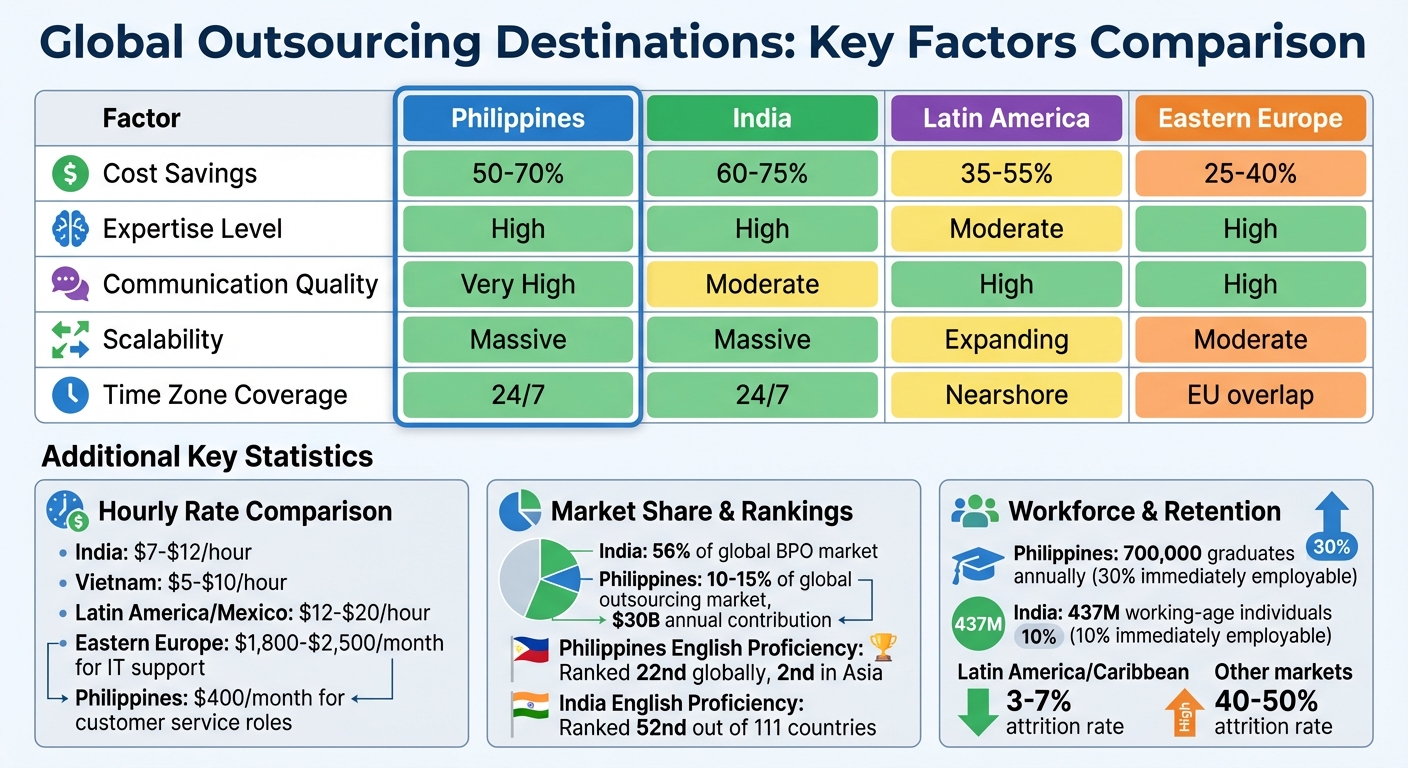
Global Outsourcing Destinations Comparison: Cost Savings, Expertise, and Communication Quality
Choosing the right outsourcing destination means balancing factors like cost savings, communication quality, scalability, and potential risks. Here’s a quick breakdown:
- Cost Savings: The Philippines offers savings of 50–70%, India provides 60–75%, Vietnam boasts hourly rates as low as $5–$10, and Latin America, including Mexico, offers U.S.-aligned time zones at $12–$20 per hour.
- Specializations: The Philippines excels in voice-related services and customer-facing roles due to neutral accents and alignment with Western business practices. India leads in IT and software development, Vietnam focuses on mobile development, and Latin America, particularly Mexico, provides excellent time zone alignment for U.S. businesses but at slightly higher costs ($12–$20 per hour).
Challenges and Infrastructure
Infrastructure reliability varies widely. The Philippines faces challenges like typhoons and power outages, while Eastern Europe offers more stable infrastructure but with lower cost savings (25–40% compared to the Philippines’ 50–70%). However, the Philippines benefits from incentives like PEZA tax breaks and a 24/7 operational culture.
The table below compares key factors for leading outsourcing destinations:
| Factor | Philippines | India | Latin America | Eastern Europe |
|---|---|---|---|---|
| Savings | 50–70% | 60–75% | 35–55% | 25–40% |
| Expertise | High | High | Moderate | High |
| Communication Quality | Very High | Moderate | High | High |
| Scalability | Massive | Massive | Expanding | Moderate |
| Time Zone | 24/7 | 24/7 | Nearshore | EU overlap |
Talent and Retention
Retention rates can vary significantly. Some areas in Latin America and the Caribbean report attrition as low as 3–7%, while other regions see rates as high as 40–50%. The Philippines stands out with a vast talent pool, producing around 700,000 graduates annually. Of these, roughly 30% are immediately employable, compared to only 10% in India.
For businesses that prioritize communication quality and cultural alignment, particularly in account management, the Philippines consistently delivers strong results despite occasional infrastructure challenges.
Partner with 365Outsource to tap into the Philippines’ workforce and maximize the benefits of dedicated account management services.
Conclusion
The Philippines stands out as a top destination for outsourcing dedicated account management, thanks to its cost efficiency, strong communication skills, and excellent alignment with Western business practices. These factors position it as a reliable and effective choice for businesses looking to enhance their account management operations.
Beyond these strengths, the country offers a deep talent pool supported by government initiatives like PEZA tax incentives and stringent data protection laws inspired by GDPR. This creates an environment where businesses can scale securely and efficiently.
To ensure a successful partnership, consider starting with a pilot project to evaluate compatibility in communication and workflow. Look for providers with ISO 27001 certification and PEZA registration to safeguard data and ensure operational reliability. Also, establish clear SLAs from the outset, outlining measurable goals like response times, resolution rates, and customer satisfaction.
365Outsource provides the tools, certified professionals, and expertise needed to leverage the Philippines’ advantages. With its focus on seamless integration, cost savings, and exceptional communication, the Philippines is a strategic choice for businesses aiming to expand their account management capabilities effectively.
FAQs
Why is the Philippines a cost-effective option for outsourcing account management?
The Philippines is an attractive choice for outsourcing account management, offering a skilled, English-speaking workforce at a fraction of the cost. Companies can cut labor expenses by as much as 70% while maintaining high standards of quality and efficiency.
What adds to its appeal is the country’s strong alignment with Western business practices and a well-established outsourcing infrastructure. This combination makes the Philippines a smart option for managing accounts while keeping operational costs in check.
How does the strong English proficiency of Filipino professionals benefit businesses in the West?
Filipino professionals’ strong command of English offers a major advantage for Western businesses, ensuring smooth and effective communication. With over 90% of the workforce fluent in English, language barriers are practically nonexistent. This fluency is particularly valuable in roles like customer service, technical support, and other business functions that require clear and precise interaction.
What sets Filipino professionals apart is not just their language skills but also their familiarity with Western practices and their customer-focused mindset. They excel at understanding customer needs, explaining complex ideas in simple terms, and aligning with Western communication styles. These strengths translate to better customer experiences, higher satisfaction levels, and streamlined business operations. It’s no wonder the Philippines is a go-to destination for outsourcing services like account management and customer support.
How is data security ensured when outsourcing to the Philippines?
Outsourcing providers in the Philippines take a variety of steps to ensure sensitive information stays protected. These include implementing secure office setups, using firewalls, and maintaining encrypted networks to block unauthorized access. To further reduce risks, employees are typically required to sign non-disclosure agreements (NDAs) and complete training focused on data confidentiality.
Trusted providers also enforce detailed data handling protocols, perform regular security audits, and adhere to privacy laws such as the Data Privacy Act of 2012. Partnering with an outsourcing company that holds strong security certifications helps businesses protect their data while staying aligned with global compliance standards.