
When U.S. companies outsource to the Philippines, they often encounter differences in work styles that can impact collaboration and productivity. Western work culture values direct communication, flat hierarchies, and strict deadlines. In contrast, Filipino work culture emphasizes harmony, respect for authority, and flexibility. These differences can lead to misunderstandings but also offer opportunities for stronger team dynamics when managed well.
Key insights include:
- Communication: Westerners prefer directness, while Filipinos use indirect, nuanced communication to maintain harmony.
- Hierarchy: Western workplaces are less formal, while Filipino teams respect titles and authority.
- Time Management: Westerners prioritize punctuality, whereas Filipinos may take a more relational approach to deadlines.
- Feedback: Western feedback is straightforward, but Filipino feedback is tactful to avoid embarrassment.
- Motivations: Western workers focus on personal growth, while Filipinos prioritize family and group harmony.
Quick Comparison
| Feature | Western Work Style | Filipino Work Style |
|---|---|---|
| Communication | Direct, explicit | Indirect, nuanced |
| Hierarchy | Flat, informal | Respect for authority, formal titles |
| Time Management | Strict deadlines | Flexible timing |
| Feedback Style | Straightforward, results-focused | Tactful, "saving face" (Hiya) |
| Motivation | Individual success | Family security, group harmony |
To bridge these differences, companies should focus on clear communication, respect for local customs, and flexible leadership styles. By doing so, they can reduce turnover, improve productivity, and build stronger partnerships.
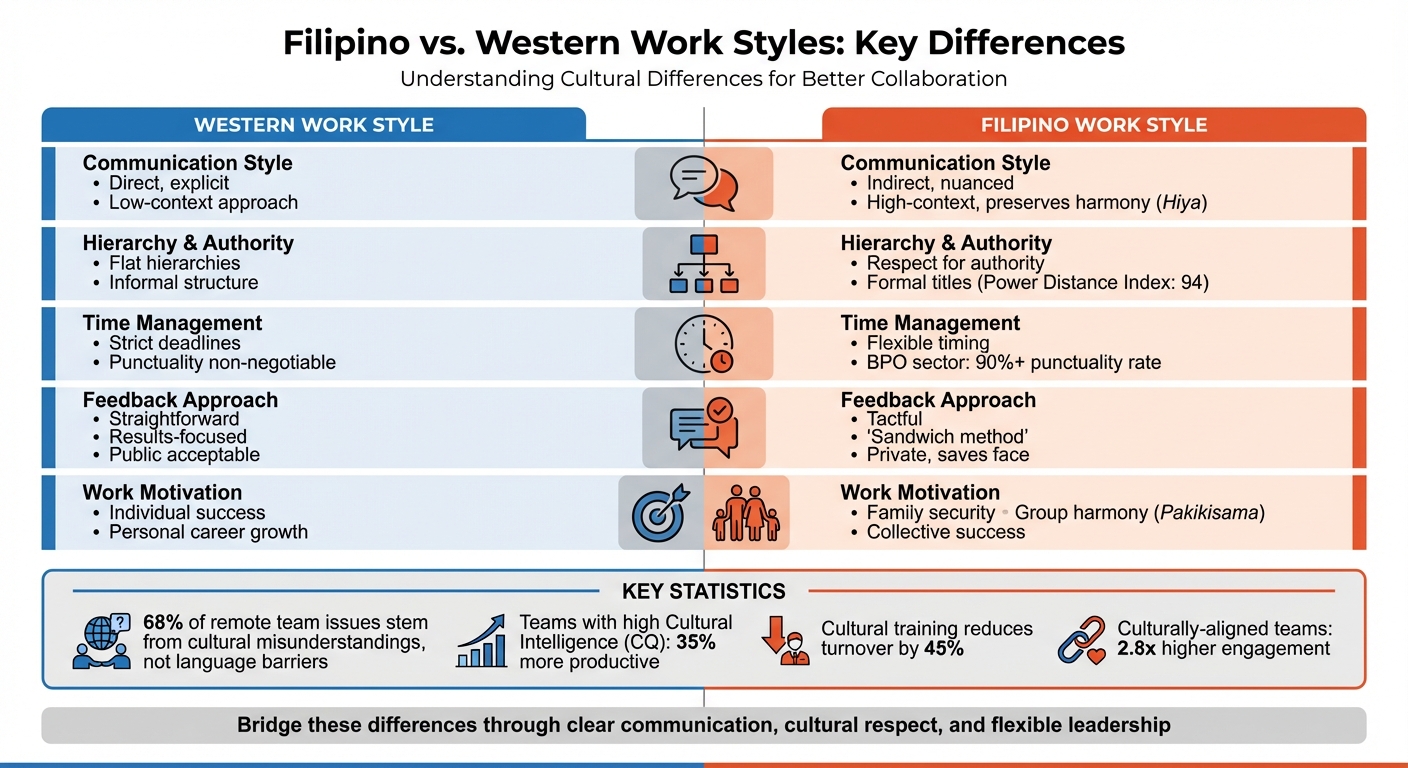
Filipino vs Western Work Styles: Key Cultural Differences Comparison
Communication Styles
Direct vs. Indirect Communication
In Western cultures, communication often follows a low-context approach. This means that messages are delivered explicitly and leave little room for interpretation. For instance, a Western manager might say, "This report needs more detail", directly addressing the issue. Filipino communication, on the other hand, leans toward a high-context style. Here, the message relies heavily on tone, non-verbal cues, and subtle suggestions. A Filipino colleague might express the same critique more gently by saying, "Maybe we could improve this section", prioritizing social harmony over bluntness.
"Filipinos are indirect communicators – they often skirt around an issue rather than address it head-on, making it difficult for Westerners to understand what they’re saying exactly".
This indirect approach is rooted in hiya, a cultural value that emphasizes preserving dignity and avoiding embarrassment. As a result, Filipinos may avoid outright refusals or direct criticism, which can contrast sharply with the more straightforward communication style expected in Western workplaces.
How Communication Styles Affect Collaboration
These differing communication styles can sometimes lead to misunderstandings in collaborative settings. For example, when a Filipino team member says, "I’ll try", a Western manager might interpret this as a firm commitment. However, in Filipino culture, this phrase may indicate that the task is challenging or that obstacles might arise. Similarly, a simple "yes" might not mean agreement or confirmation but could merely signify acknowledgment.
To navigate these differences, managers can adopt strategies that encourage clarity without compromising cultural sensitivities:
- Ask open-ended questions instead of relying on yes/no answers. For example, replace "Do you understand?" with "Can you walk me through your understanding of this process?"
- Provide feedback privately and use the sandwich method: start with positive feedback, follow with constructive criticism, and conclude with encouragement. This approach respects hiya while ensuring the message is clear.
- Explicitly invite disagreement by framing it as part of the job. For instance, clarify that identifying potential issues early is a responsibility, not a sign of disrespect.
- Pay attention to non-verbal cues during conversations, especially in video calls. Long pauses or reduced eye contact may signal unspoken concerns or disagreements.
Understanding these communication nuances is crucial for fostering effective collaboration. By addressing these differences, teams can better handle other challenges, such as timing and task management.
Time Management and Punctuality
Strict Deadlines vs. Flexible Timing
In Western work environments, punctuality is non-negotiable. Meetings start right on the dot, and showing up a few minutes early is often seen as the norm. Deadlines are treated as firm agreements, and missing them can be interpreted as unprofessional or disrespectful of others’ time. On the other hand, Filipino culture has traditionally embraced a more relaxed approach to time, often referred to as "Filipino Time", which typically means arriving 15 to 60 minutes later than scheduled.
That said, this stereotype is fading in modern Filipino workplaces, especially in industries like business process outsourcing (BPO) and tech. Professionals in these fields, who often work with international clients, are known for their exceptional punctuality. For instance, over 90% of BPO developers consistently show up early for daily standups and deliver on sprint deadlines. Many Filipino remote workers also adjust their schedules – working late nights or early mornings – to match Western time zones, showing their dedication to meeting client expectations.
The rise of remote work has further reduced delays by eliminating common barriers like Metro Manila’s notorious traffic and unreliable public transport. When delays do happen, they are usually due to temporary issues like power outages or internet disruptions, rather than attitudes toward time. Understanding these nuances is key to setting clear expectations for collaboration across teams.
How to Align Time Expectations
To ensure smooth collaboration, start by setting clear punctuality standards during onboarding. Build in buffer times for internal deadlines to account for time zone differences or technical hiccups. Tools like Asana, Trello, or shared calendars can help keep everyone on the same page and improve accountability across distributed teams.
When delays occur, approach the situation by asking about scheduling conflicts instead of assigning blame. This helps identify whether the issue is a one-off or part of a larger pattern. Recognizing team members who consistently meet deadlines can also reinforce a culture of punctuality. Clear and consistent time management practices can bridge cultural differences and improve team dynamics.
Hierarchy and Leadership Styles
Respect for Authority vs. Flat Hierarchies
The Philippines scores 94 on the Power Distance Index, indicating a strong cultural acceptance of hierarchical structures in the workplace. Unlike Western countries such as Australia and Austria, which lean toward flat hierarchies, Filipino workplaces emphasize formal titles and respectful language. Employees typically address their superiors as "Sir", "Ma’am", or by professional titles like "Attorney" or "Director" to show respect. This formal approach reflects a deep-rooted value of viewing leaders as mentors.
Decision-making processes also highlight these differences. In Western organizations, decisions often follow a top-down, individualistic approach. In contrast, Filipino culture leans toward a consultative style, where managers seek input to maintain harmony. However, the final say still rests with the top authority. It’s common for Filipino employees to consult higher-ranking individuals even for minor decisions, showcasing respect for hierarchy.
"The datu [ancient chief] exercised power with parental care… his style of governance applied consultation, persuasion and consensus – the same style after which Pinoy bosses would pattern their own centuries later."
- Zenaida S. Macaspac, Institute for Small-Scale Industries
The cultural value of hiya (saving face) also plays a role. Filipino employees often avoid publicly disagreeing with their superiors, whereas Western workers are more likely to provide direct feedback regardless of rank. This doesn’t mean Filipino employees lack opinions – they simply need a supportive setting to share them. These cultural norms significantly influence team dynamics and decision-making processes.
How Leadership Styles Affect Teams
Leadership approaches have a direct impact on team performance. Filipino teams, guided by the concept of Kapwa (shared identity), often require 40% less management oversight while maintaining high-quality work. When leaders combine servant leadership with clear authority, team performance in collectivist cultures like the Philippines can improve by 41%.
One example from June 2025 illustrates this well. A Filipino development team at Penbrothers used Slack to self-organize and resolve a critical system failure ahead of a key executive meeting. This proactive effort was driven by Kapwa, where a colleague’s problem is seen as a shared responsibility.
To navigate these leadership differences, feedback should be delivered privately using the "kiss-kick-kiss" method – praise, constructive criticism, and more praise – to preserve dignity. Since Filipino employees may hesitate to challenge authority, open-ended questions like "What would work best?" can encourage initiative. Balancing clear direction with empathy fosters loyalty. Finally, ensure alignment by asking team members to outline their approach to tasks.
Work-Life Balance and Commitment
Clear Boundaries vs. Extended Work Hours
In Western workplaces, it’s common to maintain strict boundaries between professional and personal life. For example, full-time employees in the U.S. work an average of 41 hours per week. Most stick to regular hours, leaving work-related tasks behind once the day ends. When the clock says it’s time to go, work stops.
In contrast, Filipino work culture often blurs the lines between work and personal time. Many Filipino employees willingly extend their hours or take calls after work, driven by a strong sense of responsibility and teamwork. This behavior isn’t necessarily about personal ambition but is deeply tied to Pakikisama – a cultural value emphasizing social harmony and treating colleagues like family.
"The line between work and personal time is sometimes blurry in the Philippines. Many Filipino workers are willing to extend their hours or take calls outside of regular work time, especially when they feel a sense of duty or commitment to the team."
- Arvin Ramos, Talent Management Professional
The reasons behind these extended hours differ significantly from those in Western cultures. While Western professionals may work overtime to climb the career ladder, Filipino employees are often motivated by their families. For many, a job is more than just personal success – it’s a way to provide financial stability for loved ones. This sense of loyalty is admirable but can lead to overcommitment. The cultural tendency to say "yes" to avoid disappointing others often makes it hard for employees to decline extra tasks, potentially leading to burnout.
Interestingly, Filipino professionals who feel their values are respected and understood report 2.8x higher engagement scores. However, without clear boundaries, this dedication can come at the cost of their well-being. Balancing commitment with self-care is crucial to maintaining a healthy work environment.
Maintaining Productivity and Well-Being
To address the risks of burnout caused by long hours, thoughtful leadership is essential. In November 2025, a 50-person SaaS company made changes to support its 5-person Filipino customer support team. Manager Vilbert Fermin introduced cultural adjustments, such as rescheduling team meetings from 11:00 PM to 11:00 AM Manila time to respect family dinner hours. He also moved feedback sessions to private one-on-one Zoom calls. The results? Ticket resolution times dropped from 8 hours to 2.5 hours, quality scores improved from 72% to 94%, and employee turnover stopped entirely within six months.
Clear and open communication plays a huge role in preventing burnout. Since Filipino employees may hesitate to express concerns, managers should take the initiative. For example, during one-on-one meetings, ask employees to rate their workload on a scale of 1 to 10 to gauge how manageable it feels. If team members put in extra hours to meet a deadline, offering "comp time" (time off to compensate for overtime) shows appreciation for their effort. Just as importantly, establish a "right to disconnect" by making it clear that after-hours messages don’t require immediate attention.
Here’s a quick guide to interpreting indirect signals from Filipino employees and how managers can respond effectively:
| Situation | Filipino Indirect Signal | Interpretation | Recommended Manager Response |
|---|---|---|---|
| Overloaded with Work | "I can manage" (while stressed) | They’re overwhelmed but unwilling to say no. | "Let’s evaluate your tasks. What can we delegate or postpone?" |
| Deadline Pressure | "I’ll try my best" | The timeline or resources may be unrealistic. | "What challenges might prevent us from meeting this deadline?" |
| After-hours Request | Immediate "Yes" | They feel obligated to comply, even if it disrupts personal time. | "You can respond during your next working day – no rush." |
Respecting local customs and rhythms also makes a difference. Be flexible during major Filipino holidays like Holy Week and the extended Christmas season (which starts as early as September and runs through January). Recognize family milestones and offer flexibility for emergencies to build trust and loyalty. Companies that invest in cultural training can reduce turnover among offshore teams by 45%, while teams with high cultural understanding see 35% higher productivity when working across borders.
"Retention, performance, and loyalty are not driven by compensation alone. They are driven by how people are treated, whether their values are understood, and if their goals are considered in the long term."
- Clara Crisostomo, KMC Solutions
sbb-itb-5665bbf
How to Bridge Work Style Differences
Using the Strengths of Both Styles
To overcome the challenges of miscommunication and differing work expectations, teams can tap into the strengths of both cultures. Instead of favoring one approach, effective teams combine Western efficiency with Filipino flexibility. Western team members bring structured processes, clear communication, and well-defined timelines to keep things organized, while Filipino professionals contribute a collaborative spirit and adaptability that naturally fosters a sense of ownership.
A key factor in making this work is Cultural Intelligence (CQ) – the ability to navigate and work effectively across cultural differences. Research shows that teams with high CQ are 35% more productive, and managers with strong CQ skills can ramp up teams 62% faster. By fostering a hybrid culture where both Filipino and Western work styles are equally valued, managers can turn these differences into an advantage. This approach sets the stage for practical tools and strategies that help bridge the gap even further.
Tools and Practices for Better Teamwork
Building on these cultural strengths, teams can adopt specific tools and practices to improve collaboration. One effective strategy is creating a "Working Together" document that outlines communication norms, expected response times (e.g., when to use Slack versus email), and who holds decision-making authority. This clarity helps avoid misunderstandings.
Since Western communication tends to be direct (low-context) and Filipino communication is often nuanced and indirect (high-context), managers should adjust how they phrase questions. For example, instead of asking, "Does anyone disagree?" – which might lead to silence due to the value of Pakikisama (maintaining social harmony) – try asking, "What concerns do you have?" or "What’s one thing we could improve?" Similarly, if a Filipino team member says, "I’ll try my best", it might signal that the timeline or resources are unrealistic. In such cases, follow up with, "What challenges do you foresee in meeting this deadline?"
Scheduling tools like World Time Buddy or Google Calendar can help identify overlapping work hours. To share the burden of non-standard hours, rotate meeting times, and avoid scheduling critical discussions during major Filipino holidays like Holy Week or Christmas Eve. When providing feedback, private one-on-one video calls are better than public forums because they align with the Filipino concept of Hiya (saving face). Using the "sandwich method" – starting with genuine praise, followed by constructive feedback, and ending with encouragement – can make feedback more effective.
Building personal connections is just as crucial. Dedicate the first few minutes of meetings to casual conversations about family or hobbies to build trust, which is central to Filipino culture. Some teams even organize "Virtual Kamayan" events, where everyone shares a meal over video call to celebrate Filipino traditions.
How 365Outsource Helps Bridge Work Style Differences

Partnering with a company that understands both work cultures can make navigating these differences much smoother. 365Outsource.com specializes in integrating Filipino talent into operations by acting as a cultural bridge between Western clients and Filipino professionals.
365Outsource assigns dedicated account managers to help bridge cultural gaps. These managers act like cultural translators, assisting Western managers in interpreting indirect cues and advising Filipino staff on when to use more direct communication. For example, they clarify that phrases like "Yes, I understand" might simply mean "I hear you", not necessarily agreement.
Additionally, 365Outsource provides detailed process documentation and step-by-step guides to eliminate confusion caused by vague expectations. They also establish clear escalation protocols, so team members know when to handle issues independently and when to seek managerial input. Their cultural training programs have been shown to reduce offshore team turnover by 45% and boost engagement by 2.8 times. By respecting values like Pakikisama (social harmony) and Utang na Loob (reciprocal loyalty) from the start, 365Outsource helps create a partnership where both Filipino and Western team members can thrive.
Interviewing my Filipino VA on What It’s Like to Work for an American
Conclusion
Recognizing the differences between Filipino and Western work styles goes beyond avoiding miscommunication – it’s about unlocking potential. Studies show that 68% of remote team communication issues arise from cultural misunderstandings, not language barriers. This means businesses can shift their focus from addressing surface-level issues to fostering authentic, collaborative partnerships. For instance, the contrast between Western directness and Filipino high-context communication – or between flat structures and hierarchical dynamics – can evolve from a roadblock into a chance to build stronger, more adaptable teams.
Consider this: teams that embrace these cultural nuances see 2.8x higher engagement and 45% lower turnover rates. These aren’t just numbers; they reflect the transition from a transactional approach to a workforce deeply committed to shared success.
"Cultural intelligence is what separates businesses that struggle with Filipino teams from those that build unstoppable partnerships that last years." – Vilbert Fermin, Konnect
This insight underscores how respecting cultural values can turn challenges into avenues for growth. Combining Western efficiency with Filipino traits like loyalty and malasakit (a deep sense of care for the organization) creates teams that are not just productive but emotionally invested. When businesses honor values such as pakikisama (social harmony) and utang na loob (reciprocal gratitude), they foster a sense of community where employees treat the business as their own.
FAQs
How can companies bridge communication gaps between Filipino and Western teams?
To improve communication between Filipino and Western teams, companies should prioritize understanding differences in communication styles and encouraging mutual respect. Filipino professionals often lean on indirect and high-context communication, which involves subtlety and non-verbal cues to maintain harmony. On the other hand, Western teams, especially in the U.S., typically favor direct and low-context communication, emphasizing clarity and straightforwardness.
Here are some ways businesses can improve collaboration:
- Offer cultural awareness training to help team members grasp each other’s communication preferences.
- Encourage open and respectful conversations while staying sensitive to cultural nuances.
- Set clear communication guidelines to reduce the risk of misunderstandings.
Focusing on these steps can help companies create stronger connections and improve teamwork across culturally diverse groups.
How can cross-cultural teams manage time effectively despite differences in work styles?
Effectively managing time in cross-cultural teams starts with understanding and respecting the differences in how various cultures approach work. For example, Western work environments often prioritize punctuality and sticking to strict schedules. In contrast, Filipino work culture may lean toward more flexible timelines. Being aware of these differences allows teams to set realistic expectations and avoid unnecessary misunderstandings.
Clear communication plays an essential role in bridging these gaps. Take the time to discuss each team member’s preferred working style and establish deadlines that balance flexibility with accountability. Regular updates and check-ins can help ensure everyone stays aligned and progress remains steady.
Another essential step is building cultural awareness. Providing training or encouraging open discussions about cultural norms related to time management can strengthen team relationships. When team members understand and respect each other’s approaches, they can develop shared standards that promote both productivity and collaboration.
How does understanding cultural hierarchy shape leadership and decision-making in Filipino workplaces?
In Filipino workplaces, cultural hierarchy plays a key role in shaping how authority, respect, and communication are managed. There’s a deep-rooted emphasis on respecting elders and authority figures, which carries over into workplace dynamics. Seniority and titles aren’t just formalities – they hold real weight and influence. This reflects what is often referred to as a high power distance culture, where employees generally accept and expect a clear, unequal distribution of power. The result? A structured and predictable work environment.
For leaders navigating this cultural framework, a thoughtful approach is crucial. Communication and decision-making often require a more subtle touch. Feedback and directives are typically delivered in a diplomatic, indirect manner to maintain harmony and sidestep potential conflict. When leaders align with these norms, they build trust, encourage teamwork, and create an environment where employees feel respected and appreciated. The payoff? A more engaged workforce and stronger organizational results.