
Outsourcing call handling to the Philippines can reduce costs by 40%–70% (how much outsourcing can save you) compared to running a U.S.-based call center. Here’s why:
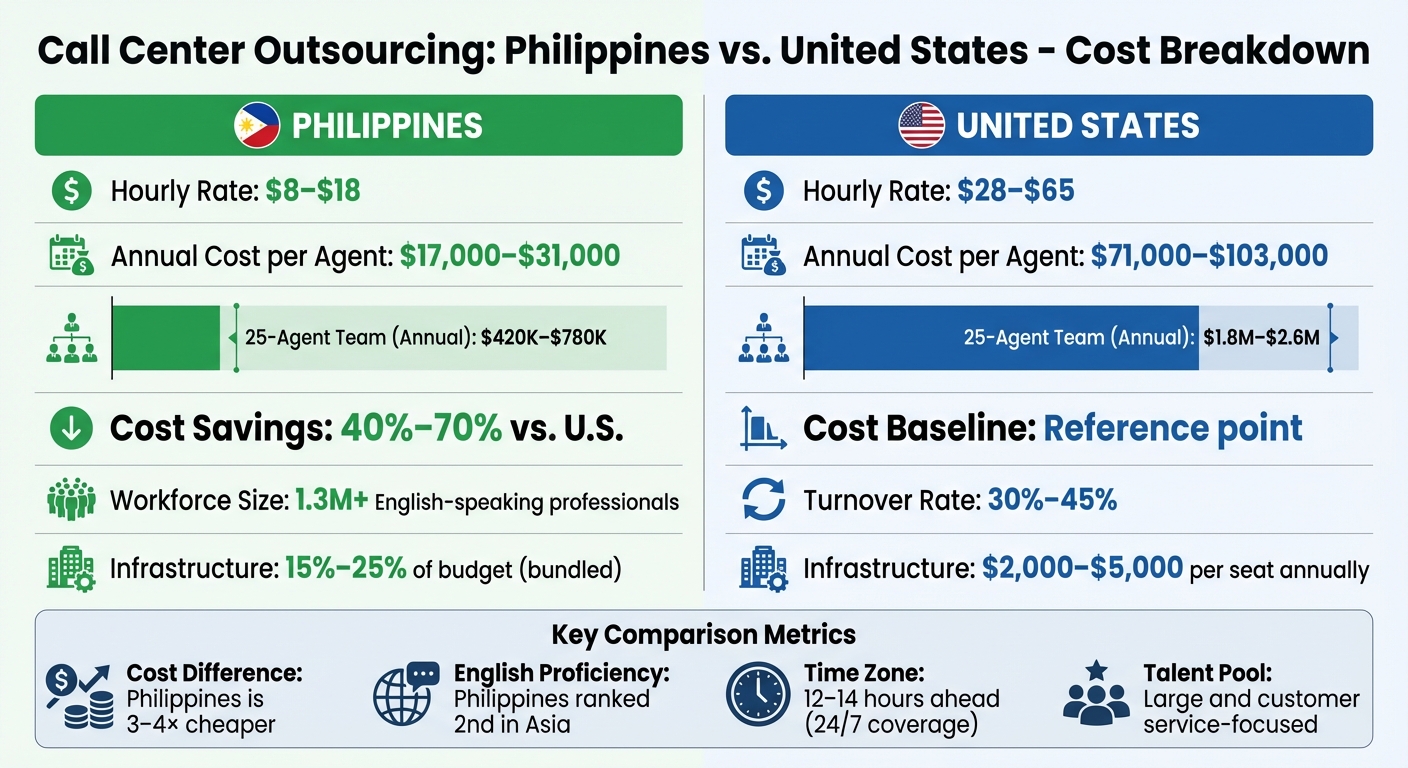
- Labor Costs: Filipino agents cost $8–$18/hour (fully-loaded), compared to $28–$65/hour in the U.S. Annual costs per agent are around $17,000–$31,000 in the Philippines versus $71,000–$103,000 in the U.S.
- Infrastructure Savings: Office space, tech, and compliance costs are bundled into lower hourly rates offshore.
- Skilled Workforce: Over 1.3M English-speaking professionals in the Philippines provide quality customer support.
- Annual Cost Comparison: A 25-agent team costs $420K–$780K in the Philippines versus $1.8M–$2.6M in the U.S.
For businesses prioritizing savings and scalability, outsourcing to the Philippines offers a clear advantage.
Philippines vs US Call Center Costs Comparison 2025
1. Call Handling Outsourcing to the Philippines
Labor Costs
One of the biggest reasons companies outsource to the Philippines is the cost savings on labor. Entry-level agents typically earn between ₱18,000 and ₱20,000 per month (about $310–$345 USD), while mid-level agents make around ₱21,000 to ₱24,000 monthly (roughly $360–$415 USD). Senior or specialized agents earn upwards of ₱25,000 to ₱30,000+ per month ($430–$520+ USD). Fully-loaded hourly rates, which include salaries, benefits, and payroll taxes, range between $8 and $18, offering a predictable cost structure.
For businesses requiring U.S. support, night shift premiums can add an extra 15%–30% to base labor costs. However, billing based on 85% productive time can help companies save up to 15% more.
Infrastructure and Technology Costs
Infrastructure and technology make up 15%–25% of the total outsourcing budget. These expenses cover essentials like office space, high-speed internet, backup power systems, workstations, CRM software, predictive dialers, and analytics tools. Providers with advanced facilities may charge premium rates of $12–$15 per hour, while those with minimal setups may offer lower rates of $6–$8. However, opting for low-cost providers can come with risks, as they account for 90% of call center program failures.
"Low-cost providers are responsible for 90% of call center program failures."
- Grace N, VP of Client Services, Piton-Global
Setup fees typically range from $5,000 to $50,000, depending on the provider. For companies with specialized compliance needs, such as PCI-DSS or HIPAA, an additional $1–$4 per hour is often added to standard rates. Businesses relocating to provincial areas like Iloilo, Davao, or Clark can further reduce facility costs by 10%–20% compared to Metro Manila.
Management and Overhead Costs
Management and administrative overhead are usually bundled into the hourly rate. This includes recruitment, training, quality assurance, HR, and the provider’s profit margin. By consolidating these costs, businesses avoid the need for separate hires or additional QA teams. Facility and compliance costs, which represent about 10%–15% of the overall budget, are also included in this bundled approach. Together, these components contribute to the overall cost efficiency of outsourcing. This shift demonstrates why outsourcing is for value, not just immediate savings.
Total Cost of Ownership
On average, the annual cost per agent in the Philippines ranges from $17,000 to $31,000. For a 25-agent operation, this adds up to $420,000–$780,000 annually. Companies with larger teams (25 to 100 agents) can often secure volume discounts of 5%–20%.
For example, providers like 365Outsource.com deliver comprehensive solutions that align with these cost benchmarks, making outsourcing a highly efficient choice for businesses.
sbb-itb-5665bbf
Outsourcing Cold Calling to the Philippines: A Guide
2. Call Handling Outsourcing to the United States
The cost of managing call handling operations in the U.S. highlights the financial advantages of outsourcing to the Philippines.
Labor Costs
In the United States, call handling labor costs are significantly higher. Hourly rates range from $28 to $65, depending on the complexity of the service. For basic inbound customer support, rates typically start at $26–$30 per hour, while specialized roles like technical support or advanced sales can cost $50–$80 per hour.
For in-house operations, agent salaries generally fall between $30,000 and $60,000 annually, but the total cost balloons when factoring in benefits, payroll taxes, and overhead. Benefits alone add 25%–35% to base salaries, while payroll taxes cost $4,000–$6,000 per agent, and management overhead adds another $8,000–$12,000 per agent. When fully accounted for, the total annual cost per agent exceeds $65,000. High turnover rates, which range from 30% to 45%, also drive up recruitment and training costs by approximately $5,000 per agent annually.
These high labor costs are just one part of the equation, as infrastructure expenses add even more to the financial burden.
Infrastructure and Technology Costs
U.S. call centers face steep infrastructure and technology expenses, which account for 15%–25% of the total call center budget. Physical facilities cost $2,000–$5,000 per seat annually, and workstation hardware adds another $1,500–$3,000 per agent. Even for a small four-agent team, technology and software expenses can reach $20,000–$60,000 per year.
Operational software costs range from $25 to $300 per user monthly, and CRM platforms average $150 per seat. Businesses requiring advanced capabilities like AI and analytics should budget an additional $2,000–$5,000 monthly. While cloud-based systems can reduce infrastructure costs by 20%–30%, upfront setup fees still fall between $10,000 and $100,000.
Management and Overhead Costs
On top of labor and infrastructure expenses, management costs further inflate U.S. call handling prices. Domestic BPO providers typically apply a 10%–20% management markup over base labor costs. Quality assurance measures, such as dedicated QA staff and recording systems, add 7%–12% to outsourcing costs. Oversight costs for domestic outsourcing partnerships range from 7%–15%, which is lower than offshore operations due to fewer communication challenges.
Total Cost of Ownership
When you add up all these factors, the total annual cost per agent for in-house operations in the U.S. ranges from $71,000 to $103,000. For a 25-agent operation, this means $1.8 million to $2.6 million annually – about 3 to 4 times the cost of outsourcing to the Philippines. Even a small four-agent team can cost between $264,000 and $300,000 per year, including all overhead. This dramatic cost difference is a key reason why businesses often turn to the Philippines to handle their call operations more efficiently.
Pros and Cons
When choosing between outsourcing call handling to the Philippines or the United States, understanding the trade-offs can help you align your decision with both budget constraints and operational goals.
| Factor | Philippines (Offshore) | United States (Onshore) |
|---|---|---|
| Cost per Hour | Low ($8–$18) | High ($25–$65) |
| Annual Cost (25 Agents) | $420K–$780K | $1.8M–$2.6M |
| Cost Advantage | 40%–70% savings vs. U.S. | Baseline |
| English Proficiency | High (ranked 2nd in Asia); neutral accent | Native speakers; mastery of slang and idioms |
| Cultural Compatibility | Strong Western affinity; familiar with U.S. holidays and consumer behavior | Deep familiarity with local cultural trends |
| Time Zone | 12–14 hours ahead; ideal for 24/7 coverage but requires night shifts | Same time zone; easier real-time coordination |
| Talent Pool | Large (1.3M+ BPO workers); customer service is a high-value career | Smaller pool; CS roles less preferred |
| Attrition Rate | 30%–40% (graveyard shifts often increase agent turnover) | Generally lower than offshore |
| Infrastructure | Occasional power outages and connectivity gaps in rural areas | Highly stable and reliable |
The table highlights the primary differences, but let’s dive into the key considerations.
The Philippines offers a clear cost advantage, with hourly rates and annual expenses significantly lower than U.S.-based options. Businesses can save up to 70% by outsourcing offshore. Additionally, the workforce in the Philippines is extensive, with over 1.3 million professionals in the business process outsourcing (BPO) sector. Many agents are highly skilled, with strong English proficiency and familiarity with Western culture, making them adept at handling U.S. customers.
However, the 12-to-14-hour time difference means agents in the Philippines often work during the night to align with U.S. business hours. This schedule can lead to higher attrition rates, with turnover ranging from 30% to 40%. Infrastructure issues, such as occasional power outages in rural areas, can also pose challenges, though these are less common in major hubs like Metro Manila or Cebu.
On the other hand, U.S.-based call centers offer native-level communication and a deep understanding of local slang and cultural nuances. Real-time collaboration is easier due to the shared time zone, but these benefits come at a steep price – labor costs are three to four times higher than in the Philippines.
For businesses prioritizing cost savings and 24/7 coverage, outsourcing to the Philippines is an attractive option, especially when partnering with providers in well-established urban centers. Alternatively, a hybrid model that combines onshore and offshore operations can balance cost efficiency with quality, allowing companies to maintain core functions locally while outsourcing high-volume or after-hours tasks.
Conclusion
Outsourcing call handling to the Philippines offers a cost reduction of 40%–70% compared to maintaining an in-house team in the U.S.. With hourly rates ranging from $6–$15 for Philippine agents versus $25–$65 in the U.S., the financial benefits are hard to ignore. For perspective, the annual cost of an in-house call center agent in the U.S. can exceed $70,000, while outsourcing to the Philippines may bring that figure down to around $26,000. Beyond wages, outsourcing eliminates expenses like office rent, equipment, and maintenance, while giving businesses access to a pool of over 1.3 million English-speaking professionals. These savings provide opportunities to reinvest in areas that enhance operations and growth.
Real-world examples highlight these advantages. UrbanMarket Retail Solutions, after partnering with a Philippine provider in July 2025, reduced their average handle time from 5 minutes to 3 minutes, saving millions annually. Likewise, Elevate Commerce Solutions redirected their outsourcing savings into product development and marketing, showcasing how outsourcing goes beyond cutting costs to creating long-term value.
For businesses looking to begin outsourcing, 365Outsource.com offers a seamless solution. Their trained virtual assistants handle phone support, email communication, and appointment scheduling at competitive rates. With dedicated account managers and tailored services for businesses of all sizes, they ensure a smooth transition while maintaining top-quality service.
If cost efficiency, round-the-clock coverage, and scalability are at the top of your list, outsourcing to the Philippines is worth considering. Start small – try a pilot program with 5–10 agents to evaluate service quality and fit. Define clear KPIs like First Call Resolution and Customer Satisfaction from the outset, and explore provincial hubs such as Cebu or Davao, where additional savings of 10–20% may be possible.
FAQs
What are the key cost factors when outsourcing call handling to the Philippines?
Outsourcing call handling to the Philippines involves several key costs: labor, infrastructure, technology, and operational expenses. Among these, labor takes the biggest share, typically making up about 60–75% of the total cost.
On the upside, expenses for things like office facilities, internet services, and software tools are usually far lower than what you’d pay in the U.S. This means businesses can enjoy considerable savings while still delivering top-notch service to their customers.
How does the time difference between the Philippines and the U.S. affect call center operations?
The time difference between the Philippines and the United States – usually 12 to 15 hours ahead – can influence call center operations. To address this, most call centers in the Philippines run on rotating shifts, enabling them to provide round-the-clock customer support that aligns with U.S. business hours. This setup ensures companies can deliver uninterrupted service without requiring their in-house teams to work outside standard hours.
Although managing overnight or early morning shifts demands thoughtful planning to safeguard both employee well-being and service quality, this adaptability is a major benefit of outsourcing to the Philippines. It guarantees consistent support for customers, helping businesses meet their operational demands efficiently.
What are the risks of outsourcing to low-cost call centers in the Philippines?
Outsourcing to low-cost call centers in the Philippines might save money upfront, but it comes with some real risks that can affect your business in the long run. Providers offering the lowest rates often struggle to hire and keep skilled agents who are fluent in English. This can lead to high employee turnover, communication challenges, and uneven customer service – none of which make for a great customer experience.
On top of that, tight budgets may mean outdated technology, weak quality control, or poorly maintained infrastructure. These problems can disrupt operations and hurt efficiency. Over time, the initial cost savings might be overshadowed by bigger expenses, like unhappy customers, damage to your brand’s reputation, or higher churn rates. To avoid these headaches, it’s crucial to choose a provider that strikes the right balance between cost and quality.