
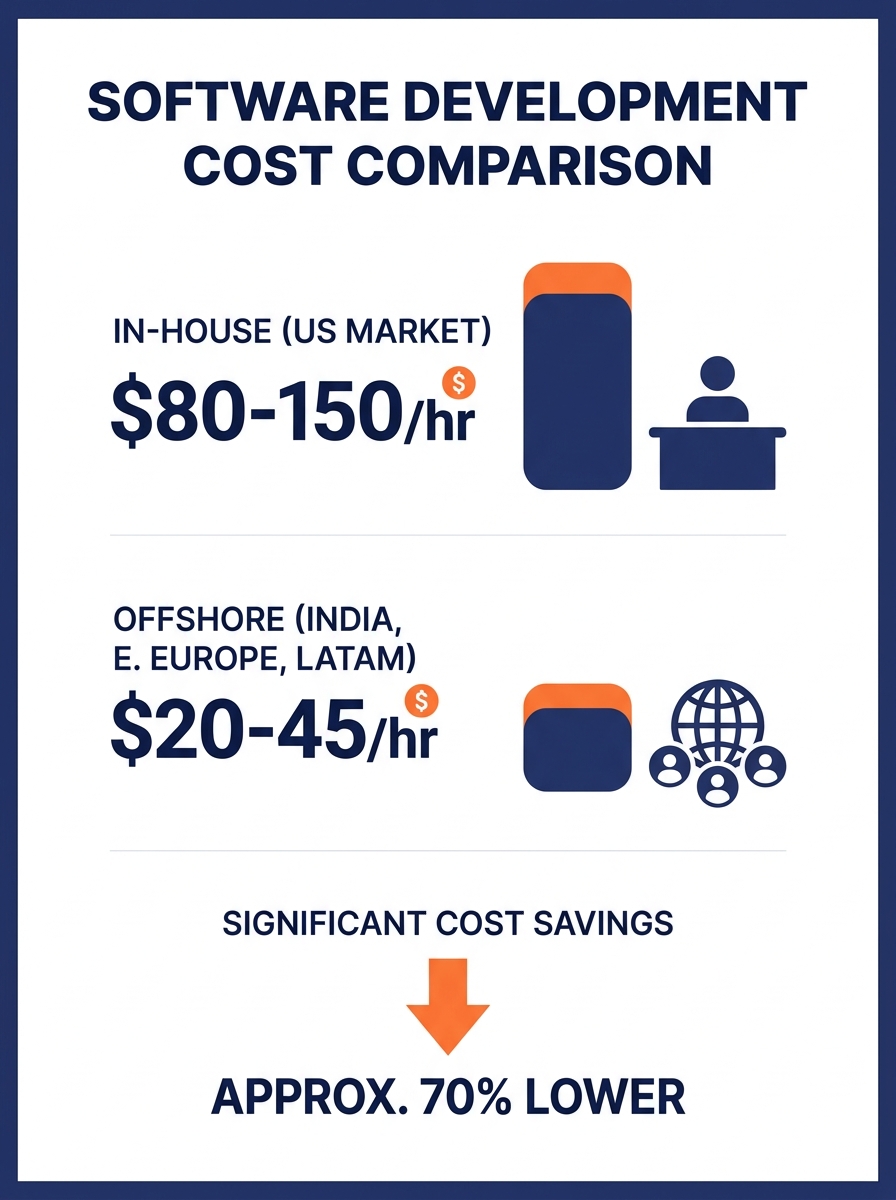
The global software development outsourcing market reached $618.38 billion in 2026, with offshore development costs running 60–73% below US in-house rates at $20–$45 per hour versus $80–$150, according to cost analysis published May 30 by Your Team in India. The market is projected to grow to $977.04 billion by 2031 at a 9.60% compound annual growth rate.
TL;DR: A new cost breakdown shows offshore software development delivers 60–73% hourly rate savings versus US in-house teams, with the global outsourcing market tracking toward $977B by 2031 as CTOs shift from hourly-rate comparisons to total-cost-of-ownership models.
The analysis targets CTOs evaluating build-versus-outsource decisions by breaking down total cost of ownership across nine operational factors rather than hourly billing rates alone. The report positions the decision as a strategic framework rather than a cost-cutting tactic, addressing what it identifies as a persistent evaluation gap in how engineering leaders assess distributed development risk.
Market Size and Growth Projections
The $618.38 billion 2026 market size represents a continuation of offshore adoption across enterprise and SMB segments. Projections show the market reaching $977.04 billion by 2031, a 58% increase over five years. The analysis attributes growth to three operational shifts: distributed Agile workflows becoming standard practice at offshore providers, DevOps integration reducing deployment friction between onshore and offshore teams, and mature governance frameworks addressing the delivery risk that historically constrained adoption.
The report does not break out Philippine market share within the global total but positions India, Eastern Europe, and Latin America as the three dominant regional hubs. Market growth above 9% annually outpaces in-house hiring velocity, according to the analysis, creating a structural advantage for companies that can operationalize offshore teams faster than they can recruit domestically.
Cost Differential Breakdown
US in-house developer costs span $80–$150 per hour depending on seniority and tech stack, while offshore rates run $20–$45 per hour across comparable skill levels, the analysis shows. The 60–73% gap narrows when factoring in project management overhead, communication tooling, and governance structure, but offshore models still deliver 40–55% total savings after adjustment, according to the report.
Fixed costs represent the primary in-house burden. Salaries, benefits, office space, and recruitment fees continue regardless of project workload. Scaling an in-house team requires multi-month hiring cycles. The analysis contrasts this with offshore engagement models that staff projects in days or weeks and scale capacity up or down without employment obligation.
Specialized skill access tilts offshore. The report notes that recruiting niche expertise domestically can extend hiring timelines by months, while offshore providers maintain pre-vetted talent pools across emerging frameworks and legacy systems. This access advantage compounds when projects require short-term specialists rather than permanent headcount.
Regional Hub Comparison
India remains the largest offshore destination due to talent pool depth, enterprise-scale operational maturity, and the lowest cost structure among major hubs. Eastern Europe, particularly Poland and Bulgaria, appeals to companies prioritizing code quality and closer cultural alignment with Western development practices, according to the analysis. Latin America has emerged as the primary nearshore option for North American businesses requiring real-time collaboration windows and minimal time-zone offset.
The report does not provide per-region hourly rates but indicates that Eastern European rates run higher than Indian rates while remaining well below North American domestic costs. Nearshore Latin American pricing sits between offshore Asian rates and US in-house costs, positioning the region as a hybrid option when synchronous communication justifies a narrower cost differential.
Philippine offshore development sits within the broader Asian hub category. The analysis does not separately profile Philippine providers but references distributed engineering operations and Agile integration as standard capabilities across reputable Asian software development companies. When to outsource versus build in-house depends on whether the product sits at the core of business operations or represents supporting infrastructure, the report notes.
Engagement Model Economics
Dedicated teams—where the same offshore developers work on a client’s product long-term—deliver the closest approximation to in-house dynamics without fixed overhead. Project-based engagements suit fixed-scope work with clear deliverables and defined end dates. Staff augmentation adds specific offshore capacity into existing in-house teams to fill skill gaps or accelerate delivery, according to the analysis.
The report positions dedicated teams as the model that best preserves institutional knowledge and reduces handover friction. Project-based work carries higher turnover risk as teams cycle between clients. Staff augmentation works when in-house leadership maintains architecture ownership and offshore developers execute within established patterns.
Total cost of ownership extends beyond hourly rates into recruitment expense, benefits, office infrastructure, and long-term employment commitment for in-house teams, versus shared project management overhead and flexible contract terms for offshore models. The analysis recommends CTOs price both models across a 12–24 month cycle rather than comparing single-sprint costs. Building custom web apps on accelerated timelines depends on upfront scope definition, which determines whether distributed teams can execute in three months versus six, the report notes.
Context and Outlook
The cost analysis arrives as US SMBs and agencies operating on $3–30K monthly budgets evaluate offshore development against domestic hiring constrained by wage inflation and extended recruitment cycles. The $618 billion market size reflects offshore development reaching operational maturity—distributed Agile workflows, DevOps tooling, and governance frameworks that once represented adoption risk are now standard practice at established providers. The 9.60% growth rate through 2031 indicates CTOs are shifting evaluation criteria from hourly cost comparison to total-cost-of-ownership models that account for scalability, specialized skill access, and time-to-productivity.
The analysis does not prescribe a universal model. In-house teams deliver direct control and cultural alignment for software that sits at the core of business operations. Offshore models deliver speed, cost savings, and global talent access when projects require rapid scaling or specialized expertise unavailable domestically. The report positions the hybrid model—strategy and architecture in-house, execution offshore—as the structure where most mature engineering organizations eventually land. For SMBs and agencies in the target budget range, the cost differential remains the primary driver, but the analysis emphasizes that governance structure and partner selection determine whether offshore engagements deliver projected savings or introduce coordination overhead that erodes the gap.
The May 30 publication date positions the analysis for mid-year budget reviews as companies evaluate H2 development capacity. Market projections through 2031 suggest offshore adoption will continue outpacing in-house hiring velocity, making partner evaluation and engagement model selection an increasingly routine operational decision for CTOs rather than a one-time strategic shift.