
A pod of three to five Philippine digital marketing specialists, equipped with AI tools, produces 2.4 times the output of equivalent unassisted headcount. That multiplier is why the gap between posting a single VA listing and building a real offshore marketing team has never mattered more for your growth trajectory.
TL;DR: Stop hiring generalist VAs and start assembling role-specific offshore specialists in sequence. Begin with the channel closest to revenue, run a structured two-week pilot for every hire, document every process before you scale, and measure pipeline quality (CPA, ROAS, MQLs) instead of task volume. A four-person Philippine team costs roughly what one senior US marketing hire costs.
The framework below treats Philippines digital marketing hiring as a structural engineering problem, not a job board exercise. Each of the five rules below applies when you’re building from scratch or backfilling gaps in an existing team. Each one also has conditions under which it falls apart. Those exceptions matter as much as the rules.
Map the outsourcing skill stack before you write a single job description
Write down every marketing activity your business runs. Not vaguely (“social media”) but specifically: Facebook ad creative production, Instagram Reels scripting, LinkedIn ghostwriting, Google Ads campaign management, on-page SEO audits, email sequence copywriting, GA4 reporting. All of them.
Then score each activity on two axes: revenue proximity (how directly does this task drive sales?) and repeatability (could someone follow a documented process to do 80% of this?). Activities that score high on both are your first offshore candidates. This scoring exercise is your outsourcing skill stack, and it prevents the single most common mistake: posting a listing that reads “Need someone who does SEO, social media, email, and paid ads.”
Aristosourcing’s analysis of the VA-versus-team question frames the distinction well: “If a VA is your right hand, a digital marketing team is your growth department.” That’s the divide your skill stack map makes visible. A VA handles task management. A specialist handles campaign execution. We covered which services to delegate first in a separate piece on sequencing.
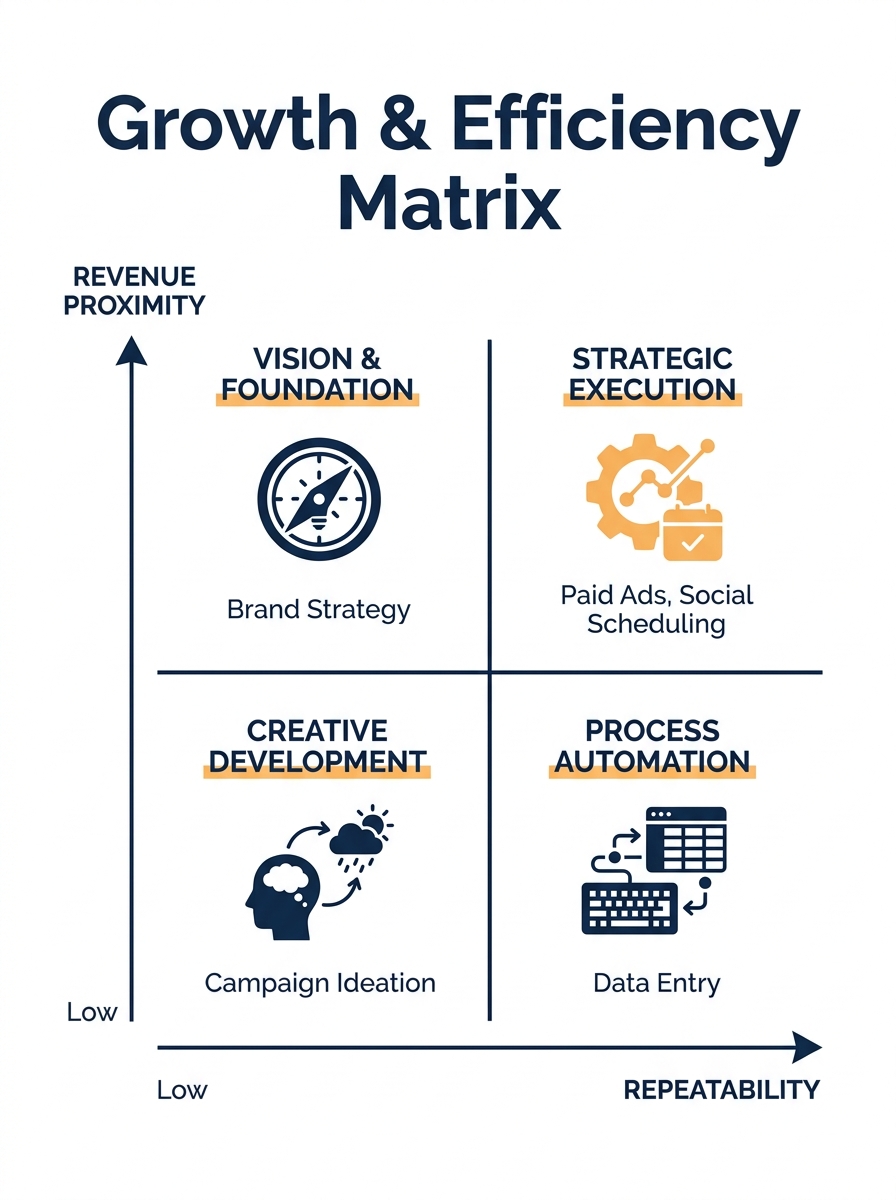
When this rule breaks: Solo founders with zero marketing infrastructure should hire a generalist VA for 60 to 90 days as a discovery phase. That period reveals which activities generate real leads before you commit to specialist hiring. But treat it as temporary scaffolding, not a permanent marketing team structure.
Hire specialists in sequence, starting with the channel closest to revenue
Don’t build a four-person team on day one. Offshore team roles compound in value when they build on each other, so the order matters.
For most SMBs and agencies, the sequence looks like this:
- Paid media specialist (Google Ads, Meta Ads): closest to revenue, fastest feedback loops, easiest to measure. Offshore cost: $1,500 to $2,500/month versus $6,000 to $8,000 for a US-based equivalent.
- SEO specialist: builds compounding organic traffic while paid media handles near-term leads.
- Content creator (social media posts, email, blog): fuels both paid and organic channels with fresh creative.
- Analytics and reporting specialist: connects channels to pipeline metrics like cost per acquisition.
- Social media community manager: handles engagement, scheduling, and audience growth across platforms.
Emapta’s guide to building remote marketing teams notes that this approach lets businesses “add skills in SEO, content, paid media, analytics, design, automation, or AI” incrementally. At $1,500 to $3,500 per specialist per month (60% to 70% below US equivalents), a four-person team costs roughly the same as one senior US marketing hire making $120,000 per year plus benefits. If you’re already running hybrid outsourcing for digital marketing, this sequence plugs offshore specialists into the exact gaps your in-house team can’t fill.
When this rule breaks: Agencies scaling social media services for clients may need to flip the order and hire content creators or community managers first. Revenue proximity depends on your business model, not a universal formula.
Treat the two-week pilot as a pass/fail gate, not a formality
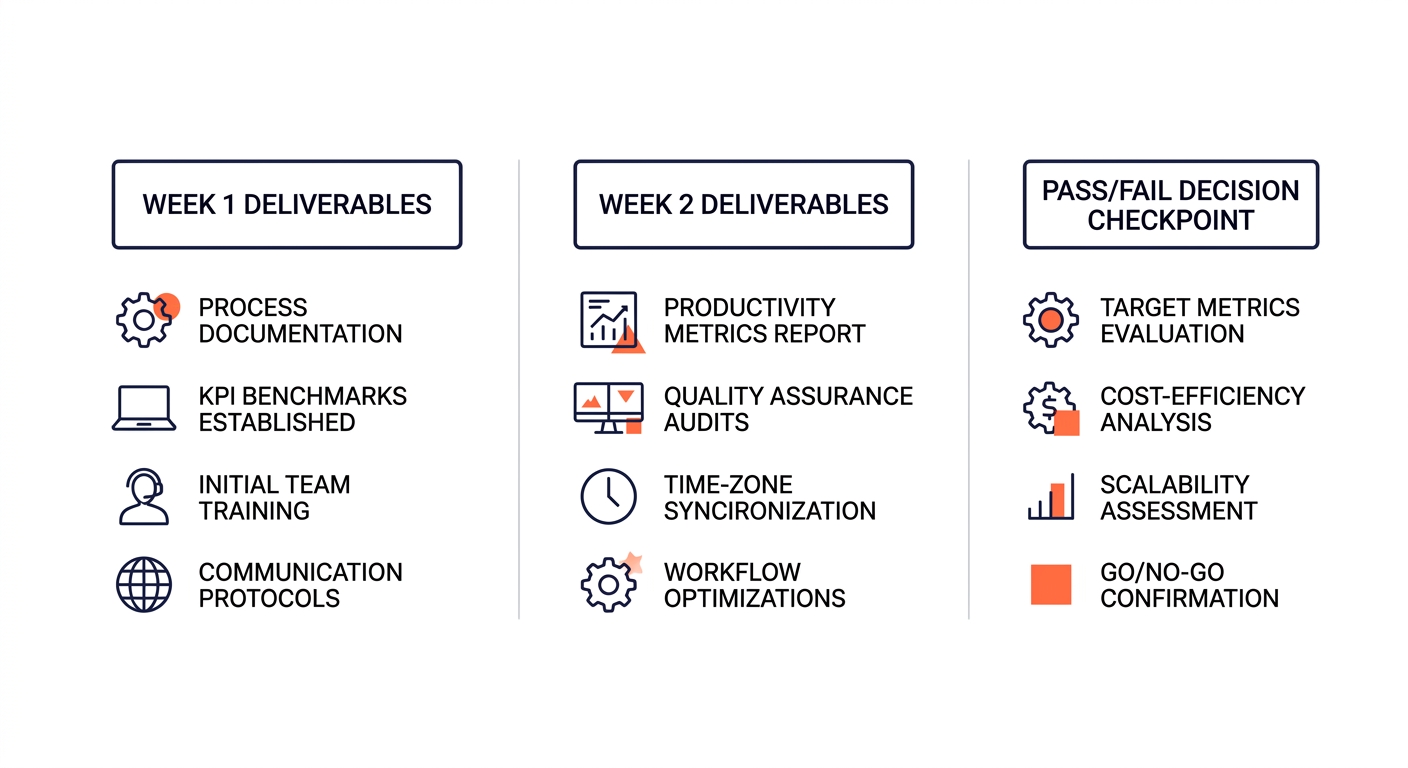
Every offshore marketing hire should start with a paid two-week trial. Not a vague “let’s see how it goes” arrangement, but a structured test with predefined deliverables and a go/no-go decision at the end.
For a social media specialist, that pilot might look like this:
- Week 1: Produce 10 social posts (copy and creative briefs) for one brand, following provided voice guidelines and a content calendar template.
- Week 2: Schedule and publish those posts, respond to all comments within 4 hours during overlapping work hours, and deliver a weekly engagement report.
- Pass criteria: 90%+ brand guideline adherence, zero missed publishing windows, report delivered by Friday end of day Philippine time.
The pilot screens for something interviews can’t: whether a person follows documented processes consistently. Outsourced.ph’s approach to Philippine marketing team recruitment emphasizes that top firms maintain average specialist tenure of 18 or more months when they invest in structured onboarding. Your two-week pilot is the first checkpoint in that onboarding arc.
Tip: Pay pilot candidates at full rate. Asking someone to “prove themselves” unpaid signals that you treat offshore staff as disposable, and the strongest specialists will decline the engagement before it starts.
When this rule breaks: Managed service providers that already screen and guarantee candidates can justify a one-week pilot with simplified scope. But skip the pilot entirely at your own risk.
Document every repeatable process before your second hire
Your first specialist can tolerate some ambiguity because you’re available to answer questions in real time. Your second one can’t, because your attention is now split. Before you add headcount, convert every marketing workflow into a written standard operating procedure.
This mirrors the thinking behind a VA hiring framework that prioritizes written procedures over extensive candidate vetting. The logic is even stronger when you build offshore marketing team capacity across multiple roles: documented processes reduce revision cycles by 40% to 50%, according to managed-service benchmarks from leading Philippine BPO firms. That’s real hours saved every week.
An SOP for social media campaign management should cover:
- Access instructions for your scheduling tool (Buffer, Sprout Social, or whatever you run)
- Brand voice guidelines with specific do’s and don’ts, plus 5 example posts that hit the mark
- Approval workflow: who reviews creative, how long they have to respond, what happens if they miss the window
- Escalation protocol for negative comments, PR risks, or customer complaints
- Reporting cadence and template, including definitions for every metric (engagement rate formula, attribution model for social-driven leads)
Documented processes reduce revision cycles by 40% to 50%. Your SOPs are the infrastructure that lets an offshore team operate at the quality bar your clients expect.
The SkillsYouNeed guide on remote marketing team management argues that “learning basic data analytics skills is a core part of running an effective marketing team remotely.” Your SOPs should include the analytics layer so every team member can self-evaluate output without waiting for feedback from headquarters.
When this rule breaks: Experimental channels resist documentation by nature. New TikTok formats, untested influencer partnerships, and emerging platform features change too fast for rigid SOPs. Give your specialist a hypothesis template and a budget cap instead, then document the process after you see results.
Measure offshore team roles by pipeline metrics, not activity volume
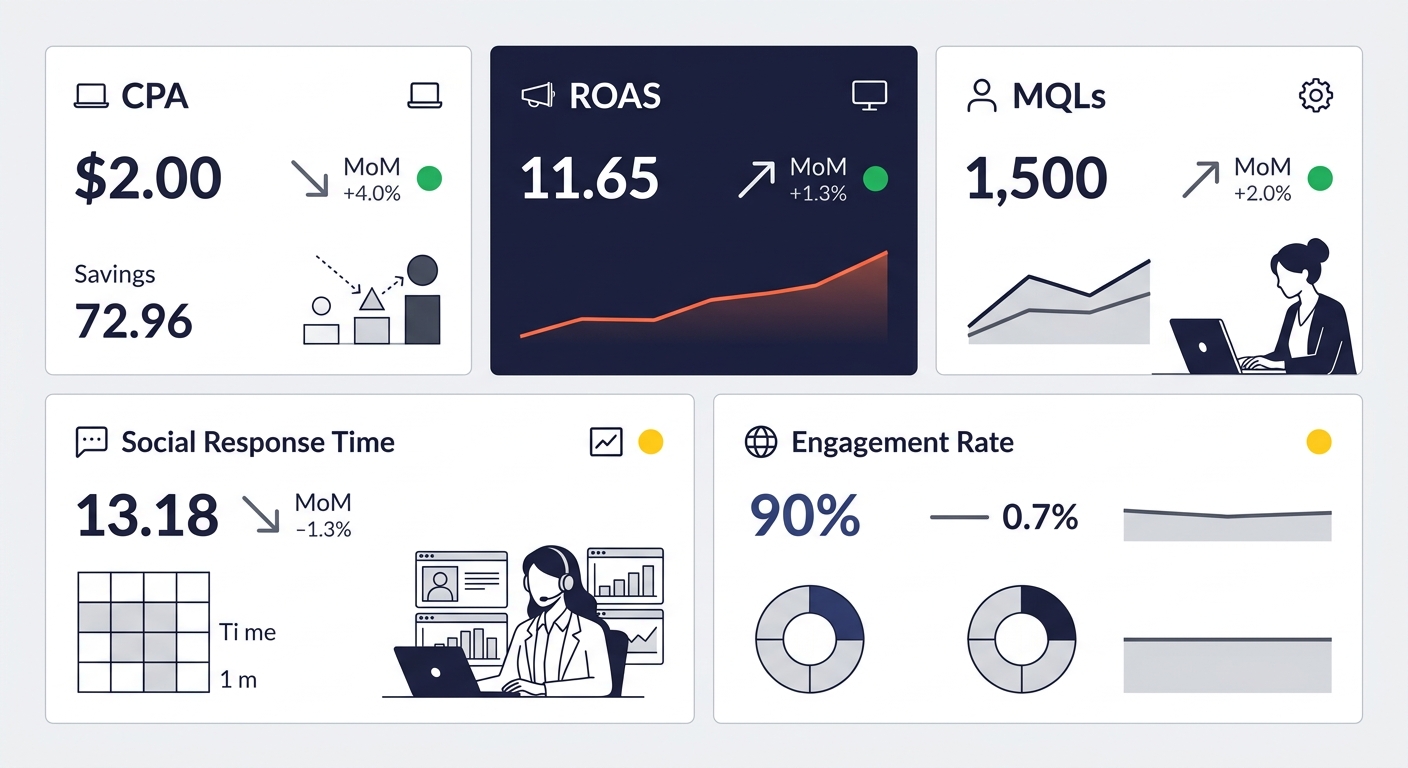
The most common management failure with offshore digital marketing teams is tracking busyness: posts published, ads launched, emails sent. Activity metrics feel productive and tell you nothing about whether your marketing team structure is generating revenue.
Track these instead:
| Metric | What It Measures | Why It Matters |
|---|---|---|
| Cost per acquisition (CPA) | Dollars spent to acquire one customer per channel | Ties offshore output directly to revenue efficiency |
| Return on ad spend (ROAS) | Revenue generated per dollar of paid media spend | Shows whether your paid media specialist is profitable |
| MQLs per channel | Marketing qualified leads from social, search, email | Reveals which specialists drive real pipeline |
| Time to first response | Average minutes from customer comment to team reply | Measures social media operational speed |
| Content engagement rate | Interactions divided by impressions per platform | Shows whether creative output resonates with your audience |
We covered the dashboard architecture for this in our piece on building quality-first dashboards for outsourced teams. The principle is simple: if your offshore team can’t see the same pipeline data you see, they’re flying blind.
Staff Domain’s offshore management guide recommends that companies “regularly engage with your outsourced marketing team through structured feedback channels.” Pipeline metrics make that feedback objective rather than subjective. When your social media manager knows their Instagram Reels campaign generated 14 MQLs this month (up from 8 last month), the conversation shifts from “do better” to “here’s what’s working, here’s what to double down on.”
When this rule breaks: Brand-building campaigns (awareness plays, thought leadership, community cultivation) won’t map to pipeline metrics for the first 90 to 120 days. Set leading indicators for those efforts: audience growth rate, share of voice, branded search volume. Agree on a specific date when pipeline metrics take over.
When These Rules Collapse
All five steps assume three things: you have a product or service already generating some revenue, a founder or marketing lead who can provide strategic direction, and enough budget to pay $1,500 to $3,500 per specialist per month. Remove any one of those, and the framework needs modification.
Pre-revenue startups should run a single generalist VA for 90 days of scrappy experiments, then revisit this framework once a working channel emerges. Companies without in-house marketing leadership will find that offshore specialists excel at execution but struggle with strategic calls about positioning, messaging, and channel selection. And if your total marketing budget sits under $3,000 per month including ad spend, a fractional marketing consultant plus one specialist will outperform a premature team build.
The framework also assumes you’re willing to invest in retention. The true first-year cost of replacing a specialist who leaves can reach 1.25 to 2.5 times their base salary once you account for recruitment, onboarding ramp-up, and lost institutional knowledge. Include offshore staff in your company’s communication channels, offer long-term contracts, and treat them as permanent colleagues rather than interchangeable contractors. The economics of Philippines digital marketing hiring only compound when your team sticks around long enough to deeply understand your business, your clients, and the creative patterns that move your specific audience to act.