
Capability stacking runs SEO, paid media, content production, and web development through a single Philippine pod instead of separate US vendors, cutting coordination overhead by consolidating handoffs that normally span three to five agency contracts into one team’s daily workflow.
TL;DR: Single-service US agencies force you to coordinate between 3–5 vendors, each operating in isolation. Philippine teams stack those capabilities into one pod, eliminating cross-vendor handoffs and reducing total marketing spend by 40–60%. The mechanism works because web development sits at the center, connecting every channel to the asset that actually converts.
What “Stacking” Replaces
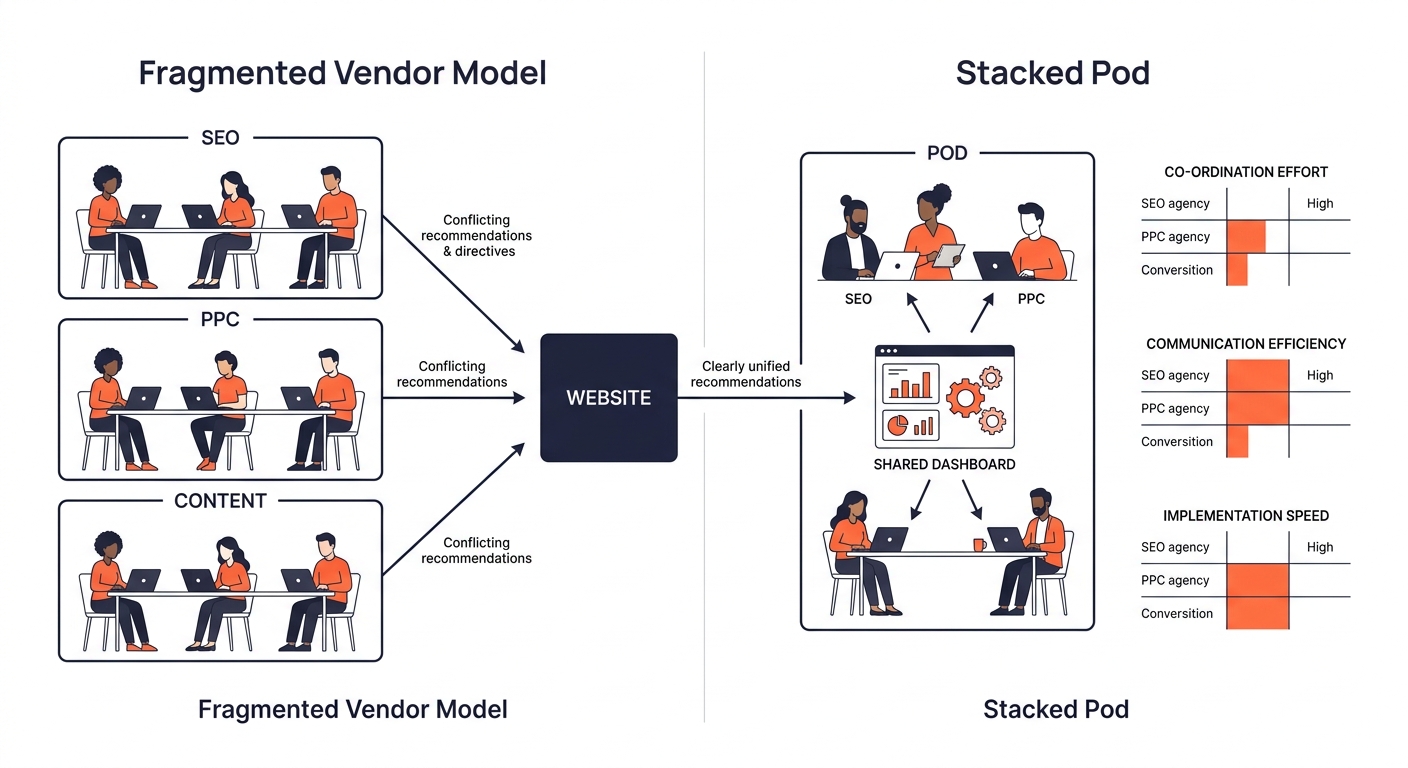
The standard US agency model works like this: you hire an SEO agency, a PPC firm, a content shop, and a web development team. Each bills separately. Each has its own project manager, its own reporting cadence, its own Slack workspace. When the SEO agency recommends restructuring your blog taxonomy, that request crosses to the web dev team, which needs a brief, a timeline, and a separate SOW. Two weeks pass before anyone touches code.
SmarkLabs’ analysis of integrated vs. tactic-specific agency models found that consolidating services under a single provider “decreases the overall cost and eliminates the inefficiency of employing a separate firm for each type of service.” The problem with multi-vendor setups isn’t any individual vendor’s quality. It’s the coordination tax between them.
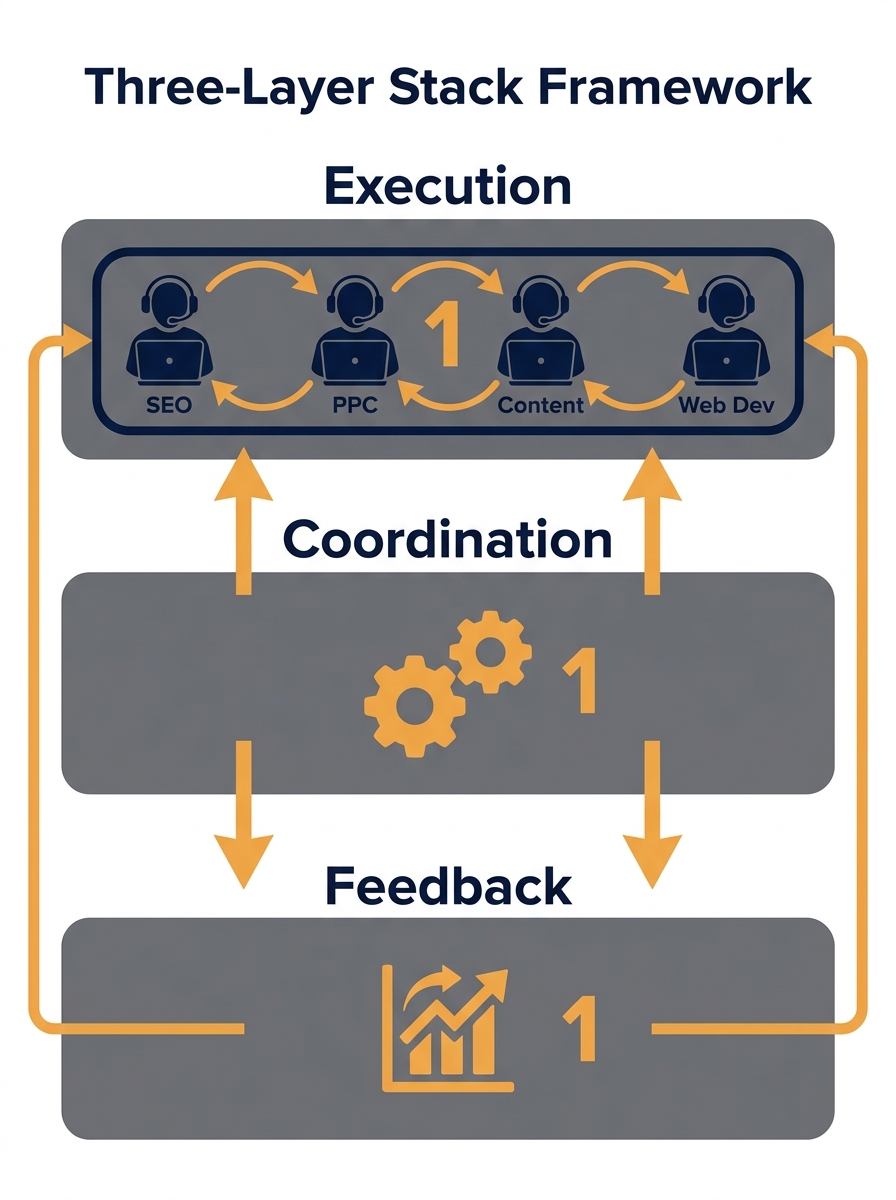
Capability stacking replaces this with what we call the Three-Layer Stack: an execution layer (specialists doing the work), a coordination layer (a single pod lead routing priorities), and a feedback layer (performance data flowing back to every specialist simultaneously). A 5-specialist Philippine pod running this structure costs $12,000–$20,000 per month. Three US specialists covering fewer channels run $36,000–$52,800 per month.
Web Development as the Binding Layer
Why does an article about marketing pods belong in a web development category? Because the website is the convergence point for every marketing channel. SEO changes require template modifications. PPC landing pages need design and deployment. Content strategy depends on CMS architecture. Email campaigns drive traffic to pages that need to load fast and convert.
When web development lives inside the same pod as the marketers requesting changes, the request-to-deployment cycle compresses from days to hours. An SEO specialist identifies that product category pages need schema markup updates. In a stacked pod, the front-end developer sitting three desks away implements the change that afternoon. In the fragmented model, that same request enters a ticketing system, waits for sprint planning, and ships two weeks later.
This is why companies investing in outsourced WordPress development alongside marketing see faster iteration cycles. The dev team doesn’t treat marketing requests as interruptions to “real” engineering work. Marketing changes ARE the work.
Philippine BPO vendors have structured around this reality. According to KDCI’s analysis of marketing outsourcing advantages, Philippine teams offer flexible work hours and always-on availability that allow web changes to deploy during US off-hours, meaning your landing pages are live and tested before your morning standup.
How the Feedback Layer Eliminates Channel Conflict
Single-service agencies create a structural problem that no amount of communication fixes: conflicting recommendations. Your SEO agency wants to add 2,000 words of content to a landing page. Your PPC agency wants to strip that page down to a headline, three bullets, and a CTA button. Neither is wrong in isolation. Both are operating with incomplete information about the other’s strategy.
In a stacked pod, the SEO specialist and the paid media buyer share the same performance dashboard. They see conversion rates by channel, bounce rates by traffic source, and revenue attribution across the full funnel. When they disagree on page structure, the pod lead mediates based on combined data rather than single-channel metrics.
When your SEO specialist and PPC buyer share the same dashboard, channel conflict resolves itself through data instead of escalation.
This feedback loop is the mechanism that makes the multi-service outsourcing advantage real. The workflow integration checklist we’ve written about previously exists precisely because this loop doesn’t happen automatically. You need shared dashboards, weekly pod syncs, and a clear escalation path. But the infrastructure cost of building those systems within one pod is a fraction of building them across four separate vendors.
The Cost Mechanics, Broken Down
The math behind BPO service stacking becomes clearest when you compare total program cost rather than individual hourly rates.
| Component | US Multi-Vendor Model | Philippine Stacked Pod |
|---|---|---|
| SEO Specialist | $8,500–$12,000/mo | Included in pod |
| PPC Manager | $9,000–$13,000/mo | Included in pod |
| Content Writer (Sr.) | $7,500–$11,000/mo | Included in pod |
| Front-End Developer | $11,000–$16,800/mo | Included in pod |
| Pod Lead / Coordinator | N/A (you do this) | Included in pod |
| Total Monthly | $36,000–$52,800 | $12,000–$20,000 |
| Coordination Overhead | 8–15 hrs/week (your time) | 2–3 hrs/week |
| Cross-Vendor Rework Rate | ~40% of deliverables | ~10–15% |
MicroSourcing’s data shows Philippine outsourcing delivers cost savings of up to 70% on employment expenses without compromising output quality. The savings compound further when you account for the coordination overhead that disappears from your calendar. Those 8–15 hours per week you spend mediating between vendors? That’s the hidden line item most ROI calculations ignore.
Our own analysis of true outsourcing ROI found that companies whose approval processes stretch to five days because of timezone gaps, and whose rework rate climbs to 40% because of unclear briefs, lose most of the cost advantage. The velocity of output per dollar spent is what matters. Stacking capabilities within one pod accelerates that velocity because the pod self-coordinates.
Why Philippine Teams Hold This Position
According to Hiver’s customer service benchmark data, 76% of service teams now offer support during non-working hours. In the Philippines, that availability pattern is the norm, and it aligns with what makes stacked pods effective for US and Australian clients: the pod works your off-hours, deploying web changes, optimizing ad bids, and publishing content while you sleep. You review results at 9 AM with fresh data already in the dashboard.
Philippine digital marketing capabilities also benefit from a workforce deeply fluent in American English and culturally tuned to US consumer behavior. When your content writer, PPC copywriter, and web developer all share native-level English comprehension, the brief doesn’t need translation between disciplines. A single creative brief feeds the entire pod.
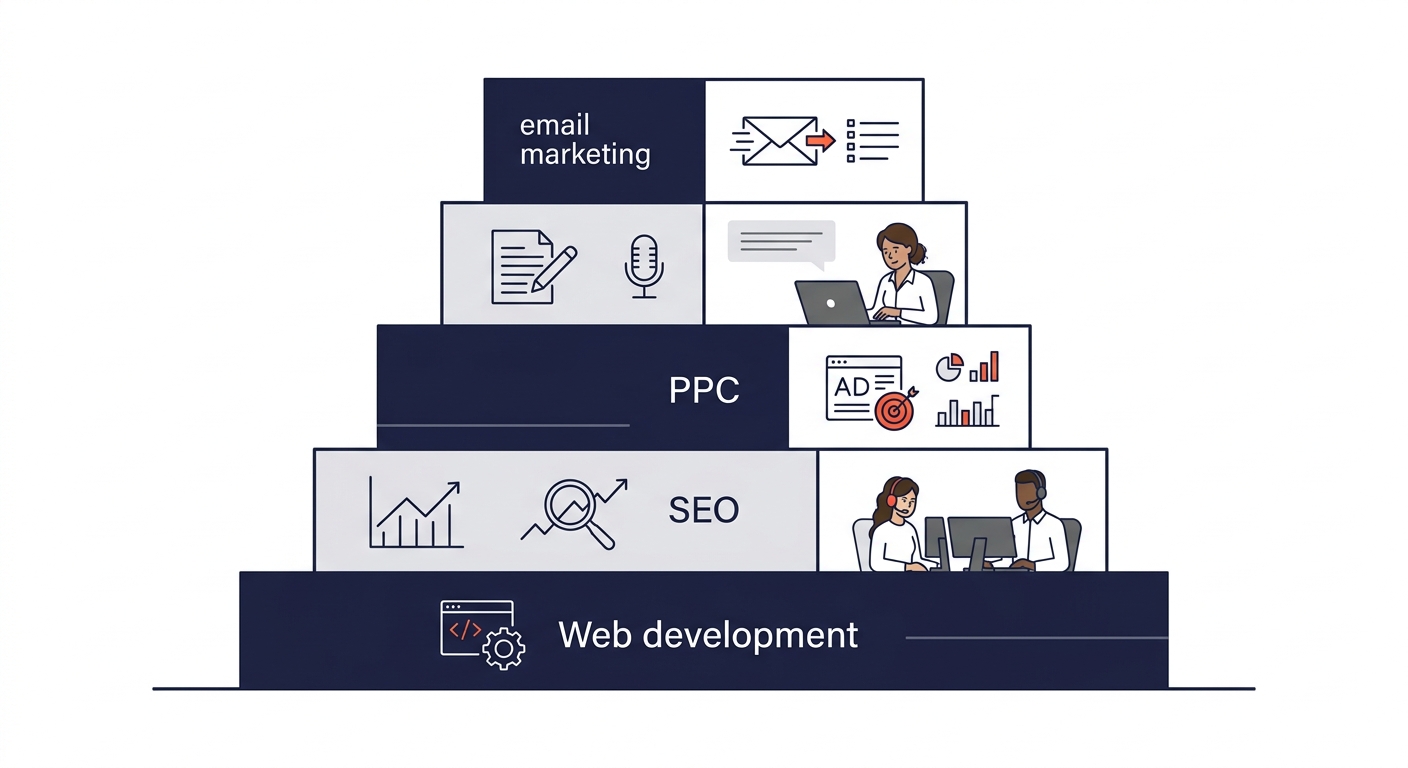
The order in which you delegate services matters, though. Teams that stack web development first and layer marketing channels on top report smoother ramp-ups than teams that outsource PPC in isolation and try to bolt on SEO later. The website foundation has to be solid before the channels driving traffic to it can produce meaningful results.
Tip: When building a stacked pod, start with web development and layer in SEO, then content, then paid media. Each channel depends on the site infrastructure beneath it. Reversing this order creates rework.
How Stacked Pods Handle Algorithm Shifts
Google’s March 2026 core update, combined with platform changes on Meta and TikTok’s ad algorithm adjustments, created three major algorithm shifts within 90 days. Single-service agencies responded predictably: the SEO firm scrambled to diagnose ranking drops, the PPC team adjusted bids independently, and the content agency kept publishing on its editorial calendar without recalibrating topic targeting.
Stacked pods handled the same period differently. When organic traffic dipped, the SEO specialist flagged it in the shared dashboard. The PPC buyer shifted budget to compensate for lost organic volume on the same keywords. The content writer adjusted the editorial calendar to target queries where organic rankings had strengthened. The front-end developer updated page speed metrics and schema markup to comply with new Core Web Vitals thresholds. All of this happened within 48 hours instead of the 2–3 week optimization loss typical of fragmented setups.
This is the integrated marketing outsourcing advantage that generalist Philippine teams bring to the equation. Breadth of capability within a single team enables speed of response that specialized vendors, working in isolation, structurally cannot match.
Where the Model Breaks
Capability stacking fails in three predictable scenarios.
High-ceiling creative work. If your brand requires Super Bowl-quality video production or Fortune 500-level brand strategy, a stacked pod won’t replace a top-tier US creative agency. The model excels at high-volume, high-velocity execution across channels. It doesn’t compete on prestige creative.
Regulatory-heavy industries. Healthcare, financial services, and legal marketing require compliance review processes that add coordination overhead regardless of team structure. Stacking capabilities doesn’t eliminate the need for a compliance layer, and Philippine teams need explicit training on HIPAA, SEC, or state bar advertising rules before they can execute safely.
Absent client-side leadership. The pod needs a strategic counterpart on the US side. If no one on your team sets quarterly goals, reviews weekly dashboards, and provides brand-level direction, the pod optimizes in a vacuum. The 2–3 hours per week of coordination time isn’t optional. Teams that treat integrated marketing outsourcing as fully autonomous consistently underperform teams that invest that small block of strategic oversight.
The model also degrades when ramp-up documentation is thin. Stacked pods need structured briefs covering brand voice, audience segments, platform credentials, and KPI targets from day one. Without that foundation, even a well-built pod spends its first 60 days guessing instead of executing. And by then, the cost advantage you signed up for has already eroded.