
Outsourcing digital marketing to the Philippines is a cost-effective way for businesses to scale operations while accessing skilled professionals. Here’s why and how you can do it:
- Cost Savings: Labor costs in the Philippines are up to 70% lower compared to countries like the U.S., with monthly salaries starting around $400.
- Skilled Workforce: The country produces 600,000–800,000 graduates annually, many specializing in IT and digital marketing fields like SEO, PPC, and social media.
- English Proficiency: Ranked 2nd in Asia for English skills, about 70% of Filipinos are fluent, ensuring smooth communication.
- Government Support: Tax incentives and infrastructure investments bolster the outsourcing sector, which generated $38 billion in 2024.
- Proven Success: The Philippines accounts for 13% of the global outsourcing market, with digital marketing being a growing focus.
Steps to Outsource:
- Define Goals: Identify tasks to outsource, such as SEO or social media, and set measurable objectives.
- Research Providers: Evaluate agencies based on expertise, pricing, and client reviews.
- Assess Talent: Test skills through interviews and trial projects.
- Set KPIs and Contracts: Establish clear performance metrics and agreements.
- Use Tools and Monitor: Leverage platforms like Asana or SEMrush to track progress and ensure accountability.
Outsourcing to the Philippines offers a practical way to reduce overhead, tap into a skilled workforce, and scale your marketing efforts efficiently.
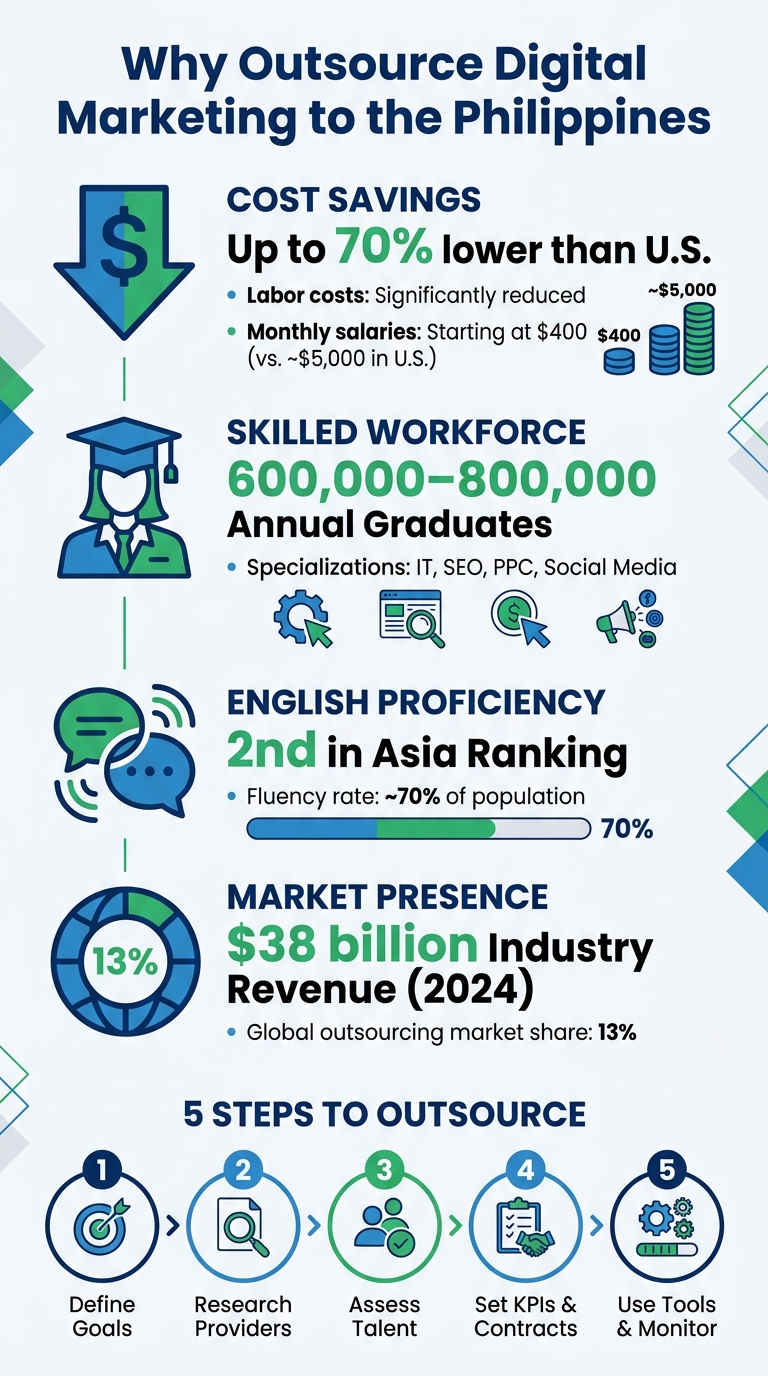
Philippines Digital Marketing Outsourcing: Key Statistics and Benefits
How to Outsource to the Philippines: The Complete Guide
sbb-itb-5665bbf
Step 1: Define Your Digital Marketing Goals and Needs
Before contacting any service provider, take time to clarify your goals and identify specific needs. Start by reviewing your current marketing strategies and pinpointing areas where you’re falling short. Do you need better SEO? Help managing your social media accounts? Or perhaps support with paid advertising? Clearly identifying these gaps will help you decide which tasks to delegate and which to handle internally.
Identify Which Tasks to Outsource
Filipino digital marketing professionals are highly skilled in a variety of areas, including SEO, SEM, PPC management, content creation, email campaigns, social media management, web design, mobile app promotion, and conversion rate optimization. Their strong command of English and familiarity with Western audiences make them particularly effective for content and communication-focused tasks.
Many businesses choose to outsource just one or two tasks initially instead of handing over their entire marketing operation. For instance, if your website traffic has stalled, outsourcing SEO to a specialized team could be your first step. Similarly, if managing social media platforms like Facebook and Instagram is eating up too much of your time, hiring a partner to outsource social media marketing might be the right move. The goal is to align your internal gaps with services that Filipino professionals excel at delivering.
Set Clear Goals and Budgets
After identifying the tasks you want to outsource, establish measurable objectives for each one. For example, you might aim for a 25% boost in organic web traffic, a 15% drop in cost-per-click (CPC), or an increase in email open rates from 18% to 24%. These specific benchmarks provide clear direction for your outsourced team and make it easier to track their progress.
When it comes to budgeting, factor in all costs, including mandatory Philippine benefits like the 13th-month pay and contributions to SSS, PhilHealth, and Pag-IBIG. Wage differences also play a role. While hiring full-time talent in the Philippines is significantly more affordable than in the U.S. (around $400/month compared to nearly $5,000/month), rates can vary widely depending on specialization and location. Professionals in cities like Manila or Cebu typically charge higher rates due to better infrastructure and higher living costs, whereas smaller cities may offer more budget-friendly options. To avoid surprises, compare pricing from multiple providers, account for potential hidden costs, and consider starting with a small pilot project to evaluate performance and cost-effectiveness before committing to a long-term agreement.
Once your goals and budget are in place, you’ll be ready to assess digital marketing providers in the Philippines.
Step 2: Research and Evaluate Philippines-Based Providers
To move forward, start by identifying Philippines-based providers that match your digital marketing needs. Focus on companies that specialize in the services you’re looking for – whether that’s SEO, PPC, social media, and content creation. Check their websites for case studies, client testimonials, and information about their team’s expertise. These details will help you assess their capabilities and set the foundation for evaluating them effectively.
How to Evaluate Providers
When comparing providers, look for qualities that directly influence your campaign’s success and ensure a smooth working relationship. Instead of focusing on the size of their workforce, prioritize the quality of their talent. Providers offering senior-level professionals can have a bigger impact on your results.
Speed also matters – top-tier providers typically share candidate resumes within 48 hours, helping you avoid hiring delays. A reliable provider will also maintain a 95% show rate, which is considered a standard for consistent output and minimal interruptions. Ask about their staff development programs, too. Providers that offer regular coaching ensure their teams stay ahead of the curve in the fast-changing digital marketing landscape.
Don’t overlook pricing structure, either. All-in pricing models that include employee benefits, HMO, and HR support simplify your budgeting process. These models eliminate the need to handle additional costs like insurance, taxes, or holiday pay. The table below breaks down key evaluation factors:
| Evaluation Factor | What to Look For | Why It Matters |
|---|---|---|
| Talent Acquisition | Resumes within 48 hours | Speeds up hiring and scaling processes |
| Staff Development | ~108 hours of annual coaching | Keeps skills up-to-date with industry changes |
| Accountability | Built-in KPIs and scorecards | Tracks ROI and ensures productivity |
| Cost Structure | All-in pricing (includes HMO/HR) | Reduces hidden costs and simplifies financial planning |
| Reliability | 95%+ show rate | Ensures steady output and stable campaigns |
Why Choose 365Outsource
365Outsource, a Philippines-based provider, has been delivering digital marketing services since 2009. Their expertise extends across SEO, PPC, social media marketing, web development, and virtual assistance. Managed on-site in Manila by American leaders, they blend Western business practices with local talent, ensuring seamless communication and alignment with U.S.-based clients.
One of their standout features is their "White Label" service, which allows their team to act as an invisible extension of your in-house operations or agency. Their all-in pricing model includes employee benefits, HMO, and HR support, removing administrative headaches. With a team of 51–200 employees and over 16 years of experience, they maintain a 95% show rate and provide 108 hours of annual coaching to keep their staff sharp.
"Partnering with 365Outsource was a game-changer for our agency. Their SEO and PPC specialists integrated seamlessly with our in-house team. We’ve been able to take on twice as many clients without sacrificing quality."
– Sarah J., Director of Operations, Digital Growth Agency
In addition to their robust support, 365Outsource delivers candidate resumes within 48 hours and uses built-in KPIs and scorecards to ensure full transparency in team performance. Their specialists are proficient in platforms like WordPress, Elementor, PHP, and various PPC tools, making them a strong choice for both technical and strategic digital marketing needs.
Step 3: Assess the Philippine Talent Pool for Digital Marketing
Once you’ve shortlisted potential service providers, it’s time to dig deeper into the professionals who will execute your campaigns. The Philippines boasts a wealth of digital marketing talent, and knowing how to evaluate and test candidates is key to finding the right match for your SEO, PPC, and social media needs.
What to Look for in Filipino Digital Marketing Professionals
When evaluating candidates, focus on their expertise in key areas like SEO, SEM, and PPC management. Additionally, look for skills in social media marketing, content creation, email marketing, and Conversion Rate Optimization (CRO) – all of which are essential for turning website traffic into measurable results. Some Filipino marketers also bring web design expertise, which can provide a more integrated approach to your campaigns.
Professional experience is another critical factor. Many Filipino freelancers have transitioned into agency roles, blending independent problem-solving skills with the structured productivity standards of a team environment. Those with experience working anonymously for international agencies bring valuable insights, as they’re accustomed to following strict brand guidelines and maintaining high-quality output.
Cultural traits are equally important. Filipino professionals are known for their collaborative nature, making them excellent team players. Their strong communication skills and resilience in fast-paced environments align well with the demands of today’s digital marketing landscape. Plus, with high English proficiency, they can communicate seamlessly with Western clients.
Once you’ve identified promising candidates, the next step is to validate their skills through interviews and practical tests.
How to Conduct Remote Interviews and Tests
After narrowing down your list, use remote interviews to further assess each candidate’s qualifications. Platforms like Zoom or Slack are great for video interviews, allowing you to evaluate their verbal fluency and professionalism in a virtual setting. During these interviews, test their English skills and confirm their technical expertise in areas like SEO outsourcing, PPC, content marketing, or social media management.
Filipino professionals often communicate indirectly to maintain harmony, so encourage open and honest dialogue during interviews. To gauge their abilities, start with a small, paid trial project. This approach lets you evaluate their performance and workflow before committing to a long-term arrangement. Use tools like Trello or Slack to monitor their progress and ensure accountability. Setting clear KPIs and using scorecards can provide insight into their potential output and work style.
Lastly, ask about their commitment to ongoing learning. Top candidates often prioritize skill development, with some dedicating up to 108 hours annually to professional coaching. Keep in mind that the Philippines is 12 to 15 hours ahead of most U.S. time zones, which may require adjustments for scheduling and real-time collaboration.
Step 4: Set Up KPIs, Contracts, and Onboarding
With your goals and evaluation methods in place, it’s time to formalize your collaboration through KPIs, contracts, and a well-structured onboarding process. After selecting your Filipino experts, you’ll need to establish measurable targets, define clear agreements, and provide immediate training to align them with your brand and workflows.
Define Key Performance Indicators (KPIs)
Your outsourced team needs specific, measurable goals to ensure success. Break down KPIs based on the customer journey:
- Awareness: Track impressions, traffic, and search rankings.
- Consideration: Monitor CTR, CPC, and social engagement.
- Decision: Focus on metrics like conversion rate, revenue, CAC (customer acquisition cost), and ROI.
Each marketing channel will require its own set of metrics. For example:
- SEO: Prioritize keyword rankings and backlink growth.
- PPC: Pay close attention to CTR (average 6.6% for search ads, 0.6% for display ads) and CPC to manage costs effectively.
- Social Media: Measure engagement rates and follow the 70:20:10 content rule – 70% value-driven content, 20% shared industry insights, and 10% promotional posts.
As Harvard Business School Professor Sunil Gupta explains:
"It isn’t enough to measure the final outcome alone. You also need to track intermediate metrics to understand where consumers might be getting stuck – essentially bottlenecks in the marketing funnel".
Surprisingly, only 23% of marketers feel confident they’re tracking the right KPIs. By setting clear benchmarks, you’ll gain a competitive edge and ensure your team stays on track.
Draft Clear Contracts
A well-written contract is critical to avoid misunderstandings. It should clearly outline the responsibilities of your Philippine provider, including handling local administrative tasks like employee insurance, workers’ compensation, sick pay, holiday pay, and taxes. Opt for all-inclusive pricing models that cover benefits, HMO, and HR support to avoid unexpected costs.
Incorporate the performance standards you evaluated earlier – such as timelines for candidate delivery and show rates – to ensure accountability. Contracts should also include:
- KPIs and scorecards: For ongoing performance tracking and transparency.
- Upskilling commitments: Many top providers offer up to 108 hours of annual coaching.
- Content expectations: For social media, you can reference the 70:20:10 rule to maintain content variety and avoid redundancy.
- Confidentiality agreements: To protect your business information.
- Timelines and payment terms: Ensure these align with your cash flow and project deadlines.
Onboard and Train Your Outsourced Team
Once contracts are in place, focus on onboarding to integrate your outsourced team with your existing operations. This process is essential for transferring your company’s culture and workflows to your new team, ensuring they operate as an extension of your in-house staff.
Start by sharing your brand guidelines and communication protocols. Tools like Trello or Slack can streamline project management and foster collaboration. Establish clear feedback channels and implement scorecards and KPIs from day one to monitor productivity.
As Sarah J., Director of Operations at Digital Growth Agency, shares:
"Their SEO and PPC specialists integrated seamlessly with our in-house team. We’ve been able to take on twice as many clients without sacrificing quality".
This level of integration requires close collaboration with your dedicated specialists to ensure they fully understand your goals and expectations. Confirm that pricing includes benefits and HR support to maintain team stability and long-term success.
Step 5: Use Tools, Monitor Performance, and Improve Results
Once your team is onboarded, the next step is to give them the right tools and set up systems to track performance. This ensures smooth collaboration, clear visibility, and a data-driven approach to refining your strategies.
Tools for Managing Outsourced Teams
Integrate your outsourced team with the same tools your in-house staff uses for consistency. Project management platforms like Asana, Monday.com, ClickUp, and Notion make it easy to assign tasks, set deadlines, and track progress in real time. For a seamless workflow, include your Filipino team in these systems and use a shared agency email alias to maintain a white-label presence.
Filipino marketing professionals are already skilled in platforms like SEMrush, Ahrefs, Google Analytics, Meta Ads Manager, and Canva. For social media virtual assistant tasks, tools like Buffer, Hootsuite, and Later simplify scheduling and reporting. Email marketing platforms such as ActiveCampaign, Klaviyo, Mailchimp, and HubSpot are also widely used for campaign management.
Before your team starts, document standard operating procedures (SOPs) for your top five recurring tasks. Spending just 3–4 hours on this step can significantly reduce errors and speed up onboarding. With proper documentation, full integration can be achieved within 4–6 weeks. As Shira, a business owner, shared:
"Everything from payroll to performance reviews is managed smoothly… so I can focus on my business without getting bogged down by virtual administrative assistant tasks." – Shira, Owner
Once your tools and processes are in place, shift your focus to performance tracking.
Monitor and Review Performance
Keeping a close eye on performance is critical when managing remote teams. Use KPIs and scorecards to measure progress across all marketing channels. Schedule regular performance reviews to provide feedback and address any challenges. Providers in the Philippines often maintain a 95% show rate with zero downtime, ensuring consistent campaign execution.
Train your virtual assistants (VAs) to use specific client reporting templates for uniformity across accounts. As 365Outsource highlights:
"We respect and listen to constructive criticism, and we welcome any opportunity to grow and develop." – 365Outsource
Improve Your Methods Over Time
The digital marketing landscape is always changing, so keeping your team up to date is essential. Invest in ongoing training to ensure they stay ahead of industry trends.
Establish a feedback loop that promotes open communication and collaboration. Treat your outsourced team as an integral part of your operations, not as a separate entity. By doing so, agencies that work with Filipino VAs often see gross margins improve by 15–25 percentage points within the first year.
Regularly analyze performance data and adjust your strategies to align with market changes. This approach not only enhances productivity but also supports scalable growth. By prioritizing transparency and continuous improvement, you’ll get the most out of your outsourced digital marketing efforts.
Conclusion
Outsourcing digital marketing to the Philippines offers a practical way to cut costs, tap into skilled professionals, and scale your business operations with ease. By following the five steps in this guide – defining your goals, researching providers, assessing talent, setting up contracts and KPIs, and leveraging the right tools – you can build a remote team that works seamlessly with your existing operations. The result? Significant savings in both time and money.
One major advantage is the reduction of overhead expenses, including insurance, workers’ compensation, and taxes. Plus, outsourcing slashes recruitment time, which can take up to 50 hours per hire. This frees up valuable resources that can be redirected toward business growth.
The Philippines boasts a deep talent pool with expertise in areas like SEO, PPC management, content writing, and social media marketing. With high English proficiency – ranked 2nd in Asia – and strong alignment with Western business practices, Filipino professionals integrate easily into U.S.-based teams. Leading providers also ensure their teams stay updated on the latest digital marketing trends through ongoing training.
Consistently positive client feedback highlights the seamless integration, scalability, and expertise that outsourcing to the Philippines can bring to your business.
FAQs
Should I start with a freelancer or a managed team in the Philippines?
Choosing between a freelancer and a managed team in the Philippines comes down to what your business requires. If you’re looking for flexibility, specialized skills, or want to experiment with strategies, freelancers or virtual assistants (VAs) are a budget-friendly and straightforward option to get started. On the other hand, if your focus is on maintaining consistent quality, handling larger campaigns, or ensuring coordinated efforts, a managed team provides the structure and long-term support you need. A smart approach? Begin with freelancers to test the waters, then transition to a managed team as your operations expand.
How do I protect logins, data, and IP when outsourcing marketing?
To protect your logins, sensitive data, and intellectual property while outsourcing marketing tasks to the Philippines, it’s crucial to put robust security measures in place. Start with tools like encryption and access controls to safeguard information. Look for providers with certifications such as ISO 27001 or SOC 2, which indicate their commitment to security standards.
Legal agreements are equally important. Use contracts that include Non-Disclosure Agreements (NDAs), Data Processing Agreements (DPAs), and Service Level Agreements (SLAs) to define expectations and responsibilities. Regular audits can help ensure these measures are being followed.
Additionally, make sure compliance requirements are met for frameworks like GDPR, HIPAA, PCI DSS, and the Philippine Data Privacy Act. While outsourcing partners play a role in maintaining security, the ultimate responsibility for protecting your business lies with you.
What overlap hours should I require with U.S. time zones?
To work efficiently across U.S. and Philippine time zones for outsourcing digital marketing tasks, aim for a 2 to 4-hour overlap. This window allows for real-time communication, smooth collaboration, and quick responses – crucial for managing areas like SEO, PPC, and social media campaigns.