
Account managers play a key role in outsourcing by connecting a company’s needs with offshore teams. They identify inefficiencies, establish clear processes, and create custom outsourcing packages to help businesses focus on core activities. This approach often reduces costs by up to 70–75% while improving efficiency in areas like digital marketing, IT outsourcing services, and customer support.
Here’s how it works:
- Discovery: Understand client challenges, set goals, and define measurable KPIs.
- Process Analysis: Evaluate workflows and identify tasks suitable for outsourcing, like HR, IT, or data analysis.
- Tailored Solutions: Match skilled professionals to specific needs, ensuring alignment with the company’s values and goals.
- Implementation: Set up performance metrics, communication systems, and training for seamless integration.
- Performance Management: Continuously monitor and adjust to meet evolving business needs.
With a clear structure, businesses gain access to global talent, save time, and improve work quality without the overhead of traditional hiring. Solutions are flexible, scalable, and designed to deliver measurable results.
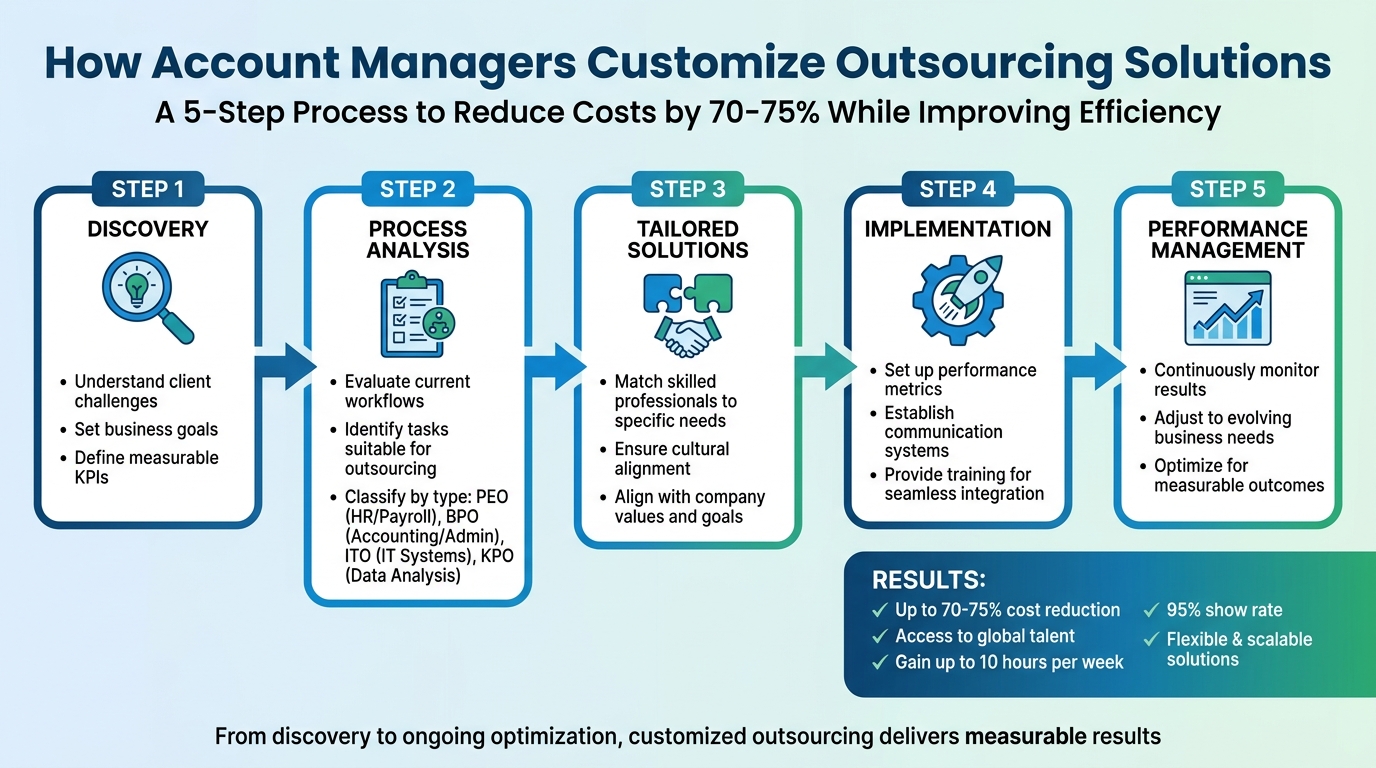
5-Step Account Manager Outsourcing Customization Process
How To Outsource Your Client Projects
sbb-itb-5665bbf
Understanding Client Needs and Business Goals
Every successful outsourcing partnership kicks off with a deep dive into the client’s internal challenges. During this discovery phase, account managers focus on aligning offshore talent with the client’s specific needs for growth and long-term goals. This process helps uncover the root causes of inefficiencies – whether it’s escalating labor costs, clogged administrative workflows, or technical tasks that sap resources.
Conducting Initial Consultations
The first step is to identify what’s slowing the business down. Initial consultations zero in on tasks that consume too much time, inflate costs, or shift focus away from strategic priorities. These discussions also establish clear performance benchmarks right from the start. Together, managers and clients define measurable KPIs, such as response times, customer satisfaction rates, or issue resolution metrics, to track progress once outsourcing begins.
For companies with a diverse customer base, account segmentation becomes critical. Managers work with clients to determine which accounts demand internal attention – typically high-value, strategic clients – and which can be efficiently handled by outsourced teams, often smaller or high-volume accounts. This approach ensures that key relationships are protected while freeing up internal teams for higher-priority tasks.
Analyzing Current Processes
Once pain points are identified, the next step is to dig into existing workflows. Account managers classify processes to determine the best outsourcing solutions:
- PEO (Personal Employment Outsourcing): Ideal for HR and payroll tasks.
- BPO (Business Process Outsourcing): Best suited for accounting and administrative functions.
- ITO (Information Technology Outsourcing): Focused on system management and IT needs.
- KPO (Knowledge Process Outsourcing): Targets data analysis and strategic decision-making.
This structured analysis highlights where outside expertise can deliver quicker and more precise outcomes.
Another key focus is addressing skill gaps. Does the company need specialists for complex areas like tax reporting, software development, or data conversion? Are non-core functions, such as facility management, driving up unnecessary costs? By answering these questions, account managers create tailored solutions that transform fixed costs into flexible operational expenses – all while maintaining high professional standards. This groundwork paves the way for designing outsourcing strategies that fit the client’s unique needs in the next phase.
Designing Tailored Outsourcing Solutions
Once client challenges are identified, account managers focus on creating solutions that align perfectly with the business’s unique needs. The aim is to deliver a package that not only solves current problems but also evolves alongside the company’s growth.
Selecting Services and Talent
The process starts with recommending service categories that address gaps uncovered during the discovery phase. For example, a growing digital marketing agency might require SEO or PPC specialists, whereas an overwhelmed e-commerce startup could benefit from a virtual assistant. Similarly, web development teams may need WordPress or PHP developers to handle specific projects.
But it’s not just about matching job titles. Managers prioritize seasoned professionals with relevant experience, ensuring that complex challenges are met with proven expertise. They also determine whether part-time or full-time support is the best fit for the client’s operational goals.
Equally important is cultural alignment. Account managers work to embed the client’s values and communication style into the offshore team, creating a seamless extension of the in-house staff.
As Sarah J., Director of Operations at Digital Growth Agency, shared, "Their SEO and PPC specialists integrated seamlessly with our in-house team. We’ve been able to take on twice as many clients without sacrificing quality."
Customizing Service Packages
After matching the right services and talent, account managers fine-tune service packages to meet the client’s evolving needs. Flexibility is a priority here. For example, a company might begin with a single virtual assistant and later scale up to a full customer service team as revenue grows.
Budget considerations are addressed through transparent, all-inclusive pricing models. These packages cover salaries, benefits, HMO coverage, and HR support, ensuring there are no hidden costs. Additionally, they include 108 hours of annual coaching and upskilling for outsourced staff and maintain a 95% show rate to minimize downtime .
Implementing and Managing Solutions
Getting started with deployment means setting clear operational standards that seamlessly integrate outsourced teams into a client’s existing workflows. Account managers play a key role by ensuring that professionals arrive fully trained in their areas of expertise – whether it’s IT, administration, or customer service. This preparation helps cut down on recruitment and training time, enabling outsourced staff to hit the ground running and deliver results from day one. These initial steps lay the groundwork for accurate performance tracking and streamlined communication.
Establishing KPIs and Communication Protocols
To keep everything on track, account managers set measurable performance metrics tailored to the specific service being provided. For instance:
- Call centers: Speed of response
- Data processing: Accuracy rates
- Security services: Adherence to protocols
- Cleaning services: Consistency in hygiene standards
Automated tools provide real-time performance data, while scheduled check-ins, feedback channels, and clear escalation paths ensure communication remains smooth and effective.
Monitoring and Optimizing Performance
Maintaining high service quality requires regular inspections, audits, and preventive measures. For example, scheduled facility checks paired with quick-response protocols can address issues before they escalate.
As business needs shift, account managers adjust staffing levels and service intensity accordingly. By incorporating feedback from both clients and team members, processes are continuously fine-tuned to meet evolving demands.
Benefits of Customized Outsourcing with 365Outsource.com
Teaming up with 365Outsource.com transforms fixed costs into flexible expenses by giving businesses instant access to skilled professionals in specialized areas, such as IT, bookkeeping, digital marketing, and virtual assistance. This setup eliminates the overhead of traditional hiring processes while delivering expertise exactly when and where it’s required.
By leveraging this model, companies can significantly reduce operational costs compared to maintaining equivalent in-house teams. It’s not just about cutting salaries – it also removes expenses like office space, employee benefits, and training. As Zayed Almarzooqi from Dubai, UAE, shared:
"Hired a virtual assistant to manage my hectic schedule and emails. It’s like gaining an additional 10 hours per week for strategic activities."
These savings and efficiency improvements create a foundation for scalable growth.
The process is straightforward, involving three key steps: Discovery & Consultation, Finding the Right Match, and Onboarding & Support. This streamlined approach enables rapid team expansion and ensures 24/7 global coverage. For businesses operating across multiple time zones, this means enhanced customer support and faster response times, which can strengthen brand reputation by addressing inquiries promptly, no matter when they come in.
Dedicated account managers oversee performance, ensure legal compliance, and maintain quality standards. Aarav Sharma from Mumbai, India, highlighted the impact of this approach:
"Outsourced our entire bookkeeping process to a team found here. They are meticulous, reliable, and have brought incredible efficiency to our finances."
With a clear pricing structure and dedicated oversight, businesses retain control and visibility while seamlessly integrating outsourced teams into their workflows. These benefits are the result of customized strategies developed during the initial consultation and planning phases.
Key Metrics Before and After Customization
The table below highlights the measurable improvements businesses experience with 365Outsource.com’s tailored outsourcing solutions:
| Metric | Before Customization | After Customization with 365Outsource.com |
|---|---|---|
| Operational Costs | High internal overhead and local salary requirements | Up to 70–75% reduction in expenses |
| Hiring Efficiency | Slow, traditional recruitment and onboarding cycles | Faster scaling with immediate access to global talent |
| Time Management | Management bogged down by administrative tasks | Gain of up to 10 hours per week for core business growth |
| Compliance & Risk | Internal responsibility for legal employment | Guaranteed legal employment and managed staff performance |
| Work Quality | Variable depending on local talent availability | High-quality work delivered by experienced, vetted professionals |
These metrics clearly show how customized outsourcing addresses common business challenges, delivering measurable improvements in cost efficiency, operational capacity, and overall work quality.
Conclusion
Managing outsourcing relationships through customized solutions creates partnerships by aligning strategies with your specific business goals. From the first consultation to ongoing performance tracking, the team at 365Outsource.com works to integrate your business culture and processes into the offshore setup. This ensures that your remote team functions as a natural extension of your in-house operations, driving growth and efficiency.
Performance metrics like rapid candidate placement, a 95% attendance rate, and continuous skill development highlight the dedication to delivering quality results, allowing you to prioritize strategic initiatives.
With tools like integrated KPIs, scorecards, and transparent pricing, you gain complete oversight and control – without the burden of managing employee benefits, taxes, or holiday pay. This fosters a collaborative and transparent partnership where your outsourced team consistently delivers on deadlines, stays within budget, and evolves alongside your business.
FAQs
How do I know what tasks to outsource first?
To figure out which tasks to outsource first, look at jobs that take up a lot of time, involve repetitive work, or need expertise your team doesn’t have. Think about tasks like data entry, customer support, or digital marketing. Focus on activities that are simple to standardize and easy to track, so you can maintain control and ensure quality. Start with tasks that can quickly deliver benefits, like cutting costs or boosting efficiency, and make sure you have a plan in place for managing them over time.
What KPIs should I track for outsourced teams?
Tracking the right KPIs is crucial to ensure your outsourced team’s performance matches your business objectives. Some of the most important metrics to monitor include:
- Productivity: Look at indicators like backlog and completion rates to gauge how efficiently tasks are being handled.
- Quality: Keep an eye on error rates and customer satisfaction to ensure work meets your standards.
- Engagement: Metrics like employee satisfaction and team collaboration can reveal how invested and connected the team feels.
It’s important to balance quantitative measures like delivery timelines with qualitative insights such as communication effectiveness and client feedback. This approach helps you track progress, spot potential problems early, and encourage ongoing improvement.
How fast can an outsourced team be onboarded?
Bringing an outsourced team on board typically takes anywhere from a few days to a few weeks. How long it takes depends on things like the complexity of your systems and the specific steps required during onboarding. Setting clear expectations and being well-prepared can make the process quicker and ensure a smoother handoff.