
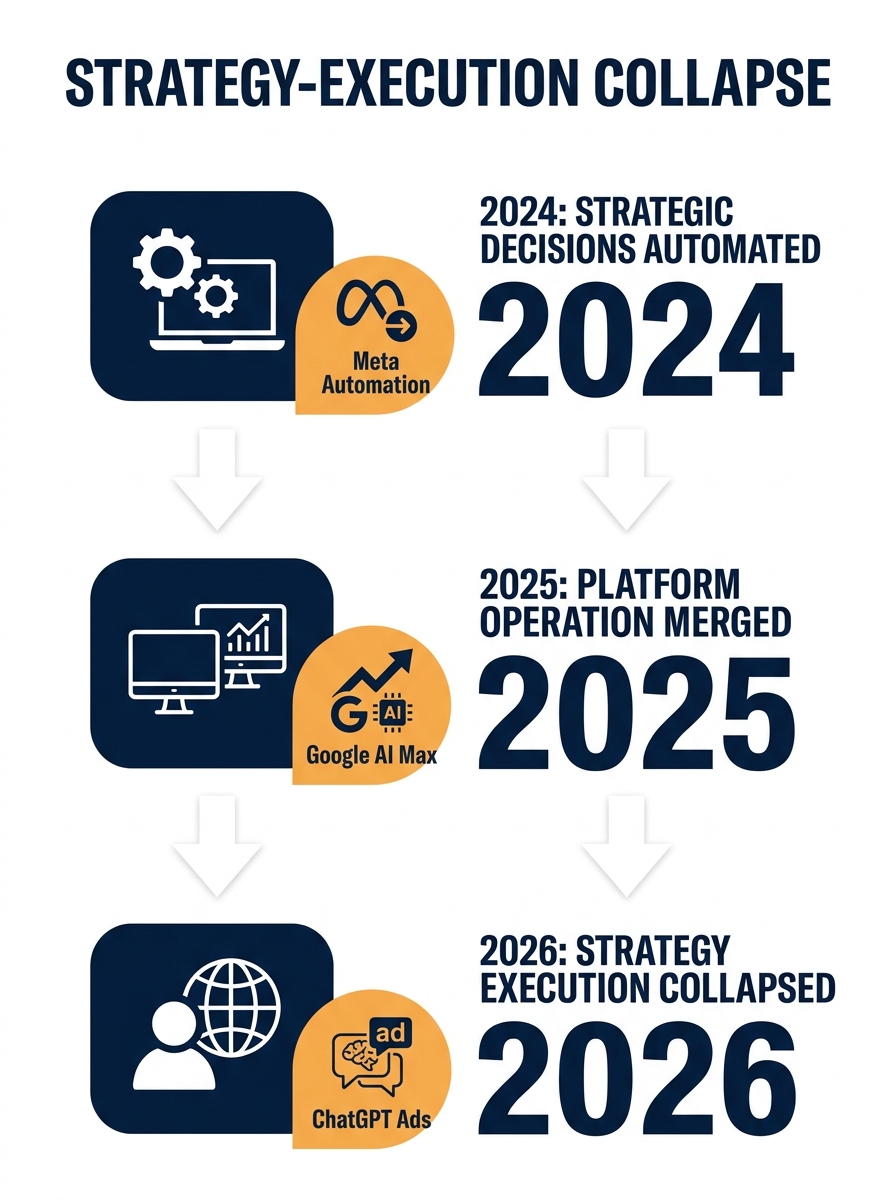
The strategy-execution divide that US agencies built their offshore marketing models around has already collapsed. As Meta, Google, and now ChatGPT push toward full campaign automation, the Philippine specialists operating these platforms daily are absorbing strategic decisions by default, because the platforms no longer separate the two.
TL;DR: Meta aims to fully automate advertising by late 2026. Google is migrating Dynamic Search Ads to AI Max in September with a 7% conversion lift. These changes mean the offshore teams running campaigns in real time are making the strategic calls that used to sit with domestic planners. The old model of strategy in-house and execution offshore no longer maps to how ad platforms actually work.
The Platforms Merged Strategy Into Execution Without Asking Permission
Meta’s publicly stated goal is to fully automate advertising by the end of 2026. Advertisers provide inputs. AI handles targeting, creative assembly, and placement. Google confirmed during May’s Google Marketing Live that it’s migrating Dynamic Search Ads to AI Max, effective September 2026, with a reported 7% average lift in conversions. And ChatGPT ads launched in the U.S. in May 2026, opening an entirely new distribution channel that didn’t exist 90 days ago.
These aren’t incremental feature updates. They represent a structural change in where decisions get made. When a platform’s AI handles audience segmentation, bid optimization, and creative testing simultaneously, the person configuring the campaign is the person setting strategy. The traditional handoff, where a domestic strategist writes a brief and an offshore executor implements it, breaks down because there is no meaningful implementation step left to separate from the strategic choices baked into platform configuration.
Philippine digital marketing teams have already adapted to this shift. As ContentGrip’s analysis of AI marketing transformations noted, “the marketing roles growing fastest in 2026 combine human creativity with AI-driven analysis and automation.” That combination describes exactly what a senior Philippine PPC specialist does: configure the AI, interpret its outputs, and adjust the inputs based on performance data.
The numbers tell the story of where ad dollars are flowing. Meta is projected to surpass Google in ad revenue this year, $243.46 billion versus $239.54 billion, according to B2the7’s marketing trend analysis from this week. Google’s AI Mode has surpassed 1 billion monthly users and AI Overviews now reach 2.5 billion. Every one of those surfaces represents a new context where campaign configuration IS the strategy, and the people closest to the platforms hold the advantage.
Philippine PPC Teams Already Operate at the Speed AI Demands
Why does proximity to the platform matter so much? Because AI-driven ad systems reward iteration speed above almost everything else, and Philippine PPC teams hold a measurable speed advantage.
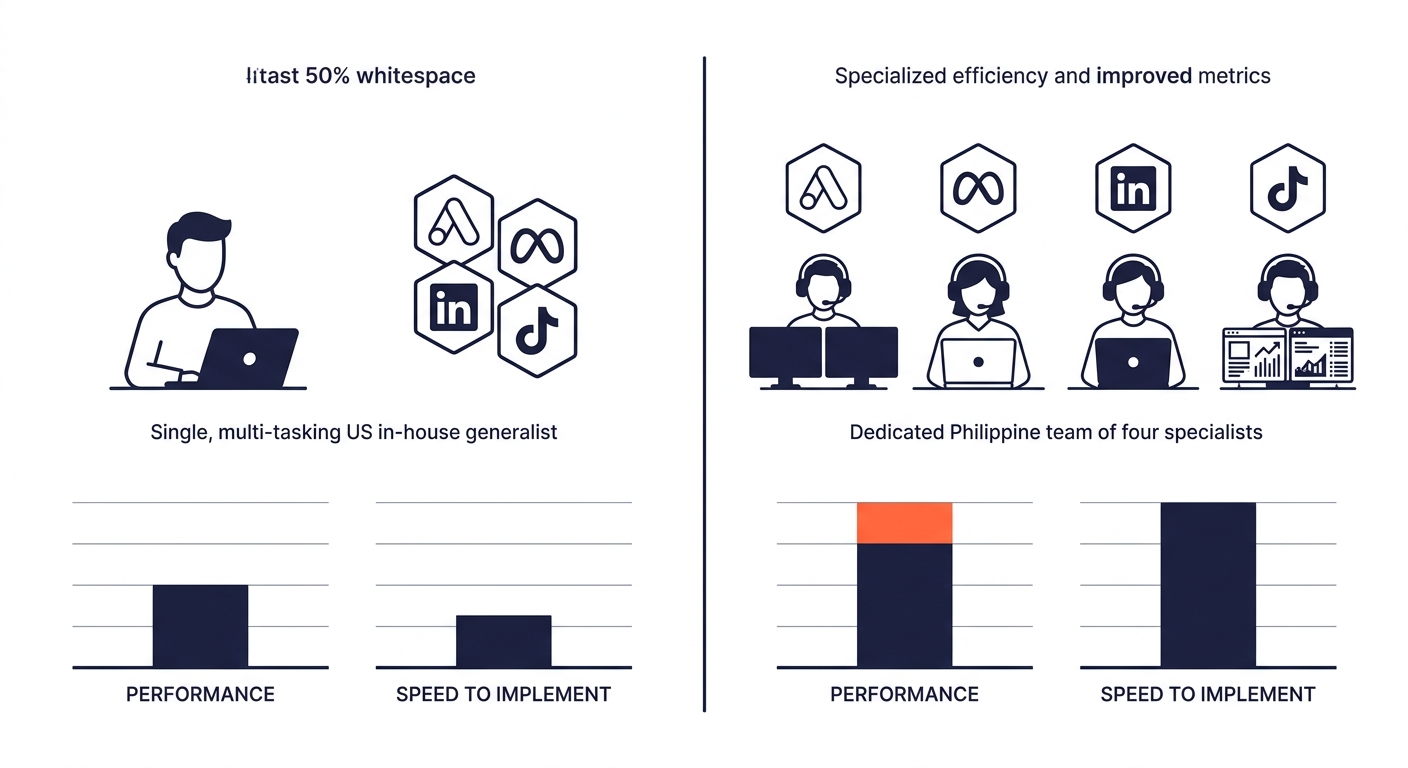
The compounding effect of faster testing cycles means a Philippine team reaches an account’s optimal settings in four to six weeks, while an in-house generalist typically takes three to four months to hit the same performance level. That gap comes from how dedicated offshore teams integrate conversion rate optimization into their standard workflows. Landing page changes aren’t tickets waiting in a queue. They’re part of the weekly testing cycle, running in parallel with bid adjustments and audience refinements.
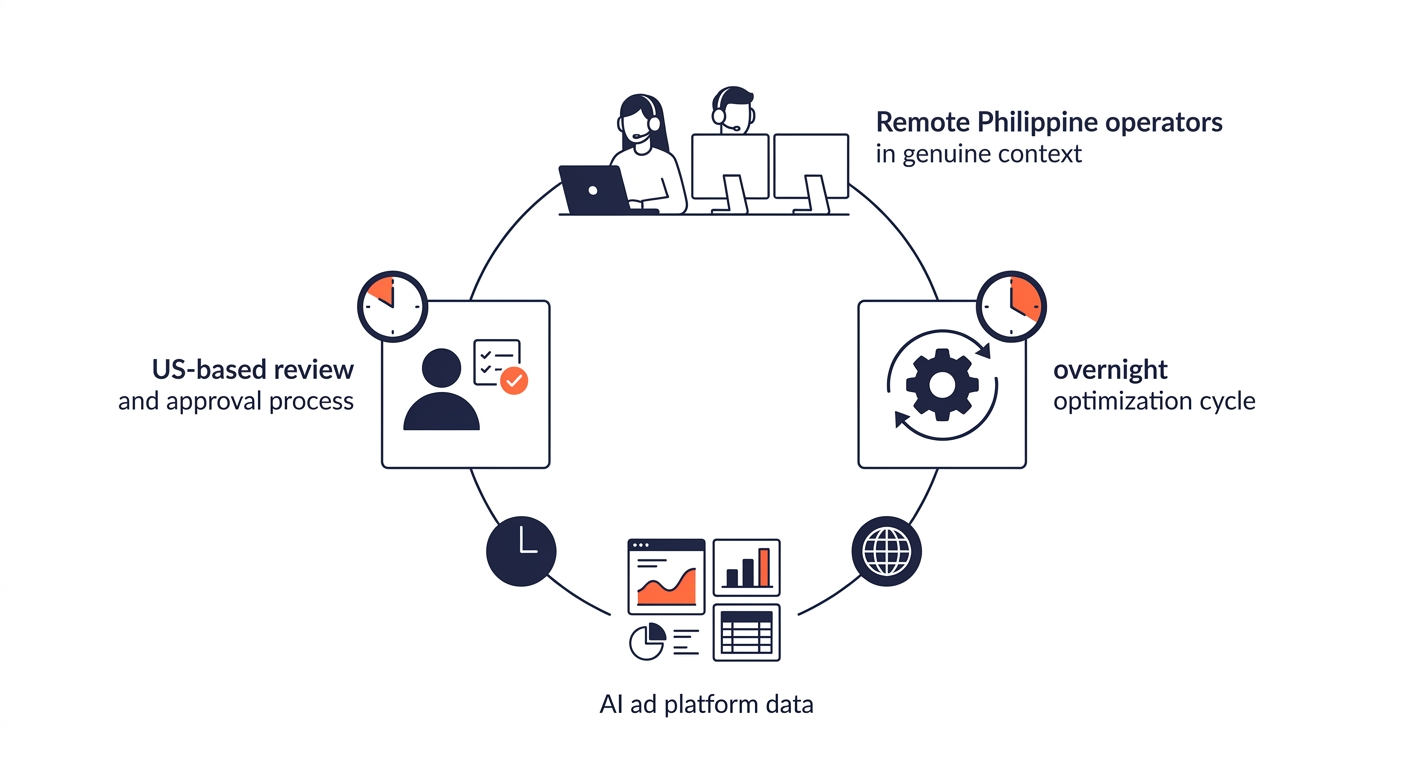
This speed advantage compounds in an AI-driven environment. Google’s AI Max doesn’t just automate bidding. It continuously tests creative combinations, audience signals, and landing page pairings. The team that reviews and redirects those AI decisions fastest captures the most value from the system. A Philippine team operating in a 12-hour offset from US business hours can review overnight performance, adjust inputs before the next business day starts, and effectively give the AI two full optimization cycles per 24 hours instead of one.
When a platform’s AI handles audience segmentation, bid optimization, and creative testing simultaneously, the person configuring the campaign is the person setting strategy.
The Philippines is also one of Southeast Asia’s most digitally active markets, with 14.3 million online consumers as of 2024 and expanding investment in influencer marketing and interactive AR/VR formats through May 2026. That domestic digital sophistication translates directly into platform fluency. Philippine specialists aren’t learning Meta’s or Google’s AI tools in a vacuum. They’re using them as consumers and advertisers in one of the world’s highest social-media-engagement markets.
And the economics reinforce the operational advantage. If you’re already working with offshore teams for PPC optimization, the cost structure lets you staff dedicated specialists per platform rather than forcing a single generalist to split time across Google, Meta, TikTok, and now ChatGPT ads. That specialization is exactly what AI-driven platforms reward.
GTM Automation Tools Reward Operators, Not Planners
The shift extends beyond paid media into the broader go-to-market stack. AI-powered GTM automation tools have matured rapidly in 2026, and they share a common trait: they generate the most value for the people who operate them daily, not the people who write the quarterly plan.
Modern GTM teams need AI tools across the full revenue cycle. Here’s how the current stack breaks down, based on Arphie’s 2026 GTM automation analysis:
| GTM Stage | Function | Leading Tools |
|---|---|---|
| Top of Funnel | Prospecting, enrichment, outbound | Apollo, Clay |
| Pipeline Management | Forecasting, deal intelligence | Clari, Gong |
| Intent and Signals | Buyer signals, account prioritization | Spotlight.ai, 6sense, ZoomInfo |
| Enablement | Content, training, coaching | Seismic, Highspot |
Every tool in that table rewards daily operational skill. Clay’s data enrichment produces better output when an operator understands which fields to combine and which signals to weight. Gong’s deal intelligence improves when someone reviews call summaries and adjusts coaching criteria weekly, not quarterly. The people who configure, monitor, and adjust these tools are the people who shape the GTM strategy, whether their title says “strategist” or not.
Philippine GTM automation offshore teams fit this model. The typical outsourcing arrangement for B2B companies, as Martal’s 2026 guide documented, keeps closing and customer relationships in-house while delegating execution-heavy top-of-funnel work to external partners. But the AI tools listed above blur that line. When a Philippine specialist configures Apollo’s prospecting sequences based on 6sense intent data, they’re making strategic targeting decisions. When they adjust Seismic’s content recommendations based on Gong’s conversation intelligence, they’re shaping the sales message.
The practical result is what we described in our analysis of outsourcing digital marketing strategy for US agencies: the offshore team drafts the plan itself for domestic review and approval, rather than waiting for a brief. The approval layer stays in-house. The intellectual work moves offshore. And the agentic AI trend accelerates this further. Walmart’s Sparky agent lifted average order value by 35%. Hershey is using AI for real-time marketing mix modeling. These are strategic tools that run on operational inputs, and the operators increasingly sit in the Philippines.
Info: Corporate AI spending has surpassed the peak of the late 1990s dotcom boom relative to the US economy, according to analysis from Proactive Investors this week. That spending level means AI-driven ad tools aren’t experimental anymore. They’re the production environment, and staffing decisions need to treat them that way.
The 2026 ad spending trends all point in the same direction. Platforms are automating execution. AI tools are embedding strategic decisions into daily operations. And the teams that spend the most hours per week inside these systems hold the most influence over outcomes, regardless of where they sit geographically.
The Claim, Revisited
The conventional wisdom says you keep strategy in-house and outsource execution. That framing assumed a clean separation between thinking and doing. The 2026 AI automation digital marketing strategy environment has erased that separation at the platform level.
When Meta automates targeting and creative assembly, the “execution” team configuring those inputs IS the strategy team. When Google’s AI Max runs continuous multivariate tests across audiences and creatives, the operator who interprets results and adjusts parameters at 6 AM Manila time is making the strategic call before the New York office opens. When a Philippine specialist wires together Apollo, 6sense, and Gong into a cohesive GTM automation workflow, the plan emerges from the operation itself.
This doesn’t mean domestic teams become irrelevant. It means their role shifts to review, approval, and brand governance rather than origination of tactical plans. The ROI advantages of Philippine PPC teams have been documented for years. What’s new in 2026 is that those same teams, because they operate AI-first platforms for 8-10 hours per day, have accumulated the strategic judgment that used to require a separate domestic role.
Agencies and SMBs clinging to the old execution-vs.-strategy outsourcing model are paying for a distinction the platforms have already eliminated. The teams closest to the AI are the teams setting direction. Right now, disproportionately, those teams are in the Philippines, and the economics, the time-zone offset, and the platform architecture all suggest that gap is going to widen through the rest of the year.