
Brand positioning, messaging strategy, and client relationships stay in-house. Technical SEO, paid media management, content production, and reporting move offshore at 40–70% cost savings. The hybrid marketing team structure outperforms both pure in-house and pure offshore for SMBs generating between $1M and $20M in annual revenue.
TL;DR: Keep strategy and brand voice domestic. Ship execution-heavy offshore digital marketing tasks (SEO, PPC, content, analytics) to dedicated offshore pods at $2,000–$3,000/month per role. The hybrid model cuts fixed marketing costs 55–60% while preserving the strategic depth that pure outsourcing sacrifices.
Three models compete for how you staff your marketing function. Each carries a specific cost profile, a documented failure mode, and a revenue range where it performs best. Here’s what the numbers say about each one.
The Case for Keeping Everything In-House
A fully in-house marketing team gives you direct control over brand voice, campaign timing, and institutional knowledge. For companies with strong product-market fit and deep pockets, this model works. The problem is cost.
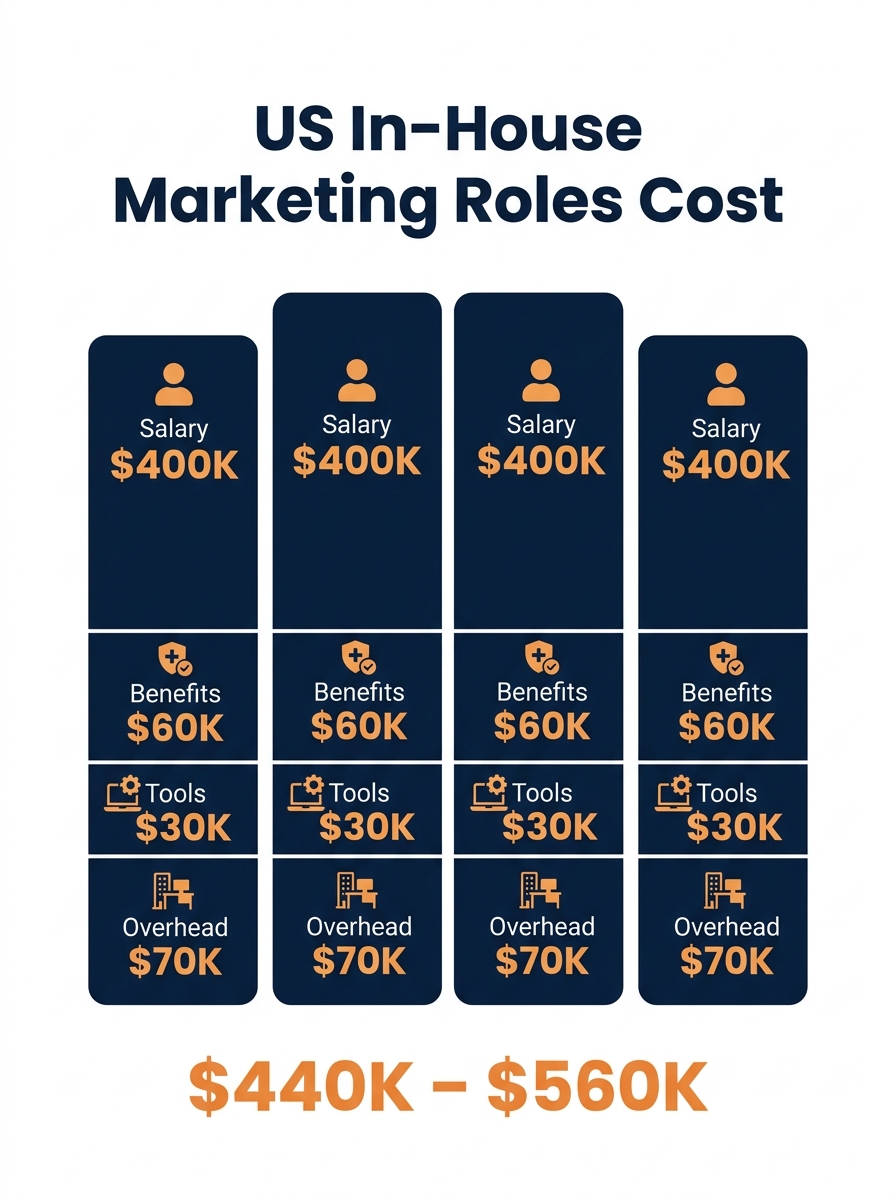
A mid-level digital marketing manager in the U.S. costs $75,000–$95,000 in salary. Add benefits, payroll taxes, software licenses, and management overhead, and you’re at $110,000–$140,000 per fully loaded FTE. A team of four (one strategist, one content writer, one PPC specialist, one SEO analyst) runs $440,000–$560,000 annually before you buy a single ad placement.
Shaun Bhagchandani, writing about hybrid marketing structures on LinkedIn, notes that “the Marketing Director must possess a deep understanding of all aspects of marketing relevant to your business and industry.” That senior hire alone can cost $130,000–$180,000 in a mid-tier U.S. market. And you need that person regardless of which model you choose.
The in-house model wins on brand depth. Your team lives inside the product, talks to customers daily, and understands the competitive landscape at a level no external team can replicate within the first 6 months. When outsourced vs in-house marketing decisions come down to brand sensitivity, keeping people close to the product matters.
But in-house loses on scalability. Doubling content output for a product launch or spinning up a new paid channel means hiring, which means 45–90 days of recruiting, onboarding, and ramp time. The opportunity cost of slow scaling compounds every quarter.
Where in-house works best: Companies above $20M revenue with marketing budgets exceeding $800,000/year and enough volume to keep every specialist busy 40 hours a week.
Where it breaks: SMBs under $5M that need four or five marketing disciplines but can only afford two full-time hires.
Going Fully Offshore
The math on full outsourcing looks irresistible at first glance. According to Floowi Talent’s 2026 analysis of offshore marketing services, the same marketing role that costs $8,000–$11,000/month in the U.S. runs $2,000–$3,000/month offshore in Asia. That’s a 60–75% reduction in direct labor cost. Nearshore teams in Latin America sit at $2,500–$3,500/month, with the $500–$1,000 monthly premium buying real-time collaboration during U.S. business hours.
Over 50% of U.S. companies now outsource digital marketing, content strategy, SEO, and social media management, per BolsterBiz’s reporting on Virtual Latinos data. That adoption rate reflects something real: execution-heavy marketing tasks translate well across borders when processes are documented.
The offshore digital marketing tasks that transfer cleanly include technical SEO audits, keyword research, PPC campaign builds, social media scheduling, email template production, analytics reporting, and graphic design. These workflows have defined inputs, measurable outputs, and established quality benchmarks. An experienced Philippine PPC specialist running Google Ads campaigns doesn’t need to sit in your office to hit a target ROAS.
But the model cracks when strategy and execution live in the same offshore team with no domestic oversight. The failure modes are specific:
- Brand voice drift. Offshore writers produce content that’s technically correct but tonally off. Without a domestic brand owner reviewing output, messaging slides over 3–6 months until it sounds generic.
- Strategic misalignment. Campaign priorities shift based on sales pipeline changes, competitor moves, or executive decisions that happen in hallway conversations. Offshore teams miss that context unless someone deliberately transmits it.
- Client-facing gaps. If you’re an agency, putting offshore team members directly on client calls without preparation creates friction. Clients expect their marketing partner to understand local market nuance instinctively.
As we’ve explored in the context of how async decision-making creates timeline slippage, even a 4-hour overlap window between domestic and offshore teams can cut project delays by 30–40%.
Where full offshore works best: Agencies with strong domestic account managers who serve as the strategic bridge, companies with thoroughly documented brand guidelines, and businesses where marketing execution is high-volume and repetitive.
Where it breaks: Companies without a senior marketer on staff domestically, businesses in highly regulated industries, and any team that hasn’t documented its processes.
The Hybrid Split
Why does the hybrid model outperform the other two for most SMBs? Because it maps each task to the team best suited to execute it, rather than forcing one team to do everything.
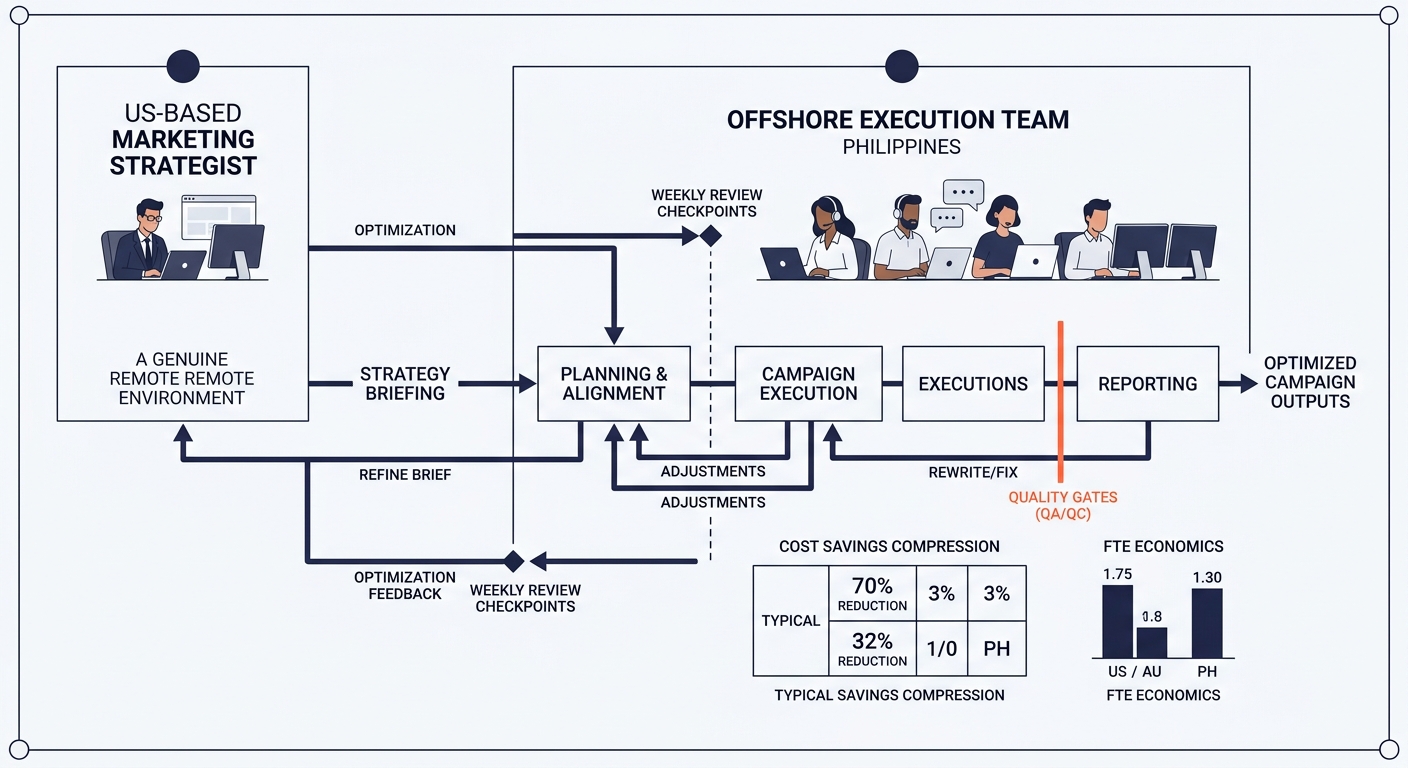
The domestic side keeps 2–3 roles: a Marketing Director who owns strategy, brand positioning, and stakeholder relationships; optionally a content strategist who maintains brand voice and the editorial calendar; and, for agencies, an account manager who handles client communication.
The offshore side handles everything else. A typical hybrid pod for a $3M–$10M SMB includes:
- 1 SEO specialist ($2,000–$2,500/month)
- 1 PPC/paid media specialist ($2,000–$3,000/month)
- 1 content writer ($1,500–$2,500/month)
- 1 graphic designer ($1,500–$2,000/month)
- 1 marketing VA for reporting, scheduling, and admin ($1,200–$1,800/month)
Total offshore cost: $8,200–$11,800/month, or roughly $98,000–$142,000/year for five roles. Compare that to the $440,000–$560,000 price tag for four in-house FTEs. Even adding a $150,000 domestic Marketing Director, you land at $248,000–$292,000 total. That’s a 47–55% reduction in fixed marketing payroll.
LLR Partners recommends a specific threshold for making this call: evaluate whether outsourcing costs 1.5 times the salary of an in-house team member for any given role. If it does, the in-house hire makes more financial sense. For execution roles where offshore rates run 25–35% of U.S. salaries, the math overwhelmingly favors outsourcing.
The digital marketing outsourcing market is projected to reach $74.76 billion by 2034 at an 11.4% CAGR, and the hybrid pod structure drives much of that growth. Companies that used to outsource entire departments now build dedicated pods of 3–5 specialists who work exclusively on one account.
If content velocity is your bottleneck, scaling production through offshore teams solves the problem without sacrificing quality, as long as editorial direction stays domestic. Similarly, outsourced link building fits the hybrid model well because prospecting and outreach are process-driven tasks that benefit from dedicated offshore hours.
The outsourced vs in-house marketing decisions that matter most are about strategy ownership, not execution location. Keep the brain domestic. Ship the hands offshore.
The hybrid model also addresses the marketing outsourcing strategy concern that keeps most founders up at night: losing control. Because your Marketing Director sits in-house, they review every campaign brief, approve every content calendar, and own the KPIs. The offshore team executes against documented standards, and the domestic team course-corrects weekly.
Tip: Set up structured feedback channels with your offshore pod. Weekly 30-minute review calls and shared Loom recordings of campaign walkthroughs cut revision cycles by 40–50%, per Staff Domain’s [research on offshore team feedback practices](https://www.staffdomain.com/blogs/effective-strategies-with-offshore-teams-to-power-local-digital-marketing/).
For agencies specifically, the shift toward offshore teams owning more of the strategy-execution split has accelerated as AI tools make Philippine marketing specialists more productive. A recent productivity study found AI-equipped VAs delivering 2.4× the output of unassisted workers, meaning your offshore pod of 5 can produce what used to require 8–10 people.
How To Choose Between These Three
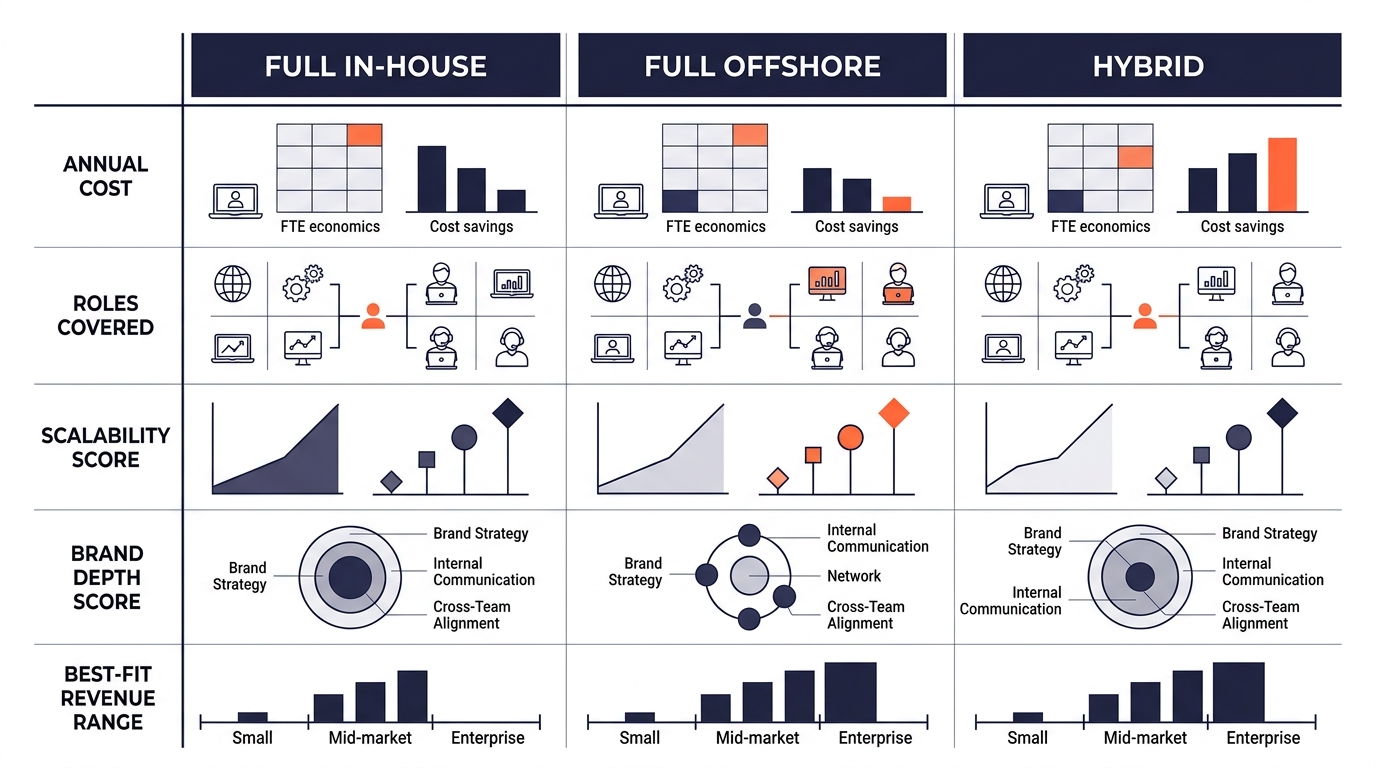
The right model depends on three variables: your annual revenue, your existing marketing leadership, and how documented your processes are. This table gives you the SMB marketing delegation framework in one view.
| Factor | Full In-House | Full Offshore | Hybrid Split |
|---|---|---|---|
| Annual marketing payroll (4–5 roles) | $440K–$560K | $98K–$142K | $248K–$292K |
| Brand voice control | High | Low without domestic oversight | High (domestic strategist) |
| Scalability | Slow (45–90 day hire cycles) | Fast (add roles in 1–2 weeks) | Fast for execution, slow for strategy |
| Best revenue range | $20M+ | Any (with domestic bridge role) | $1M–$20M |
| Biggest risk | Cost bloat, specialist idle time | Strategic drift, brand erosion | Coordination overhead |
| Time to full productivity | 90–120 days per hire | 30–45 days with good onboarding | 45–60 days for the full pod |
If you’re under $2M in revenue with no senior marketer on staff, start with a single offshore marketing VA and a fractional CMO. You don’t need a pod yet, and you don’t have enough volume to justify full in-house hires.
If you’re between $2M and $20M with at least one strong marketing leader domestically, the hybrid split is your best path. Hire your offshore pod, run a structured onboarding process that gets them productive in 30–45 days, and let your domestic lead focus on strategy and stakeholder management instead of building email templates at 11 PM.
If you’re above $20M with a budget that supports 8+ FTEs, you have the option to keep everything in-house. Even then, most companies at this stage still offshore 2–3 execution roles because the economics are too favorable to ignore. A senior SEO analyst in Manila at $2,500/month produces the same technical audit output as a $95,000/year U.S. hire, and the savings fund another campaign or another channel entirely.
The pattern across every revenue tier is consistent: strategy ownership belongs where your customers, stakeholders, and product knowledge live. Execution belongs where you can get disciplined, process-driven specialists at a cost that lets you invest the savings back into growth. For most SMBs reading this, that means a domestic strategist and an offshore pod of 3–5, scaled up as revenue grows and workload demands it.