
Google’s May 20 keynote at Google Marketing Live 2026 replaced keyword-first campaign management with Gemini-native workflows across ads, commerce, and measurement. Dynamic Search Ads sunset in September. Universal Cart integration lets users buy without leaving Google. Every outsourced PPC team’s playbook needs rewriting before Q4.
The May 20 Keynote That Killed Keyword-First Campaigns
GML 2026 wasn’t a feature update. It was a platform-level architecture change. Google positioned Gemini as the connective intelligence layer coordinating campaigns, predictive optimization, conversational discovery, and transaction flows across its entire ecosystem. The ad platform you’ve been managing since 2015 is being dismantled piece by piece, and the timeline is aggressive.
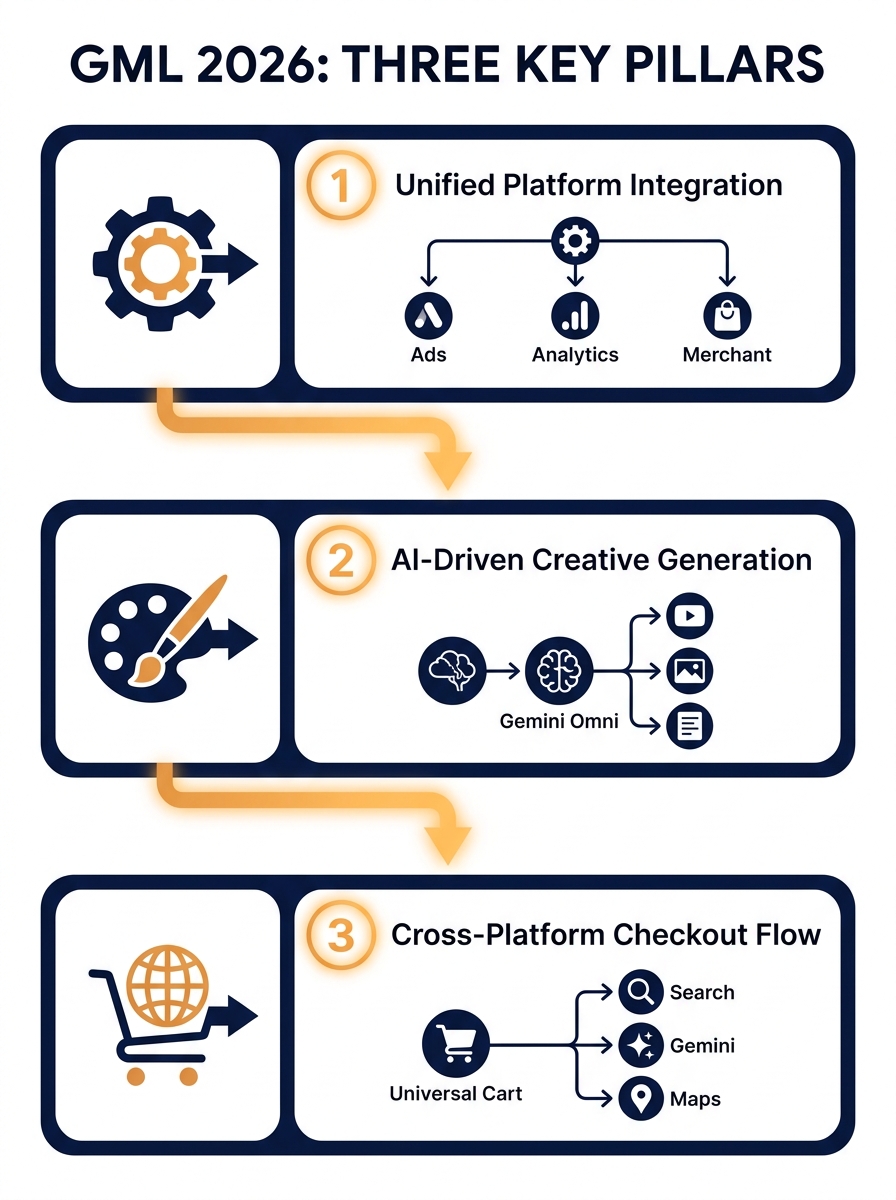
Three announcements define the shift. First, Gemini 3.5 Flash went generally available on May 19, 2026, one day before the keynote, powering a new layer called Ask Advisor that connects Google Ads, Analytics, and Merchant Center into a single AI collaborator. Second, Asset Studio now uses Gemini Omni to generate image and video assets from natural language prompts, with full creative testing baked in. Third, Universal Cart checkout went live across Search, Gemini, and Maps, letting users complete purchases without ever visiting your client’s website.
Bloomberg’s coverage today described online advertisers experiencing a “collective freakout” over the changes. That reaction tracks with what we’re hearing from agency partners. The panic is concentrated among teams still running manual keyword-match campaigns and treating Google as a traffic referral engine rather than a transaction platform.
If your outsourced digital marketing team hasn’t started retooling around conversational advertising and AI-driven campaign optimization, the window is closing. Google product leaders at GML 2026 explicitly stated that Gemini changes how intent matching works at a fundamental level, according to backstage interviews published by PPC Land. The old signals (exact match, phrase match, broad match with negative keywords) are being absorbed into AI Max’s intent-prediction layer.
For teams already managing the strategy-execution split through Philippine digital marketing specialists, the transition has a head start. But the knowledge required is different from what most PPC operators have trained on for the past decade.
Gemini Omni and Asset Studio Replace the Creative Brief
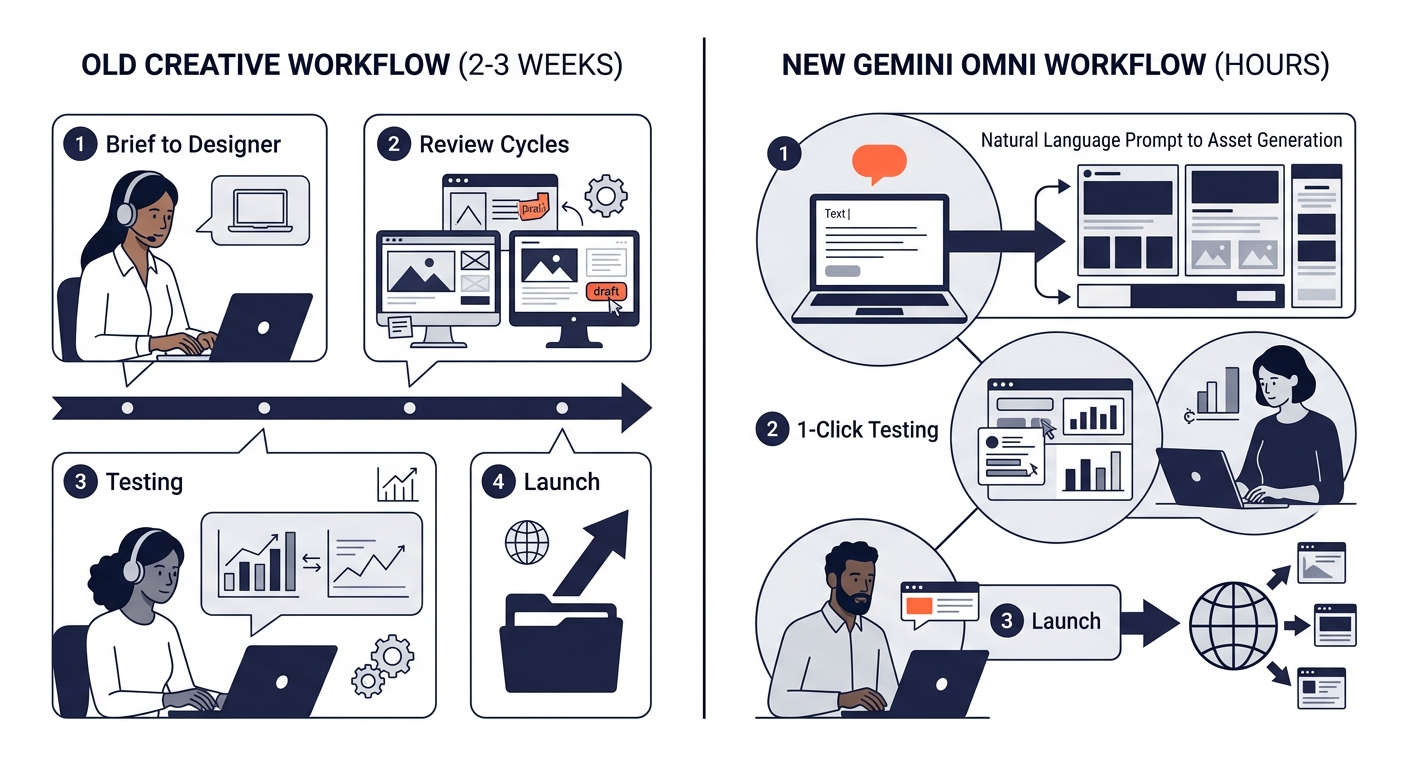
The creative production pipeline for Google Ads campaigns just collapsed from weeks to hours. Asset Studio now allows advertisers to use natural language prompts to generate image and video assets directly from brand guidelines. Gemini Omni handles the video workflow, and 1-Click Creative Testing automates the variant optimization that used to require a media buyer, a designer, and a two-week testing window.
This is rolling out in summer 2026. When it lands, the bottleneck moves from “we need creative assets” to “we need someone who can write precise AI prompts against brand guidelines and interpret performance data in real time.” That’s a fundamentally different skill set than what traditional PPC teams carry.
Google’s NewFront 2026 announcement detailed how the optimization layer now tracks creative rejections and surfaces insights to push campaigns toward optimal spend. The system monitors which assets get rejected, identifies why, and recommends corrections through Ask Advisor’s conversational interface. Campaign reporting across line items responds to a single prompt.
The conversational advertising model extends beyond creative. Infobip’s marketing AI documentation describes campaigns becoming interactive conversations rather than one-way messages, with AI agents delivering personalized campaigns, handling customer responses, qualifying leads, and driving conversions across WhatsApp, SMS, RCS, and web chat simultaneously. This is the direction Google is moving, and Gemini is the engine.
The bottleneck moved from “we need creative assets” to “we need someone who can write precise AI prompts and interpret performance data in real time.”
For outsourced teams, the implication is clear: creative production hours drop, but strategic prompting and performance interpretation hours increase. Agencies that outsource digital marketing strategy alongside execution are better positioned here because their offshore teams already participate in the strategic layer where prompt engineering lives.
Universal Cart Turns Google Into the Storefront
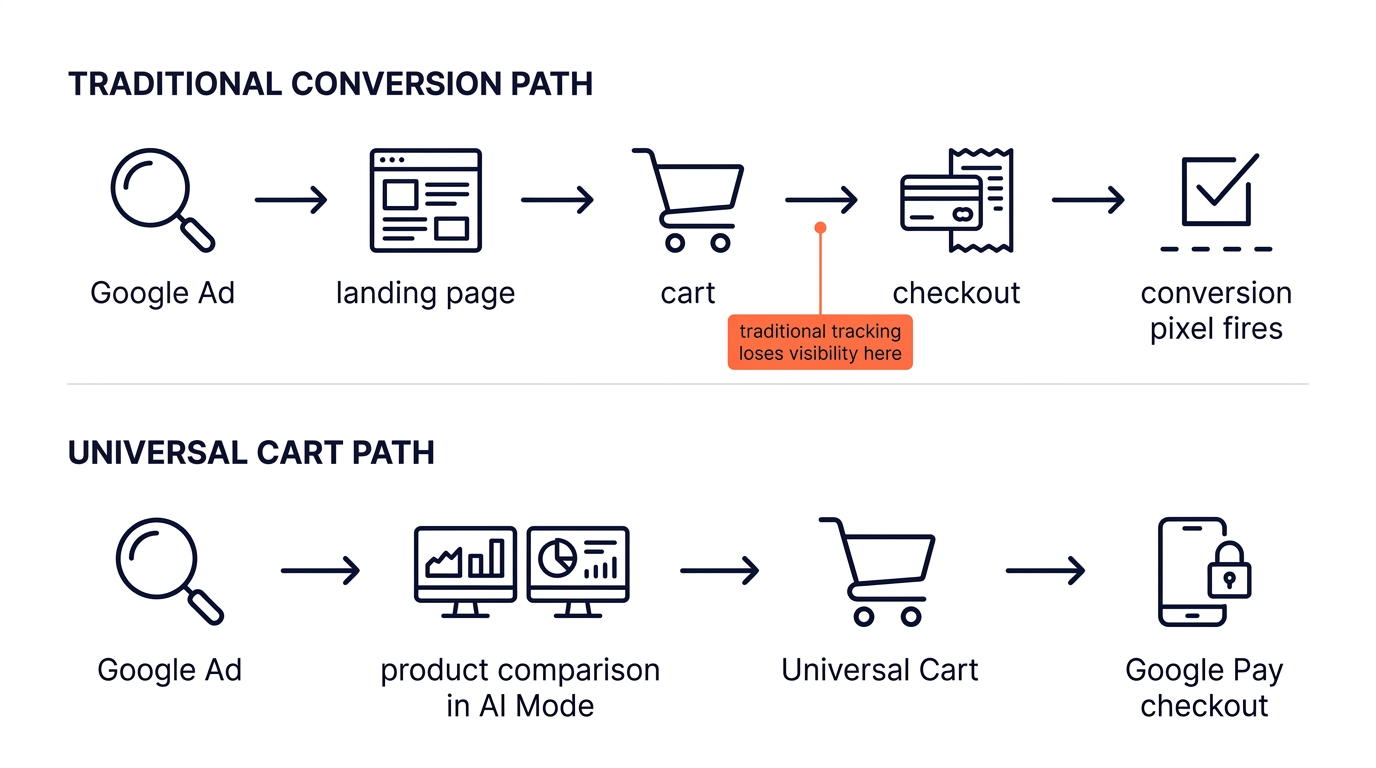
Universal Cart integration is the announcement that should have gotten more attention than it did. Google is positioning its platforms as the place where users discover products, compare options, monitor pricing, manage carts, and complete purchases, according to Search Engine Journal’s coverage of the I/O announcement. The feature lets shoppers check out with Google Pay at major retailers directly within Search, Gemini, and Maps.
This shifts Google’s role from referral engine to transaction facilitator. ContentGrip’s analysis noted the strategic consequence: even if clicking out to a brand’s site remains possible, the default path becomes “discover, decide, buy” without leaving Google’s interfaces. That changes how brands think about landing pages, site speed, and on-site conversion optimization.
For PPC campaign teams, the measurement framework breaks in a specific way. If conversions happen inside Google’s ecosystem, attribution models built around on-site pixel tracking lose visibility. Google’s response is Qualified Future Conversions (QFCs) for predictive reporting and Meridian, an open-source marketing mix model now integrated into Analytics 360. Your outsourced team needs to understand both by Q3.
Google’s shopping updates blog post confirmed new Universal Commerce Protocol features simplify shopping across Search, Gemini, and Maps. Merchant Center is getting new tools to support this, which means product feed management becomes a higher priority and a more technical task. The teams running PPC campaign optimization for your clients need feed expertise alongside bid management expertise.
The DSA Funeral Scheduled for September
Dynamic Search Ads are being sunset in September 2026. Google is consolidating that functionality into AI Max, its intent-based campaign type that replaces traditional keyword targeting with AI-predicted intent matching. Every account running DSA campaigns needs a migration plan, and “September” is closer than it sounds when you factor in testing cycles.
The forced migration to AI Max requires different creative strategies, different bidding approaches, and different campaign structures. Accounts that relied on DSA as a catch-all for long-tail queries will need to rebuild that coverage inside AI Max’s framework. According to PPC Land’s backstage coverage, Google product leaders described specific requirements for AI Max campaigns that differ substantially from DSA configuration.
This migration timing is why outsourced marketing agility matters more in the second half of 2026 than it has in years. A 2X Marketing analysis found that AI combined with outsourcing delivers campaigns to market up to 40% faster, reduces customer acquisition cost by 10–20%, and sustains adoption levels that AI-only internal teams rarely match beyond the first quarter. That speed advantage becomes critical when you’re racing a hard September deadline across a portfolio of client accounts.
If you’ve dealt with paid search migrations going wrong before, you know the risk. Traffic drops during poorly executed campaign transitions can take months to recover. The DSA-to-AI-Max migration carries that same risk at portfolio scale, with every Google Ads account affected simultaneously.
Warning: Dynamic Search Ads sunset in September 2026. If your outsourced team hasn’t started mapping DSA campaigns to AI Max structures, the migration window is already tight for accounts with complex campaign architectures.
Ninety Days Between the Announcement and the DSA Deadline
The distance between GML 2026’s May 20 keynote and the September DSA sunset is roughly 90 working days. Subtract onboarding time for new tools, subtract learning curves for Gemini-native creative workflows, subtract the QA cycles needed to validate AI Max campaign structures against historical DSA performance. You’re left with a narrow operational window.
This is where teams built for agility across the strategy-execution divide separate from teams built for steady-state account management. The Gemini ads 2026 changes demand three parallel workstreams running simultaneously: creative pipeline retooling around Asset Studio and Gemini Omni, DSA-to-AI-Max migration planning with testing, and measurement infrastructure updates for Universal Cart and QFC integration. Running all three across a client portfolio with a three-person in-house team isn’t realistic.
The Bloomberg piece published today captures the mood among advertisers who are still processing the scope of the changes. But processing time is a luxury that the September deadline doesn’t offer. Philippine digital marketing teams running 8-12 hour time-zone offsets from US agencies can effectively double the available working hours per day on migration projects, and the cost economics at $12-18/hour loaded versus $65-95/hour for US-based PPC specialists makes parallel workstreams financially viable at a scale that in-house teams can’t match.
The advertising platforms that defined digital marketing for two decades are being rebuilt around conversational AI, predictive intent matching, and closed-loop commerce. The teams that adapt their workflows, measurement frameworks, and creative processes between now and September will hold a structural advantage over those still figuring out where to start in Q4.