
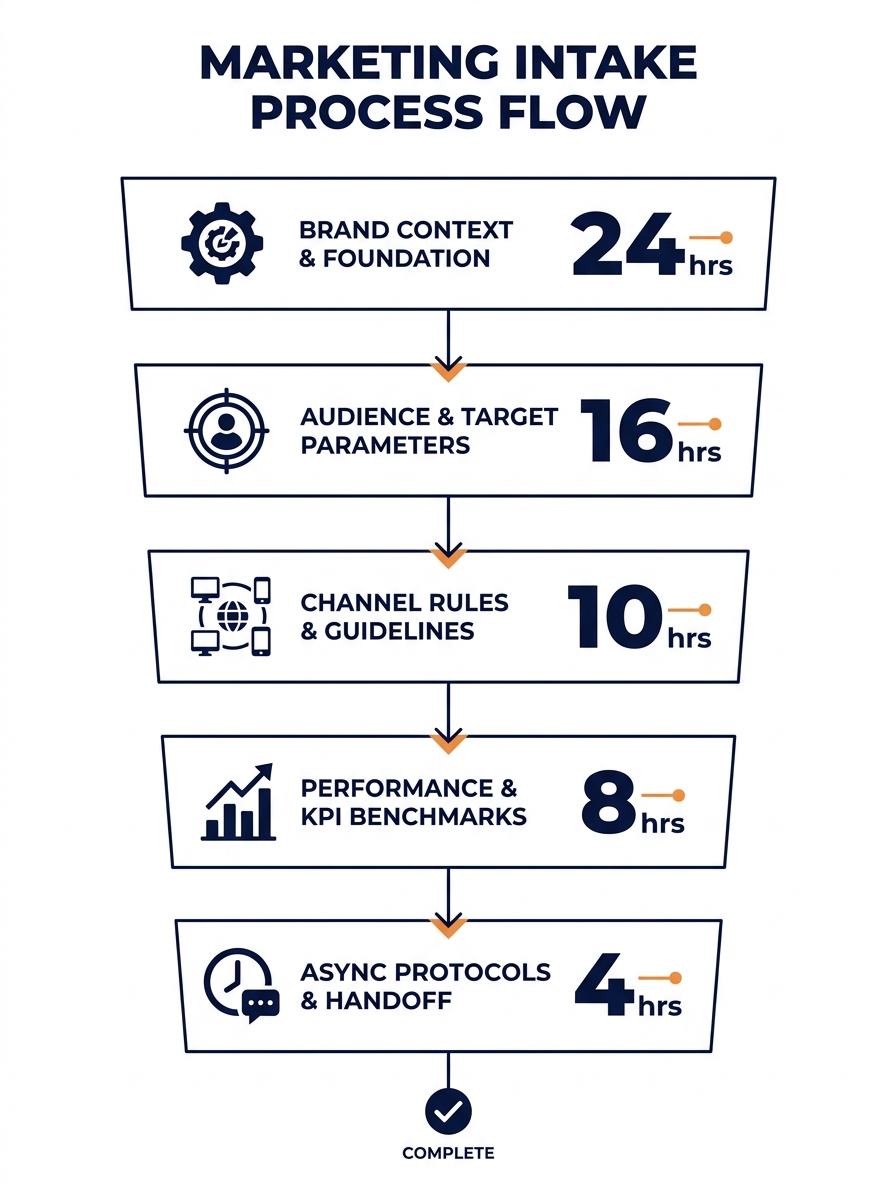
A formal outsourcing intake process covering brand context, audience targeting, platform rules, KPIs, and async communication protocols prevents the misalignment that derails social media campaigns handed to offshore teams. Stackmatix’s onboarding analysis pegs structured intake at two to four weeks; skipping it costs months of correction.
TL;DR: Social media campaigns fail at the brief, not the execution. A five-field intake framework covering brand context, audience parameters, channel-specific rules, performance benchmarks, and async protocols gives your Philippine marketing team the structured onboarding they need to run campaigns from day one without guesswork.
The Onboarding Window Nobody Budgets For
Stackmatix’s onboarding breakdown identifies four sequential stages that fill those two to four weeks: knowledge transfer, tool access provisioning, baseline audits, and initial strategy alignment. Each stage has dependencies. Baseline audits require tool access. Strategy alignment requires baseline data. Skip a stage, and every downstream decision lacks context.
For social media campaigns specifically, the stakes are higher than most brands realize. A single Instagram Reels campaign involves brand voice calibration, visual identity standards, hashtag strategy, posting cadence, audience response protocols, and paid amplification rules. That’s six distinct knowledge domains your Philippine team needs before they write a single caption. Sending a logo file and a Canva link covers roughly one of those six.
The administrative side of Philippine marketing team onboarding has gotten faster. A January 2026 Manila Bulletin report found that zero-touch onboarding workflows reduced new hire setup times from three to five days down to hours. But operational setup and campaign-level knowledge transfer are different problems. Getting someone access to Meta Business Suite in 45 minutes means nothing if they don’t know your brand’s policy on responding to negative comments or your target CPA for lead-gen ads.
Why Social Media Campaigns Break at the Brief
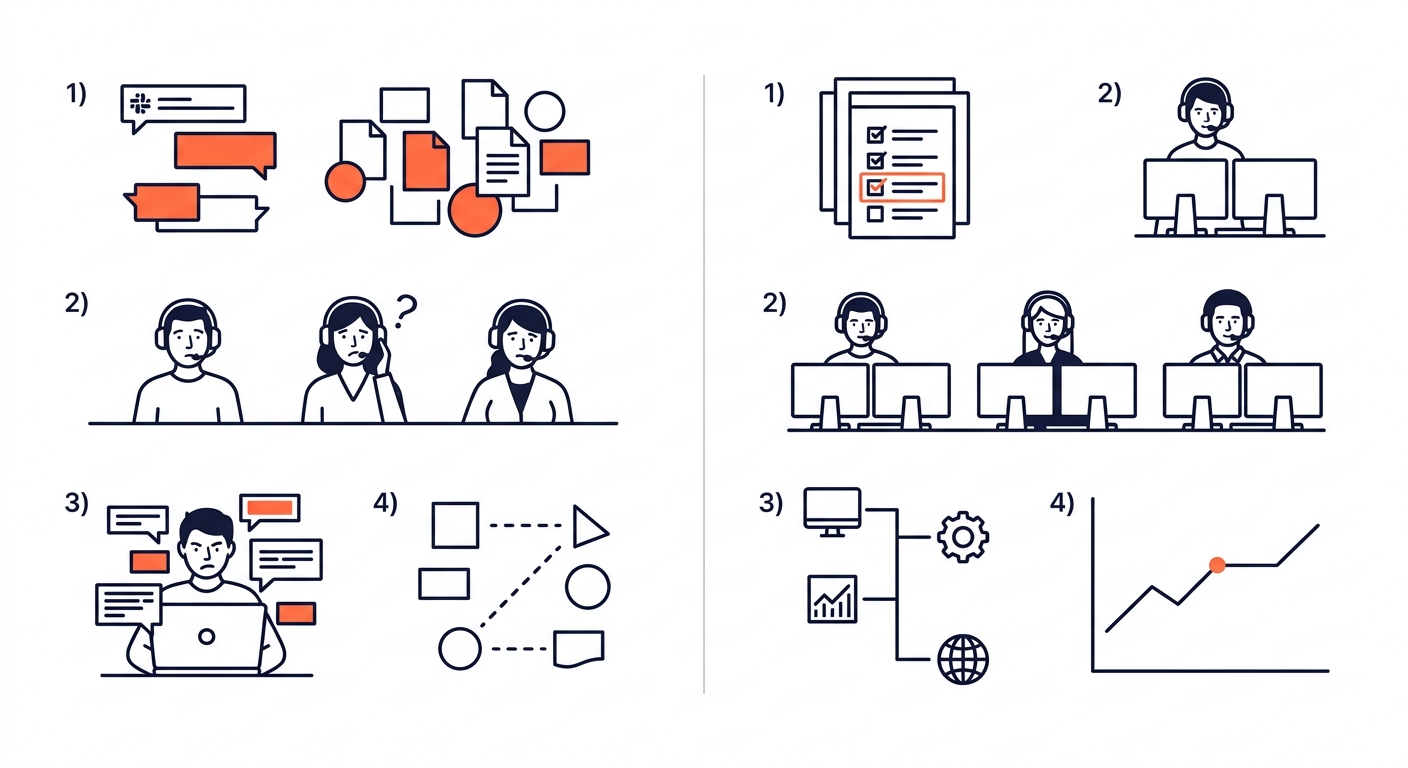
The pattern is consistent across engagements we’ve seen. A brand hires a Philippine social media team, shares a 2-page brand guidelines PDF and a spreadsheet of “content ideas,” grants tool access, and expects posts to go live within 5 business days. The team delivers on schedule. The content looks professional. And the client hates it.
Why? Because the brief didn’t capture the 15 to 20 unwritten rules that define what “on-brand” actually means for social content. Which competitor accounts to avoid mimicking. Whether the brand uses Oxford commas in captions. How much emoji use is acceptable (zero? moderate? aggressive?). Whether customer testimonials need legal review before resharing. The gap between what’s documented and what the in-house team “just knows” creates the misalignment that kills campaigns.
As agency management platform Scribbl’s client expectations guide puts it: “A clear set of ground rules doesn’t restrict a client relationship; it protects it. By establishing boundaries early, you create the trust and safety needed for a true partnership to flourish.” That protection is what a structured digital marketing brief template provides. We’ve covered why the first 90 days determine outsourcing success, and the brief is what makes or breaks the first 9 days specifically.
ManyRequests’ expectation management research reinforces this with practical language: instead of promising a specific number of leads or sales, agencies should communicate what they’ll work toward and how. Their example, “We’ll aim to increase web traffic by 15-20%, but results may vary based on market conditions,” gives the Philippine team both a target and permission to contextualize results. That framing belongs in the intake brief, not in a month-two retrospective.
The Five-Field Intake Framework for Social Campaigns
Every digital marketing brief template you’ll find online covers the basics. Smartsheet’s marketing brief templates focus on summarizing the project, identifying its purpose, and defining essential objectives. The Digital Marketing Institute’s campaign brief template adds strategic context around content marketing and digital strategy planning. These are solid starting points for domestic agency relationships.
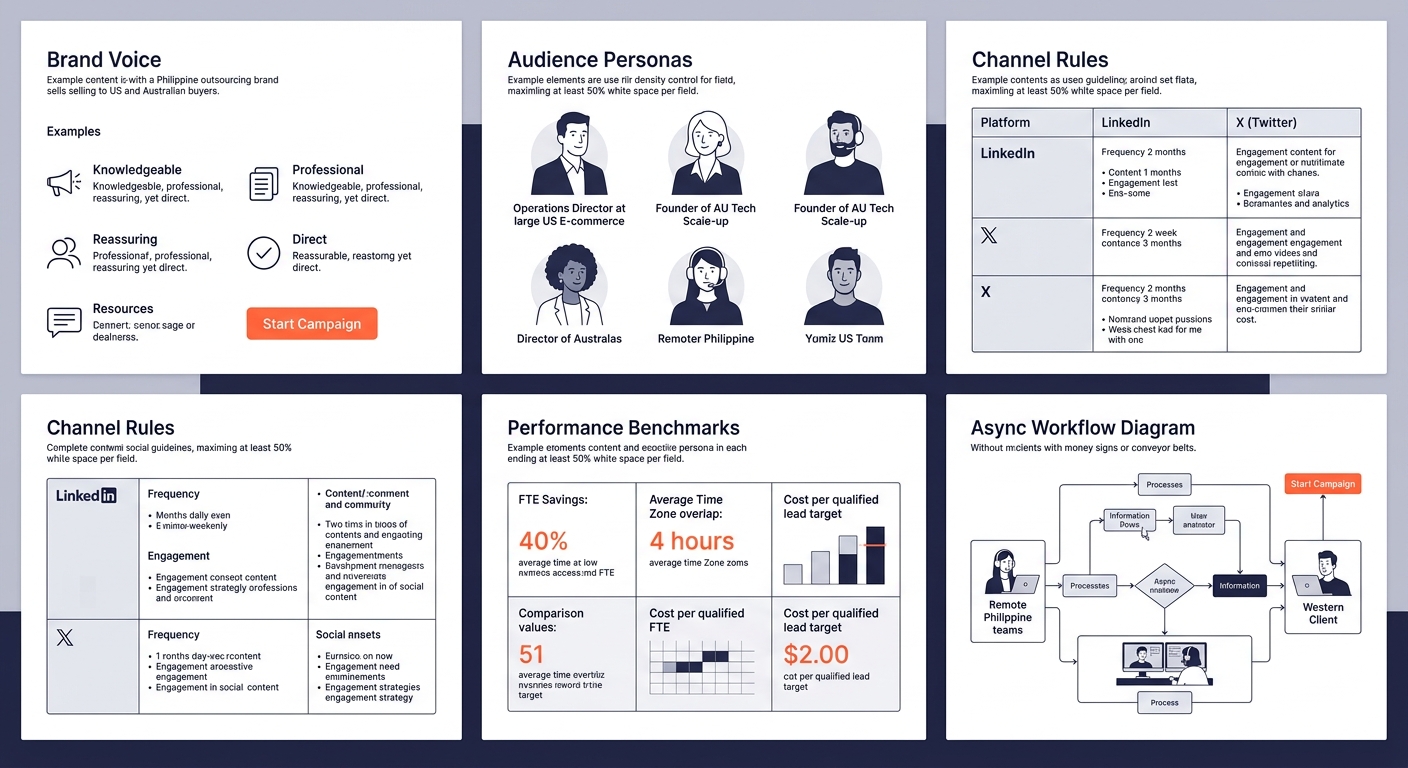
But social media campaigns managed by a Philippine team across a 12-to-16-hour time zone gap need five specific fields that generic templates miss. I’m calling this the Five-Field Intake Framework because each field addresses a distinct failure mode in offshore social campaign management.
| Field | What It Captures | Failure Mode Without It |
|---|---|---|
| Brand Context & Voice | Tone guidelines, vocabulary restrictions, competitor differentiation notes, visual identity beyond logo files | Content sounds generic or mimics competitors |
| Audience Parameters | 3-5 persona summaries with platform-specific behavior notes (e.g., “our LinkedIn audience skews 35-50, director-level”) | Posts target wrong demographic or use wrong register |
| Channel-Specific Rules | Per-platform posting cadence, format preferences, hashtag limits, paid vs. organic boundaries, response time SLAs | Team posts 4x daily on LinkedIn (appropriate for X, wrong for LinkedIn) |
| Performance Benchmarks | Current baseline metrics (engagement rate, CPC, CPL, ROAS) plus 30/60/90-day targets | Team optimizes for vanity metrics; no shared definition of success |
| Async Communication Protocol | Decision escalation paths, approval workflows, response windows, tool designations (Slack vs. email vs. project board) | 18-hour feedback loops on time-sensitive content |
Brand Context & Voice
This field needs more than a style guide PDF. Include 10 to 15 example posts your team considers “perfect,” annotated with brief notes explaining why each one works. Add 5 posts that missed the mark, with notes on what went wrong. Your Philippine team learns voice through pattern recognition faster than through adjective-heavy brand guidelines that say things like “conversational yet authoritative.”
Specify 8 to 12 vocabulary terms the brand always uses and 8 to 12 it never uses. If you sell SaaS, do you say “users” or “customers” or “members”? These micro-decisions add up across 60+ social posts per month.
Audience Parameters
Generic demographic data is insufficient for social media targeting. Break audiences down by platform. Your Facebook audience and your TikTok audience are different people with different content expectations, even if they share a demographic profile. Document 3 to 5 personas per active channel, each with specific behavioral notes: what they share, what they comment on, what makes them unfollow.
Channel-Specific Rules
This is where briefs consistently fall short in cross-border engagements. Your Philippine team needs a per-platform playbook that covers posting frequency (3 to 5 posts per week on Instagram vs. 1 to 2 on LinkedIn), content format ratios (e.g., 40% video, 30% carousel, 20% static, 10% Stories), and paid media parameters including daily budget caps, audience exclusion lists, and approval thresholds for spend above a set dollar amount.
The gap between what’s documented and what the in-house team “just knows” creates the misalignment that kills social campaigns before month two.
Performance Benchmarks
Share current numbers. If your organic Instagram engagement rate is 2.3%, your Facebook page reach averages 4,100 per post, and your LinkedIn posts generate 12 comments on average, put those numbers in the brief. Without baseline data, your Philippine team has no reference point for whether their output is improving performance or degrading it. The DesignRush marketing agency onboarding playbook specifically calls out budget guardrails and outcome-setting as day-one requirements, and social metrics deserve the same treatment.
Set 30-day, 60-day, and 90-day targets. Be specific: “increase Instagram engagement rate from 2.3% to 2.8% within 60 days” is useful. “Improve social media presence” is not.
Async Communication Protocol
This is the field that separates domestic agency briefs from an effective expectation setting framework for offshore teams. When your Philippine social media manager finishes work at 6 PM Manila time, it’s 6 AM Eastern. If a trending topic breaks at 9 AM Eastern, you need a documented protocol for who approves reactive content, what the pre-approved boundaries are for real-time posts, and which topics require explicit sign-off regardless of time zone.
Document response windows: 4-hour maximum for content approvals during overlapping hours, 12-hour maximum for non-urgent items, and immediate escalation via phone for crisis scenarios. This async marketing handoff protocol should live in the brief itself, not in a separate document your team may never reference. We’ve written extensively about how async decision delays drain 20+ hours per month from outsourced marketing projects, and a clear protocol in the intake brief prevents most of that waste.
From Brief to Operating Rhythm
The intake brief isn’t a one-time document. It’s the foundation for an operating rhythm that evolves across the first 90 days. During week one, the Philippine team references it 8 to 12 times per day. By week four, they’ve internalized the brand voice and audience parameters and reference it primarily for channel rules and escalation protocols. By day 90, the brief has been updated 3 to 5 times based on real campaign data.
This evolution mirrors what structured Philippine marketing team onboarding looks like in practice: pre-launch alignment documents feed into brand immersion sprints, which feed into controlled campaign launches with clear KPIs, which feed into a day-90 data review that gives leadership actual ROI evidence. The brief is what makes the sequence from chaos to pipeline clarity possible.
For companies that also work with outsourced web development teams in the Philippines, the intake process looks similar in structure. The domains are different, but the principle is identical: document assumptions before they become expensive misunderstandings.
Tip: Store your completed intake brief in the same project management tool your Philippine team uses daily. A brief buried in Google Drive gets referenced once. A brief pinned in Asana, ClickUp, or Monday.com becomes a living reference that shapes every task.
What The Brief Can’t Tell You
The Five-Field Intake Framework captures the knowable, documentable inputs that make social campaigns work across a 12-to-16-hour time zone gap. It doesn’t capture the feedback loops that develop between week 3 and week 8, where your Philippine team starts recognizing patterns in audience behavior that weren’t in any persona document. It doesn’t capture the brand intuition that comes from running 200+ posts through approval cycles.
The data on structured onboarding is clear: two to four weeks of deliberate intake work prevents months of misalignment. The zero-touch administrative improvements tracked in 2026 have shortened the operational setup from days to hours. But the brief can’t tell you whether your team will develop the creative instinct that separates adequate social content from content that actually drives engagement above your 2.3% baseline.
What remains unmeasured is how quickly trust compounds when both sides start from a shared document rather than a shared assumption. The brief creates the conditions for that trust. The first 90 days prove whether it was warranted. And the campaigns that follow carry the quality of every decision made, or avoided, in those first two to four weeks.