
A digital marketing outsourcing brief that covers brand voice, target audience, and campaign goals will fail if those are the only layers it includes. The missing components are operational — per-platform format ratios, async decision protocols, and numeric escalation triggers that keep a Philippine team executing instead of guessing.
Where the Standard Vendor Brief Falls Apart
Why do outsourcing engagements crater in the first 60 days? Stackmatix onboarding data points to a specific window: agencies that skip a structured two-to-four-week intake process spend months correcting misalignment that a tighter brief would have prevented entirely. The problem is almost never talent. It’s the document that was supposed to align that talent to the work.
The typical vendor brief template describes desired outcomes. It says “increase engagement on Instagram” or “generate 40 qualified leads per month from paid social.” What it does not address is how the remote team should behave when the client hasn’t responded to an approval request for 18 hours, or whether a 1.8% engagement rate on a carousel post counts as underperformance worth escalating. Maya.ph’s vendor management guide puts the responsibility squarely on the client side: “Take the time to walk vendors through your business model and clarify expectations.” That advice is accurate, but it undersells how much structural work “clarify expectations” actually requires when the vendor sits in a timezone 12 to 16 hours offset from yours.
The gap shows up in a specific number: expert consensus from multiple onboarding audits suggests that the average brief omits 15 to 20 unwritten rules about tone, competitor avoidance, legal review requirements, and platform-specific formatting. Every one of those omissions becomes a correction cycle. At $35 to $55 per hour for a mid-level Philippine marketing specialist, each round of revisions caused by an incomplete brief costs $140 to $330 in direct labor, not counting the 24-hour delay baked into every async feedback loop. We’ve covered why outsourced marketing fails before day one in detail before, and the root cause is consistently the same: the brief.
SLA-defined contracts produce 28% higher client satisfaction than handshake agreements, according to vendor management research from Sprout Solutions. That statistic matters because it quantifies what many agencies already feel — the formality of the brief correlates directly with how well the engagement goes. A brief is a contract about how the work gets done, even if the actual legal contract lives in a separate document.
Anatomy of a Brief That Survives the Timezone Gap
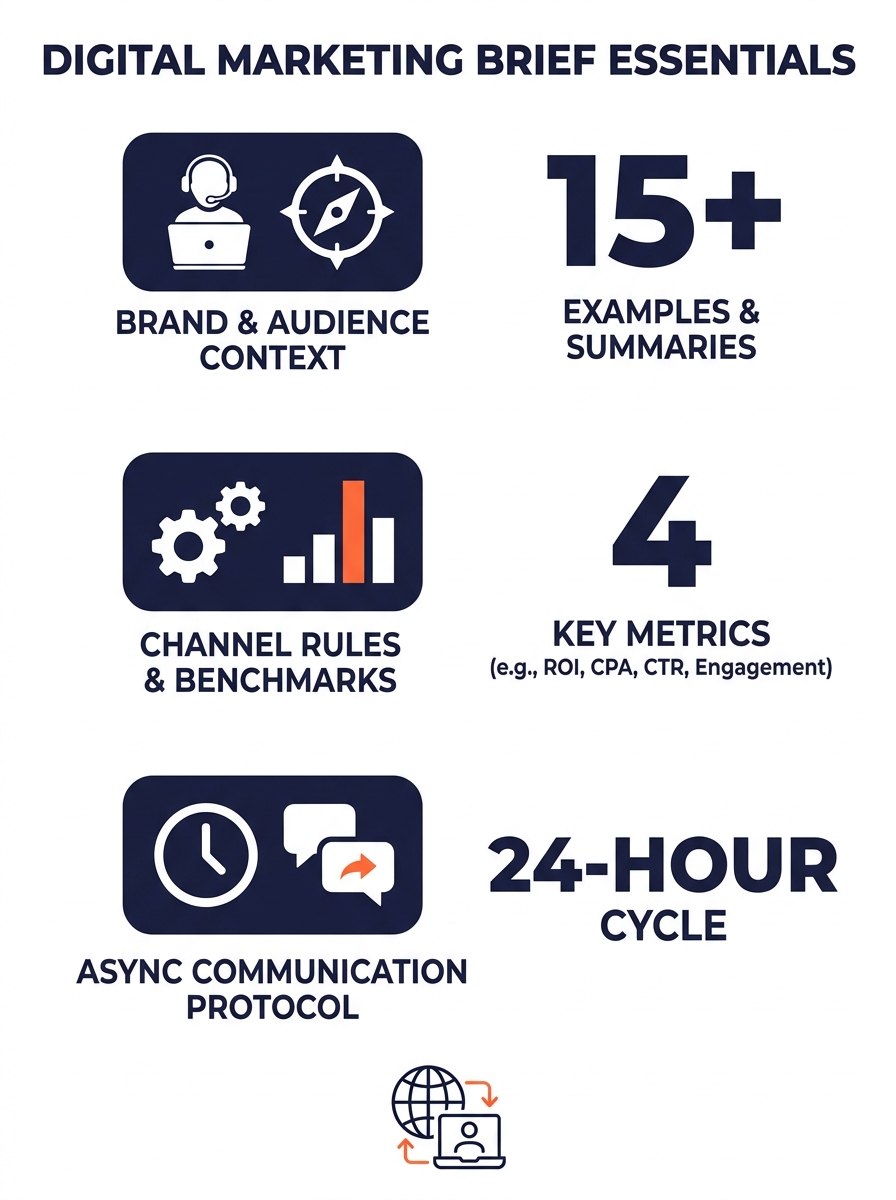
A functional digital marketing outsourcing brief contains five operational fields that go beyond the brand guidelines PDF most agencies send on day one. Each field addresses a specific category of decisions that a Philippine team will otherwise make on their own, without enough context to get it right.
The first is brand context with annotated examples. Adjective-heavy style guides (“our voice is warm, professional, and approachable”) don’t translate into consistent output across a remote marketing team. The brief needs 10 to 15 annotated samples of content the client considers perfect, along with 8 to 12 specific vocabulary terms — words the brand always uses, words it never uses, and phrases that require legal review. Twine’s project brief framework emphasizes including “samples of the content if you can,” and that recommendation is correct but incomplete. Samples without annotations explaining why each one works are decorative, not instructive. The annotation is the brief; the sample is the evidence.
The second field is audience parameters defined per platform, not per campaign. Demographic data (age 25-44, household income $75K+) is a starting point, but a Philippine team running your Instagram and LinkedIn simultaneously needs 3 to 5 persona summaries per platform with behavioral notes. The 34-year-old marketing director who follows you on LinkedIn consumes content differently than the 28-year-old coordinator who engages on Instagram. Format preferences, scroll behavior, and content length expectations all shift by platform, and your brief needs to name those differences explicitly. Teams that listen before they create consistently outperform those that start producing from a generic audience profile.
A brief is a contract about how the work gets done, even if the actual legal contract lives in a separate document.
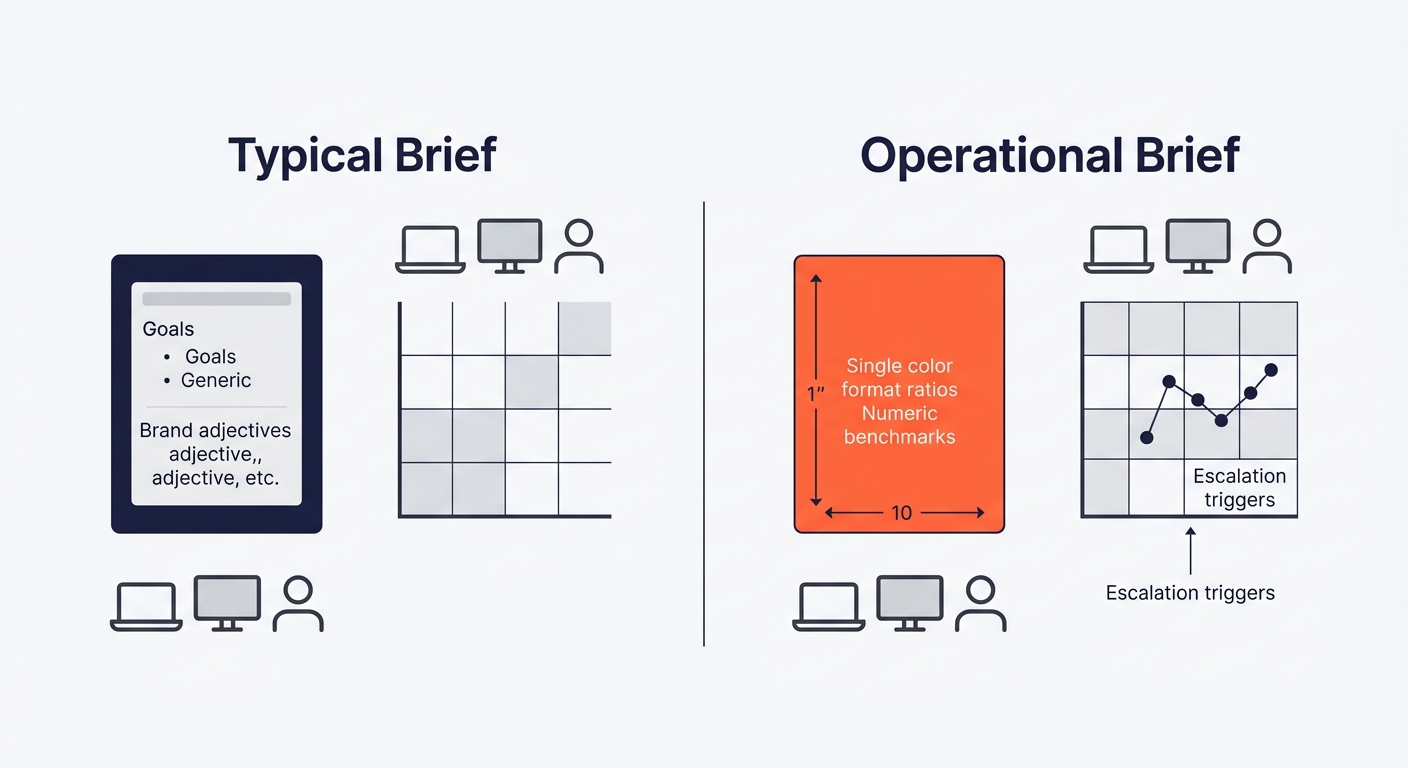
Channel-specific format rules make up the third field. This means defining per-platform posting cadences (4 posts per week on Instagram, 2 on LinkedIn, daily Stories), format ratios (40% video, 30% carousel, 30% static for Instagram), and paid media budget allocations per channel. These numbers feel granular, but granularity is exactly what prevents a remote team from defaulting to whatever’s easiest to produce. When you’re working with outsourced social media management, the format ratio in the brief determines whether you get a feed full of stock-photo posts or a channel that actually reflects your strategy.
The fourth field is performance benchmarks with numeric thresholds. “Improve engagement” is meaningless without a baseline. The brief should state the current engagement rate (say, 2.3%), the 30-day target (2.8%), the 60-day target (3.2%), and the 90-day target (3.5%). It should also define escalation triggers: CPA above $45, click-through rate below 0.8%, or bounce rate above 65% on landing pages. These numbers give the Philippine team authority to flag problems early rather than waiting for a quarterly review to discover that three months of spend went sideways.
The Async Protocol Most Agencies Forget to Write Down
MyOutDesk’s outsourcing guide describes effective remote management as requiring “ongoing guidance from Account Managers who actually understand remote team dynamics” and “proactive support that catches friction before it compounds into resentment.” That framing is useful because it names the specific failure mode: friction doesn’t announce itself. It accumulates silently through unanswered Slack messages, ambiguous approval chains, and 18-hour feedback loops that turn a two-day task into a full week.
The fifth field of the brief — the async communication protocol — addresses this directly. It defines who approves what, how long they have to respond, and what happens when the approval window expires. A Philippine team producing 12 to 15 pieces of content per week for a US client needs to know whether the creative director or the account manager holds approval authority on paid ad copy, whether organic social posts require sign-off or can publish on schedule, and whether a missed 12-hour approval window means the post ships as-is or gets held. We’ve written about how the async decision tax costs agencies 20+ hours per month, and the fix is almost always the same: write the protocol into the brief before work begins.
Setting clear PHP outsourcing expectations also means defining what “done” looks like for recurring deliverables. A monthly SEO content package from an outsourced SEO partner should specify word count range (1,200 to 1,800 words per post, not “long-form”), keyword density targets, internal linking requirements, and whether the deliverable includes meta descriptions and alt text or if those are a separate line item. The same applies to content marketing outsourcing — every ambiguity in the brief becomes a correction cycle downstream.
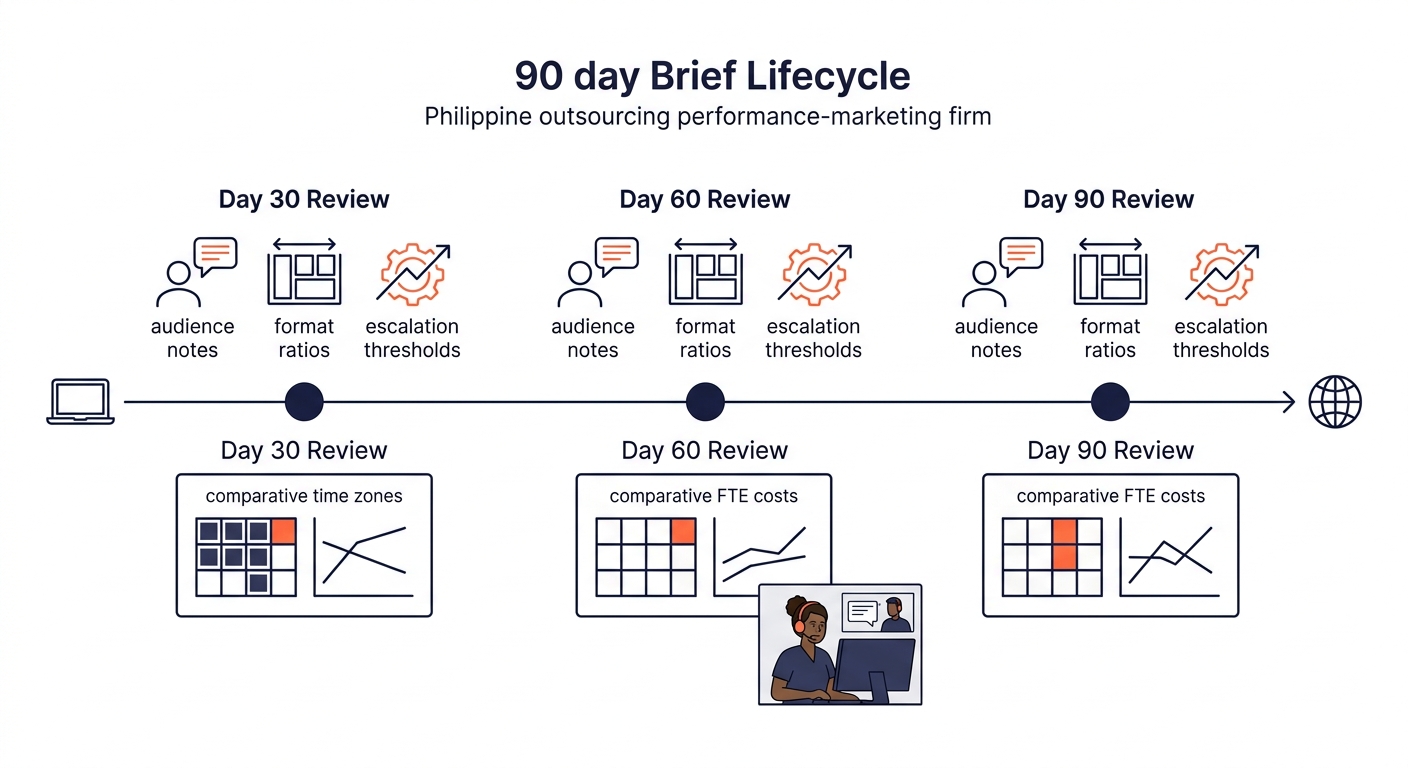
Smartsheet’s marketing brief template framework recommends specifying “target audience and fine-tune marketing strategies and messaging” at the project level. That’s sound advice for a single campaign brief. But outsourcing communication across an ongoing engagement requires something more durable — a living document that gets updated at 30, 60, and 90 days as the team’s understanding of the brand deepens. Sprout Solutions recommends quarterly business reviews as “a great way to check in, evaluate progress, and reset expectations if needed,” and building a brief-review cadence into those QBRs ensures the document stays accurate as the engagement matures.
What the Brief Still Can’t Capture
The uncomfortable truth about any vendor brief template, no matter how detailed, is that it captures explicit knowledge well and tacit knowledge poorly. The 15 to 20 unwritten rules that live in a creative director’s head — which competitors to never mention by name, which client stakeholders get defensive about specific color choices, which product features are under NDA until a launch date — resist documentation because they feel too small or too obvious to write down. They’re obvious to the person who’s been managing the account for two years. They’re invisible to a Philippine team member seeing the brand for the first time.
A Week One Brand Immersion Sprint partially solves this. Before any production work begins, the remote team spends five business days reviewing 6 to 12 months of historical content, competitor positioning, and past campaign performance data. Structured intake processes that include this immersion step compress what would normally take weeks of trial-and-error into a concentrated learning window. But even after immersion, gaps remain. The brief can set expectations for the first 90 days, but remote marketing team alignment is an ongoing process that requires judgment calls neither party can fully anticipate at the start.
What this means in practice is that the brief should be treated as a living artifact, not a launch document. The best-performing outsourcing engagements we’ve observed treat the brief as version-controlled — the day-one version captures everything the client knows to write down, and the day-90 version captures everything the team has learned through doing the work. The gap between those two documents tells you exactly how much institutional knowledge was missing from the original spec. That gap will always exist. The question is whether your brief is structured well enough to shrink it fast, or whether you’re paying revision costs for months while your Philippine team slowly figures out what you meant.