
The UK Information Commissioner’s Office published the final version of its storage and access technologies guidance in early 2026, replacing what the industry had casually called “the cookies guidance” for over a decade. The timing was deliberate. Within the same quarter, PECR fines were aligned to UK GDPR levels under the Data (Use and Access) Act 2025, three new US state privacy laws took effect on January 1, and the European Data Protection Board launched a coordinated enforcement action targeting transparency in digital marketing. For any team running campaigns across jurisdictions, the compliance surface area expanded in every direction at once. And for US and Australian companies that outsource marketing execution to the Philippines, each of those changes landed squarely on the offshore team’s desk.
This is the story of how that convergence played out, what it actually means for data privacy outsourcing, and where the real exposure sits.
The ICO Rewrote the Tracking Rules While Everyone Watched Cookies
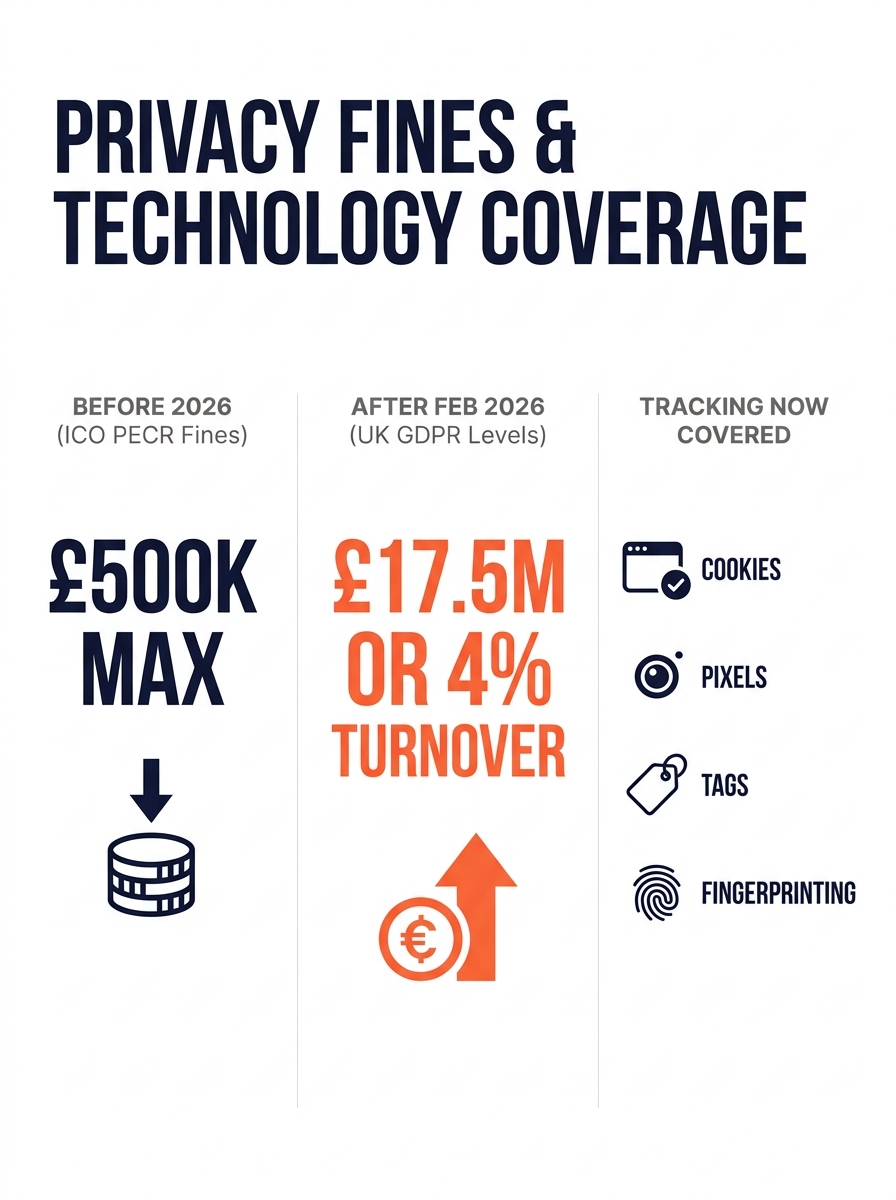
The ICO’s updated guidance covers far more than cookies. It addresses tracking pixels, scripts, tags, and device fingerprinting under the Privacy and Electronic Communications Regulations (PECR). The strategy update published by the ICO made the regulator’s priorities clear: “meaningful opt-out” is the standard, and consent mechanisms that look compliant but don’t function correctly are enforcement targets.
The fine ceiling change is the part that should keep marketing directors awake. PECR violations previously carried a maximum penalty of £500,000. Under the February 2026 commencement order, that ceiling rose to match UK GDPR levels: up to £17.5 million or 4% of global annual turnover, whichever is higher. A Slaughter & May analysis described the shift as an area of intense focus across the UK, EU, and US, noting that developments have “continued apace.”
For outsourced Philippine marketing teams managing UK-facing campaigns, the ICO tracking guidance changes mean that every tag firing on a client’s site, every pixel placed in an email, and every consent banner configuration is now subject to a penalty framework 35 times larger than it was a year ago. If your offshore PPC specialists are implementing tracking for Google Ads or Meta campaigns targeting UK audiences, they’re operating within this enforcement perimeter whether they realize it or not. Teams that have already dealt with rebuilding campaign performance after platform migrations know how tightly tracking configurations are coupled to campaign outcomes. Now those configurations carry regulatory weight, too.
Kentucky, Rhode Island, and Indiana Joined the Patchwork on January 1
The US privacy landscape didn’t simplify. Three more state laws took effect at the start of 2026: Kentucky’s Consumer Data Protection Act, Rhode Island’s Data Transparency and Privacy Protection Act, and Indiana’s Consumer Data Protection Act. Each mandates clear privacy notices, consumer rights workflows, and data protection impact assessments.
According to a Secure Privacy analysis of US state privacy laws, despite the patchwork structure, state laws converge around four core requirements that directly affect marketing: consumer data rights (access, correct, delete), data inventories that can retrieve a specific user’s profile from your CRM or email platform, opt-out mechanisms for targeted advertising, and documented impact assessments when processing sensitive data.
California’s amended CCPA regulations added another wrinkle. Personal data of individuals under 16 is now classified as sensitive personal information, requiring explicit consent for processing and enhanced opt-out rights. Updated COPPA rules expanded the definition of personal information to include biometric and government-issued identifiers. If your outsourced team handles any audience segmentation or lead generation for campaigns targeting US consumers, they’re touching these requirements daily.
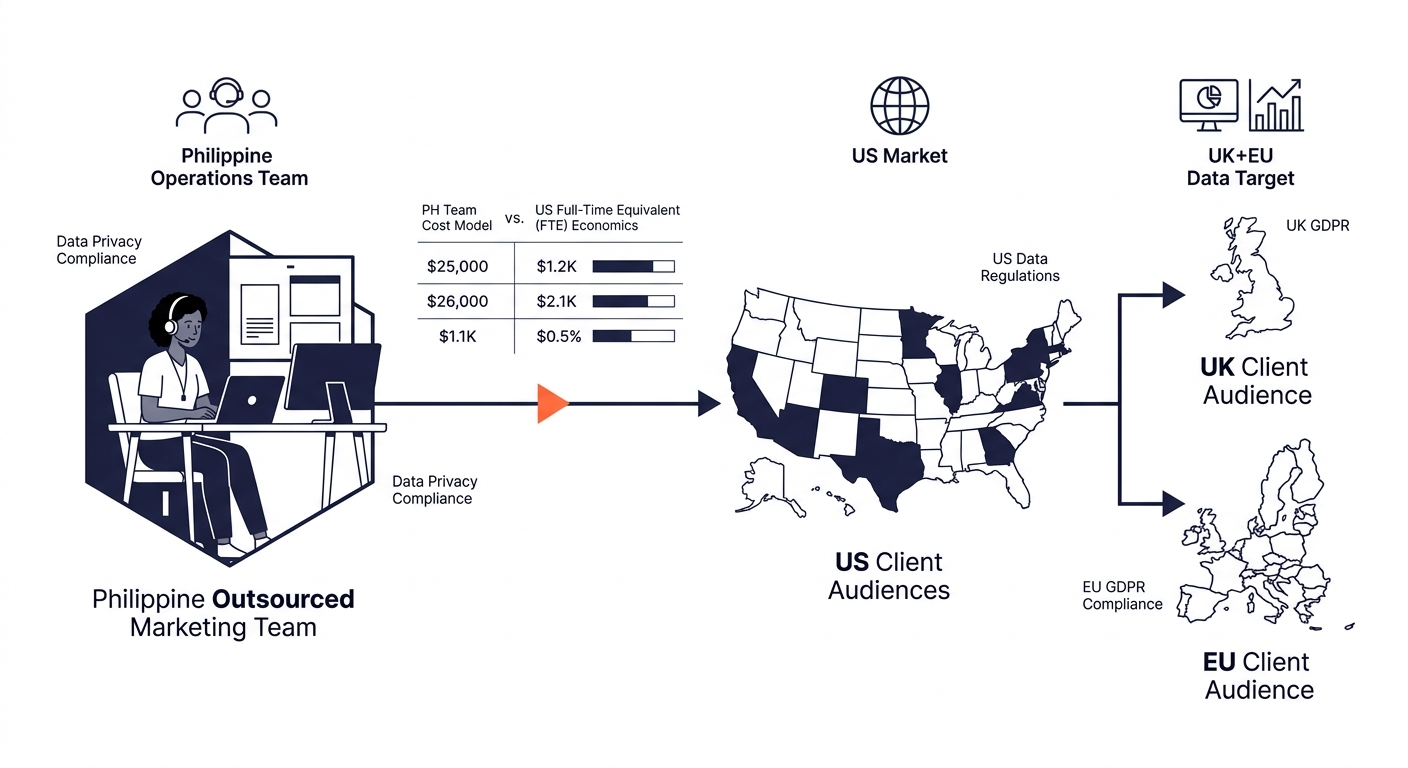
The practical problem for offshore marketing teams is jurisdictional layering. A single email campaign sent from a Philippine-based team, on behalf of an Australian agency, targeting US consumers across multiple states, with tracking pixels that also fire for UK visitors who land on the same page, creates compliance obligations under at least three regulatory regimes simultaneously. And each regime has its own consent standards, data subject rights timelines, and penalty structures.
Where the Compliance Burden Actually Lands in an Offshore Setup
Here’s where digital marketing compliance 2026 gets uncomfortable for companies that outsource execution without thinking through the compliance chain. Under GDPR, the Philippine team is typically a data processor acting on behalf of the data controller (the client company). Under US state laws, the relationship maps to “service provider” or “processor” depending on the state. The controller or business bears primary liability, but that doesn’t mean the processor walks away clean.
GDPR Article 28 requires processors to implement appropriate technical and organizational measures. Standard Contractual Clauses (SCCs) must be in place for cross-border data transfers from the EU or UK to the Philippines. The Philippine Data Privacy Act of 2012 imposes its own obligations on personal information processors, and the National Privacy Commission has shifted to proactive enforcement, demanding demonstrated compliance rather than paper policies.
A single email campaign can create compliance obligations under three regulatory regimes simultaneously, and each regime has its own consent standards, rights timelines, and penalty structures.
Philippine BPO firms operating in regulated industries have responded by building compliance into their operational structure. Many now maintain ISO certifications alongside GDPR and HIPAA alignment, as documented across leading IT outsourcing firms in the Philippines. The compliance capability gap between a team that treats privacy as a checkbox and one that treats it as operational infrastructure is the gap that creates offshore marketing legal risk.
This is where the staffing model matters. Companies that treat outsourced IT services as a cost play without compliance investment end up exposed when a regulator comes calling. The controller can’t outsource liability the way they outsource labor. And as we’ve covered when discussing common outsourcing mistakes that erode ROI, operational shortcuts in the setup phase tend to surface as expensive problems later.
The DPO Question Philippine Teams Are Answering Differently
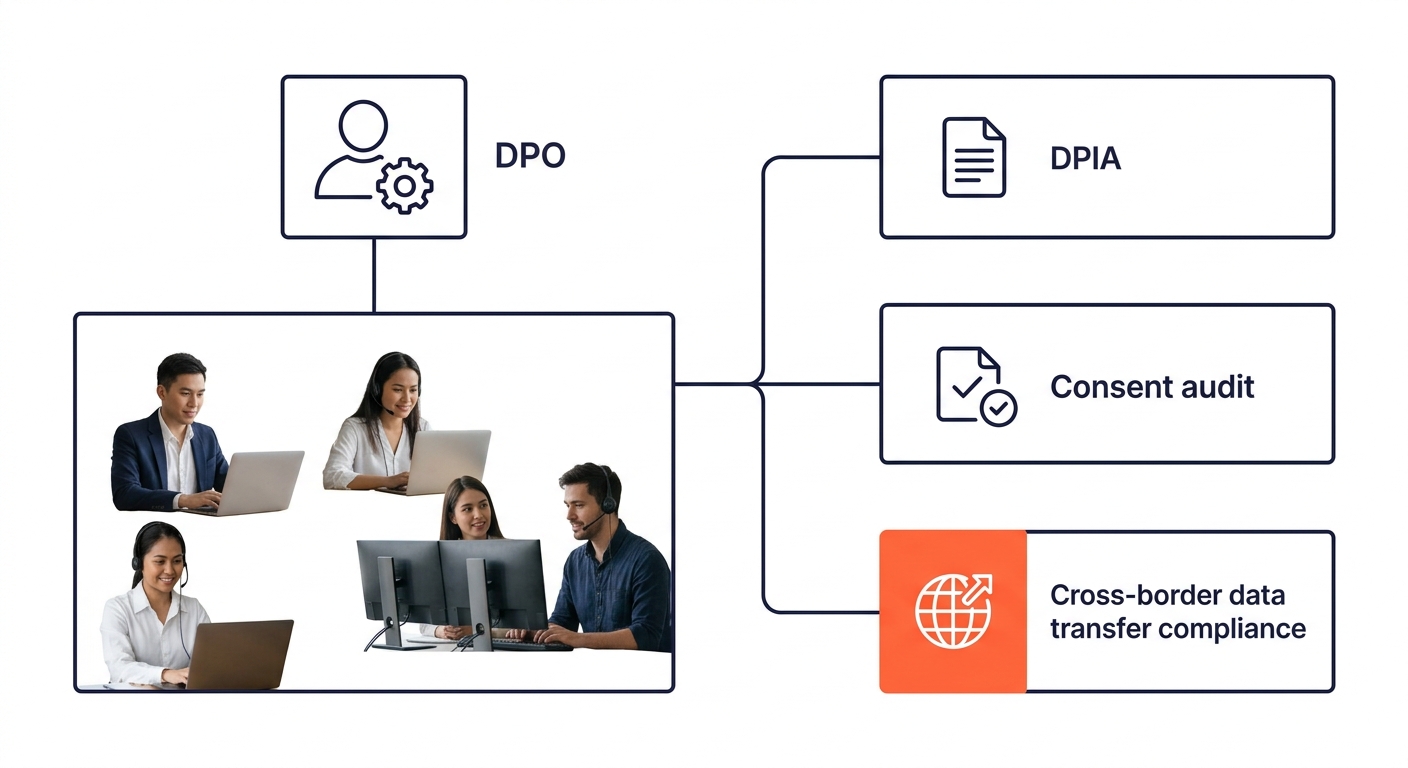
One of the structural responses from Philippine outsourcing operations has been the appointment of Data Protection Officers, either internally or through external providers. Under GDPR, a DPO is mandatory for organizations that carry out large-scale monitoring of data subjects or process special categories of data. Many marketing operations hit one or both of those thresholds, especially when running programmatic advertising, behavioral retargeting, or CRM-driven email campaigns at scale.
The Philippines allows external DPO appointments, and as VeraSafe has noted, an external DPO can bring an impartial perspective to a company’s privacy compliance program, operating independently and without conflicts of interest. This model works well for mid-size Philippine marketing teams that handle data for multiple international clients. A single dedicated DPO can oversee data protection impact assessments across campaigns, audit consent management platform configurations, and maintain the documentation trail that regulators expect.
The alternative, which is more common than it should be, is assigning compliance responsibilities to someone on the marketing team who already has a full workload. That person reviews privacy policies once a quarter, updates a spreadsheet, and hopes nothing surfaces. This approach worked when PECR fines maxed out at half a million pounds and US state laws were limited to California. It doesn’t work when you’re managing compliance obligations across fifteen or more jurisdictions with penalty ceilings in the tens of millions.
Teams adopting privacy-enhancing technologies like tokenization, data minimization at collection, and encrypted processing environments are building the kind of technical layer that satisfies regulators during audits. The cost of a dedicated DPO in the Philippines typically runs between $1,500 and $3,000 per month, depending on scope and seniority. Compare that to the $2.75 million Disney settlement over Global Privacy Control signal handling, and the economics are obvious.
The Compliance Costs That Should Already Be in Your Rate Card
The tendency when discussing GDPR outsourcing Philippines is to frame compliance as an add-on, something bolted onto the marketing engagement after the scope is set. That framing is the root cause of most offshore marketing legal risk. Compliance costs should be visible in the rate card from day one, the same way you’d expect content production at scale to account for quality controls.
Here’s what those costs look like in practice for a Philippine marketing team running multi-jurisdiction campaigns:
- DPO allocation: $1,500-$3,000/month for a shared or dedicated officer
- Consent management platform licensing: $200-$800/month depending on traffic volume and jurisdictions covered
- DPIA documentation: 8-16 hours per new campaign type, typically front-loaded
- SCC administration and annual review: 4-8 hours per client relationship per year
- Ongoing ICO and state law monitoring: 2-4 hours per week to track enforcement actions, guidance updates, and regulatory consultations
These line items add roughly 10-15% to the base cost of an offshore marketing engagement. Companies that skip them aren’t saving money. They’re borrowing against future enforcement risk at a rate they can’t calculate until the bill arrives.
The regulatory trajectory is clear. The ICO is raising fine ceilings and expanding enforcement scope. US states are adding new privacy laws every January. The EDPB’s 2026 coordinated action is specifically targeting transparency in marketing and profiling. Philippine outsourcing teams that have built compliance into their standard operating procedures, with appointed DPOs, documented DPIAs, functional consent mechanisms, and maintained SCCs, are the ones positioned to run campaigns without creating liability for their clients.
The teams that haven’t done this work are still sending emails, still placing pixels, and still configuring tracking tags. They’re doing so under regulatory frameworks that have fundamentally changed since those engagements were scoped. The gap between those two operational realities is where the next wave of enforcement actions will find their targets.