
Outsourcing disputes can be resolved efficiently in the Philippines through strong legal frameworks and practical strategies. The country offers structured approaches using mediation, arbitration, and litigation, supported by laws like the ADR Act of 2004 and the Civil Code of the Philippines. These options prioritize privacy, enforceability, and faster resolutions compared to lengthy court battles.
Key Takeaways:
- Mediation and Arbitration: Preferred for resolving disputes quickly and maintaining business relationships.
- Legal Protections: The ADR Act aligns with international standards, ensuring enforceability of arbitration awards in over 160 countries.
- Contract Design: Clear service level agreements (SLAs), dispute resolution clauses, and force majeure provisions prevent conflicts.
- Prevention Tips: Regular communication, thorough partner vetting, and clear documentation reduce risks.
The Philippine legal system and established ADR infrastructure provide businesses with reliable tools for managing disputes while protecting partnerships and investments.
Legal Framework for Outsourcing Disputes in the Philippines
The Philippines has established a strong legal framework to address disputes in outsourcing by combining traditional contract law with modern approaches to alternative dispute resolution (ADR). Two key laws form the backbone of this system: the Alternative Dispute Resolution Act of 2004 (Republic Act No. 9285) and the Civil Code of the Philippines. Together, these laws provide a structured approach to managing conflicts while upholding the enforceability of contracts.
Philippine ADR Act of 2004
The ADR Act of 2004 (Republic Act No. 9285) introduced faster and more private alternatives to litigation, emphasizing the importance of party autonomy in resolving disputes. This allows businesses to customize their dispute resolution processes directly within their contracts.
Under the Act, arbitration is considered "commercial" when it involves activities such as the supply of goods or services, consulting, or licensing – key elements in outsourcing agreements. For international disputes, the Act aligns with global standards by adopting the UNCITRAL Model Law on International Commercial Arbitration.
If a case is filed in court despite an existing arbitration agreement, the court is required to refer the matter to arbitration during the pre-trial stage, provided the agreement is valid. Additionally, the Act ensures confidentiality for mediation and arbitration proceedings, with information disclosed in these processes being inadmissible in court unless both parties agree otherwise.
The Office for Alternative Dispute Resolution (OADR), established under the Department of Justice, plays a key role in promoting and developing ADR practices nationwide. However, the Act excludes certain disputes from its scope, such as labor issues, matters involving civil status or marriage validity, criminal liability, and other non-negotiable issues. For outsourcing, this means employment-related disputes are typically handled under the Labor Code, rather than through the ADR mechanisms outlined in the Act.
While the ADR Act focuses on the "how" of resolving disputes, the Civil Code of the Philippines addresses the "what" – defining contractual obligations and remedies to ensure outsourcing agreements are legally sound.
Civil Code of the Philippines
The Civil Code of the Philippines (Republic Act No. 386) complements the ADR Act by outlining the foundations of valid contracts and specifying the consequences of breaches. Book IV on Obligations and Contracts serves as the cornerstone for outsourcing agreements. Articles 1306 and 1308 empower parties to define their own terms – such as service level agreements and penalties – while ensuring mutual obligations are fair and enforceable.
The Civil Code also provides clear guidelines for what constitutes a breach of contract, the liabilities involved, and the remedies available, which can include rescission or damages. Additionally, it governs compromise agreements, ensuring that settlements reached through mediation are legally binding.
For legal claims, there’s generally a five-year prescriptive period unless otherwise stated. Philippine courts may also apply the doctrine of laches, which prevents claims if there’s an unreasonable delay in enforcing rights, making timely action crucial in dispute resolution. These provisions help reduce uncertainty and streamline the resolution process for outsourcing contracts.
Dispute Resolution Methods for Outsourcing Contracts
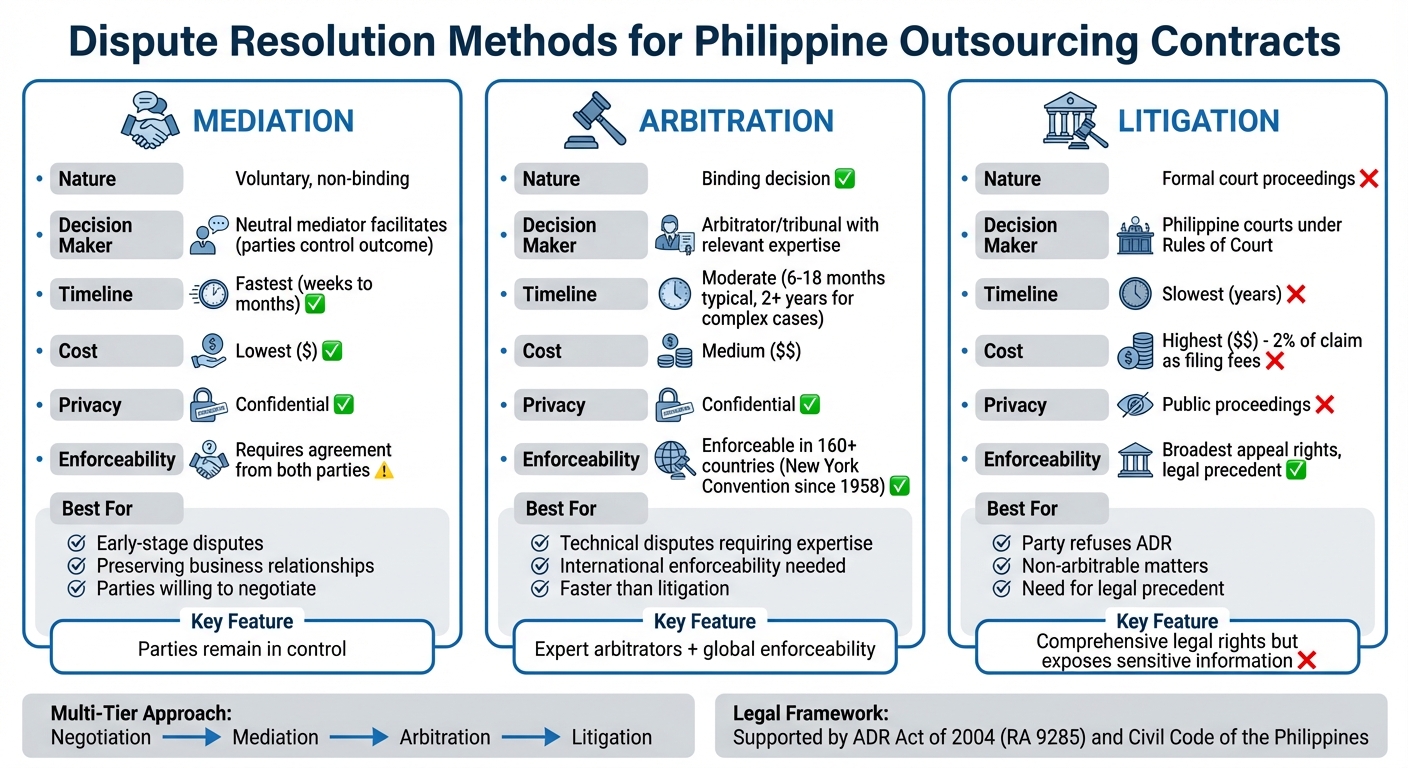
Comparison of Dispute Resolution Methods in Philippine Outsourcing: Mediation vs Arbitration vs Litigation
When outsourcing disputes arise, businesses typically turn to mediation, arbitration, or litigation. Each approach suits different scenarios, balancing factors like cost, time, and the importance of preserving relationships.
Mediation involves a neutral third party helping both sides reach a mutually agreeable solution. This method is voluntary, quick, and cost-effective, making it ideal for early-stage disputes or when maintaining a working relationship is crucial. The mediator doesn’t impose a decision – both parties remain in control of the outcome. Mediation works best when both sides are open to negotiation and committed to resolving the issue without hostility.
Arbitration bridges the gap between mediation and litigation. In this process, an arbitrator or tribunal reviews evidence and delivers a binding decision, similar to a court ruling. Arbitration is faster than litigation, avoiding the delays often seen in the Philippine court system, where cases can drag on for years. Since the Philippines has been a signatory to the New York Convention since 1958, arbitral decisions are enforceable in over 160 countries. A key advantage of arbitration is the ability to choose arbitrators with relevant expertise – such as IT specialists for software-related disputes or BPO experts for service delivery issues. While arbitration typically concludes within 6 to 18 months, more complex international cases may take over two years.
Litigation, on the other hand, involves formal proceedings in Philippine courts under the Rules of Court. Although it provides the broadest appeal rights and establishes legal precedent, it’s the slowest and most expensive option. Court cases are public, which can expose sensitive information, and filing fees are around 2% of the total claim amount. Litigation is often unavoidable if one party refuses to engage in alternative dispute resolution (ADR) or if the matter involves issues that can’t be arbitrated.
Under the ADR Act, mediation and arbitration offer streamlined alternatives to litigation. Choosing the right method depends on priorities: mediation is best for speed and preserving relationships, arbitration suits cases requiring technical expertise and international enforceability, and litigation is necessary for comprehensive legal rights and formal precedent. Many outsourcing contracts include multi-tier dispute resolution clauses, requiring negotiation and mediation before escalating to arbitration or court proceedings. These options, grounded in Philippine law, help ensure disputes are resolved efficiently while protecting business partnerships.
Contract Clauses That Prevent Disputes
The smartest way to manage disputes in outsourcing contracts? Stop them before they start. By combining solid legal frameworks with proactive contract design, you can address potential issues before they escalate. While alternative dispute resolution (ADR) methods provide quick solutions, well-crafted contract clauses can reduce the likelihood of disagreements altogether. Clear and precise wording is key to avoiding misunderstandings. Below are three essential provisions – dispute resolution, service levels, and clauses for unforeseen events – that help keep conflicts at bay.
Dispute Resolution Clause
A well-defined dispute resolution clause lays out the process for resolving disagreements. It should specify key details like the governing law, the forum, the chosen ADR method (mediation, arbitration, or a multi-step process), the language for proceedings, and confidentiality rules. Comprehensive language ensures that all possible claims – whether related to the contract, tort, or statutory rights – are covered. This clarity creates a foundation for other preventive measures, such as those outlined in Service Level Agreements (SLAs).
"Establish unambiguous service-level metrics, payment schedules, acceptance criteria, and dispute resolution procedures." – Respicio.ph
Service Level Agreements (SLAs)
SLAs are all about setting clear expectations. They outline performance benchmarks and remedies, like service credits or liquidated damages, to measure service quality objectively. By clearly defining these standards, SLAs help both parties quickly identify shortcomings and avoid disputes over whether the work meets agreed-upon expectations. They also act as a safeguard against scope creep, making it clear which tasks are included in the original agreement and which might require additional charges.
Force Majeure and Termination Clauses
Force majeure clauses address unexpected disruptions, such as natural disasters, pandemics, or political upheaval. These provisions typically combine broad language with a specific list of events, explaining when obligations can be suspended or excused. Meanwhile, termination clauses clarify valid reasons for ending the contract, required notice periods, and the steps for a smooth exit. Even if the main contract is deemed void, the dispute resolution clause often remains enforceable under the separability principle.
sbb-itb-5665bbf
How to Minimize Disputes in Outsourcing Partnerships
Even the best-written contracts can’t promise a conflict-free outsourcing experience. What truly matters is how the partnership is managed daily. Clear communication, understanding cultural differences, and picking the right partner from the start are far more effective at preventing disputes than relying solely on legal terms. Here’s how you can take proactive steps to reduce potential conflicts.
Regular Communication and Reporting
Good communication is the backbone of any successful partnership. It helps resolve small issues before they snowball into major conflicts. Start by setting up a clear escalation process – one that moves from project managers to senior leaders, and eventually to executives if needed. Each stage should have a specific timeframe, such as 15 to 30 days for negotiation, before escalating further. Also, clearly define how formal notices should be sent (e.g., via email, registered mail, or courier) and who should receive them.
Keep thorough records of all interactions, including emails, change requests, timesheets, and acceptance certificates. These documents act as a safety net if disagreements arise, helping to clarify expectations and avoid "scope creep." Regularly review the contract to ensure performance metrics stay relevant as the project evolves. Implement milestone-based billing to tie payments to verified deliverables, promoting accountability and consistent service quality. These steps not only reduce risks but also build trust and mutual understanding.
Cultural Awareness and Adaptation
Legal agreements are important, but understanding cultural differences can prevent many disputes. For example, the Philippines is a popular outsourcing hub known for its skilled workforce and strong English proficiency, which reduces language barriers. But effective collaboration goes beyond language. Understanding how your Philippine partner approaches business relationships can make all the difference.
"Internal escalation… helps preserve the commercial relationship by fostering amicable settlements before more adversarial methods come into play." – Respicio & Co.
By maintaining open communication channels and monitoring progress closely, you can address minor disagreements before they escalate into major issues.
Selecting a Reliable Outsourcing Partner
The foundation of a successful outsourcing relationship lies in picking the right partner. Conduct thorough due diligence before signing any agreements. Check their legal status through the Securities and Exchange Commission (SEC), assess their financial stability, and review their history of legal or regulatory issues. A provider with a clean compliance record and a strong track record of meeting Service Level Agreement (SLA) targets is far less likely to cause future headaches.
Choose a partner who values contractual clarity and has solid dispute resolution practices. They should agree to clearly defined project scopes, milestone-based billing, and specific remedies for non-performance. Additionally, ensure they comply with the Data Privacy Act of 2012 to avoid both contractual and regulatory troubles. Companies like 365Outsource.com stand out by offering transparent communication, dependable support, and tailored solutions that integrate smoothly into client operations – minimizing the friction that can lead to disputes.
| Common Dispute Cause | Prevention Strategy During Partner Selection |
|---|---|
| Scope Creep | Ensure the partner defines a clear Statement of Work (SOW) and change process |
| Performance Issues | Review their history of meeting realistic SLA targets and benchmarks |
| IP Infringement | Confirm they accept strong Intellectual Property Rights (IPR) clauses |
| Payment Disagreements | Verify fixed exchange rates and clarify who handles bank transfer fees |
| Confidentiality Breach | Require strict NDAs and data security audits |
Conclusion
Disputes in outsourcing don’t have to disrupt your operations. The Philippine legal system strongly supports Alternative Dispute Resolution (ADR), favoring it over lengthy courtroom battles. ADR offers faster, more private, and technically informed resolutions. Thanks to the Philippines’ adherence to the UNCITRAL Model Law and its status as a signatory to the New York Convention, arbitration awards are enforceable in over 160 countries – making it a trusted framework for international outsourcing agreements. These legal protections complement the practical safeguards of well-drafted contracts.
"Ultimately, careful contract drafting and proactive dispute prevention measures are the keys to a smoother relationship and minimize the risk of protracted legal battles." – Respicio & Co.
Strong contracts with clear SLAs, choice of law clauses, and multi-tier dispute resolution mechanisms can effectively prevent conflicts. By starting with negotiation, moving to mediation, and, if necessary, concluding with binding arbitration, businesses can protect relationships while ensuring fair and predictable outcomes . Philippine courts respect party autonomy, intervening minimally and upholding agreements that have been thoughtfully negotiated .
Consistent communication and meticulous documentation are also critical in reducing conflicts. Partnering with a provider that values transparency, maintains compliance, and delivers on clear performance metrics lays the foundation for a long-lasting collaboration. Companies like 365Outsource.com embody this approach, offering dependable support and tailored solutions that integrate seamlessly into your business.
"Knowledge and preparation stand as the best defenses against protracted disputes." – Harold Respicio, Attorney
FAQs
What are the benefits of choosing mediation instead of litigation for outsourcing disputes in the Philippines?
Mediation brings several advantages compared to litigation when handling outsourcing disputes in the Philippines. It’s often quicker, less expensive, and provides a level of privacy that’s crucial for safeguarding sensitive information and preserving business relationships.
This approach is also less confrontational, encouraging collaboration and understanding between parties. This aligns well with the Philippines’ focus on alternative dispute resolution (ADR) methods, as outlined in the ADR Act of 2004. By choosing mediation, businesses can address conflicts effectively while maintaining a positive and professional connection with their outsourcing partners.
How does the ADR Act of 2004 improve the global enforceability of arbitration awards?
The ADR Act of 2004 (Republic Act No. 9285) boosts the global enforceability of arbitration awards by adhering to international guidelines. It integrates the UNCITRAL Model Law and the New York Convention, ensuring that foreign arbitral awards are recognized and enforceable within the Philippines.
By aligning with these standards, the law minimizes legal obstacles and facilitates smoother dispute resolution for businesses engaged in cross-border operations. This makes arbitration a dependable method for addressing outsourcing contract disputes in the Philippines.
What key clauses should be included in outsourcing contracts to avoid disputes?
Including certain clauses in outsourcing contracts can go a long way in minimizing disputes. For example, governing law and jurisdiction clauses spell out which legal system applies and where any disputes will be handled, bringing clarity from the start. Service level agreements (SLAs) are another key element, as they lay out performance standards and specify accountability measures. Additionally, termination clauses detail the steps and conditions for ending the agreement, ensuring a smoother exit if needed. Finally, data security provisions safeguard sensitive information and help meet privacy regulations. Together, these clauses set clear expectations and establish a strong framework for a successful outsourcing relationship.