
Looking to cut costs and access skilled talent? Hiring offshore teams in the Philippines offers a clear path to achieving both. With labor costs up to 88% lower than in the U.S., a highly skilled, English-speaking workforce, and government-backed incentives, the Philippines has become one of the top destinations for outsourcing. Here’s why:
- Cost Savings: Labor expenses in the Philippines are 60–88% lower. For example, a U.S.-based customer support role costing $2,500–$3,500 per month can be filled for $350–$600 offshore.
- Skilled Workforce: The country produces 750,000+ university graduates annually, many fluent in English and trained in IT, engineering, and other specialized fields.
- Time Zone Advantage: Filipino professionals are accustomed to night shifts, enabling 24/7 operations for U.S. businesses.
- Tax Incentives: Programs like PEZA offer tax breaks, reducing operational costs by 40–50%.
Whether you need long-term team extensions, project-based help, or managed services, the Philippines provides flexible hiring models to match your business goals. However, success depends on choosing the right outsourcing partner, understanding local labor laws, and ensuring proper integration of your offshore team.
Ready to explore the details? Let’s dive into the benefits, hiring models, legal considerations, and strategies to make your offshore team thrive.
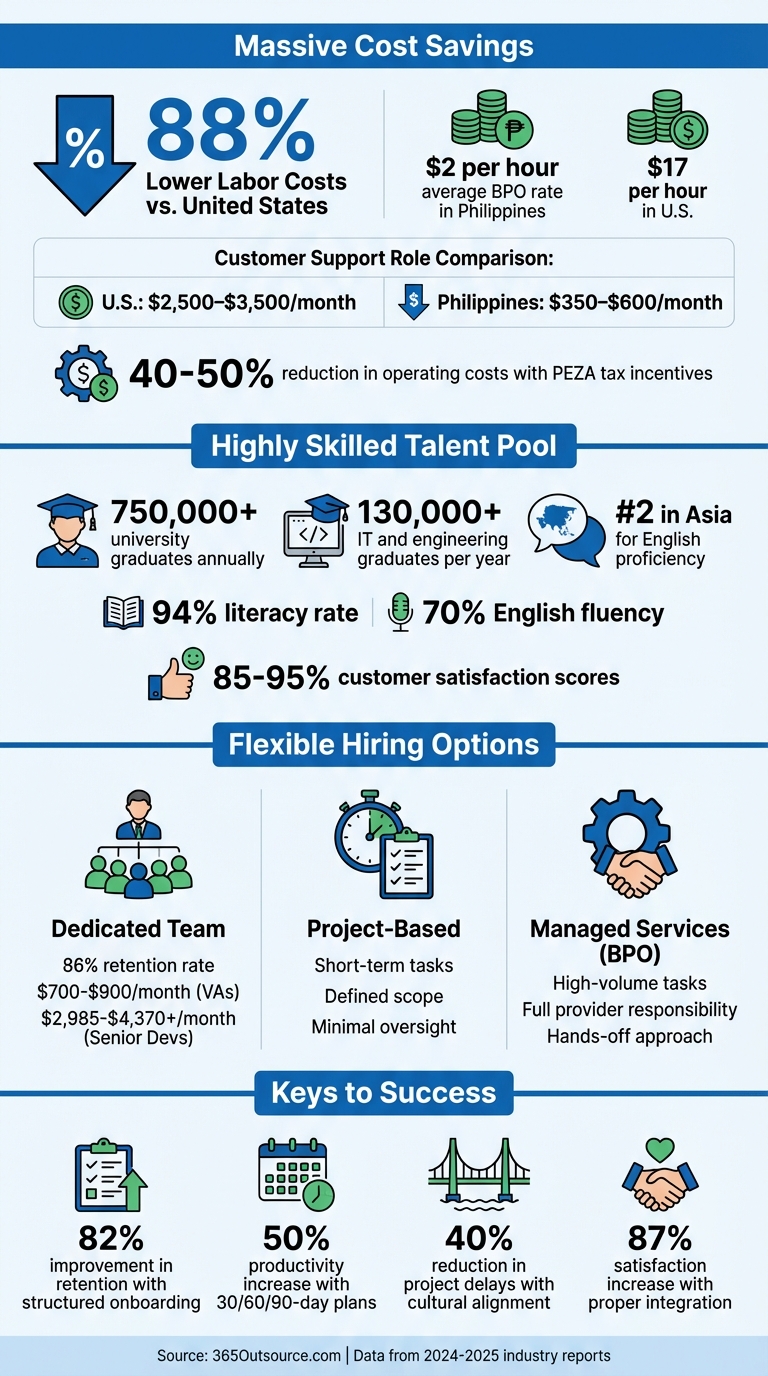
Cost Savings and Benefits of Hiring Offshore Teams in the Philippines
Benefits of Hiring Offshore Teams in the Philippines
Cost Efficiency
One of the biggest perks of hiring offshore teams in the Philippines is the dramatic reduction in labor costs – savings can range from 60% to 88% compared to hiring in the U.S.. For instance, while a U.S.-based customer support representative earns about $2,500–$3,500 per month, the same role in the Philippines costs only $350–$600. This trend holds true across other roles like accounting and software development.
"The average hourly BPO rate in the Philippines approximates $2 per hour, compared to around $17 per hour in the United States – representing an 88% reduction in labor costs." – 365Outsource.com
Beyond salaries, businesses save on office space, hardware, and utilities because offshore providers typically handle these expenses. On top of that, the Philippine government offers tax incentives through the PEZA program, including a full exemption from corporate income tax for up to eight years, followed by a 5% special tax on gross income. These factors collectively reduce operating costs by 40% to 50%. Plus, you gain the flexibility to adjust team sizes based on business needs, converting fixed labor costs into variable ones – perfect for scaling down during slower periods without paying for unused capacity.
And while the cost savings are impressive, the Philippines also stands out for its highly skilled and English-proficient workforce, which adds even more value.
Skilled and English-Proficient Workforce
The Philippines pairs cost efficiency with a workforce that’s both skilled and fluent in English. Ranked #2 in Asia for English proficiency and 28th globally out of 123 countries, the country boasts a 94% literacy rate, with 70% of its population fluent in English. This minimizes communication barriers, making collaboration with U.S. teams smooth and efficient.
Every year, the Philippines produces over 800,000 college graduates, including more than 130,000 specializing in IT and engineering. Many Filipino professionals hold globally recognized certifications in areas like AWS, Google Cloud, PMP, and CPA. Their performance speaks for itself – customer satisfaction scores often range between 85–95%, matching or even surpassing those of in-house teams in North America.
The workforce also shines in specialized fields like software development (with expertise in Python, JavaScript, and Java), data analysis, cybersecurity, AI, and cloud architecture. Additionally, their neutral, American-style accents make them especially effective in voice-based BPO roles.
Cultural Compatibility and Work Ethic
Cultural alignment and a strong work ethic are other reasons why Filipino teams excel. Historical ties between the U.S. and the Philippines (from 1898 to 1946) have shaped the country’s educational, legal, and business systems, making them closely resemble Western models. This shared history means Filipino professionals easily understand American idioms, humor, and cultural references, which helps foster better communication and collaboration.
This compatibility is further enhanced by core Filipino values. The concept of malasakit reflects a deep sense of care and responsibility for an organization’s success, while bayanihan and pakikisama emphasize teamwork and harmony. Companies that invest in their Filipino teams often see lower turnover rates and a strong sense of loyalty. Additionally, the hospitality-driven mindset of Filipino professionals makes them particularly effective in customer-facing roles.
Cultural friction is a common cause of underperformance in offshore engagements, accounting for nearly 70% of such issues. However, Filipino teams’ cultural alignment significantly reduces this risk. In fact, cross-cultural training and alignment can cut project delays by up to 40%, making Filipino teams a reliable choice for global businesses.
sbb-itb-5665bbf
How to Outsource to the Philippines: The Complete Guide
Hiring Models for Offshore Teams in the Philippines
Once you’ve decided to hire offshore, the next step is choosing the right model for your business. The Philippines offers several options tailored to different needs, whether you’re looking for a long-term team extension, help with a one-time project, or a fully managed solution.
Dedicated Team Model
The dedicated team model is perfect for businesses seeking a long-term extension of their in-house team. Under this setup, an outsourcing provider takes care of recruitment, onboarding, HR, and infrastructure for an entire team – such as developers, QA specialists, and project managers. While the provider handles these logistics, you maintain control over the team’s daily tasks, culture, and product direction.
This model is ideal for companies that prioritize close collaboration and want offshore staff to feel like part of their core team. It also boasts impressive retention rates, with dedicated setups achieving 86%, compared to the 30–40% annual turnover typical in traditional BPO environments. Filipino employees in these roles also report average tenures of over 34 months, significantly higher than the industry norm. Costs range from $700–$900 monthly for virtual assistants to $2,985–$4,370+ for senior developers, covering salaries, benefits, and provider fees.
"The companies that perform best don’t optimize for location. They optimize for how their offshore teams operate." – Global Staff Network
If your needs are more short-term or project-specific, there are other models to explore.
Project-Based Outsourcing
Project-based outsourcing is ideal for defined, short-term tasks like building a website, integrating a CRM, or conducting an accounting audit. You provide the scope, and the outsourcing company manages the project from start to finish. This model is best for tasks that don’t require constant collaboration with your core team or real-time integration. However, keep in mind that you’ll have less control over the process, which makes it a better fit for non-core activities where results are the main focus.
For businesses needing minimal involvement in day-to-day operations, the Managed Services Model could be a better fit.
Managed Services Model
The managed services model, often referred to as BPO, shifts full responsibility for operations to the outsourcing provider. They handle everything – hiring, training, performance tracking, and meeting KPIs – while you focus on your core business. This hands-off approach is best suited for high-volume, repetitive tasks like Tier 1 customer support, IT helpdesk functions, or data entry.
In this setup, the provider is accountable for meeting deliverables rather than managing individual team members. It’s an excellent choice for businesses without the internal resources to oversee remote teams.
"BPO is well-suited for transactional, high-volume functions. EOR [Dedicated Teams] is ideal for specialized roles, product teams, or long-term offshore expansion where continuity and integration are critical." – Clara Crisostomo, KMC Solutions
Steps to Hire Offshore Teams in the Philippines
If you’re ready to tap into the talent pool in the Philippines, here’s a step-by-step guide to help you hire an offshore team effectively.
Define Your Business Needs
Start by identifying the roles you need to fill and the skills required. These could include IT, customer support, accounting, finance, or creative services – areas where hiring locally might be challenging. Be specific about job responsibilities, technical expertise, English proficiency, and experience levels.
Set clear performance metrics like KPIs and OKRs, and consider behavioral traits that align with your company values. It’s also important to decide on practical matters such as work schedules, time zone overlap, and reporting structures.
"A successful Filipino offshore staff is not a group of freelancers or a third-party vendor. They are a dedicated and integrated team that becomes part of your company culture, uses your systems, and works towards your strategic objectives."
– Romelie Annette De Leon, Author
Prepare standard operating procedures (SOPs) and assign an onshore manager to oversee the team’s integration. When budgeting, include costs beyond salaries, such as government-mandated benefits (SSS, PhilHealth, Pag-IBIG), 13th-month pay, and expenses for equipment and software.
Once your needs are clear, you can move on to selecting the best hiring model.
Select a Hiring Model
Choose a hiring model that aligns with your goals. For first-time offshore hiring, an Employer of Record (EOR) model is a good starting point. This approach ensures compliance, as the provider acts as the legal employer. Use this model to test the waters with an offshore team over 12–24 months before committing to a local entity.
When your team grows to 30–50+ members, consider transitioning to a local entity or adopting a Build-Operate-Transfer (BOT) model. Always request a detailed cost breakdown from potential providers, covering expenses like 13th-month pay, health insurance, night shift differentials, and equipment fees to avoid unexpected charges.
After deciding on the right model, the next step is to find a reliable outsourcing partner.
Partner with a Trusted Outsourcing Provider
The success of your offshore team depends heavily on the provider you choose. Look for a partner with a proven track record, strong client reviews, and a transparent approach to pricing and processes. They should ensure compliance with the Philippine Labor Code, local tax regulations, and statutory benefits.
Ask about employee retention rates to gauge team stability and review their recruitment strategies to confirm they can meet your technical and cultural expectations. Don’t forget to assess their data security measures and certifications like ISO 27001, PCI-DSS, or GDPR readiness.
A reliable partner, such as 365Outsource, can handle recruitment, onboarding, payroll, and IT support, allowing you to focus on scaling your business. With dedicated account management, they simplify operations and ensure compliance, serving as a single point of contact for your needs.
"Offshoring in the Philippines works when you plan deliberately and manage well. You gain skilled, English-speaking talent and long-term scalability, but only if you get structure, compliance, and integration right from day one."
– Chris Van Vladricken, CEO and Co-Founder, ScalableOS
Legal and Compliance Considerations When Hiring Offshore Teams
Hiring offshore teams in the Philippines comes with specific legal requirements aimed at protecting workers and defining employer responsibilities. It’s crucial to understand these laws to minimize risks and establish trust with your team.
Employment Laws in the Philippines
The Labor Code of the Philippines (Presidential Decree 442) governs employment relationships, covering areas like wages, working hours, job security, and termination procedures. For remote workers, the Telecommuting Act (Republic Act 11165) ensures they receive the same pay, benefits, and treatment as on-site employees.
Proper worker classification is critical. Misclassifications can lead to legal issues. Philippine courts use a "four-fold test" to determine the nature of the employment relationship, focusing on control over selection, payment, dismissal, and work processes. As Respicio & Co. explains:
"The law looks at the substance of the relationship rather than its label".
Even if a contract specifies foreign laws, Philippine labor laws still apply to employees based in the Philippines. Employers are required to provide mandatory benefits, including contributions to the Social Security System (SSS), PhilHealth, and Pag-IBIG. As of 2025, SSS contributions are around 14–15% of the salary, and PhilHealth contributions are 5%.
Here’s a quick breakdown of key mandatory benefits:
| Benefit | Requirement |
|---|---|
| 13th-Month Pay | 1/12 of annual salary, paid by December 24 |
| Service Incentive Leave | 5 paid leave days after one year of service |
| SSS/PhilHealth/Pag-IBIG | Monthly employer and employee contributions |
| Night Differential | 10% premium for work between 10 PM and 6 AM |
| Maternity Leave | 105 days (120 for solo parents) |
| Paternity Leave | 7 days for the first 4 deliveries |
Termination requires strict adherence to due process. "Just cause" (e.g., misconduct) or "authorized cause" (e.g., redundancy) must be established, and the twin-notice rule applies: a written "Notice to Explain" and a "Notice of Decision" are required. Separation pay may range from half to one month’s salary per year of service, depending on the cause of termination.
As of July 2023, the minimum wage in Metro Manila was PHP 610 per day. Overtime pay is calculated at an additional 25% of the hourly rate. For companies without a local entity in the Philippines, partnering with an Employer of Record (EOR) can help manage payroll, taxes, and statutory contributions while ensuring compliance.
Once employment standards are addressed, the focus shifts to securing data and meeting digital compliance requirements. This is especially critical when managing outsourced digital marketing services that handle sensitive customer information.
Data Privacy and Security
The Data Privacy Act of 2012 (Republic Act 10173) regulates personal data processing in the Philippines, including by foreign companies employing local teams. Companies handling data for over 1,000 employees must appoint a Data Protection Officer (DPO) and register with the National Privacy Commission (NPC).
Data breaches must be reported to the NPC within 72 hours, with fines of up to PHP 5,000,000 for non-compliance. Employers are also responsible for securing remote work environments under the Telecommuting Act, which mandates robust data protection measures.
For outsourcing arrangements, use Data Processing Agreements (DPAs) when your company controls the data and the offshore team processes it. Data Sharing Agreements (DSAs) are necessary for data exchanges between controllers. If transferring data from the EU to the Philippines, ensure compliance with EU-approved safeguards like Standard Contractual Clauses (SCCs).
Employ technical measures such as encryption, multi-factor authentication (MFA), and Mobile Device Management (MDM) to protect data. Be transparent about monitoring practices, whether through CCTV, keystroke logging, or productivity tools, and provide written notices to meet legitimate interest standards. Conduct Privacy Impact Assessments (PIAs) for high-risk data processing or monitoring systems.
After meeting legal and data security requirements, clear contracts can further protect both parties and clarify expectations.
Contracts and Service-Level Agreements
A well-structured contract is essential for defining roles and responsibilities. Specify employment status – whether regular, probationary, project-based, casual, or independent contractor – to avoid potential misclassification issues. For independent contractors, explicitly state that no employer-employee relationship exists.
Include details like base salary, payment currency, and payment schedule. For employees, outline mandatory benefits and clarify responsibilities for statutory contributions. Define standard work hours (typically eight hours per day, 40 hours per week) and reference the mandatory benefits table for overtime and night shift requirements.
To protect intellectual property, include "work-for-hire" clauses that transfer ownership of deliverables to your company upon payment. Non-Disclosure Agreements (NDAs) can safeguard sensitive business information, while a Data Privacy Annex ensures compliance with the Data Privacy Act.
For probationary employees, note that the evaluation period is capped at six months. If performance standards are not clearly outlined, the employee may automatically become regular after this period. As Raymond Rodis of Penbrothers points out:
"Knowing the basics of labor law isn’t just about compliance – it’s about building trust and long-term success with your Filipino team".
Service-Level Agreements (SLAs) should detail key performance indicators (KPIs), reporting protocols, response times, and time zone overlaps. For independent contractors, consider adding a "stop work" clause to pause work if invoices remain unpaid.
Challenges and Solutions in Managing Offshore Teams
Managing offshore teams in the Philippines comes with its own set of challenges, particularly around productivity and morale. However, understanding these hurdles makes it easier to find practical solutions.
Communication Across Time Zones
The Philippines operates on GMT+8, which can mean up to a 12-hour difference with U.S. time zones. This gap often causes delays in handoffs and unanswered queries. To address this, establish a 2–3 hour overlap window for live discussions. Many Filipino professionals work night shifts (typically 9:00 PM to 6:00 AM) to sync with U.S. hours, often earning an additional 10–30% night differential premium for this arrangement. Rotating meeting times can also help distribute after-hours inconvenience fairly.
Another challenge stems from a cultural tendency to agree even without full understanding, often to avoid conflict. As Shore360 explains:
"In Filipino culture, agreeing (‘yes’) is common even when the context isn’t fully grasped, often to avoid prolonged discussions".
To mitigate this, focus on overcommunication. Summarize meetings in writing, confirm deadlines, and ask clarifying questions like, "Can you walk me through how you’ll approach this?"
For routine updates, asynchronous tools like Loom (for video messages) and Slack (for topic-based conversations) can streamline communication. Scheduling apps like World Time Buddy make coordinating across time zones easier. These strategies not only improve clarity but also set the stage for measuring productivity effectively.
Ensuring Productivity and Accountability
Tracking performance remotely requires a shift from monitoring hours worked to evaluating outcomes. Use frameworks like SMART objectives or OKRs to define clear deliverables, and monitor progress with tools like Jira, Asana, or ClickUp. These platforms provide real-time dashboards for tracking task status, deadlines, and quality metrics, ensuring transparency without micromanagement. As Crewbloom puts it:
"Trust is everything. You can’t exactly stroll over to someone’s desk to ‘see how it’s going’… accountability shouldn’t feel like a police check; it should feel like teamwork".
To avoid ambiguity, establish Standard Operating Procedures (SOPs) for recurring tasks and store them in centralized knowledge bases like Notion or Confluence. Companies that implement structured 30/60/90-day onboarding plans report retention rates improving by 82% and productivity increasing by 50%. Additionally, appointing an in-house quality specialist to review offshore output before it reaches clients can further ensure consistency.
Clear performance metrics combined with a collaborative approach create an environment where accountability feels supportive rather than intrusive.
Building Team Collaboration and Engagement
Remote teams can feel disconnected if they aren’t integrated into the broader company culture, leading to disengagement or burnout. Treat offshore employees as integral team members by including them in company-wide meetings, announcements, and decision-making processes.
In Filipino culture, relationship-building is key. Trust and loyalty grow when leaders invest in genuine human connections. Schedule regular one-on-one video calls to build rapport and address issues early. When giving feedback, use the "Sandwich Method" (positive feedback, followed by constructive criticism, and ending on a positive note) to align with cultural sensitivities.
Creating informal spaces for interaction can also help. Dedicated Slack channels for non-work topics or virtual team-building activities can simulate the camaraderie of an office environment. Peer buddy systems for new hires help them adjust to company culture, while celebrating team wins in group chats fosters a sense of belonging.
Offering growth opportunities is another way to keep teams engaged. Virtual training, certifications, and clear career paths encourage long-term commitment – 94% of employees are more likely to stay with companies that invest in their learning. Additionally, acknowledge Filipino holidays and traditions, as many professionals prefer not to work on Sundays or Christian holidays.
How 365Outsource Simplifies Offshore Team Hiring
365Outsource takes the complexity out of building offshore teams, saving businesses countless hours and headaches. While creating an offshore team can take up to 50 hours per hire, 365Outsource eliminates this time sink by managing everything – from recruitment to compliance. This approach allows businesses to focus on growth while leaving the administrative tasks to the experts.
Complete Staffing Solutions
365Outsource offers flexible staffing options across four major areas:
- Digital Marketing: Services include SEO, PPC, and social media management.
- Web Development: Expertise spans WordPress, PHP, and mobile app development.
- Data Processing: Tasks like data entry, bookkeeping, and medical transcription are covered.
- Virtual Assistance: Includes email management, research, and call handling.
This range of services means businesses can scale multiple functions at once without juggling multiple vendors. Additionally, 365Outsource provides cost-effective solutions, offering SEO specialists at rates of $4 to $8 per hour or $640 to $1,280 monthly for full-time roles. They also handle HR, insurance, and statutory benefits, eliminating hidden costs.
Customized Hiring and Management Processes
365Outsource enhances the hiring process by tailoring it to your specific project needs and budget. As the company explains:
"Our products are customized for each client and based on the needs of their business projects".
Clients can opt for a managed services model, where 365Outsource oversees intake, workflow, and deliverables, or a dedicated team model, where offshore staff integrate directly with your in-house operations. Each client is assigned a dedicated account manager to ensure seamless communication and personalized support. To add value, the company also provides complimentary SEO proposals.
For transparency, tools like staging sites are used during web development, allowing clients to monitor progress in real time.
Integration with Client Operations
365Outsource ensures offshore staff align with your business culture and processes. Dedicated specialists work closely with clients from day one to ensure a smooth transfer of internal practices to the offshore team. As they put it:
"Our dedicated specialists work closely with you from start to finish, so we understand what you want and transfer your business culture and process to our offshore environment successfully".
To maintain seamless collaboration, 365Outsource uses familiar tools like Slack, Zoom, Asana, Monday.com, and Trello. This ensures offshore staff operate as strategic partners, upholding your brand standards and customer service expectations while fostering unified operations across borders.
Conclusion
Offshore teams in the Philippines offer a combination of cost savings and skilled talent, but their success depends on how well they are integrated into your business. While the advantages are undeniable, the initial integration phase plays a critical role in determining long-term outcomes. Statistics show that outsourcing efforts fail in 40% to 70% of cases due to poor planning and mismatched expectations.
On the other hand, companies that implement structured integration frameworks during the first 90 days see an 87% increase in satisfaction rates and achieve productivity 43% faster. This process includes clearly defining roles with measurable outcomes, setting up effective communication systems, and treating offshore team members as an essential part of your core workforce.
For example, in 2025, Servantex expanded its offshore accounting team in the Philippines from one specialist to 11, cutting costs by 69% while enabling 24/7 business operations. Similarly, Propeller Aero successfully hired 50 specialized roles within just 40 days, saving 73% per role compared to hiring locally in Australia.
The financial appeal is further underscored by the Philippine BPO sector, which generated $38 billion in revenue in 2024, with labor costs that are roughly 88% lower than in the United States. However, the real value lies in building a dedicated, integrated team that aligns with your company’s culture and long-term objectives.
365Outsource simplifies the process by managing recruitment, compliance, and integration, ensuring your offshore team functions as a seamless extension of your business. Success in offshoring comes from treating it as a strategic partnership – founded on trust, accountability, and thoughtful planning – rather than just a way to cut expenses.