
Deciding between in-house and outsourced social media analytics depends on your budget, goals, and team capacity. Here’s a quick breakdown to help you choose:
- In-House: Offers more control and alignment with your brand but comes with high costs (e.g., a social media manager’s salary averages $72,000/year) and slower scalability.
- Outsourced: Provides access to experts and tools at a predictable monthly cost ($500–$10,000+), but you may face challenges with communication and data security.
Key Insights:
- Costs: In-house is expensive due to salaries and tools, while outsourcing is often more affordable.
- Scalability: Outsourcing adjusts quickly to campaign needs, while in-house teams require time to hire and train.
- Data Security: In-house offers more control, but outsourcing can meet security standards with the right vendor.
- Expertise: Outsourcing brings specialists with up-to-date knowledge, while in-house teams focus on brand familiarity.
Quick Comparison
| Metric | In-House Analytics | Outsourced Analytics |
|---|---|---|
| Cost | $72,000+ per year per employee | $500–$10,000+ per month |
| Scalability | Slow to expand | Fast adjustments based on needs |
| Expertise | Strong brand knowledge | Advanced tools and platform expertise |
| Data Security | Full internal control | Vendor-dependent, requires due diligence |
Bottom Line: Smaller businesses often save by outsourcing social media marketing, while larger companies may benefit from a hybrid model combining both approaches. Choose based on your specific needs and priorities.
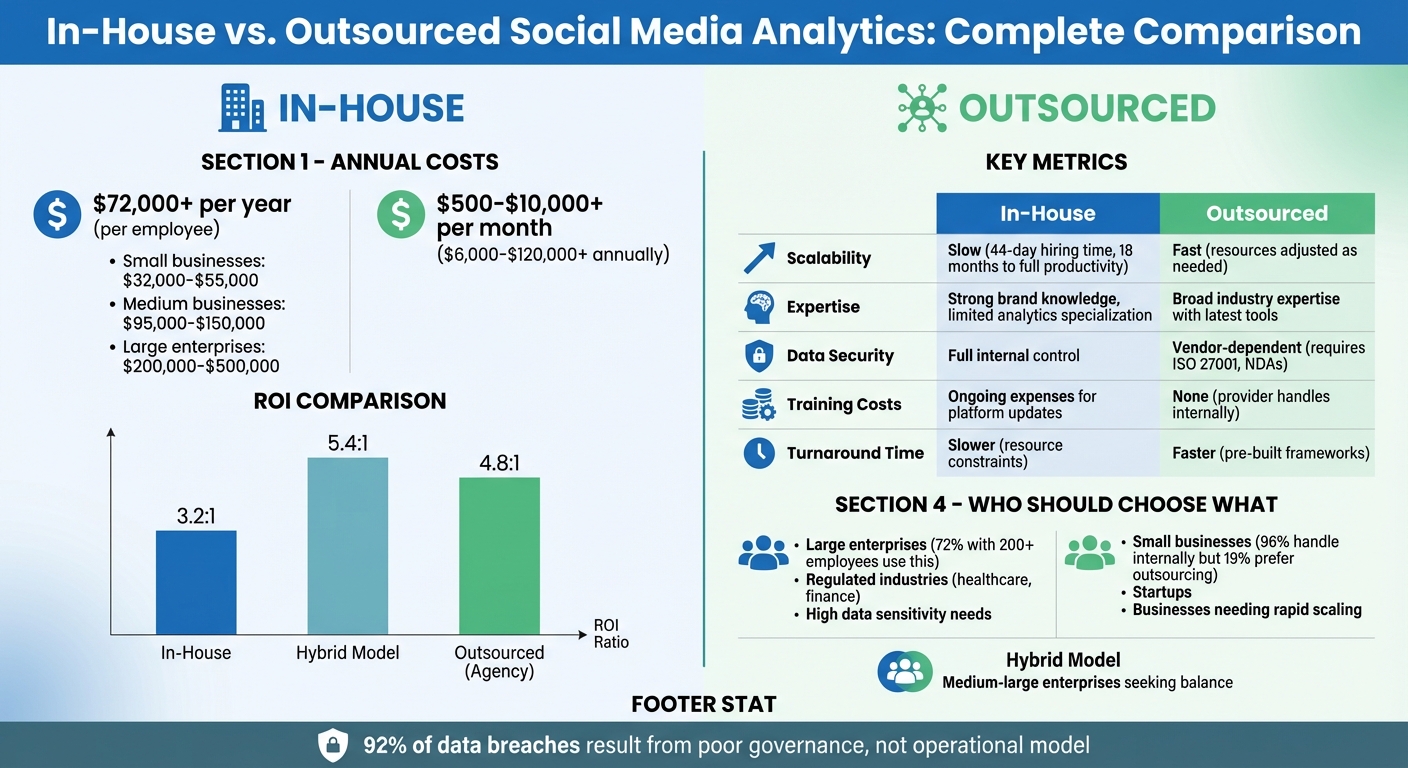
In-House vs Outsourced Social Media Analytics: Cost, ROI, and Key Metrics Comparison
Outsourcing Social Media Marketing 101 [Complete Guide to Outsourcing for Beginners]
sbb-itb-5665bbf
In-House Social Media Analytics: Pros and Cons
Creating an internal social media analytics team means hiring staff dedicated solely to your company. This setup offers direct control and ensures your team is fully immersed in your brand’s identity and values. Interestingly, a survey revealed that 96% of small businesses handle their social media operations internally, though 19% admitted they would prefer outsourcing if given the chance. These insights provide a foundation for weighing the costs and benefits of managing analytics in-house and whether outsourcing is right for you.
While aligning with your brand’s culture is a definite upside, the financial investment is equally notable. In the U.S., a social media manager earns an average of $72,000 annually, with salaries typically ranging between $62,000 and $70,000. Adding specialized roles like content creators or graphic designers can cost an additional $50,000–$60,000 per year each. Overall, annual costs vary significantly: small businesses spend about $32,000–$55,000, medium-sized companies allocate $95,000–$150,000, and large enterprises pay anywhere from $200,000 to $500,000.
"In-house talent will always know your brand best."
- Lindsay Ashcraft, Social Content Lead, Later
From a performance standpoint, in-house teams deliver an average ROI of 3.2:1. However, this falls short of the 4.8:1 ROI seen with professional agencies and the 5.4:1 ROI achieved by hybrid models. Despite this, 72% of large enterprises with over 200 employees maintain in-house teams, often supplementing them with agency support. These metrics highlight both the strengths and the challenges of an in-house approach, summarized below.
In-House Pros and Cons
| Aspect | Advantages | Disadvantages |
|---|---|---|
| Control | Full control over data, processes, and messaging; highly customizable reporting | Lacks external benchmarking and expert perspectives |
| Access | Instant access to data; ability to respond quickly during crises | Limited by staff availability and working hours; risk of burnout |
| Cultural Alignment | Deep understanding of brand values and maintaining an authentic voice | Over-immersion may lead to losing objectivity about audience needs |
| Costs | Avoids agency markups; potentially more economical for high-volume operations | High fixed expenses for salaries, benefits, recruitment, and tools |
| Scalability | Direct control over resources; aligns with long-term goals | Slow and challenging to scale during busy periods without hiring additional full-time staff |
| Expertise | Team gains brand-specific and industry-specific knowledge | May lack up-to-date expertise on evolving platform algorithms and trends |
In-house management is ideal for businesses that prioritize tight control over sensitive data, require consistent brand alignment, or operate in industries with strict compliance requirements, such as healthcare or finance. However, these benefits come with considerable upfront and ongoing costs. This analysis sets the stage for a deeper comparison with outsourcing strategies.
Outsourced Social Media Analytics: Pros and Cons
Outsourcing social media analytics involves delegating the task of data analysis to external experts. This option has become increasingly popular among startups and expanding businesses aiming to cut costs while tapping into specialized expertise. Costs for outsourcing typically range from $500 to over $10,000 per month, depending on the level of service and tools included. This makes it a practical alternative to in-house analytics for many companies.
One of the biggest advantages of outsourcing is the ability to reduce expenses. Businesses no longer have to cover salaries, benefits, office space, or training. Instead, they only pay for the services they need.
However, outsourcing isn’t without its drawbacks. Communication can be a challenge, especially when time zones or language barriers come into play, potentially leading to delays or misaligned messaging. Data security is another concern, as sharing sensitive information with third parties increases the risk of unauthorized access. Additionally, external providers may struggle to fully capture a brand’s unique voice, which can result in content that feels disconnected or overly generic.
"Working with an agency isn’t just the work hours being allocated… it’s also the tools, expertise, and knowledge. Particularly with social, it’s an intersection of design, writing, storytelling, and community management."
- Bowie Fan, Social Media Marketing Specialist, NVISION
For U.S. businesses looking for an affordable way to gain expert analytics, 365Outsource.com offers a solution. Based in the Philippines, their team of social media specialists provides comprehensive services, including analytics and management. With dedicated account managers and clear communication protocols, they help businesses scale their marketing efforts while avoiding the costs of hiring full-time staff.
Outsourced Pros and Cons
| Aspect | Advantages | Disadvantages |
|---|---|---|
| Cost Efficiency | Saves on salaries, benefits, and office space; offers predictable monthly expenses. | May involve hidden fees or unexpected cost increases over time. |
| Expertise Access | Provides instant access to specialists familiar with the latest trends and platform updates. | Requires time for providers to fully understand your brand’s voice and goals. |
| Scalability | Easily adjusts resources based on campaign needs or seasonal demand. | Poorly managed transitions can disrupt operations during critical periods. |
| Tool Access | Includes advanced analytics tools (e.g., Sprout Social, Brandwatch) as part of services. | Automated tools may miss contextual nuances like sarcasm or subtle cultural references. |
| Fresh Perspective | Offers new ideas and strategies from varied industry experience. | Risk of creating content that feels impersonal if brand guidelines are unclear. |
| Communication | Enables 24/7 monitoring and faster customer responses, improving retention. | Time zone and language differences can cause delays or miscommunication. |
| Data Security | Professional providers often use strong security measures and compliance protocols. | Sharing sensitive data increases the risk of breaches or unauthorized access. |
In-House vs. Outsourced: Direct Comparison
Deciding between in-house and outsourced social media analytics boils down to how each option stacks up in key areas like cost, scalability, and data security. Each approach has its strengths and challenges, and your choice will depend on your specific business needs.
Cost structures are a major factor. Hiring an in-house manager comes with a base salary of about $72,000 annually. When you add benefits, recruitment fees, and overhead, the total cost can exceed $100,000 per employee. On the other hand, outsourcing typically involves a predictable monthly fee, ranging from $500 to over $10,000, which often includes access to analytics tools and expertise.
Scalability is another critical difference. Hiring in-house is a slow process. In 2023, the average time to hire was 44 days, and new analysts often need up to 18 months to reach full productivity. This makes it challenging to scale quickly when campaigns demand extra resources. Outsourcing, however, allows for rapid adjustments. Providers can allocate additional resources as needed, ensuring your campaign stays on track.
Data security is a nuanced area. In-house teams provide greater control over data and intellectual property (IP). However, it’s worth noting that 92% of data breaches result from poor governance, not the operational model. Outsourced providers with certifications like ISO 27001 and strong non-disclosure agreements can offer enterprise-level security. That said, industries with strict regulations, such as healthcare and finance, often prefer to keep analytics in-house.
Comparison Table for Key Metrics
Here’s a quick breakdown of how in-house and outsourced analytics compare across key metrics:
| Metric | In-House Analytics | Outsourced Analytics |
|---|---|---|
| Hiring Costs | $72,000+ salary plus 30–40% for benefits and overhead | $500–$10,000+ monthly fee, no hiring costs |
| Tool Investment | High – requires purchasing software licenses (e.g., Adobe) | Low – tools included in service package |
| Expertise | Strong brand knowledge but limited analytics specialization | Broad industry expertise with the latest tools |
| Scalability | Slow – 44-day hiring time; 18 months to ramp up | Fast – resources adjusted as needed |
| Data Security | High – complete internal control | Variable – depends on vendor compliance and NDAs |
| Turnaround Time | Slower due to resource constraints | Faster with pre-built frameworks and dedicated teams |
| Training Costs | Ongoing expenses for platform updates | None – provider handles training internally |
Each approach has its pros and cons. Deciding which one fits your business requires weighing factors like cost, speed, and security against your operational goals.
How to Choose Between In-House and Outsourced Analytics
Decision Framework
Your choice between in-house and outsourced analytics largely depends on factors like business size, campaign volume, budget, and data sensitivity.
For smaller businesses with tighter budgets, outsourcing is often the smarter move. Building an in-house analytics team can cost upwards of $1,000,000 per year. By comparison, outsourcing runs between $500 and $10,000+ per month, giving you access to skilled professionals and premium tools without the added expenses of salaries, benefits, or training. Services like 365Outsource.com provide flexible, cost-effective solutions, including dedicated account managers who can scale resources up or down depending on your campaign needs. This flexibility is ideal for businesses that can’t justify hiring a full-time team.
Medium and large enterprises, however, often benefit from a hybrid approach. A small in-house team can handle brand-focused tasks and daily monitoring, while external specialists are brought in for high-volume campaigns or complex projects like predictive modeling. This strategy blends the internal team’s deep understanding of your brand with the technical expertise of outsourced professionals.
For industries that are highly regulated, in-house analytics is usually the safer choice. But if data sensitivity isn’t a major concern and speed is your priority, outsourcing can deliver fast results. External experts can often provide actionable insights in just weeks, avoiding the delays of building and training an internal team.
"The question isn’t whether you can afford to outsource analytics support. It’s whether you can afford not to." – Scoop Team
Conclusion
Deciding between in-house and outsourced analytics boils down to factors like your business size, budget, team capacity, and industry-specific requirements. For smaller businesses with tighter resources, outsourcing can be a practical choice. It offers access to specialized skills and advanced tools without the need for full-time staff expenses. Meanwhile, larger companies often find value in a hybrid approach, blending in-house expertise with external technical support. This decision reflects the ongoing balance between maintaining control and achieving flexibility.
In-house teams offer direct oversight and faster response times, which is particularly critical for industries like finance or healthcare that operate under strict regulations. However, when rapid scaling is necessary – such as during product launches or seasonal campaigns – outsourcing provides the flexibility to quickly adjust resources.
"No one knows your business like you do and you are the only one who will know if you need to seek help from a trusted expert whether you choose to outsource or build in-house." – Infinit-O
At its core, the choice requires a clear sense of purpose. Take the time to define your goals, evaluate your internal strengths, and decide whether maintaining brand consistency or leveraging specialized expertise and SEO is more critical at this stage of your growth. Many successful businesses begin with one model and adapt as their needs change. The key is to align your analytics approach – whether in-house, outsourced, or hybrid – with your broader strategic goals, ensuring it evolves alongside your business.
FAQs
What should small businesses consider when deciding between in-house and outsourced social media analytics?
When deciding how to handle social media analytics, small businesses need to weigh their budget, expertise, and goals carefully. Keeping analytics in-house can offer more control, quicker response times, and a stronger connection to the company’s overall vision. But there’s a catch – it takes a lot of resources to hire, train, and keep a skilled team, which might be tough for businesses working with limited funds.
Outsourcing, on the flip side, brings in specialized expertise, access to advanced tools, and the latest insights into social media trends. Plus, it eliminates the need to support an in-house team. This option also frees up time and energy for businesses to focus on their main priorities while leaving analytics and strategy to the pros. The decision ultimately comes down to finding the right balance between cost, control, and what your business truly needs.
What are the key differences in data security between managing social media analytics in-house and outsourcing?
When you handle social media analytics in-house, your organization has complete control over data security. This means you can put in place tailored security measures, oversee access directly, and address any potential threats promptly. Keeping everything internal also makes it easier to comply with data privacy regulations since the data never leaves your organization.
On the flip side, outsourcing involves sharing sensitive information with an external provider. This can introduce risks, as you depend on the provider’s security practices. To reduce these risks, it’s crucial to thoroughly evaluate potential partners, ensuring they adhere to strict security protocols and meet all relevant data privacy standards. While outsourcing can be a time-saver and reduce workload, choosing a reliable provider is key to protecting your data.
What are the costs of managing social media analytics in-house compared to outsourcing?
The cost of managing social media analytics depends on whether you choose to handle it in-house or outsource the work.
Outsourcing is often a more budget-friendly choice for businesses that lack internal expertise. By outsourcing, you gain access to skilled professionals without the expense of hiring full-time staff. Typical service fees for outsourcing range from $850 to $2,000 per month, excluding ad spend. This makes it a predictable option, particularly for small to medium-sized businesses.
On the other hand, in-house management requires a higher upfront investment. You’ll need to account for costs such as hiring, training, and purchasing premium tools. Depending on the size of your team and the tools you use, monthly expenses can range from $2,000 to $4,000. While this approach offers greater control and alignment with your company’s goals, it can become increasingly expensive as your business grows and scales its operations.
For many, outsourcing strikes the right balance between affordability and scalability. However, if maintaining control and ensuring seamless integration with internal processes is a priority, managing analytics in-house might be the better fit.