
Outsourcing to the Philippines offers U.S. businesses a chance to cut costs by up to 88% while accessing a skilled, English-speaking workforce. With over 1.82 million professionals in its BPO sector and 800,000 college graduates entering the job market annually, the Philippines has become a top choice for handling tasks like customer service, IT, and finance. Companies like Accenture and JPMorgan Chase already rely on the Philippines for quality service at a fraction of the cost.
Key Takeaways:
- Cost Savings: Labor costs are 60–88% lower than in the U.S. (e.g., $400/month for a customer service agent vs. $2,500–$3,500 in the U.S.).
- Skilled Workforce: Ranked 2nd in Asia for English proficiency, with strong familiarity with U.S. business practices.
- Government Incentives: Tax holidays and reduced tax rates through the Philippine Economic Zone Authority (PEZA).
- Industry Growth: The BPO sector was valued at $35 billion in 2024, projected to reach $59 billion by 2028.
Challenges to Consider:
- Time Zone Differences: A 12–15 hour gap with the U.S. requires careful coordination.
- Infrastructure Issues: Power outages and internet disruptions can occur, especially in remote areas.
- Data Security: Ensure outsourcing partners have ISO 27001 certification for compliance.
By starting with a short-term pilot program and partnering with experienced providers, businesses can mitigate risks and maximize the benefits of outsourcing to the Philippines.
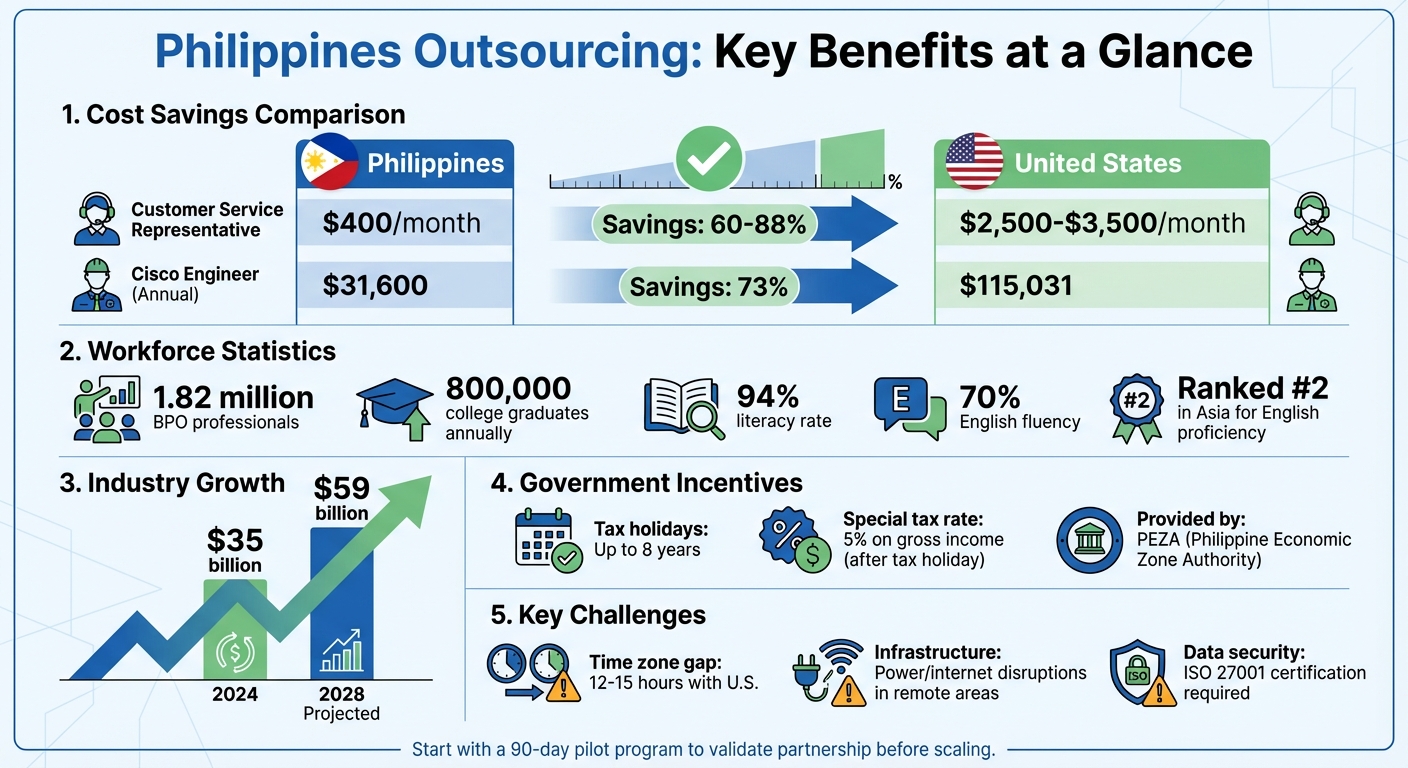
Philippines Outsourcing Cost Savings and Benefits Comparison
1. Key Reasons for Choosing Philippines Outsourcing
Cost Savings
Outsourcing to the Philippines offers a major advantage: significant cost reductions. U.S. companies can save anywhere from 60% to 88% on labor expenses without compromising on quality. For example, hiring a customer service representative in the Philippines costs around $400 per month, compared to nearly $5,000 in the United States. Specialized roles, such as Cisco Engineers, cost approximately $31,600 annually in the Philippines – an impressive 73% savings compared to the U.S. average of $115,031.
Additionally, outsourcing eliminates the need for hefty investments in office space, hardware, and software, as service providers handle these requirements. The Philippine Economic Zone Authority (PEZA) further sweetens the deal with tax incentives, including up to eight years of tax holidays and a reduced 5% special tax on gross income afterward. This model allows businesses to turn fixed costs into variable ones, enabling them to scale operations flexibly based on demand.
But cost savings aren’t the only draw – the Philippines also boasts a highly skilled workforce.
Talent Quality
Each year, the Philippines produces approximately 800,000 college graduates in fields like IT, finance, and healthcare. With a 94% literacy rate and 70% English fluency, the workforce is well-equipped to meet the demands of international clients. In fact, the country ranks 2nd in Asia for English proficiency, according to the EF English Proficiency Index. Filipino professionals are also known for their familiarity with American idioms, humor, and business etiquette, thanks to deep historical and business ties with the United States.
Global giants have recognized the potential of this talent pool. Accenture, for instance, began its Philippine operations in 1985 with just 75 employees. Today, it employs over 45,000 people across 22 delivery centers, offering not just basic BPO services but also advanced strategy and digital transformation solutions. Similarly, JPMorgan Chase relies on Filipino IT professionals to support its tech-driven operations.
This skilled workforce ensures that companies can maintain high service standards, making the Philippines a top outsourcing destination. This status is driven by the continued growth of BPO in the Philippines, which shows no signs of slowing down.
Service Excellence
Filipino professionals are renowned for their empathetic communication skills and ability to align seamlessly with Western business expectations.
"The ability of Filipino professionals to effortlessly engage with Western clients creates true partnership and business alignment – a factor often underestimated by other global BPO hubs." – Industry Executive, IBPAP
The country’s outsourcing industry also benefits from strong infrastructure, enabling 24/7 operations. Providers offer competitive salaries, robust wellness programs, and efficient logistical support, fostering high employee satisfaction. This approach has led to staff retention rates exceeding 98%.
Moreover, the Philippines has retained its #1 global ranking in voice and call center services since 2010. This achievement reflects the country’s managerial expertise, experienced team leaders, and rigorous quality assurance processes, ensuring consistently high service delivery.
sbb-itb-5665bbf
Why the Philippines is a Global Leader in the BPO Industry
Pros and Cons
Philippine outsourcing offers a mix of opportunities and challenges that businesses need to carefully assess. While the advantages are compelling, there are also hurdles that require attention for a successful partnership.
One of the standout benefits is cost savings – outsourcing to the Philippines can reduce labor expenses by 60% to 88% compared to U.S. rates. On top of that, the government provides generous tax incentives through PEZA, adding even more value. The country also boasts a highly skilled workforce, ranking 2nd in Asia for English proficiency. Filipino professionals often have a strong understanding of Western business practices, making them effective communicators with minimal need for additional training on American idioms or customer service expectations.
However, there are challenges to consider. The 12- to 15-hour time difference with the U.S. can make scheduling live meetings tricky. While many outsourcing providers offer 24/7 operations to address this, coordination still requires effort. Additionally, infrastructure in more remote areas can be unreliable, with power outages and internet disruptions becoming more common during typhoon season. High turnover rates in entry-level positions can also disrupt operations. Lastly, data security is a critical concern – businesses must ensure their outsourcing partners have ISO 27001 certification and strong cybersecurity measures in place.
| Pros of Philippine Outsourcing | Cons of Philippine Outsourcing |
|---|---|
| 60–88% savings on labor costs | 12–15 hour time difference with the U.S. |
| High English proficiency and cultural familiarity | Infrastructure issues like power outages and internet instability |
| Government tax incentives through PEZA | High turnover rates in entry-level roles |
| 24/7 operational capabilities with normalized night shifts | Data security concerns requiring ISO 27001 certification |
| Access to over 800,000 new graduates annually |
To navigate these pros and cons effectively, businesses must adopt a strategic approach. For instance, starting with a 90-day pilot program that includes clear performance metrics can help confirm a partner’s quality and compatibility before scaling operations. Companies like 365Outsource.com address potential risks by offering structured onboarding processes and dedicated account managers, ensuring smoother transitions and better oversight.
Conclusion
The Philippines has solidified its reputation as a leading outsourcing destination by addressing key business needs. Companies benefit from benefits of outsourcing to the Philippines, access to a workforce ranked 2nd in Asia for English proficiency, and a steady stream of skilled college graduates. All of this is backed by a well-established BPO industry that continues to hold a strong position in the global market.
Outsourcing is no longer just about cutting costs – it’s a way to drive growth. By partnering with providers certified in data security and registered with PEZA, businesses can take advantage of government incentives while ensuring compliance. Starting with a pilot program that includes clear KPIs is a smart way to validate the partnership before scaling up.
The focus has shifted from simple labor cost reductions to outsourcing for specialized skills in areas like AI, data analytics, and healthcare. This transformation positions the Philippines as more than just a cost-effective option – it’s becoming a hub for innovation and high-value services that enhance business capabilities.
To maximize these opportunities, companies should implement strong governance practices, such as daily stand-ups and shared dashboards, to address operational challenges effectively. Providers like 365Outsource.com simplify the process with dedicated account managers and structured onboarding, helping businesses navigate the transition smoothly.
FAQs
What jobs should I outsource to the Philippines first?
Outsourcing to the Philippines works best when you focus on roles that leverage the country’s strengths: English proficiency, technical skills, and cost-effectiveness. Great starting points include customer support, virtual assistance, digital marketing, web development, and data entry. These roles tap into a highly skilled workforce and align well with Western business practices, creating a seamless collaboration.
Once you’ve built trust and established a solid working relationship, you can explore more specialized areas like SEO, web design, and software development. These advanced roles can help drive efficiency and fuel business growth.
How do I manage the 12–15 hour time difference with my U.S. team?
Handling a significant time difference, like 12–15 hours, demands solid planning and clear communication. Start by establishing shared working agreements that outline expectations for response times and define overlapping hours – for instance, 6:00 PM–9:00 PM EST. These overlapping periods can be crucial for real-time collaboration.
For asynchronous communication, rely on tools like email, project management software, and shared documents. These platforms help keep everyone on the same page, even when schedules don’t align perfectly.
If your team includes night-shift workers, make sure they’re fairly compensated for their efforts. Additionally, implement clear handoff procedures to keep workflows running smoothly. This ensures tasks progress seamlessly, even when one team logs off and another logs on.
What should I ask a provider to confirm data security?
To ensure data security, verify if the provider adheres to recognized standards such as ISO 27001 or SOC 2. Look into their use of encryption, access controls, and breach notification protocols, ensuring these align with the Philippine Data Privacy Act. Additionally, confirm they are willing to sign Data Processing Agreements (DPAs) and that they perform regular security audits. Employee training programs should also be in place to uphold stringent security measures.