
Outsourcing data analytics can save costs, provide access to global expertise, and offer scalability. However, it’s not without challenges. Businesses often face issues like data security risks, communication gaps, inconsistent data quality, and technology integration problems.
Key Takeaways:
- Data Security Risks: Outsourcing increases exposure to breaches and compliance violations (e.g., GDPR, CCPA fines).
- Data Quality Issues: Misaligned processes can lead to inconsistent metrics and costly errors.
- Communication Barriers: Time zone and cultural differences can slow progress and create misunderstandings.
- Technology Integration: Incompatible systems can delay projects and add complexity.
Solutions:
- Use encryption, access controls, and certified vendors for security.
- Standardize processes with data dictionaries and automated checks for accuracy.
- Establish overlapping work hours and clear communication workflows.
- Conduct tech audits and use integration tools to ensure compatibility.
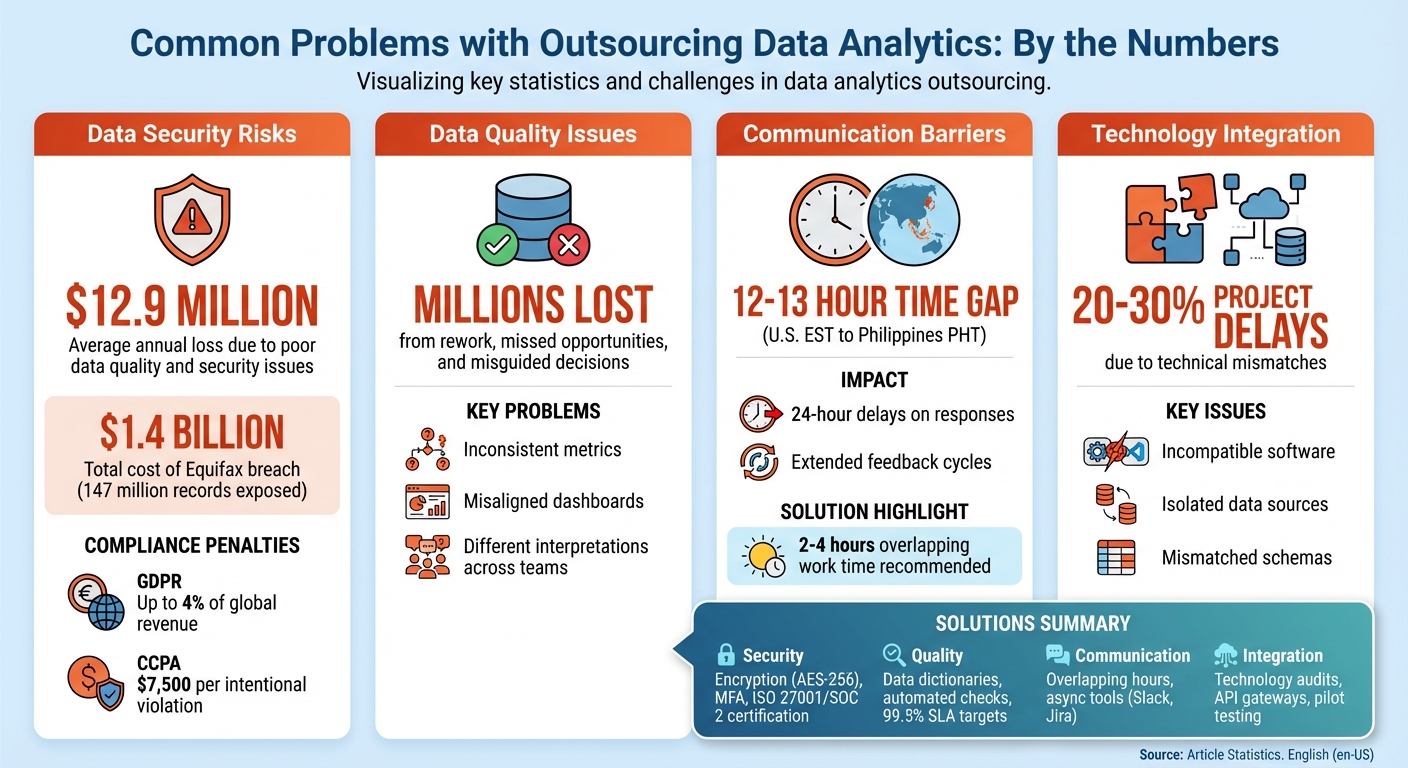
Key Challenges and Costs of Outsourcing Data Analytics
Data Security, Privacy, and Compliance Risks
Data Security Concerns
Entrusting sensitive business and customer data to an external vendor comes with its share of risks. Data breaches, unauthorized access, and loss of control over how your information is managed are all potential threats. On average, companies lose $12.9 million annually due to poor data quality and security issues in analytics outsourcing.
Take the 2017 Equifax breach as a cautionary tale. While not solely an outsourcing problem, third-party data handling played a role in exposing 147 million records. The fallout? A staggering $1.4 billion in costs, alongside regulatory investigations and public backlash. Weak security protocols or inadequate remote access methods on the vendor’s side can leave your data exposed to cyberattacks and unauthorized use.
Regulatory compliance further complicates the landscape. Violations of GDPR can lead to penalties as high as 4% of global revenue, and under CCPA, intentional violations can cost $7,500 each, not to mention potential lawsuits from affected individuals. Beyond the financial hit, companies risk damaging their reputation and losing customer trust – setbacks that can take years to overcome.
These challenges highlight the need for strong security protocols to protect your data.
How to Secure Your Data
Securing your data starts with advanced encryption standards like AES-256, ensuring both data in transit and at rest are protected. Pair this with role-based access control (RBAC) to limit vendor permissions – analysts, for instance, should only have access to anonymized datasets rather than full customer information.
Make multi-factor authentication (MFA) and regular security audits mandatory in your vendor agreements. Tools like Okta can manage access, while platforms such as AWS Shield or Azure Sentinel offer real-time threat detection. Contracts should specify requirements like breach notifications within 24 hours, quarterly penetration testing, and clear data ownership terms.
When choosing a vendor, prioritize those with certifications like ISO 27001 or SOC 2. Conduct thorough due diligence by reviewing client case studies and audit reports before finalizing any agreements. These steps help ensure your data remains secure and compliant, even when managed by external partners.
Maintaining Data Quality and Accuracy
Data Quality Problems
When data processing is outsourced, maintaining control becomes tricky. Vendors might adjust ETL logic, filters, or aggregation methods without informing you. The result? Metrics become inconsistent, dashboards don’t align, and key business terms are interpreted differently across teams.
Things get even messier with inconsistent pipelines. One analyst might update a data source mapping, another might tweak the schedule, and someone else could change how duplicates are handled – all without a unified standard. This can lead to the same report showing different numbers week after week, creating distrust among your U.S. leadership team. Poor data quality doesn’t just hurt credibility – it can lead to millions in losses from rework, missed opportunities, and misguided decisions.
Consider this: your marketing team reallocates its ad budget based on conversion metrics calculated with the wrong time zone or currency. Meanwhile, finance presents board reports with revenue figures that don’t match your ERP system. These aren’t hypothetical scenarios – they’re real risks that undermine decision-making and financial health.
To avoid such pitfalls, it’s crucial to establish strict controls and standardized processes.
How to Ensure Quality and Accuracy
Tackling these issues starts with clear standards and automated checks. Begin by creating a central data dictionary. This should define every field, KPI formula, and business rule your vendor must adhere to. For example, specify how revenue recognition works in your business or clarify what qualifies as a completed transaction versus a refund. Any updates to this dictionary should require approval before being rolled out.
Build pipelines that halt immediately if a schema changes unexpectedly, instead of silently dropping columns. Implement automated tests for every data load – monitoring row counts, null rates, and outliers. If something breaks, alerts should go to both your team and the vendor. Your service level agreements (SLAs) should include specific data-related commitments, such as dashboards being updated daily by 6:00 a.m. ET with 99.5% on-time delivery, revenue figures matching your system of record within 0.5%, and critical data issues resolved within 24 hours during U.S. business hours.
Consistency also requires version control and regular governance. Store all SQL scripts, transformation code, and dashboard definitions in a version-controlled repository like Git. Require code reviews before any significant changes go live. Hold bi-weekly governance meetings with your U.S. business owners and the outsourcing team to review data quality metrics, upcoming changes, and recent incidents. These steps ensure that quality control becomes a structured, reliable process, unaffected by which analyst happens to be on duty.
Overcoming Communication and Time Zone Differences
Communication Barriers
When your U.S. team wraps up the workday at 6:00 p.m. EST, your team in the Philippines is just starting their day at 7:00 a.m. PHT. This 12–13 hour gap can slow things down significantly. For instance, a question about a data field sent late in the day might not get answered until the next morning, delaying decisions and stretching out feedback cycles.
Time zones aren’t the only challenge. Communication styles can also clash. U.S. teams often prefer direct communication and flagging issues immediately, while offshore teams may lean toward a more indirect style and hesitate to voice concerns with senior stakeholders. This can result in misunderstandings, such as when offshore teams deliver exactly what was requested but miss the bigger picture of what’s actually needed. Even when offshore teams have strong English skills, subtle language differences can cause misalignment. Without regular check-ins, these small issues can snowball into major delays or rework, compounding existing risks. Tackling these challenges requires clear strategies, which we’ll dive into next.
Better Collaboration Methods
The key isn’t working 24/7 – it’s about creating structured overlap and effective asynchronous workflows. Scheduling 2–4 hours of overlapping work time can make a huge difference. For example, East Coast analysts could extend their day to 6:00 p.m. EST to connect with offshore teams starting at 7:00 a.m. PHT. Alternatively, vendors might adjust some team members’ schedules to better align with U.S. hours. Use this overlap for critical tasks like reviewing requirements and troubleshooting in real time to avoid misunderstandings.
For the rest of the day, rely on clear asynchronous communication. Tools like Slack or Microsoft Teams are great for this – set clear response expectations, such as replying to non-urgent messages within 24 hours and urgent ones within 4 hours. Task management platforms like Asana or Jira can also help track progress and keep everyone aligned. To stay on the same page without excessive meetings, try daily standup summaries, weekly progress updates tied to agreed KPIs, and bi-weekly video reviews.
Cultural differences shouldn’t be ignored either. Encourage offshore team members to ask questions and paraphrase requirements to confirm understanding. Creating a space where clarifications are welcomed can close communication gaps. Providers like 365Outsource.com in the Philippines can be a great resource – they offer teams with strong English skills, familiarity with Western business norms, and experience adjusting schedules to U.S. time zones, making collaboration smoother.
Finally, centralize key resources to keep everyone informed. Use platforms like Confluence or Google Docs to store requirements, data dictionaries, and process definitions in one place. Live dashboards can also display work progress and data quality metrics, reducing the need for constant updates. These strategies turn time zone challenges into manageable parts of a global workflow.
Technology Compatibility and Integration Issues
Tool and System Integration Problems
Technical integration issues can be a major roadblock for smooth analytics operations. If your internal systems don’t align with your outsourcing provider’s tools, progress on analytics projects can come to a standstill. For instance, incompatible software might force you to rely on manual data transfers, which not only slows down the process but also increases the likelihood of errors. Isolated data sources – like customer information, financial data, and web analytics being stored in separate systems – can make it difficult to achieve a unified view. On top of that, mismatched data schemas can result in parsing errors or even data loss. Fixing these issues often requires expensive custom ETL (Extract, Transform, Load) processes. Imagine a scenario where a field labeled "customer_id" in your system is called "client_number" in your provider’s tools – this would demand manual mapping, adding yet another layer of complexity. Such technical mismatches can delay projects by as much as 20–30%. Clearly, addressing these integration challenges is crucial for keeping projects on track.
How to Align Technology Systems
To tackle these challenges, start by conducting a joint technology audit before signing any contracts. This means mapping out all systems on both sides – your CRM, ERP, databases, and analytics tools – to identify potential issues like API compatibility or cloud connectivity. Agreeing on data schema standards upfront is another critical step. Use common formats like JSON or CSV and define field names, validation rules, and metadata documentation. Document these standards in a shared guide and review them quarterly to ensure alignment as systems evolve.
Integration tools can also make a big difference. Platforms like Apache Airflow or Talend, API gateways such as MuleSoft, and cloud services like AWS Glue or Azure Data Factory can automate data pipelines, ensure real-time connectivity, and simplify schema mapping. Before going live, test everything with pilot integrations using sample datasets. This helps catch and resolve potential issues early. Additionally, include specific service level agreements (SLAs) in your contract to cover system uptime and compatibility expectations.
Some providers, like 365Outsource.com, specialize in working with your existing infrastructure – whether it’s legacy systems or cloud-based platforms – to minimize friction and deliver integrated analytics solutions effectively.
sbb-itb-5665bbf
The Strategic Edge of Outsourcing Your Data Platform
Choosing and Managing Your Analytics Outsourcing Partner
Now that you’ve tackled challenges like data security, quality, communication, and technology, the next step is finding and managing the right analytics outsourcing partner.
How to Evaluate Outsourcing Providers
Start by examining the provider’s technical skills. Do they have hands-on experience with tools like SQL, Python, Power BI, or platforms such as AWS and Azure? Industry expertise is just as important – whether you’re in healthcare, finance, or e-commerce, a vendor familiar with your sector will already understand your compliance needs and performance metrics, saving you time on training and onboarding.
Security should be a top priority. Check for certifications like ISO 27001, review their encryption standards, and ensure they adhere to U.S. regulations like the CCPA. To test their capabilities, consider running a paid pilot project lasting two to four weeks, using real data to evaluate their ETL pipelines and dashboard delivery. Additionally, reference calls with at least two U.S.-based clients in similar industries can reveal potential issues, such as scope creep or unexpected billing practices.
Another key consideration is communication. Look for a vendor that offers 3–4 hours of overlapping work time with U.S. business hours and commits to regular meetings. Providers like 365Outsource.com, known for serving U.S. clients with strong English proficiency, can reduce friction by aligning hybrid schedules to maximize time zone overlap.
Once you’ve identified a provider with the right skills and alignment, solidify the partnership with clear contracts and governance.
Setting Up Contracts and Governance
After choosing a provider, draft detailed contracts that clearly outline responsibilities and performance expectations. These agreements protect both parties and help avoid misunderstandings. Define SLAs and measurable KPIs, tying payments to milestone achievements and including service credits for missed targets.
Data ownership is a critical element to address. Your contract should explicitly state that you own all raw data, processed data, trained models, and analytics outputs. Specify where the data will be stored (including the region and cloud provider), how long it will be retained, and the process for returning or securely destroying it once the engagement ends. To avoid vendor lock-in, require data exports in open, documented formats, and ensure the vendor agrees to cooperate during transitions. It’s also smart to build an exit strategy into the contract, detailing notice periods, handover responsibilities, and the support required during the transition.
Internally, appoint an analytics lead to manage the backlog and review deliverables. Weekly stand-ups can help address blockers quickly, while a monthly cross-functional steering group – including IT, finance, and business leaders – should review KPI performance and upcoming priorities. Quarterly executive reviews can evaluate ROI and determine if adjustments to the scope or terms of the engagement are needed. Using shared dashboards and project management tools can further enhance transparency and keep workflows on track.
Conclusion
Outsourcing data analytics, when approached thoughtfully, can seamlessly integrate into core business operations. While challenges like data security, quality control, communication gaps, technology integration, and vendor management are very real, they are far from insurmountable. Companies that adopt strong security measures, establish clear contracts, maintain structured communication, and enforce rigorous governance can transform outsourcing into a reliable, scalable solution for generating actionable insights.
The key to success lies in taking deliberate, proactive steps. Start by defining clear objectives and measurable success metrics before entering any agreement. Contracts should address critical elements such as data ownership, service level agreements (SLAs), security protocols, and exit strategies. To ensure alignment across teams and time zones, set up regular check-ins, shared dashboards, and clear escalation procedures. Miscommunication often underpins many so-called "quality" or "control" issues, but these can be mitigated with structured processes and consistent feedback loops.
When executed effectively, outsourcing analytics becomes more than just a cost-saving measure – it’s a strategic advantage. For instance, companies can avoid the staggering $12.9 million annual cost of poor data quality by implementing strict validation protocols. This not only improves forecasting accuracy but also enhances operational efficiency. As discussed in earlier sections, with proper vendor vetting, contractual safeguards, and ongoing monitoring, outsourced analytics can match or even surpass in-house security standards, even under stringent regulations like GDPR and CCPA.
Outsourcing analytics also opens the door to specialized talent pools. Providers like 365Outsource.com offer services such as data processing, analytics staffing, digital marketing, web development, and virtual assistance from skilled professionals in the Philippines. By combining expertise with robust processes, secure frameworks, and clear communication channels, businesses can scale analytics capabilities while managing costs effectively.
Treat outsourced analytics as a strategic partnership, not just a transactional service. Clearly define goals, document processes, secure data, and maintain open communication. By applying this strategic mindset consistently, businesses can harness global analytics talent, safeguard their data, and maximize returns on investment over the long term.
FAQs
What steps can businesses take to protect their data when outsourcing analytics?
When outsourcing analytics, protecting your data should be a top priority. Start by implementing strict access controls to ensure only authorized individuals can access sensitive information. Always use secure data transfer protocols to encrypt your data during both transmission and storage, keeping it safe from unauthorized access.
Before partnering with a vendor, conduct thorough assessments to evaluate their security measures and ensure they comply with industry standards. Additionally, signing detailed confidentiality agreements is essential to legally safeguard your data.
To maintain ongoing security, regularly monitor and audit the vendor’s data handling practices. This proactive approach helps ensure they continue to meet your security expectations over time.
How can businesses address communication challenges with offshore teams?
Effective communication with offshore teams requires a thoughtful approach to bridge gaps and ensure smooth collaboration. Begin by establishing clear and reliable communication channels so everyone is on the same page. Tools like video conferencing platforms and project management software can help streamline discussions and keep progress visible to all team members.
Holding regular meetings is another way to maintain alignment and address any roadblocks. Providing training on cultural differences can also enhance mutual understanding and strengthen teamwork. Lastly, when scheduling, consider overlapping time zones to enable real-time conversations and quicker resolutions to issues.
What should you look for in an outsourcing partner for data analytics?
When choosing a data analytics outsourcing partner, pay close attention to their expertise in managing complex datasets, their experience in your industry, and their technical skills. It’s equally important to assess how well they can communicate, whether they align with your company’s values, and their ability to deliver projects on time and within budget.
Take a close look at their track record by reading client reviews and examining case studies. Additionally, make sure they follow stringent data security protocols to safeguard sensitive information. These steps can help you build a dependable and effective partnership.