
Want to save on WordPress development costs without sacrificing quality? Hiring developers in the Philippines can reduce expenses by 60–80% compared to U.S. rates. Here’s why:
- Lower Rates: Mid-level developers cost $20–$35/hour in the Philippines versus $75–$125/hour in the U.S.
- Skilled Workforce: 1.3M IT professionals, 190K software engineers, and 47K IT graduates annually.
- English Proficiency: Ranked 22nd globally, ensuring smooth communication.
- Time Zone Advantage: U.S. businesses can benefit from overnight progress, cutting project timelines by 30–40%.
To find the right developer, define your project scope, set a realistic budget, and choose between freelancers or outsourcing agencies. Freelancers are cost-effective for short-term tasks, while agencies handle recruitment and management for long-term projects. Use platforms like Freelancer.com, outsourcing web development companies, or referrals to source talent. Vet candidates thoroughly with skill tests, portfolio reviews, and interviews.
For contracts, include clear payment terms, intellectual property clauses, and milestones. Choose payment platforms like Wise or Payoneer for lower fees. With proper planning, you can hire skilled WordPress developers in the Philippines while staying on budget.
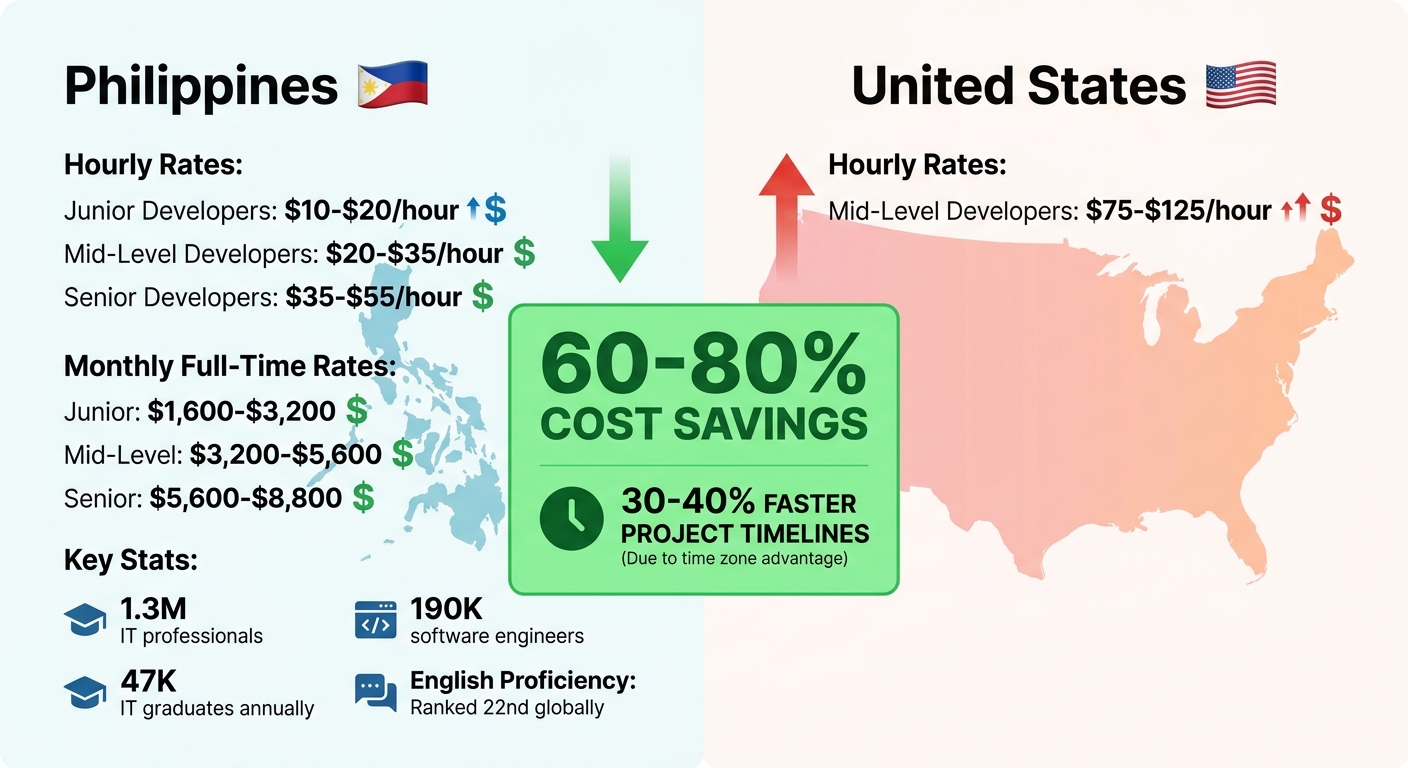
WordPress Developer Rates: Philippines vs USA Comparison 2026
How to Hire a Filipino WordPress Developer? – Practical Advice
sbb-itb-5665bbf
Step 1: Define Your Project Scope and Budget
Before posting a job listing, take the time to clearly define your project scope. Skipping this step can lead to costly errors and mismatched hires. For example, a vague description like "need WordPress help" often attracts the wrong candidates and wastes time for everyone involved. A well-defined scope and a realistic budget are essential for making cost-effective hiring decisions and achieving quality results.
Identify Your Project Goals
Start by outlining the type of website you need. Is it a simple blog, an e-commerce store, or a high-traffic corporate site? Each type requires varying levels of expertise and development time. For instance, a basic WordPress site using a pre-made theme might take around 4–8 hours to set up, while custom themes or integrations will require significantly more time and skill.
Be as detailed as possible about your technical requirements. Consider whether your project involves custom plugin development, third-party API integrations, or specific design and performance benchmarks. Do you need responsive design, animations, or Figma prototypes turned into functional code? Providing these details upfront helps developers assess whether they’re the right fit for your project.
Set a Realistic Budget
Your budget should align with both the complexity of your project and the expertise required. As of 2026, WordPress developers in the Philippines charge the following hourly rates:
- $10–$20/hour for junior developers
- $20–$35/hour for mid-level developers
- $35–$55/hour for senior developers
For full-time monthly contracts, you can expect to pay:
- $1,600–$3,200 for junior developers
- $3,200–$5,600 for mid-level developers
- $5,600–$8,800 for senior developers
"The cheapest developer is rarely the best value; a $15/hour developer who takes 3x longer costs more than a $30/hour one." – Dixie Raiz Pacheco
Be sure to include your budget range in the job description. This helps filter candidates, ensuring you only receive applications from developers who match both your needs and financial constraints. Don’t forget to account for additional costs like premium plugins, hosting, and ongoing maintenance. These can quickly add up if overlooked during the planning stage.
With your project scope and budget in place, the next step is finding skilled WordPress developers in the Philippines who can bring your vision to life.
Step 2: Where to Find WordPress Developers in the Philippines
Once you’ve outlined your project scope and budget, the next step is figuring out where to find skilled developers. The Philippines boasts a large pool of talent, and there are several effective ways to connect with the right professionals, depending on your budget and timeline.
Freelance Platforms
Freelance platforms are a great starting point if you’re looking for affordable WordPress developers. Websites like Freelancer.com and Freelancer.ph host professionals who handle everything from basic WordPress setups to advanced plugin development and API integrations. These platforms have earned an average client satisfaction score of 4.9 out of 5 from over 885,000 reviews.
"Freelance web designers with key skills in WordPress will charge you less as they commonly work from home and have fewer overheads." – Freelancer.com
Cost is a major factor here. WordPress developers on these platforms typically charge $10–$25 per hour, while senior developers with more advanced skills charge between $35–$60 per hour. To minimize risks, opt for milestone-based payments, releasing funds only after tasks are completed to your satisfaction. When shortlisting candidates, review their portfolios carefully and prioritize those who have passed platform-specific coding tests or earned "Certified Partner" credentials.
Local Outsourcing Companies
For businesses that require long-term support rather than a one-off project, outsourcing companies based in the Philippines offer a reliable solution. Firms like 365Outsource provide access to pre-vetted WordPress developers experienced in PHP, WooCommerce, and custom theme development. These companies handle recruitment, HR, and administrative tasks, freeing you to focus on your business.
Their pricing models include employee benefits, health insurance, and taxes, eliminating hidden expenses like workers’ compensation or holiday pay. Top outsourcing firms can deliver qualified resumes within 48 hours and maintain a 95% show rate with minimal downtime. Developers in these companies often receive up to 108 hours of annual training and skill development, ensuring they stay updated with the latest technologies. This level of support contributes to retention rates exceeding 97%, as developers feel valued and integrated into their teams.
Professional Networks and Referrals
Platforms like LinkedIn are excellent for finding experienced WordPress developers in the Philippines. Additionally, Filipino developer communities on Discord and Facebook groups are great places to source talent through referrals.
"Filipino developer communities on Discord, Facebook groups, and local meetups can be goldmines for finding talent through referrals. Developers vouch for people they’ve worked with." – Dixie Raiz Pacheco, Web Designer and Developer
If you already have Filipino team members, consider asking them for recommendations. Referrals from trusted colleagues often lead to candidates who are a better fit, both in terms of skills and work style. Before committing to a referral, make sure to conduct thorough reference checks by speaking with previous clients about the candidate’s reliability and problem-solving abilities. Running a 5–10 hour paid trial project is another effective way to assess their work quality and communication style before entering into a long-term agreement. These approaches will help you build a solid foundation for evaluating candidates in the next step.
Step 3: Vet Candidates for Skills and Compatibility
A strong vetting process is critical, especially when you consider that nearly half of outsourced projects worldwide fail to meet expectations. This often stems from inadequate vetting rather than location issues. By thoroughly evaluating technical skills, work quality, and communication abilities, you can avoid costly mistakes and hire developers who deliver results. The goal is to find developers who not only excel technically but also align with your team’s communication style and values.
Review Portfolios and Past Work
A developer’s portfolio can be a useful starting point, but it doesn’t always tell the full story. For instance, many WordPress portfolios highlight visually appealing front-end designs but fail to address backend logic, security, or performance.
"A visually impressive portfolio doesn’t always reflect strong technical skills. Many WordPress portfolios showcase front-end design… but they rarely show what’s happening behind the scenes." – Hayden Cohen, CEO and Co-Founder of Near
Examine portfolios for links to live websites so you can test responsiveness, load times, and functionality firsthand. If a developer shares their GitHub profile, take time to review their repositories. Look for well-structured code, effective version control practices, and examples of custom functions. Ask direct questions about their past work, like, "What was the biggest technical challenge on this project, and how did you solve it?" This helps confirm that the work is genuinely theirs. Also, check for projects that match your industry or complexity level, and determine whether they rely heavily on third-party tools or create custom themes and plugins. Overuse of third-party tools can lead to performance issues and security vulnerabilities. Beyond portfolios, live assessments can further validate their technical skills.
Conduct Skill Tests or Coding Challenges
It’s one thing to list skills on a resume; it’s another to demonstrate them. Structured tests are a reliable way to gauge both technical expertise and problem-solving abilities.
- Junior developers (1–3 years): A 45-minute test covering PHP 7.4+, object-oriented programming (OOP) basics, HTML/CSS, MySQL, and Git.
- Mid-level developers (3–5 years): A 60-minute test paired with a code review, focusing on PHP 8.x, frameworks like Laravel or Symfony, unit testing with PHPUnit, API development, and design patterns.
- Senior developers (5+ years): A 90-minute assessment followed by a discussion about system architecture, microservices, performance optimization, security, and leadership skills.
Check Communication and English Proficiency
Technical skills alone won’t guarantee a successful collaboration. Strong communication and problem-solving abilities are just as important, especially for long-term projects. The Philippines, for example, ranks 22nd globally in English proficiency, outperforming other outsourcing hubs like India and Vietnam.
Schedule a 45–60 minute video call to assess how well candidates articulate their ideas and explain their technical decisions. Instead of asking what they did on a project, ask why they made certain choices. This approach reveals their depth of involvement and how they think through problems. Behavioral questions like, "Tell me about a project that didn’t go well", or "What do you do when you’re stuck?" can offer valuable insights into their work habits and personality. Creating an open and conversational environment encourages candidates to share challenges they’ve faced, helping you gauge their ability to adapt and collaborate effectively.
Step 4: Compare Freelancers vs. Outsourcing Agencies
Once you’ve vetted potential candidates, the next step is deciding whether to go with a freelancer or outsourcing to the Philippines via an agency. This decision depends on the scope of your project, how much management you’re prepared to handle, and your long-term objectives. By comparing these options carefully, you can strike the right balance between quality and cost.
Freelancers are often the more budget-friendly choice. With no agency fees, you only pay for the work completed. That said, hiring freelancers means you’ll need to take on extra responsibilities – like overseeing their work, managing payroll, and ensuring quality. Freelancers are a great fit for short-term needs, such as updating plugins or customizing themes, but they require more direct involvement from you.
On the other hand, outsourcing agencies come with a higher price tag, as they include costs for HR, recruitment, equipment, and employee retention. While this raises your expenses, it significantly reduces your workload. Agencies take care of vetting, provide reliable office setups with backup power and internet, and include quality control in their services. If you’re working on a long-term project, need to scale quickly, or lack the bandwidth to manage individual freelancers, agencies offer the structure and accountability you might need.
"Staff augmentation companies add a 30-50% premium over direct hire but handle HR, payroll, and retention." – Dixie Raiz Pacheco
Here’s a quick comparison to help guide your decision:
| Aspect | Freelancers | Agencies |
|---|---|---|
| Hourly Rates | $20–$55 | 30–50% premium over direct rates |
| Project Suitability | Small, short-term tasks or one-off projects | Long-term builds, scaling teams, or complex roadmaps |
| Pros | Lower cost, direct communication, high flexibility | Comprehensive support, quality assurance, reduced management overhead |
| Cons | Higher management burden, infrastructure risks, fewer safety nets | Higher cost, less flexibility, longer onboarding times |
Freelancers are ideal for short-term, budget-conscious tasks, while agencies are better suited for long-term, complex projects that require more stability and support.
Step 5: Negotiate Rates and Finalize Contracts
Secure fair rates and establish a contract that keeps your project both on budget and free from unexpected surprises. With a clear project scope and thorough vetting process already in place, these steps will help protect your investment.
Discuss Payment Terms and Milestones
Avoid paying large upfront amounts. Instead, structure payments around milestones tied to specific deliverables. For example, you could release 30% of the payment once the homepage is approved, 40% when the site is fully functional on a staging server, and the remaining 30% after the site is launched and tested. This approach ensures you only pay for work that’s been completed, minimizing financial risks.
Another helpful step is running a 1–2 week paid trial. Assign a specific task during this period to assess the developer’s communication, code quality, and work habits. As Dixie Raiz Pacheco advises:
"Never commit long-term without a trial. Period."
This trial period also gives you a chance to confirm your payment structure works for both parties.
Keep in mind that value often outweighs lower hourly rates. A $15/hour developer who takes three times longer to complete tasks may end up costing more than a $30/hour developer who works efficiently and delivers high-quality results. If your budget is limited, think about offering benefits like flexible working hours, learning budgets for certifications, or clear career growth opportunities – these can be just as appealing as higher pay for many Filipino developers. Providing 13th-month pay is another way to enhance loyalty and retention.
For payment platforms, Wise and Payoneer are generally better options than PayPal or Western Union, as they come with lower fees.
Include Clear Project Scope in Contracts
Once payment terms are agreed upon, formalize the project details in a detailed contract.
Make sure your contract includes an Intellectual Property (IP) assignment clause to ensure all code, designs, and assets become your property once payment is made. Add a non-disclosure agreement (NDA) to safeguard any proprietary information or trade secrets before sharing sensitive data.
Clearly define deliverables and establish standards for success – for instance, requiring page load speeds under three seconds, full mobile responsiveness, and strong security measures. This level of detail helps avoid confusion about what constitutes a completed project.
Also, outline termination conditions, such as notice periods and the steps for ending the agreement. Including a dispute resolution process can save time and money if disagreements arise by providing a straightforward way to address issues without legal complications.
Finally, agree on a communication schedule in advance. Opt for a balance, like daily asynchronous updates and weekly video calls, instead of constant real-time availability. This prevents burnout while keeping everyone aligned. Additionally, discuss contingency plans for power and internet outages, as typhoons and occasional disruptions in the Philippines can impact timelines.
Use 365Outsource for Budget-Friendly WordPress Developers
If you’re looking for an efficient way to manage WordPress development without breaking the bank, 365Outsource offers a straightforward solution. They handle the hard parts – like vetting and contract management – so you can focus on your projects. Based in the Philippines, their service provides access to skilled WordPress developers with an all-in pricing model that covers salary, health insurance, benefits, and HR support. This means no surprise administrative costs.
Their process not only saves time but also ensures consistent, high-quality results. While traditional hiring can take up to 50 hours, 365Outsource delivers qualified resumes in just 48 hours. They maintain an impressive 95% show rate for remote talent and invest in their developers by providing 108 hours of coaching and upskilling each year. This commitment to training ensures their developers stay sharp and deliver excellent work.
Mark T., the founder of a digital marketing agency, shared his thoughts:
"We needed a reliable team to handle our overflow WordPress development. 365Outsource delivered beyond our expectations. Their developers are skilled, communicative, and always hit their deadlines. It’s like having our own dedicated dev team in the Philippines."
To make project management easier, 365Outsource offers tools like KPIs and scorecards, giving you full visibility into performance. Their team works closely with you to align your project needs with the offshore developers, ensuring everything runs smoothly. Whether you’re looking for part-time or full-time support, they offer offshore staffing plans that provide access to experienced developers while staying within your budget.
Final Checklist for Hiring Affordable WordPress Developers
To wrap up your hiring process, use this checklist to ensure you’re covering all the critical steps.
Key Takeaways for Finding the Right Developer
These points summarize the vetting and negotiation strategies mentioned earlier.
- Review 15–20 applications and narrow it down to 5–7 candidates by evaluating portfolios, GitHub repositories, and writing skills.
- Go beyond coding tests – ask candidates to explain their approach to site speed optimization and debugging.
- Conduct video interviews to assess their problem-solving abilities and how well they can explain technical issues to non-technical team members .
- Finalize contracts that clearly address intellectual property rights, confidentiality, payment milestones, and termination clauses.
Tips for Long-Term Collaboration Success
After choosing the right developer, follow these practices to ensure a productive partnership:
- Schedule daily written updates and weekly video calls to keep communication streamlined.
- Use trusted payment platforms like Wise or Payoneer for international transactions. These are often more cost-effective than Western Union.
- Be proactive in addressing potential issues by asking direct questions, especially if communication styles are indirect.
- Act quickly when you’ve found the right candidate – top developers are highly sought after.
- Show your commitment by covering the cost of essential tools like PhpStorm or Visual Studio, which can boost their efficiency.
- Keep in mind that the entire hiring process, from posting the job to onboarding, typically spans 2–4 weeks.
FAQs
How do I estimate hours for my WordPress project?
To figure out how many hours your WordPress project might take, start by clearly outlining the scope and requirements. This includes identifying all the features and assessing their complexity. Break the project into manageable tasks – such as design, development, testing, and deployment – and estimate the time needed for each based on the difficulty of the task and the developer’s experience level.
It’s a good idea to consult with your developer to get their input, as they can provide valuable insights. You can also look at similar past projects to refine your estimates. Taking the time to plan thoroughly will help you predict timelines more accurately.
What’s the safest way to pay a Philippines-based developer?
When working with a developer based in the Philippines, it’s best to use secure and traceable payment methods to ensure both parties are protected. Popular choices include:
- Escrow services: These hold the payment until the agreed-upon work is completed to your satisfaction.
- PayPal: Offers buyer protection and a reliable platform for international transactions.
- Bank transfers with fraud protection: Ensure the bank supports tracking and safeguards against unauthorized activity.
To further reduce risks, establish clear payment terms upfront. For example, break the project into milestones tied to specific deadlines. This way, payments are released only when the work meets your agreed-upon standards.
How can I confirm a developer’s portfolio work is real?
To ensure a developer’s portfolio is authentic, start by asking for references from their previous clients or projects. Reach out to these clients directly to verify the work and evaluate its quality. If a developer seems reluctant to share references, it could be a red flag regarding their credibility. Additionally, take a close look at the projects highlighted in their portfolio to see if their experience matches the specific skills and expertise you’re looking for.