Hire Dedicated Social Media Marketing Professionals in the Philippines
A solid social media strategy opens the doors to a massive audience and fosters closer interaction with them. With our social media marketing outsourcing team, we provide you with the right formula to better connect your business with the people you built it for.
Whether you need a part-time specialist or a full-time dedicated Social Media Manager, we connect you with high-level, plug-and-play talent ready to execute your campaigns from day one.
Experience Outsourcing Excellence
Join leading companies who trust 365Outsouce
Premium Talent at
$17 Per Hour
Our reliable and low-cost social media services reach out to your audience easily. By hiring a dedicated Social Media Specialist through 365Outsource, you gain access to top-tier digital marketing talent at highly competitive rates of $17 per hour, available for both part-time and full-time engagements.
Dedicated Social Media Marketing Experts
We want nothing less than the best outsourced social media services for you. Our dedicated Social Media Marketing Professionals are rigorously vetted for
their strategic mindset, creative capabilities, and proven track records. If you need someone who will navigate your online social venues with precision, our experts will give you just that.
Plug-and-Play
Platform Expertise
$17/hrPart-Time and Full-Time Available


Plug-and-Play Talent
High-Level Philippines-Based Social Media Specialist
- Vetted and Experienced
- Fluent English
- Ready to Execute from Day One
Social Media Marketing Services Your Dedicated Talent Can Handle
Our outsourced social media services make reaching out to your audience easier and better. When you hire a dedicated Social Media Manager, they can manage, create, and advertise your social media presence for a better connection with prospects.
Content Calendar
Plan, organize, and schedule every post with precision. Your dedicated Social Media Manager builds a monthly content calendar across Facebook, Instagram, LinkedIn, and TikTok — keeping your brand consistent, timely, and always ahead of the curve.
Graphic Design & Creatives
Make every post stop the scroll. Your dedicated specialist designs eye-catching graphics, carousels, stories, and reels using Canva and Adobe Creative Suite — delivering on-brand visuals that drive engagement across every platform.
Paid Social Advertising
Turn ad spend into measurable results. Your dedicated Social Media Manager sets up, monitors, and optimizes paid campaigns across Facebook, Instagram, LinkedIn, and TikTok — targeting the right audience to maximize reach and lower cost per lead.
Analytics & Reporting
Know exactly what’s working and why. Your dedicated specialist tracks key performance metrics, interprets platform data, and delivers clear monthly reports with actionable insights to continuously improve your social media strategy and ROI.
Community Management
Build a loyal, engaged audience around your brand. Your dedicated Social Media Manager responds to comments and messages, fosters meaningful conversations, and proactively engages with your community to strengthen relationships and boost brand trust.
Short-Form Video Content
Dominate Reels, TikTok, and YouTube Shorts. Your dedicated specialist edits, captions, and optimizes short-form videos that capture attention in the first three seconds — keeping your brand relevant in the fastest-growing content format online.
Managing Your Social Media Platforms
Your dedicated Social Media Specialist will effectively manage your social media profiles across Facebook, Instagram, LinkedIn, and TikTok. They will create comprehensive social media content calendars, monitor your various profiles daily, engage with your community, and send you detailed analytics and competitor reports every month.
Building and Maintaining Your Social Media Presence
We are in it for the long haul. Your offshore team member will work as an integrated part of your company, allowing you to build and maintain your brand’s social presence continually. They excel at crafting authentic narratives, designing eye-catching graphics using Canva or Adobe, and producing short-form video content that resonates with your target audience.
Getting Your Name Right in Front of Your Customers
We bring your brand into the spotlight with targeted social media advertising. Your dedicated Social Media Marketing Professionals can handle ad campaign creation, budget optimization, A/B testing, and performance tracking across all your social media profiles to ensure maximum return on your investment.
How Our Social Media Staff Leasing Process Works
Staff Lease Recruitment Authorization
We begin by finalizing the job description, required skills, job grade, and specific role requirements for your ideal Social Media Specialist or Social Media Manager.
Candidate Profiles
Our recruitment team actively sources applications and gathers resumes from our extensive network of Philippines-based Social Media Specialists.
Initial HR Interview
The 365Outsource Recruitment Team conducts comprehensive initial screenings to evaluate communication skills, cultural fit, and basic qualifications.
Technical Assessment
Candidates complete a role-specific skills evaluation to prove their proficiency in platforms like FB/IG, LinkedIn, TikTok, and tools like Canva and Adobe.
Second Interview
A 365Outsource Manager conducts a final internal review to ensure only the highest-quality candidates are shortlisted for your consideration.
Client Interview
You meet and evaluate the shortlisted candidates directly, ensuring you find the perfect fit for your company’s culture and goals.
Job Offer
Once you select your preferred Social Media Specialist, we handle the job offer, onboarding, and integration of your new dedicated team Member.
Why Outsource Social Media Marketing in the Philippines?
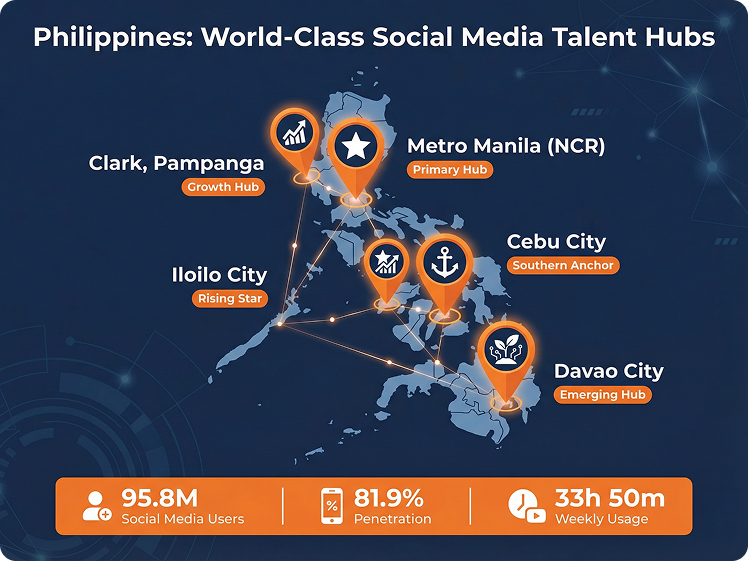
Many companies work with Social Media Marketing Professionals from the Philippines because of the unbeatable combination of high-quality work and reasonable pricing.
The Philippines is home to social media management experts with a firm and flawless grasp of the English language and Western cultural nuances. Their experience enables them to practice creativity and demonstrate their knowledge in developing strategies that benefits the business. As digital natives, they adapt quickly to algorithm changes and emerging trends on platforms like TikTok and Instagram.
Outsourcing rates for social media marketing are at their most competitive in the Philippines. With 365Outsource.com, you get more value than what you do from any other outsourcing agency in the country with the same budget, securing high-level, plug-and-play talent for just 17 per hour.