
The Philippines has become a key player in outsourcing SEO to the Philippines for niche link-building services. Here’s why:
- Cost Savings: Businesses save 40%–88% compared to U.S. rates. Junior professionals start at $10/hour, while senior experts charge $35–$55/hour.
- Skilled Workforce: With over 1.82 million professionals in IT and business services by 2024, the country offers a deep talent pool trained in SEO and digital marketing.
- English Proficiency: Ranked 2nd in Asia for English skills, 70% of Filipinos are fluent, ensuring smooth communication for Western clients.
- Government Support: Programs like SPARK focus on upskilling professionals in AI, cybersecurity, and internet technologies.
- Proven Results: Case studies show companies achieving traffic boosts of 66%–371% through Philippine-based link-building campaigns.
For cost-effective, high-quality SEO services, the Philippines stands out as a reliable outsourcing destination. Below, we explore how this is achieved and compare it to other global outsourcing hubs.
1. Philippines
Cost Efficiency
The Philippines offers a significant cost advantage for niche link-building services, with savings of 60%–75% compared to U.S. or U.K. rates. This price gap stems from differences in the cost of living rather than a lack of skill. In fact, top Filipino professionals meet international standards while operating at much lower overhead costs.
Here’s a breakdown of hourly rates in the Philippines:
- $10–$20 for junior professionals
- $20–$35 for mid-level talent
- $35–$55 for senior experts
- $55–$90+ for elite specialists
In contrast, Western markets typically charge $100–$250 per hour for similar services.
Geography within the Philippines also influences pricing. Metro Manila, for example, has a 20%–30% premium over the national average. Cebu offers rates at the average and is often seen as the "value sweet spot", while provincial areas like Davao charge 15%–25% below the average.
However, focusing solely on hourly rates can be misleading. As some Philippine hiring managers explain:
There is a difference between offshoring and cheap-shoring. Most bad experiences are a result of cheap-shoring.
Senior-level professionals often work more efficiently, completing tasks faster and with fewer errors. This reduces long-term costs compared to hiring lower-tier talent who may lack the necessary expertise. Combined with high English proficiency and niche skills, the Philippines provides an attractive balance of cost and quality.
English Proficiency
The Philippines is known for its strong English skills, ranking "High Proficiency" in the 2024 EF English Proficiency Index and securing second place in Asia, just behind Singapore. With 70% of the population fluent in English and a literacy rate of 94%, the Philippines is the third-largest English-speaking nation in the world. This proficiency is rooted in its education system, where English is the primary medium of instruction from preschool through college.
For link-building efforts, this fluency is crucial. Filipino professionals understand American idioms, business language, and cultural nuances, which allows them to craft compelling email pitches, write high-quality guest posts, and create branded content that resonates with Western audiences.
The financial advantage is clear, too. Business Process Outsourcing (BPO) rates in the Philippines average $2 per hour, compared to $17 per hour in the U.S. – an 88% cost reduction while maintaining native-level English communication. For comprehensive link-building campaigns, top SEO agencies in the Philippines charge between $1,500 and $5,000 per month, a budget that might only cover a basic on-page audit in Western markets.
Niche Expertise
The Philippines combines fluent English with deep technical expertise to deliver targeted link-building strategies. Moving beyond its call center roots, the country has become a hub for specialized digital services. Collaboration between the government and universities ensures that around 800,000 college graduates enter the workforce annually, with many trained in fields like IT, healthcare, and finance.
SEO professionals in the Philippines are trained extensively in ethical "white hat" practices and manual outreach techniques. Agencies in the country have built solid reputations across industries such as SaaS, eCommerce, healthcare, finance, and education. They maintain thousands of publisher relationships, allowing them to secure links on high-authority sites (DR30 to DR70) without resorting to spammy tactics or Private Blog Networks.
This expertise translates into tangible results. For instance, Keypath Education gained over 820 high-quality links with the help of Philippine link-building services. Brian Dean, Founder of Backlinko, praised the country’s talent, saying:
Venchito is one of the few people in the internet marketing world, who understands how to build quality links in today’s SEO world.
At 365Outsource.com, we leverage this thriving ecosystem to provide tailored link-building solutions. By combining technical skill with cultural understanding, we help businesses scale their digital marketing strategies while keeping costs under control.
sbb-itb-5665bbf
2. India
Cost Efficiency
India has made a name for itself in the SEO outsourcing world, largely because of its low hourly rates. For businesses on a tight budget, this can be a tempting option. For comparison, while teams in the Philippines charge roughly $1,600–$1,900 per month, India often offers even lower pricing. However, this affordability comes with a catch: businesses may need to invest more effort in managing teams to ensure deliverables meet expectations. The balance between cost and quality is a key consideration here.
English Proficiency
Indian SEO professionals are highly skilled in technical aspects, but their English proficiency can sometimes pose challenges. Their language skills often require adjustments to align with Western markets. As noted by 365Outsource.com:
India excels in technical specialization but often requires more translation and cultural adaptation.
This can impact the effectiveness of conversational and persuasive communication, such as email pitches and guest posts. In comparison, the Philippines tends to have stronger English communication skills, which can be a significant advantage for outreach-focused tasks.
Niche Expertise
India’s core strength lies in technical SEO and data-driven strategies. With a well-established outsourcing infrastructure and a focus on technical expertise, it’s a dependable choice for large-scale, technically complex projects. However, this focus on technical skills often means less emphasis on the softer skills needed for tasks like link building and relationship management. Unlike the Philippines, which balances technical know-how with cultural adaptability, India’s approach can sometimes feel more transactional. This may require additional oversight to ensure that strategies align with broader goals. Time zone differences also play a role in determining how efficiently projects can be managed.
Time Zone Compatibility
India’s time zone presents challenges for businesses based in the U.S., as it doesn’t align as closely with U.S. business hours compared to the Philippines. This can complicate scheduling and slow down communication, making it harder to achieve quick turnarounds or collaborate in real time. For campaigns that demand speed and flexibility, this time zone mismatch may require extra planning and coordination.
3. Eastern Europe
Cost Efficiency
When it comes to pricing, Eastern Europe stands out for its technical expertise, but this often comes with a steeper price tag. Rates here are generally higher than the $1,500–$5,000 range typical of white label SEO agencies in the Philippines. For businesses keeping an eye on their budget, this cost difference can be a critical factor to consider.
English Proficiency
While Eastern European professionals are highly skilled in technical areas, their English proficiency doesn’t quite match the level found in the Philippines. This can sometimes lead to delays in translation and slower communication. In contrast, the Philippines benefits from native-level English fluency, which plays a key role in smoother and faster outreach efforts.
Niche Expertise
Eastern Europe shines in technical SEO, particularly in areas like data-driven strategies and advanced technical solutions. Teams here excel at conducting in-depth competition analysis and using white-hat methods to secure high Domain Authority backlinks. However, this technical emphasis often comes at the expense of the relationship-building side of link building. Unlike the Philippines, where outreach tends to focus on forging strong relationships, Eastern Europe’s approach leans heavily on technical prowess. This difference in focus can impact the overall success of campaigns depending on the goals and priorities of a business.
Why the Smartest Businesses Build Remote Teams in the Philippines
4. United States
After examining outsourcing markets in Asia and Eastern Europe, let’s take a closer look at the U.S., which often sets the standard for link-building quality.
Cost Efficiency
The U.S. is known for its high-quality standards, but this comes with a hefty price tag. On average, business process outsourcing (BPO) services in the U.S. cost about $17 per hour, a stark contrast to the $2 per hour rate in the Philippines. This translates into an 88% reduction in labor costs when outsourcing to the Philippines, without compromising on quality.
For context, a simple on-page SEO audit from a U.S. agency typically costs between $1,500 and $5,000. That same amount could fund an entire link-building campaign when working with a provider in the Philippines. While the U.S. maintains its reputation for top-tier quality, the cost differential highlights the financial advantages of outsourcing to more economical markets like the Philippines.
English Proficiency
In the U.S., native-level English is the default, ensuring seamless communication and a deep understanding of Western cultural nuances. Domestic teams eliminate the risk of language barriers, making collaboration smooth and efficient.
The Philippines, however, is no slouch when it comes to English fluency. It’s the third-largest English-speaking country in the world, with 70% of its population fluent in the language. Ranking 22nd globally and 2nd in Asia on the 2022 EF English Proficiency Index, the Philippines also boasts professionals who are well-versed in American idioms and business practices, thanks to shared historical ties. This high level of fluency, paired with lower costs, makes the Philippines a standout option for outsourcing.
Niche Expertise
The U.S. remains the epicenter of SEO thought leadership and innovation, with industry leaders setting global benchmarks for white hat techniques. As of 2020, the U.S. SEO industry was valued at approximately $80 billion. With Google headquartered in the U.S., domestic agencies are at the forefront of defining and adhering to white hat standards to avoid penalties.
While U.S. agencies dominate in strategy and thought leadership, the Philippines is catching up. Filipino professionals are increasingly involved in digital PR and high-level SEO work, narrowing the expertise gap. The country’s BPO sector employs over 1.4 million professionals, with 800,000 college graduates entering the workforce annually, many in specialized fields. Despite this progress, U.S. agencies still stand out for their ability to integrate scheduling and collaboration seamlessly into their operations.
Time Zone Compatibility
One clear advantage of U.S.-based outsourcing is aligned business hours. Domestic teams enable real-time communication without the need to navigate time zone differences.
That said, the 12-to-13-hour time difference with the Philippines can be turned into a strategic benefit. Many companies use this gap to create a "follow-the-sun" model, where Philippine teams work overnight, ensuring round-the-clock operations. By using productivity tracking tools and opting for dedicated teams instead of project-based setups, businesses can maintain control and visibility while reaping the benefits of continuous workflow.
Advantages and Disadvantages
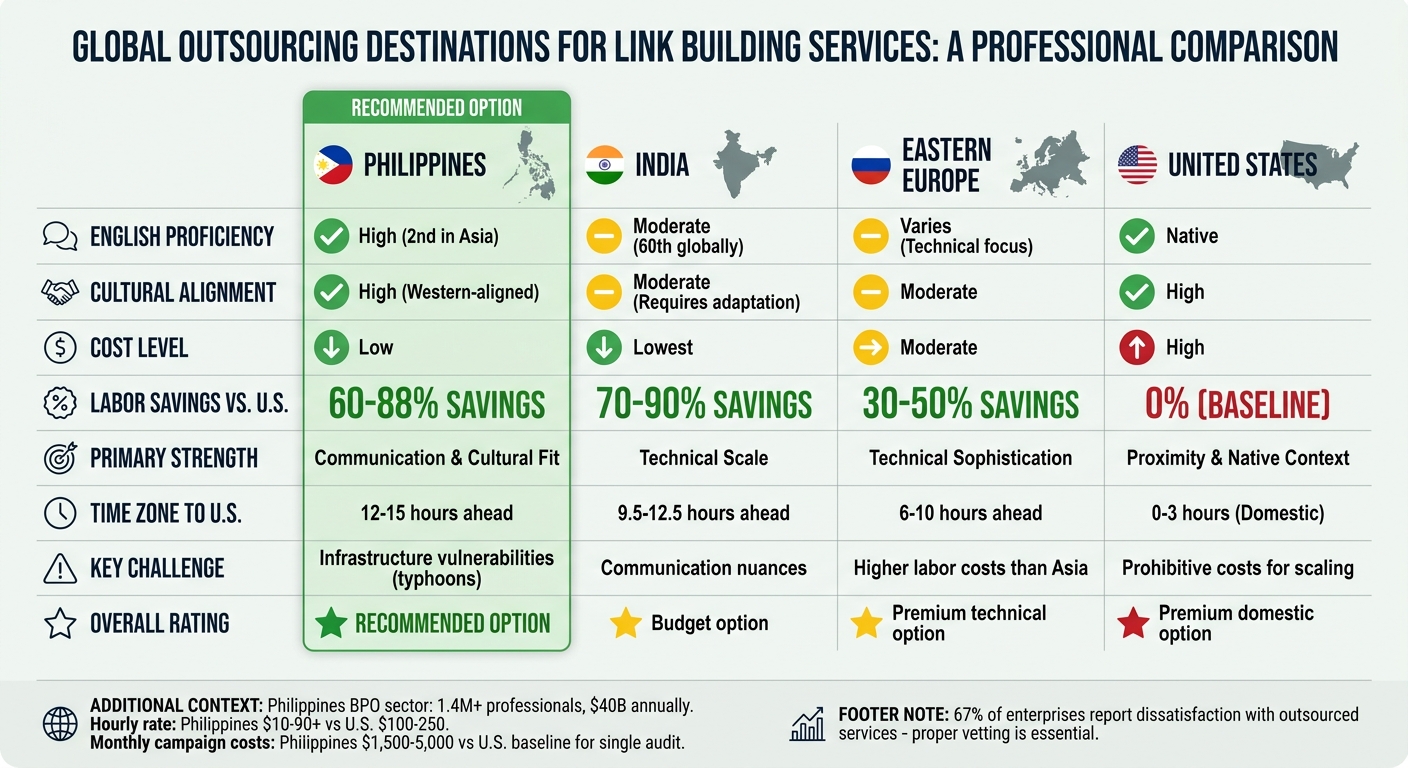
Global Outsourcing Comparison: Philippines vs India vs Eastern Europe vs USA for Link Building Services
This comparison highlights why the Philippines is a strong contender for outsourcing standard and custom link-building tasks. Each region brings its own mix of strengths and limitations across key factors.
| Feature | Philippines | India | Eastern Europe | United States |
|---|---|---|---|---|
| English Proficiency | High (2nd in Asia) | Moderate (60th globally) | Varies (Technical focus) | Native |
| Cultural Alignment | High (Western-aligned) | Moderate (Requires adaptation) | Moderate | High |
| Cost Level | Low | Lowest | Moderate | High |
| Labor Savings vs. U.S. | 60–88% | 70–90% | 30–50% | 0% (Baseline) |
| Primary Strength | Communication & Cultural Fit | Technical Scale | Technical Sophistication | Proximity & Native Context |
| Time Zone (to U.S.) | 12–15 hours ahead | 9.5–12.5 hours ahead | 6–10 hours ahead | 0–3 hours (Domestic) |
| Key Challenge | Infrastructure vulnerabilities (typhoons) | Communication nuances | Higher labor costs than Asia | Prohibitive costs for scaling |
The Philippines stands out for businesses that prioritize clear communication and cost efficiency. India, while offering the lowest costs and vast technical talent pools, often faces challenges with communication that can slow down collaboration. Eastern Europe is ideal for advanced technical work but comes with rates closer to Western standards. Meanwhile, the U.S. provides unmatched proximity and native context, but the high costs make it less feasible for startups or mid-sized firms looking to scale.
Globally, quality can vary significantly. Surveys reveal that 67% of enterprises report dissatisfaction with outsourced services, often due to poor vetting or skill gaps. The Philippines addresses this with its well-established BPO sector, employing over 1.4 million professionals and generating around $40 billion annually. Even so, businesses should minimize risks by starting with paid test projects and milestone-based payments before committing to long-term contracts.
Infrastructure challenges further differentiate these regions. The Philippines faces about 20 typhoons annually, which can disrupt power and internet connectivity. While major hubs have backup systems in place, rural areas remain more vulnerable. On the other hand, Eastern Europe and the U.S. offer stable infrastructure at a higher cost.
The time zone difference between the Philippines and the U.S. – 12 to 15 hours ahead – can also be an advantage. Many companies use this gap to implement a "follow-the-sun" model, assigning tasks at the end of the U.S. workday and ensuring completion by the next morning. This approach enables round-the-clock operations without the expense of domestic night shifts, turning a potential obstacle into a strategic benefit for businesses needing continuous workflow.
Case Studies: Philippine Success Stories
These examples highlight how the Philippines combines specialized skills and cost-effective services to achieve impressive link building results.
Philippine link building agencies have delivered measurable success across various industries. Take SharpRocket, a Manila-based agency known for its white-hat manual outreach. Their campaigns have consistently shown the ROI potential of targeted link building efforts.
For example, Spenmo, a fintech platform, experienced a 371% increase in traffic value after collaborating with a Philippine team. The strategy focused on securing placements in financial and business publications with domain ratings between DR30 and DR70. By blending content marketing with digital PR, the campaign helped Spenmo build credibility in a highly competitive industry where trust signals are crucial.
In the eCommerce sector, Fiddlershop, a music retail business, saw a 310% boost in organic traffic. This was achieved through targeted link building efforts that focused on music education and instrument review websites. Similarly, BlastOne, an industrial equipment supplier, enjoyed a 66.45% increase in organic traffic by earning links from blogs in the construction and manufacturing niches.
Another standout example is Waterzen, a home water services company, which grew from $0 to $101,000 in traffic value. This was the result of a long-term campaign that prioritized placements in local service directories and home improvement publications. Additionally, Keypath Education secured over 820 high-quality links by leveraging a Philippine team’s network of more than 5,000 editorial contacts across education and career development sites. This extensive network significantly sped up outreach and link placements.
These campaigns typically cost between $1,500 and $5,000 per month, a fraction of what similar services would cost in countries like the U.S., UK, or Canada.
These success stories demonstrate how the Philippines combines affordability with technical know-how, making it an ideal choice for choosing an SEO outsourcing company for specialized link building services.
Conclusion
The Philippines has carved out a strong position in the niche link building outsourcing market, thanks to its skilled workforce and well-established BPO infrastructure. With a $38 billion BPO market, the country showcases its expertise and enjoys robust government backing through the Department of Information and Communications Technology. These factors make it a strategic choice for businesses seeking outsourcing solutions.
"Compared to other BPO locations, the Philippines has the right balance of English proficiency, cultural affinity with the West, technical prowess, and affordability." – Unity Communications
One of the standout reasons to choose the Philippines is its cultural alignment and professional compatibility. With a 99.27% literacy rate and business practices influenced by Western standards, collaboration becomes smoother, avoiding many of the communication hurdles that arise in other outsourcing hubs.
To ensure a successful partnership, it’s crucial to conduct real-time vetting through video calls and start with a paid test project using milestone-based payments. This approach helps secure quality outcomes while protecting your investment. Additionally, confirm that providers hold ISO certifications and implement strict non-disclosure agreements to safeguard sensitive information.
For companies aiming to scale their link building efforts efficiently, the Philippines offers a combination of skilled talent, cost-effectiveness, and operational advantages. Providers like 365Outsource.com make the process seamless by offering dedicated account managers and transparent communication, enabling businesses to integrate offshore teams without losing focus on their core objectives.
FAQs
How do I vet a Philippines-based link building team before hiring?
To evaluate a link-building team based in the Philippines, start by looking at their communication skills, experience, and reputation. Check their portfolios and case studies to see if they have expertise in your niche. Request client testimonials to understand their track record and assess how well they grasp your industry. Transparency is key – make sure they provide clear reports with measurable outcomes. You can also conduct interviews or assign trial projects to get a sense of their professionalism and how effectively they communicate. These steps will help you find a dependable team for your link-building goals.
How can I protect my business data when outsourcing link building?
To keep your business data safe, begin by selecting an outsourcing provider known for their strong security measures. Put non-disclosure agreements (NDAs) in place to maintain confidentiality and restrict access to only the data that’s absolutely necessary. Use role-based permissions, ensure secure communication channels, and schedule regular audits. These actions help safeguard sensitive information while still allowing you to take advantage of affordable link-building services.
How can the Philippines–U.S. time difference speed up link building work?
The time difference between the Philippines and the U.S. creates an opportunity for link-building tasks to be handled outside of U.S. business hours. This ensures work is progressing even when the U.S. team is offline. Additionally, the overlapping hours allow for real-time communication when necessary, enabling quicker responses and boosting overall project efficiency.