
Content marketing is more than just a buzzword; it’s a long-term business strategy that continues to shape how brands attract, engage, and convert audiences in the digital age. As consumer behavior has shifted dramatically toward online research and self-directed decision-making, content has become the primary bridge between businesses and their potential customers. Today, people consume a constant stream of digital content—ranging from videos, blog posts, and news articles to white papers, social media updates, podcasts, webinars, and eBooks. For modern marketers, investing in content is no longer optional; it is a fundamental requirement for staying visible and competitive.
However, with such a wide variety of content formats available, one of the biggest challenges businesses face is deciding what actually works. Not every content type delivers the same results, and not every format aligns with every business goal. This is where strategy becomes essential. The effectiveness of your content depends heavily on what you are trying to achieve. Are you focused on increasing brand awareness and reaching new audiences? Do you want to generate qualified leads and drive conversions? Are you trying to build a loyal online community or strengthen customer retention? Or perhaps your goal is to position your business as an authority and thought leader within your industry?
Each of these objectives requires a different content approach. For example, short-form content such as social media posts and blog articles may be highly effective for visibility and awareness, while in-depth resources like white papers and case studies are more powerful for lead generation and B2B decision-making. Meanwhile, video content and webinars often excel at engagement and education, helping businesses build trust and authority with their audience over time.

In this context, content marketing becomes less about producing random materials and more about building a structured ecosystem of content that supports specific business outcomes. Every piece of content should serve a purpose within the customer journey, guiding users from initial discovery to final conversion.
In today’s discussion, we’ll explore content strategies that have been shown to generate some of the highest return on investment (ROI), based on research insights originally highlighted in a study released by CopyPress, a software company specializing in content marketing tools and strategy development. The findings emphasize not only which types of content perform well but also how marketers are shifting their focus toward more measurable and impactful content-driven approaches.

Interestingly, the study revealed that even as early as 2013, a significant portion of marketers were already beginning to reallocate their budgets and channel focus toward content marketing. Half of the surveyed marketers reported changing their channel strategies, with a majority indicating that content marketing would become their primary focus moving forward. This early shift marked the beginning of what has now become a dominant force in digital marketing.
One of the most compelling insights from the research was the identification of the most cost-effective content formats. According to the findings, featured articles, videos, and white papers ranked as the top-performing content types in terms of return on investment. Among these, featured articles stood out significantly, with 62.2% of respondents reporting that they delivered the highest ROI compared to other formats.
This data highlights an important principle in content marketing: success is not determined solely by volume, but by value and relevance. High-performing content tends to be informative, well-structured, and aligned with audience intent. It addresses real problems, provides actionable insights, and builds trust with readers or viewers over time.
Featured articles, for instance, are particularly effective because they combine storytelling with SEO optimization, making them highly discoverable while still engaging to read. Videos, on the other hand, offer a dynamic and visual way to communicate complex ideas quickly and effectively, which is especially powerful in today’s fast-scrolling digital environment. White papers provide depth and authority, making them ideal for audiences who are further along in the decision-making process and require detailed information before taking action.
Ultimately, the key takeaway from these insights is that successful content marketing is not about choosing a single format, but about building a balanced strategy that aligns content types with specific business goals. By understanding what drives ROI and how different formats serve different stages of the customer journey, businesses can make more informed decisions and create content that not only attracts attention but also delivers measurable results.
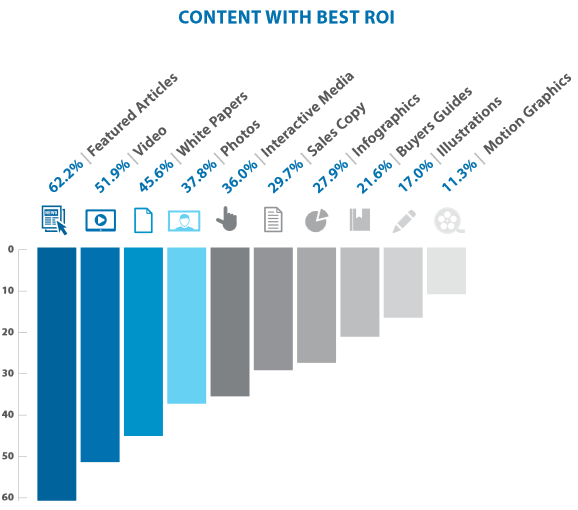
While video is considered as a close second with 51.9% votes, marketers also described it as a challenge to create, along with infographics and interactive media.
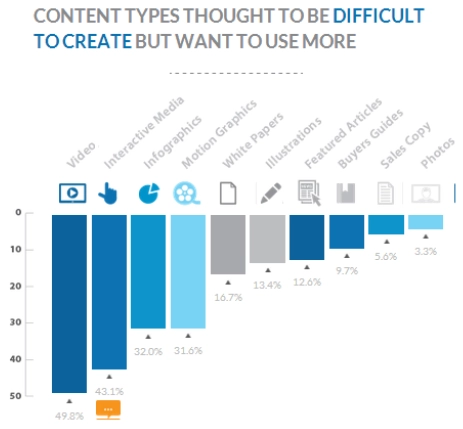
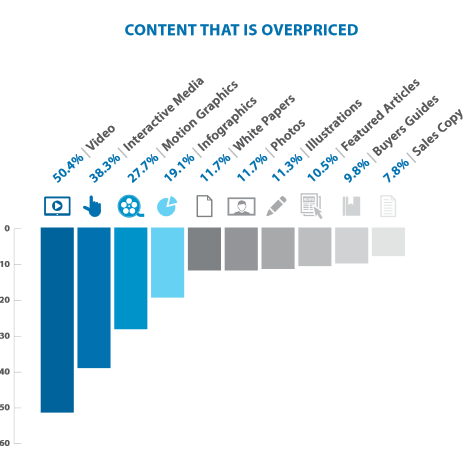
According to CopyPress, there was an interesting correlation between the content strategy which marketers found ‘difficult’ to source and that which they found ‘expensive’. In the graph below, video, interactive media, and motion graphics are still the top three answers for most marketers.
Of all the concepts that are directly related to content marketing, Google Authorship would probably win the title of the most talked about buzzword of 2012. To get a better gauge at how much marketers are paying attention to this content marketing element, CopyPress surveyed how many marketers are focusing on authorship this year. It revealed that majority of the marketers think if authorship as an important part of their content marketing strategy.

To get the full report from CopyPress, click this link to download the white paper.