
Outsourcing back-end development can save you money, speed up your projects, and give you access to skilled developers worldwide. Here’s why it works:
- Cost Savings: U.S. developers can cost $120,000–$150,000 annually, while outsourcing to places like the Philippines can cut costs by up to 75%.
- Access to Talent: Outsourcing connects you with experienced developers skilled in technologies like Java, Node.js, and Python.
- Faster Timelines: Pre-vetted teams and time zone advantages enable quicker project completion.
- Scalability: Easily scale your team up or down based on project needs without long hiring processes.
- Maintenance Support: Outsourced teams handle updates, bug fixes, and security so you can focus on growth.
- Improved Security: Outsourcing partners follow strict security protocols and compliance standards.
- Focus on Core Tasks: Delegating technical work frees your team to prioritize business strategy and customer relationships.
For U.S. companies, outsourcing to the Philippines offers cost-effective solutions, skilled professionals, and smooth collaboration due to English proficiency and alignment with U.S. business practices.
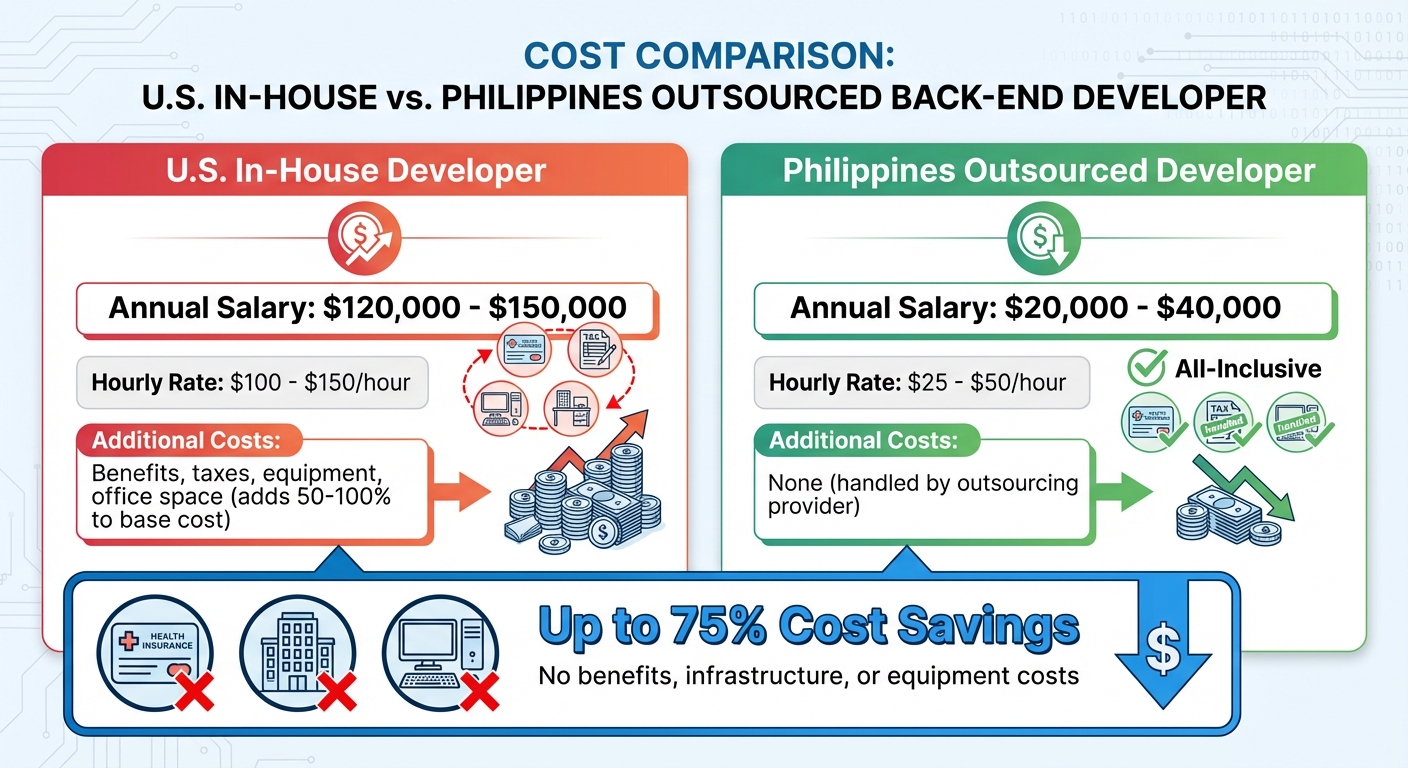
Cost Comparison: In-House vs Outsourced Back-End Development
4 Reasons Why Outsourcing Software Development Works
1. Lower Costs and Fixed Budgets
Hiring a back-end developer in the U.S. comes with a hefty price tag – between $120,000 and $150,000 annually. Factor in overhead costs like benefits, taxes, and equipment, and that figure can climb 50–100% higher. When broken down, the fully loaded cost for just one developer can hit $100–$150 per hour. These high expenses make outsourcing an attractive alternative.
Outsourcing to the Philippines offers a much more budget-friendly option. Developers in the Philippines typically earn $20,000–$40,000 per year, with hourly rates ranging from $25 to $50. Skilled in key programming languages like Java and Node.js, these developers provide up to 75% savings in labor costs without compromising on quality. Companies such as 365Outsource.com offer full-time or part-time developers at these rates, and you won’t need to worry about covering benefits, infrastructure, or equipment costs.
Outsourcing also brings much-needed financial stability. Fixed-rate contracts provide clear, upfront pricing in USD, with milestones laid out from the start. This eliminates hidden fees and helps avoid the budget surprises that often come with in-house teams.
“You won’t have to provide benefits to the workers and have fewer overhead expenses to worry about. No more employee insurance, workers’ compensation, sick pay, holiday pay, or taxes – we take care of all that for you.” – 365Outsource.com
2. Access to Experienced Back-End Developers
Hiring back-end developers in the U.S. can be a lengthy process, especially when your project demands specialized skills. The local talent pool often becomes limited, making it challenging to find the right fit. Outsourcing solves this issue by opening the door to a global network of highly skilled professionals.
Tech hubs around the world, including the Philippines, are home to teams with expertise in sought-after technologies like Java (Spring Boot), PHP (Laravel), Node.js, Python with Django, and databases such as MongoDB, PostgreSQL, and Redis. These developers not only bring technical expertise but also follow established workflows, prioritize security, and are proficient in modern tools like Docker, Kubernetes, AWS Lambda, and GraphQL. With an average tenure of 2.5 years, outsourced developers provide stability and long-term value to your projects.
For U.S. businesses, companies like 365Outsource.com connect you with experienced back-end developers from the Philippines. Their team specializes in back-end technologies, including WordPress and PHP, and has years of experience collaborating with international brands to deliver high-quality results. Learn more about how they can help your business scale efficiently.
“If you are looking for a team with years of experience and an out-of-this-world work ethic, you’ve come to the right place.” – 365Outsource
3. Faster Project Completion
Outsourcing back-end development can shave off significant time when compared to the often lengthy process of hiring locally. For instance, recruiting a U.S.-based developer can take up to 50 hours. When you outsource, you bypass this hurdle entirely, gaining access to pre-vetted teams that are ready to dive in immediately, ensuring your project gets off the ground without unnecessary delays.
Once onboard, these outsourced teams bring efficiency to the forefront. They operate with established workflows and proven systems, leveraging Agile methodologies, DevOps practices, and automated testing. This approach cuts down on trial-and-error cycles and reduces rework, keeping timelines predictable and on track.
Time zone differences can also work to your advantage. Teams in the Philippines, for example, operate on a 12–15 hour offset from U.S. time zones. This setup enables a “follow-the-sun” workflow, where development continues even after your in-house team clocks out. The result? A near–24/7 development cycle that significantly reduces time-to-market.
Another key benefit is the ability to run parallel workflows. Outsourced agencies often deploy specialized sub-teams to tackle different components of a project simultaneously – whether it’s APIs, database architecture, or integrations. This multi-pronged approach compresses timelines and ensures faster project completion.
“We understand that time is a valuable and irreplaceable commodity. That’s why we do things right the first time. We do what we say and we say what we do. We hit deadlines, stay on budget, and practice a proactive approach to client relationships.” – 365Outsource.com
4. Easy Team Scaling
Outsourcing doesn’t just speed up project timelines – it also makes scaling your team a breeze. Project needs can fluctuate wildly – one month you might need three developers, and the next you could be scrambling for eight. Outsourcing offers the flexibility to adjust your team size without the headaches of hiring or layoffs.
With outsourcing, you gain access to a pool of pre-vetted developers who can jump into your project in just days. Compare that to the weeks – or even months – it often takes to recruit and onboard in-house employees. For instance, let’s say you need Node.js experts for a quick API integration. With outsourcing, you can bring them on board almost immediately. Once the sprint wraps up, scaling down is just as simple – no HR complications, no severance packages.
The financial benefits are undeniable. By outsourcing, you avoid the overhead costs tied to full-time employees, cutting expenses by as much as 50–70% compared to maintaining an in-house team.
| Aspect | In-house hiring | Outsourced team |
|---|---|---|
| Time to scale up | Months (recruiting, interviewing, onboarding) | Days to a few weeks |
| Time to scale down | Slow; involves layoffs and severance | Contract-based; adjust at the end of a sprint |
| Fixed commitments | Salaries, benefits, taxes, office space | Pay only for needed capacity |
| Flexibility for short projects | Low; risky for 3–6 month work | High; easy to spin up temporarily and then disband |
For U.S. companies, outsourcing partners like 365Outsource.com make scaling web development teams effortless. They offer part-time and full-time back-end developers from the Philippines, allowing you to quickly ramp up during product launches or seasonal surges. This kind of flexibility ensures smooth project execution and efficient management.
sbb-itb-5665bbf
5. Ongoing Maintenance and Support
Getting your back-end system up and running is just the first step. After launch, there’s a lot that needs constant attention – server monitoring, database optimization, security updates, and bug fixes. Instead of building an in-house team for these tasks, outsourcing can be a game-changer. Many outsourced back-end teams offer continuous maintenance packages, taking the burden off your shoulders.
One of the standout perks of outsourcing is 24/7 monitoring. For instance, teams in the Philippines often start their workday as U.S. teams are wrapping up, ensuring quick issue detection and minimal downtime. Imagine an e-commerce business outsourcing its web development maintenance – experts handle everything from security updates to bug fixes and performance tweaks. This keeps the platform running smoothly, allowing the business to focus on what really matters: boosting sales.
Outsourcing also helps trim ongoing expenses. You’re not paying for full-time salaries, training programs, or on-call staff. Instead, you only pay for the services you need. Plus, outsourced teams usually come with tried-and-tested QA processes and risk management strategies, which can significantly reduce production hiccups over time. This cost-effective setup pairs perfectly with the other advantages of outsourcing.
For U.S. companies looking to outsource back-end maintenance, providers like 365Outsource.com offer flexible and affordable solutions. Their teams in the Philippines handle everything from bug fixes and performance optimization to security compliance with standards like GDPR and PCI-DSS. This frees up your in-house team to focus on innovation and growth, rather than routine upkeep.
6. Better Security Practices
When you outsource back-end development, you gain access to teams with extensive experience in managing sensitive systems daily. These providers follow established, reliable processes to secure APIs, databases, and server infrastructure – tasks that can be difficult for smaller in-house teams to handle consistently. They often adhere to secure coding standards like those outlined by OWASP, enforce strict access controls for production environments, and maintain clear role separations within their workflows. This creates a solid starting point for implementing advanced, layered security measures.
Top outsourcing partners employ a range of security techniques, including strong encryption, multi-factor authentication, network segmentation, and application safeguards. On the application side, they use coding practices designed to prevent vulnerabilities like SQL injection, enforce rigorous input validation, and apply rate limiting. On the infrastructure front, they focus on hardened operating systems, regular patching, least-privilege access roles, encrypted storage for databases and backups, and detailed logging of all access to sensitive endpoints.
Security is never a one-and-done task – it requires ongoing attention. Experienced teams integrate tools like automated testing, static and dynamic security scans, and continuous monitoring directly into their CI/CD pipelines. They evaluate dependencies for vulnerabilities before deployment, use centralized logging to identify anomalies such as repeated login failures or unusual data exports, and perform regular internal audits and external security assessments to ensure their measures remain effective over time.
For U.S. companies managing regulated data, compliance is a critical factor. Skilled outsourcing providers can help you meet standards such as GDPR, HIPAA, PCI-DSS, and ISO 27001. They achieve this by implementing practices like data minimization, defining clear retention policies, and documenting how data is stored and processed. They also maintain audit trails to track access to sensitive information, properly manage encryption keys, and handle agreements like Business Associate Agreements for healthcare data – allowing you to meet compliance requirements without building a complex infrastructure from scratch.
When selecting a partner, look for evidence of their security protocols, such as certifications, documented policies, and incident response plans. Ask about their penetration testing frequency, how they enforce multi-factor authentication, and where your data will be stored. Providers like 365Outsource.com follow stringent security measures, embedding them into every stage of development. These practices ensure your back-end systems remain secure, compliant, and resilient – all while keeping costs under control.
7. More Time for Core Business Activities
Handing off back-end tasks to an external team frees up your internal staff to focus on what truly matters. Instead of spending countless hours hiring developers, managing code reviews, or juggling technical details, your team can channel its energy into product strategy, nurturing customer relationships, and driving revenue. According to a Deloitte Global Outsourcing Survey, 65% of organizations outsource specifically to concentrate on core business functions, with software development being one of the top areas delegated.
This approach is particularly beneficial for companies with limited technical expertise or those in the early stages of growth. Take an e-commerce brand, for instance: outsourcing web development allows leadership to prioritize sales and customer experience while a skilled external team handles the creation and upkeep of the online store. This way, teams like product owners, marketing specialists, and customer success managers can stay laser-focused on what sets the business apart, rather than getting bogged down by technical challenges. This operational pivot also aligns seamlessly with the cost and scalability advantages mentioned earlier.
Outsourcing partners often deliver comprehensive services that streamline coordination and reduce the time spent on project management. By assigning tasks to an external team that operates based on your priorities and acceptance criteria, you can cut oversight demands significantly – sometimes by as much as 50%.
For U.S.-based companies, working with providers in the Philippines, such as 365Outsource.com, offers a budget-friendly way to delegate routine development and maintenance tasks. These providers bring strong English skills, cultural alignment, and flexible staffing options, whether you need part-time or full-time support. Meanwhile, your in-house team can stay focused on growth areas like market expansion, partnerships, and customer acquisition. The cost savings from outsourcing can then be reinvested into marketing, sales, and R&D to fuel further growth.
The key is to identify which activities are central to your business and delegate the rest. Keep strategic roles – like those driving product vision, customer engagement, and business development – in-house, while outsourcing tasks such as back-end implementation, system integrations, and maintenance to specialists. Choose vendors with a track record of clear communication and proven processes to minimize the need for constant oversight.
Why Outsource Back-End Development to the Philippines
Outsourcing back-end development to the Philippines offers more than just cost savings – it provides access to skilled talent and efficient workflows. In 2022, the country’s IT-BPM sector generated over $32 billion in revenue and employed 1.3 million professionals. For U.S. companies, this means tapping into a pool of highly capable developers at rates that are typically 60-70% lower than hiring domestically. But the benefits go beyond the numbers.
One standout advantage is the workforce’s English proficiency. The Philippines ranks among the top in Asia for English skills, with over 90% of its population fluent in the language. English is also the primary language of instruction in universities, including IT and computer science programs. This ensures that technical discussions, code reviews, and project documentation happen without the hurdles of language barriers. For tasks like managing complex database systems, API integrations, and security protocols, clear and effective communication is absolutely essential.
Another key factor is the cultural alignment with U.S. business practices. Developers in the Philippines are well-versed in agile workflows, Western management styles, and widely used tools like Slack, Jira, GitHub, and AWS. This familiarity minimizes onboarding time and ensures smooth collaboration during daily standups, sprint planning, and code deployments. Additionally, the strong service-oriented mindset prevalent in the Philippines fosters trust, responsiveness, and a high level of professionalism – qualities that U.S. businesses highly appreciate.
The Philippines also offers a time zone advantage that can boost productivity. Although Manila operates on UTC+8, which is 13-16 hours ahead of U.S. time zones, many outsourcing providers structure night or split shifts to ensure 3-5 hours of daily overlap with U.S. teams. This overlap allows for real-time collaboration during U.S. business hours. Meanwhile, the “follow-the-sun” model enables Philippine teams to implement, test, and deploy work overnight, accelerating development cycles and reducing time-to-market.
Companies like 365Outsource.com enhance this experience by providing dedicated account managers who serve as single points of contact for U.S. clients. These managers handle everything from project scoping to resource allocation and progress tracking, ensuring seamless integration between your offshore and in-house teams. Whether you need developers for scalable server architectures, API development, or ongoing maintenance, their tailored solutions bridge operational and cultural gaps, delivering cost-efficient and effective results.
Conclusion
Outsourcing back-end development gives U.S. businesses a clear path to cut costs, speed up delivery, and scale teams as needed. By shifting fixed staffing expenses to project-based spending, companies can save anywhere from 30% to 60%. This eliminates the need for recruitment, benefits, and office overhead, while tapping into skilled professionals experienced in technologies like Node.js, Python, Java, and .NET. These experts can tackle complex infrastructure challenges that might take months to address with local hires.
This cost-effective approach also streamlines project timelines. Outsourcing allows businesses to leverage pre-vetted teams and established workflows, making it easier to roll out new features quickly. Plus, the ability to scale teams up or down based on project demands ensures labor costs stay in sync with business needs. Reliable outsourcing partners also bring structured QA processes, secure coding practices, and compliance measures to the table, reducing risks like data breaches and downtime.
Beyond the operational benefits, outsourcing frees up internal teams to focus on strategic priorities such as sales, marketing, product development, and customer experience. While in-house resources drive growth, specialized developers handle the technical heavy lifting – whether it’s managing infrastructure, integrating systems, or fine-tuning performance. For startups and mid-sized firms that need enterprise-level back-end solutions but lack the resources for a full in-house team, outsourcing transforms IT into a tool for growth.
The Philippines stands out as a strong outsourcing destination, offering affordable labor and alignment with U.S. business practices. Providers like 365Outsource.com offer web development and back-end services, helping U.S. companies expand their development capacity while ensuring clear communication and predictable budgeting.
To get started, businesses should identify resource-intensive back-end tasks that could benefit from outsourcing. A pilot project – like developing a new API, integrating systems, or improving performance – can serve as a test run to validate the partnership before scaling up. In today’s fast-paced digital world, leveraging global back-end expertise delivers the speed, flexibility, and resilience needed to stay ahead of the competition.
FAQs
How can outsourcing back-end development speed up project completion?
Outsourcing back-end development can help you speed up your project timelines by connecting you with skilled professionals who are ready to jump in right away. This bypasses the usual delays tied to hiring, onboarding, and training an in-house team.
An outsourced team brings focus and expertise to the table, helping you smooth out workflows, avoid bottlenecks, and accelerate development cycles. This means you can hit your deadlines more efficiently, roll out projects faster, and get your product to market sooner.
What security practices do outsourced back-end teams follow?
Outsourced back-end teams take security seriously, employing a range of measures to safeguard sensitive data and systems. These include data encryption, secure access controls, multi-factor authentication, and firewalls. Regular security audits are also a key part of their approach, helping to pinpoint vulnerabilities and ensure adherence to international standards like GDPR and ISO 27001.
With these practices in place, outsourced teams work to protect your business operations while upholding strong data protection and privacy standards.
Why is the Philippines a top choice for outsourcing back-end development?
The Philippines has become a go-to destination for outsourcing back-end development, thanks to its affordable services, a talented workforce, and strong English language skills. Professionals in the country stand out for their excellent communication abilities and alignment with U.S. business practices, ensuring smooth and efficient collaboration.
On top of that, the Philippines provides access to highly skilled tech professionals through dependable outsourcing companies. This allows businesses to tap into flexible solutions without compromising on quality, making it an appealing option for back-end development projects.