
In today’s online-driven world, your reputation can make or break your business. A single negative Google result or overlooked mention can cost you customers, deals, and even top talent. Managing this internally is time-consuming and complex, which is why many businesses outsource digital marketing, especially for businesses handling high review volumes or operating across multiple locations. That’s where a reputation monitoring partner comes in.
Here’s how to choose the right one:
- Check Experience: Look for firms with a proven track record and expertise in your industry.
- Evaluate Tools: Advanced monitoring tools should cover all platforms, from social media to AI-generated content.
- Review Case Studies & References: Prioritize measurable results and long-term success over vague promises.
- Compare Pricing: Understand costs, hidden fees, and contract flexibility.
- Ensure Compliance: Verify data security and adherence to regulations like GDPR and CCPA.
- Assess Communication: A dedicated point of contact and clear reporting are non-negotiable.
The stakes are high, but with the right partner, you can safeguard your brand, save time, and focus on growth. Let’s dive deeper into these steps.
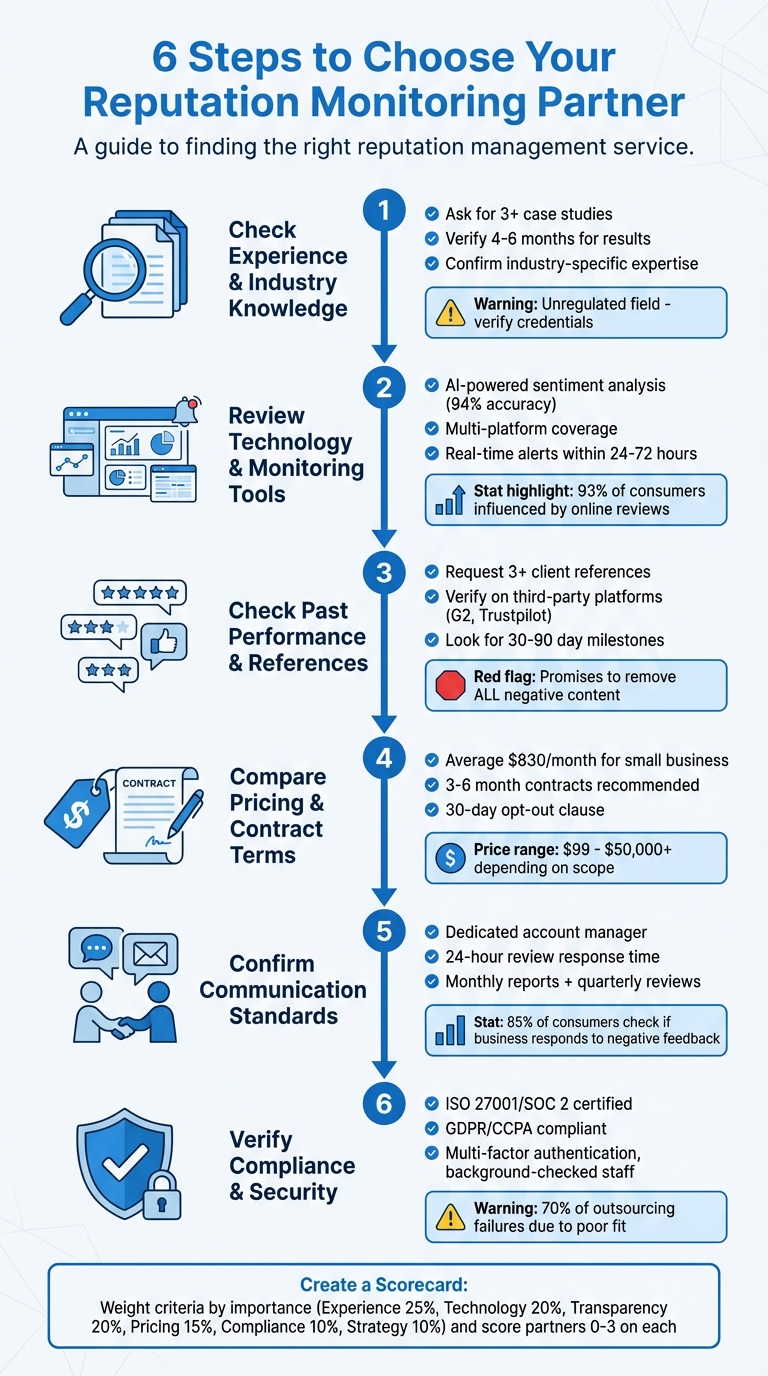
6-Step Guide to Choosing the Right Reputation Monitoring Partner
How to Choose an Effective Online Reputation Management Service
Step 1: Check Experience and Industry Knowledge
Choosing the right reputation monitoring partner starts with evaluating their experience and understanding of your industry. Since the online reputation management field is unregulated, anyone can claim to be an expert overnight. That’s why verifying genuine expertise is so crucial.
Focus on partners whose primary focus is reputation management and SEO outsourcing. They should have in-house experts with diverse backgrounds in PR, legal matters, technology, and digital strategy, rather than relying entirely on outsourced professionals. A trustworthy firm will also have a track record of tackling PR crises, managing negative search results, and resolving social media controversies specific to businesses like yours.
Understanding your industry is just as important. Whether you’re in B2B SaaS, healthcare, legal services, or retail, a partner familiar with your sector will better handle unique regulations, customer expectations, and reputation challenges.
Review Their Case Studies
Case studies are a great way to separate real expertise from empty promises. Ask for at least three case studies. These should clearly outline measurable outcomes, such as published content, improved rankings, or secured profiles, instead of vague claims about "improved brand sentiment."
Timelines matter too. Ask about key milestones at 30, 60, and 90 days to gauge their workflow. Keep in mind that significant changes in search results usually take 4–6 months to materialize, while lasting stability often requires a year of consistent effort. Look for proof that results held steady beyond 12 months, as short-term fixes often indicate unsustainable strategies.
Go beyond written testimonials by contacting references. Ask if the agency met deadlines, communicated effectively, and delivered as promised. This step not only confirms their technical abilities but also sheds light on their understanding of your industry.
Confirm Industry-Specific Knowledge
Once you’ve confirmed their general expertise, dig deeper into their knowledge of your industry’s unique challenges. Ask how they’ve tackled reputation issues specific to your field. For instance, how do they help healthcare providers comply with HIPAA regulations, or how do they assist legal firms in adhering to bar association advertising rules?
Speak with their current clients in your industry to validate their understanding of market-specific nuances. Also, check if they regularly share insights or trends relevant to your sector on their blog or social media platforms. This shows they’re actively engaged with your industry and not just applying generic solutions.
Lastly, do some research on the partner’s own reputation. Look into trade publications, industry associations, and analyst reports to see how they’re perceived. If they can’t effectively manage their own brand, it’s a serious warning sign. Their online presence should reflect the same standards they promise to uphold for your business.
Step 2: Review Technology and Monitoring Tools
The tools your partner uses play a major role in how quickly they can detect issues and how well they can measure your reputation. Today, brand perception is shaped across many channels at once – reviews, social media, videos, eCommerce platforms, customer support, and search engines all contribute to the bigger picture. Relying on basic tools like Google Alerts just doesn’t cut it anymore.
Ask your partner which platforms they monitor. Advanced tools should cover mentions across social media, review sites, forums, news outlets, blogs, and even podcasts. Some providers go a step further with visual AI that can spot your brand logo in images and videos. Tools like YouScan and Talkwalker are great for identifying your products in user-generated content that text-based monitoring might miss.
AI answer engines are the latest area to watch. Tools like LLMrefs (starting at $79/month) can track how your brand is represented in responses from ChatGPT, Gemini, and Perplexity. Considering that 81% of shoppers research online before making a purchase, it’s crucial to ensure AI-generated responses accurately reflect your brand’s story. This makes it even more important to evaluate the specific tools your partner uses.
Check Their Monitoring Tools
Modern sentiment analysis platforms powered by AI, like Revuze and Sprinklr, can filter out bots and spam, delivering precise sentiment scores across vast amounts of data. Meanwhile, tools like SentiOne maintain an impressive 94% accuracy across over 75 languages.
Opt for partners who provide tools that go beyond just consumer sentiment. For example, platforms like Caliber monitor real-time perceptions from employees, investors, and regulators – not just customers. This is essential since reputation directly impacts over 25% of a company’s revenue, and stakeholders like employees or policymakers can influence your overall standing.
"The emerging standard is continuous, AI-enabled Stakeholder Intelligence that not only monitors reputation but predicts behaviors and business outcomes." – Guna Pursele, Author, Caliber
If your business operates in multiple locations, ensure your partner uses multi-location management tools like Reputology, Chatmeter, or SOCi. These platforms consolidate reviews from various sites into a single dashboard, helping you respond consistently. This is especially important since 53% of customers expect a response to a negative review within a week, and 33% expect it within three days.
Also, ask about real-time alerts and escalation processes. Your partner should have systems in place to notify you of negative mentions so that urgent issues are flagged to the right team within 24–72 hours. Look for tools with AI-powered event detectors capable of spotting unusual spikes in mentions, which could signal a potential crisis. These features not only help monitor but also prepare for emerging challenges, aligning with a proactive approach to reputation management.
Review Reporting and Analytics
Monitoring is just one part of the equation. The ability to turn data into actionable insights is equally important. Your partner’s platform should offer centralized dashboards that allow you to drill down into specific locations or regions, rather than limiting you to high-level corporate summaries. Request sample reports that show sentiment trends, historical data, and options to export information to tools like Tableau or Microsoft Power BI. This will help you align reputation metrics with your existing KPIs.
Integration with your CRM system is another must-have. Platforms like Sprout Social and Brandwatch can connect directly with Salesforce, merging reputation data with customer profiles. This gives your sales and support teams immediate insight into customer sentiment, enabling more tailored interactions. Some tools also integrate with Slack or Microsoft Teams, allowing your team to receive alerts and respond to reviews without leaving their usual workspace.
Lastly, confirm that they track competitor sentiment and review trends. Knowing how your reputation stacks up against competitors can reveal market opportunities and areas for improvement. With 93% of consumers saying online reviews influence their buying decisions, and businesses with 4+ star ratings earning 32% more revenue than those with lower ratings, your partner’s reporting should clearly show where you stand in the competitive landscape.
Step 3: Check Past Performance and Client References
A flashy website doesn’t guarantee expertise – results do. In the largely unregulated world of online reputation management, anyone can claim to be an expert, so it’s crucial to dig deeper. Testimonials, references, and case studies provide the proof you need to determine if a firm delivers long-lasting results or just temporary fixes that crumble over time.
Ask for Client Testimonials
Client testimonials offer insight into a firm’s reliability and effectiveness. But not all testimonials are created equal. Look for ones that follow a clear structure: the problem the client faced, the specific solutions applied, and the measurable outcomes achieved. Vague praise like "great to work with" isn’t helpful. Instead, focus on detailed accounts that highlight the firm’s approach and results.
Industry-specific testimonials are particularly valuable. For instance, a firm skilled in automotive reputation management may not have the expertise to navigate compliance issues in healthcare or finance. Testimonials from businesses in your industry demonstrate the firm’s familiarity with your sector’s challenges, terminology, and tools. Also, check how long the improved reputation lasted – sustained success often signals ethical, long-term strategies rather than risky shortcuts.
Don’t stop at on-site testimonials. Verify the firm’s reputation on third-party platforms like G2, Trustpilot, Capterra, or Google Business Profiles. Some companies fabricate testimonials or misuse "as seen in" logos without actual affiliations. As Recover Reputation’s founder advises, always confirm testimonials are genuine.
Ask for at least three direct client references. When speaking with these references, inquire about the length of their partnership, specific results achieved, and areas where the firm could improve. Honest feedback, including mentions of any weaknesses, provides a clearer picture of what to expect. Also, ask about any surprises during onboarding or execution – this can help you identify potential issues before committing to a contract.
Study Their Case Studies
Case studies offer a more in-depth look at a firm’s capabilities. These detailed accounts show how they handled specific challenges, going beyond the surface-level information found in testimonials. Look for case studies that clearly outline the problem, the strategy implemented, and the timeline for results. Be cautious of claims of instant success – lasting improvements typically take 4–6 months or longer.
For local businesses, results may come a bit quicker. For example, Widewail achieved a 243% increase in review volume within 30 days, while Code Style Club saw a 573% increase in 60 days. These timelines, ranging from 30 to 90 days, are realistic for local reputation improvements.
Case studies can also help you determine whether the firm uses in-house teams or outsources work. Ask if all services are handled internally or if they rely on subcontractors, as outsourcing can lead to communication gaps and quality issues. Confirm that they offer a dedicated point of contact and provide transparent reporting throughout the engagement.
Be wary of red flags, such as promises to remove all negative content. While some content, like copyright violations, can be removed, suppression is often the only legal and sustainable option for media-related articles. Firms that guarantee complete removal are either misleading you or using risky tactics that could backfire. A trustworthy partner will set realistic expectations and include a clear exit clause if those expectations aren’t met. This ensures their promises align with what they can actually deliver.
Step 4: Compare Pricing and Contract Terms
When it comes to reputation management, clarity in pricing is a key indicator of a trustworthy partner. The average cost for small businesses is about $830 per month, but actual prices vary widely – from as low as $99 for basic services to over $50,000 for enterprise-level crisis management. Without clear pricing, you risk overpaying or locking into unsuitable agreements.
Compare Pricing Models
Reputation management pricing typically depends on factors like number of locations, review volume, and service scope. For instance:
- A single-location business with stable reviews might pay $200–$500 monthly for basic monitoring and alerts.
- A larger business managing over 100 reviews per month could spend $2,000–$5,000 monthly.
If your needs include active reputation repair or crisis management, expect to pay 50–200% more, with setup fees ranging from $3,000 to $15,000.
Industry type also affects costs. Highly regulated fields like healthcare, finance, and law often face a 20–40% price increase due to compliance requirements. For example, a dental office monitoring patient reviews will likely pay more than a retail store with similar review activity because of HIPAA concerns and the need for tailored responses.
Don’t overlook hidden fees. Some companies charge $5–$25 per review response, impose extra fees per location ($50–$300), or add costs for custom reporting. Always ask upfront: "Are there additional fees beyond the monthly retainer?" If setup fees exceed three times the monthly cost, that’s a red flag.
Before committing, calculate your return on investment (ROI). For example, a single negative search result for a product with 8,000 monthly searches could lead to over $1 million in lost annual sales. Compare the cost of reputation management to the potential revenue saved. If you’re spending $1,500 per month but preventing $10,000 in lost sales, the investment pays off.
Check Contract Flexibility
Contract terms vary, from month-to-month agreements to year-long commitments. However, 3–6 month terms are often the sweet spot recommended by reliable providers. Be cautious of contracts exceeding 12 months, especially if you’re a small business testing the waters. As Solange Messier, Content Strategy Manager at Vendasta, explains:
"You should avoid offering a month-to-month contract – since it doesn’t give you enough runway to deliver on expectations".
This works both ways: while providers need time to show results, you need an exit strategy if those results aren’t delivered.
Look for contracts that include a 30-day opt-out clause or satisfaction guarantee within the first 90 days. This allows you to exit without hefty fees, which can range from $500 to $5,000. When negotiating, try saying: "I’m willing to commit to three months, but after that, I’d like to switch to a month-to-month plan. Can we make that work?" Many providers will accommodate this, especially if your business aligns well with their services.
Scalability is another consideration as your business grows. Most providers charge per location ($50–$300 per additional site) or adjust pricing based on review volume. If you’re planning to expand significantly – say, from 5 to 20 locations – confirm how pricing will change. You might even negotiate to waive setup fees for a longer commitment, like six months.
Finally, ensure the contract specifies data ownership. You should retain control of all reviews, content, and profiles created during the partnership if you decide to switch providers. Addressing these details now will make the transition smoother and set the stage for evaluating communication standards in the next step.
sbb-itb-5665bbf
Step 5: Confirm Communication Standards and Team Compatibility
Protecting your digital reputation isn’t just about technical expertise – it also requires clear communication and alignment with your values. Once you’ve finalized pricing and terms, ensure your partner communicates effectively and understands your company’s culture. Even the best technical capabilities can falter if communication breaks down. As ReputationManagement.com puts it:
"A real partnership requires involvement from both the SEO company and the customer. The more you participate, the more aligned the strategy and the results will be".
This collaboration starts with setting clear expectations about how and when communication will happen.
Review Communication Methods
Make sure your partner assigns a dedicated account or project manager to oversee your campaign on a daily basis. This single point of contact can prevent confusion and streamline communication. Real-time alerts are also crucial – your partner should notify you immediately if negative reviews or mentions of your brand surface online. This quick response is vital, especially considering that 85% of consumers factor in whether a business responds to negative feedback before deciding to engage with them. Ask direct questions like: "How quickly will I be notified of a crisis, and what is your response protocol?"
During the first week, establish a service level agreement (SLA) that outlines key communication standards. This should include response times for reviews (preferably within 24 hours), how often reports will be shared (weekly or monthly), and the preferred communication tools – such as Slack for quick updates and email for detailed reporting. Regular check-ins, including monthly meetings to review performance metrics and quarterly business reviews (QBRs) to evaluate ROI, should also be part of the plan.
Once communication protocols are in place, shift your attention to ensuring the team handling your account aligns with your brand values.
Check Team Compatibility
Don’t just rely on the sales team for insights – speak directly with the staff and management who will be managing your account. Ask about their recruitment and training processes, particularly how they prepare employees to reflect your brand voice and company values. This will help you gauge how well they understand and can represent your business.
Another key factor is employee turnover. Providers committed to quality typically maintain voluntary attrition rates between 2% and 4% per month. Higher rates could signal internal issues, such as poor workplace culture or underpaid staff, which might lead to inconsistent service due to frequent retraining. Be sure to ask: "What’s your monthly voluntary attrition rate, and how do you ensure continuity when team members leave?"
Finally, verify that your partner shares your ethical standards. If issues like fair wages or environmental practices are important to your business, confirm that these values are reflected in their operations. As Outsource Accelerator notes:
"By choosing a BPO that aligns with your values, it becomes a whole lot easier and stress-free to work with them".
When your partner’s team aligns with your brand values and operates seamlessly, it not only ensures smooth collaboration but also strengthens your digital reputation – especially in public-facing interactions where they represent your business.
Step 6: Confirm Compliance and Risk Management
At this stage, it’s time to evaluate your partner’s compliance and risk management practices. Even if they excel in communication and technical expertise, failing to meet data security or regulatory standards could land your business in hot water. The reputation monitoring industry operates with little regulation, meaning anyone can claim expertise without being held to consistent standards. This leaves you responsible for ensuring your partner follows the law and protects your sensitive data.
As Outsource Accelerator puts it:
"Global compliance refers to the international standards, rules, and guidelines businesses and outsourcing partners need to follow. It ensures they can operate lawfully and ethically in the countries they want to operate, outsource operations, or provide services."
Without these safeguards, you risk data breaches, hefty fines, and damage to the reputation you’re trying to protect.
Verify Data Security Measures
Your reputation monitoring partner will likely handle sensitive data, including customer information and confidential business plans. To ensure they’re up to the task, ask for detailed documentation of their security measures. These should include:
- Hard drive encryption
- Endpoint protection tools like CrowdStrike
- Enterprise-grade firewalls with intrusion prevention
- Multi-factor authentication (MFA) for all accounts
Physical security is just as important. Check if their facilities have features like biometric access controls, 24/7 surveillance, and backup generators to prevent data loss during outages. Employee screening is another critical area – ensure all staff undergo background checks, sign NDAs, and receive regular security training. Access to your data should be tightly controlled, with clear policies on data retention and destruction.
You should also request copies of recent security audits, penetration test results, and certifications such as ISO 27001 (for information security) or SOC 2 (for system controls). Be wary of vague claims about compliance without concrete evidence – this could be a red flag.
Beyond security, your partner must also meet all relevant regulatory standards.
Check Regulatory Compliance
Compliance with data privacy laws is non-negotiable. In the U.S., this includes the California Consumer Privacy Act (CCPA) and the Children’s Online Privacy Protection Act (COPPA) if your business involves younger audiences. For customers in the European Union, adherence to the General Data Protection Regulation (GDPR) is a must, as it sets strict rules on collecting, storing, and processing personal data. Non-compliance can result in severe penalties from Data Protection Authorities (DPAs).
Additionally, ensure your partner follows Google’s webmaster guidelines and avoids risky "black-hat" tactics like fake reviews or link farms. These practices can lead to permanent penalties from search engines and potential legal consequences – not just for the agency but for your business too. Ask about their SEO and content practices to confirm they stick to "white-hat" strategies that align with platform rules.
For extra peace of mind, look for partners with certifications like B-Corp, which evaluates companies for their legal, social, and ethical standards. Compliance with anti-corruption measures like ISO 37001 (Anti-bribery) and ethical labor standards under SA8000 (Social Accountability) are also strong indicators of a trustworthy partner.
Lastly, include a 30-day opt-out clause in your contract. Studies show that nearly 50% of outsourcing relationships fail within five years, often due to compliance issues or mismatched expectations. Having this safety net in place can protect your business and support the proactive reputation management strategy you’ve built so far.
Create a Scorecard to Compare Partners
Now that you’ve analyzed compliance and performance, it’s time to take the next step: objectively comparing potential partners. Without a clear system in place, decisions can easily be swayed by personal bias or first impressions. A structured scorecard helps keep things fair and focused, ensuring you choose the partner best suited to your needs.
Here’s a startling fact: 70% of outsourcing failures stem from poor talent fit and cultural misalignment. A well-designed scorecard can help you avoid falling into that trap by keeping your priorities front and center. It builds on your earlier assessments, providing a consistent way to measure everything that matters – from compliance to technology.
Define Your Scoring Criteria
Start by listing the factors most important to your business. Keep in mind that not all criteria carry the same weight. For instance, if you handle sensitive data, security certifications might be non-negotiable, especially when evaluating IT outsourcing solutions, while they might be less critical in other industries. Common categories to evaluate include:
- Experience and industry knowledge: How long has the partner been in business? Do they have relevant case studies? Is their core focus aligned with your needs?
- Technology and monitoring tools: Are they using proprietary platforms or free tools like Google Alerts? How adaptable are they to AI advancements?
- Transparency and reporting: Do they offer real-time updates and clear access to the team working on your account?
- Pricing and contract terms: Are their fees straightforward? Do they offer flexible terms like 30-day exit clauses?
- Compliance and data security: Do they meet encryption standards? Are NDAs in place? Do they employ ethical practices?
- Strategy approach: Are their tactics proactive or reactionary? Do they integrate SEO into their approach?
Once you’ve identified your criteria, assign weight percentages based on your priorities. For example, you might allocate 25% to experience, 20% each to technology and transparency, 15% to pricing, and 10% each to compliance and strategy. Adjust these weights to reflect what matters most to your business. If compliance is a top concern, it might deserve a higher percentage.
Build a Comparison Table
With your criteria and weights in place, you can now organize your findings into a comparison table. Score each partner on a scale of 0 (does not meet), 1 (meets), to 3 (exceeds) for each criterion. Multiply each score by its weight to calculate a weighted total for each partner. This method ensures a fair and consistent evaluation.
Here’s an example:
| Evaluation Criterion | Weight | Partner A Score (0-3) | Partner B Score (0-3) | Partner C Score (0-3) |
|---|---|---|---|---|
| Experience & Industry Knowledge | 25% | 2 (0.50) | 3 (0.75) | 1 (0.25) |
| Technology & Proprietary Tools | 20% | 3 (0.60) | 1 (0.20) | 2 (0.40) |
| Transparency & Reporting | 20% | 2 (0.40) | 3 (0.60) | 2 (0.40) |
| Pricing & Contract Flexibility | 15% | 3 (0.45) | 2 (0.30) | 1 (0.15) |
| Compliance & Data Security | 10% | 3 (0.30) | 3 (0.30) | 2 (0.20) |
| Strategy Approach | 10% | 1 (0.10) | 2 (0.20) | 3 (0.30) |
| TOTAL WEIGHTED SCORE | 100% | 2.35 | 2.35 | 1.70 |
If two partners end up with the same score, dig deeper into your "must-have" criteria. Ask for direct links to case studies, at least three client references, and proof of their monitoring tools. Be cautious of firms that display generic media logos – request the actual URLs to verify their legitimacy.
It’s also worth noting that organizations using flexible outsourcing pricing models see up to 30% higher ROI compared to those locked into rigid, long-term contracts. If a partner scores well but refuses to offer a trial period or a 30-day opt-out clause, that’s a potential red flag. In such cases, it’s worth reevaluating your options.
Final Steps Before Partnering with 365Outsource
Once you’ve evaluated potential partners, the next step is ensuring your final choice aligns with both your current goals and future aspirations. Take a close look at how 365Outsource measures up against your criteria and the specific services they bring to the table.
Review 365Outsource’s Services
365Outsource is known for its reputation monitoring services, blending SEO with online reputation management (ORM) to ensure that positive, authoritative content outranks any negative reviews or smear campaigns in search results. This is crucial when you consider that 85% of consumers avoid businesses with recent negative reviews.
They keep a close eye on social media platforms like Facebook, Twitter, LinkedIn, and Instagram, as well as online forums and competitor activities. Their content-driven approach includes creating blogs, managing social media calendars, and generating Google Places reviews to build a strong foundation of positive content. As they put it:
"Building and protecting your brand name is our specialty".
Another standout feature is their competitor intelligence monitoring, which tracks competitor strategies and publications. This not only helps you anticipate potential negative campaigns but also uncovers new ways to attract clients. Their solutions cater to a range of professionals, including business owners, doctors, lawyers, and architects. Operating out of the Philippines, they offer English-speaking experts at competitive rates, eliminating the need for recruitment, training, equipment, or office space costs.
With these services in mind, it’s clear how 365Outsource can support both immediate needs and long-term objectives.
Confirm Long-Term Partnership Fit
A good partner grows alongside your business. 365Outsource’s flexibility allows them to scale their services based on your evolving needs, whether due to market shifts or seasonal trends. They maintain your brand’s online presence with consistent effort, providing detailed monthly reports to track sentiment and campaign results.
Their focus on proactive engagement rather than reactive crisis management is a key advantage. As Ashley Cash from Global Life explains:
"Individuals are more in-tuned or likely to make decisions based on their peers’ feedback and comments than a marketing campaign".
This drives 365Outsource’s strategy of building positive content early, ensuring that your brand is well-protected before any negative mentions arise.
With dedicated account managers and transparent communication, they make outsourcing straightforward. Their promise is clear:
"We make social media marketing outsourcing simple and affordable with strategies geared to delivering results".
Considering that 88% of marketers believe reputation directly impacts revenue, choosing a partner like 365Outsource – offering affordability and proven expertise – can set the stage for sustained growth and a strong digital reputation.
FAQs
What should I look for in a reputation monitoring partner’s case studies?
When evaluating case studies from a reputation monitoring partner, it’s important to focus on examples that highlight their success in managing challenges similar to yours. Look for specifics about the strategies they used, the results they delivered, and the lasting changes they achieved for their clients’ online presence.
Dig into the metrics they share – things like growth in positive reviews, shifts in brand sentiment, or better search engine rankings. These numbers give you a clearer picture of their skills and what they might be able to accomplish for your business.
What should I look for in a reputation monitoring partner to ensure their tools meet my business needs?
To find a reputation monitoring partner that aligns with your business needs, start by digging into the tools and strategies they offer. Ask if they handle areas like social media monitoring, review site tracking, and search engine results management. It’s also smart to request case studies or measurable results from past projects to see how well their approach works.
You’ll want to know if their tools include real-time monitoring, detailed reporting features, and quick response options for managing negative content. It’s equally important to understand their experience across different industries and whether their tools can be tailored to fit your specific needs. Finally, take a look at client reviews or testimonials to get a sense of their reliability and performance. These steps can guide you toward a partner that aligns with your reputation management goals.
What should I look for when evaluating pricing and contract terms for a reputation monitoring partner?
When evaluating pricing and contract terms, it’s essential to consider the value you’re receiving for the cost. Make sure the services provided directly align with your business objectives, and confirm that the scope of work is clearly outlined. Clarity and transparency are crucial – carefully review the pricing structure to spot any hidden fees, and ensure all contractual terms are straightforward and easy to follow.
Flexibility in the contract is another critical factor. Whether you need part-time or full-time support, look for options that fit your budget and operational requirements without sacrificing quality.