
Backlinks are critical for improving your site’s authority and search rankings. But when outsourcing link building, poor-quality backlinks can harm your SEO and waste your budget. Here’s how to ensure the links you receive are effective and safe:
- Focus on Quality: High-quality backlinks come from authoritative, relevant sites. Look for metrics like Domain Authority (DA) above 30 and organic traffic over 100 visitors/month.
- Avoid Toxic Links: Links from spammy, irrelevant, or low-authority sites can lead to penalties. Use tools like Ahrefs or SEMrush to flag harmful backlinks.
- Check Relevance: Links should come from sites and content that align with your niche.
- Anchor Text Diversity: Maintain a natural mix of branded, generic, and keyword-rich anchor texts to avoid over-optimization.
- Placement Matters: Links embedded in the main content (not footers or comments) carry more weight.
Pro Tip: Use tools like Google Search Console, Ahrefs, and SEMrush to audit backlinks and verify your provider’s work. Request standardized reports and set clear quality benchmarks to ensure compliance.
How to Audit Your Backlinks and Master Link Strategy [2025 Edition]
What Makes a Quality Backlink and What Can Go Wrong
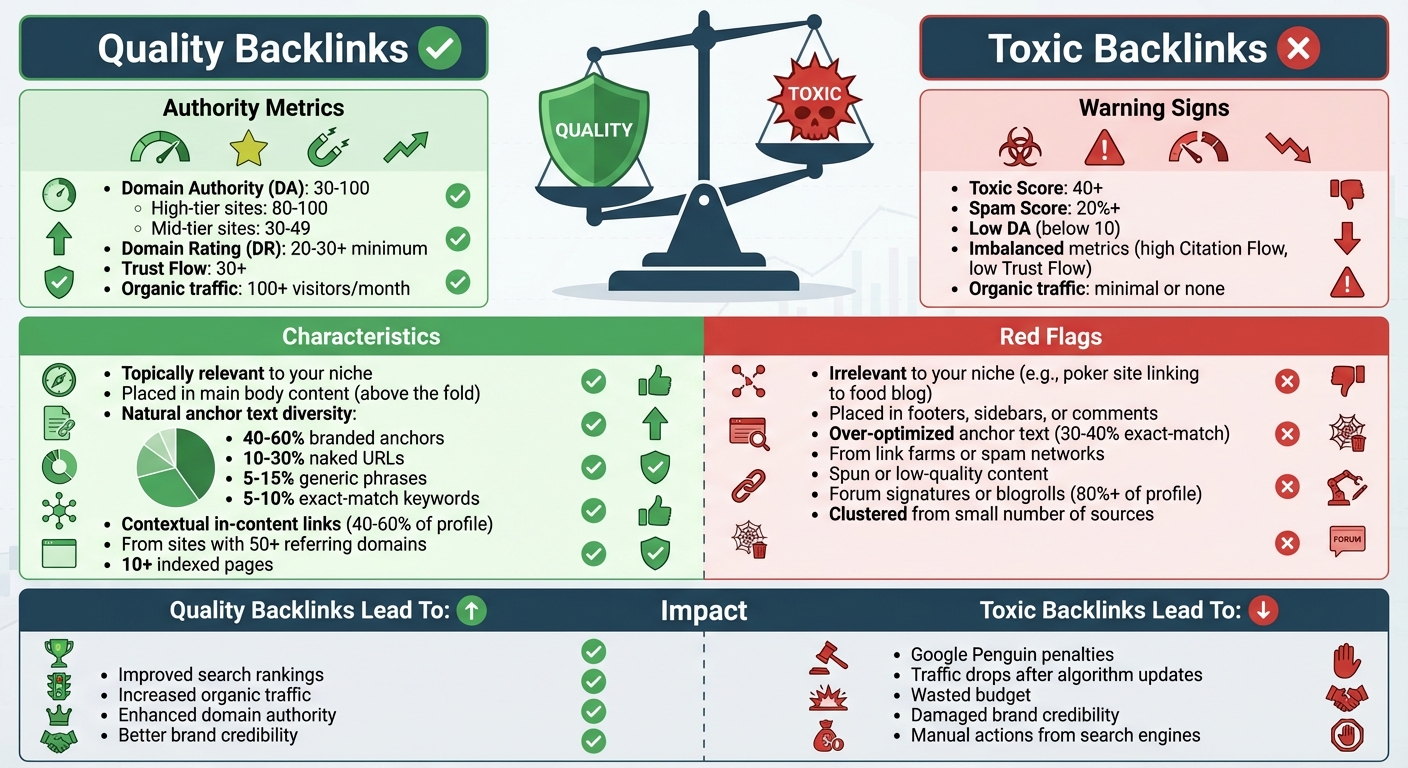
Quality vs Toxic Backlinks: Key Metrics and Indicators
A quality backlink comes from a site that’s both authoritative and relevant to your niche, and it should appear naturally within the content. This is especially important to keep in mind when outsourcing link-building efforts. If providers cut corners, they might deliver links that search engines flag as unnatural. These shortcuts don’t just fail to help – they can harm your site’s credibility and rankings.
How to Measure Backlink Quality
To evaluate the quality of a backlink, start by checking the site’s Domain Authority (DA) or Domain Rating (DR). These scores, which range from 0 to 100, provide a quick overview of a site’s authority. High-tier sites typically score between 80 and 100, while scores between 30 and 49 require closer inspection. For instance, a dofollow link from a tech blog with a DA of 45 that aligns with your niche might outperform a higher-DA general site because of its topical relevance.
But authority isn’t the only factor. Look at the site’s organic traffic trends and engagement metrics, like bounce rate and session duration. These numbers can indicate whether the site attracts real users who value its content.
Relevance is just as important as authority. Ask yourself if the linking page’s topic aligns naturally with your content. For example, a backlink from a poker website to your food blog would raise serious concerns, no matter how authoritative the poker site is. Placement also matters – links embedded naturally within the main body of the content, especially above the fold, carry more weight than those buried in footers, sidebars, or comments. Finally, ensure anchor text is diverse to avoid over-optimization penalties.
Once you’ve identified what makes a backlink valuable, it’s equally important to understand what can go wrong with low-quality links.
Problems Caused by Low-Quality Backlinks
Toxic backlinks can trigger Google’s spam detection systems, particularly through the Penguin algorithm. If your site accumulates links from spammy domains with low DA, you may notice a traffic drop after algorithm updates. These low-quality links waste your budget, offer little to no authority, and fail to drive meaningful referral traffic. Worse, cleaning up these links can be costly and slow down your site’s growth.
The issues go beyond traffic and rankings. When your site is tied to spam networks or irrelevant link farms, it damages your brand’s credibility. It also creates an unnatural backlink profile that search engines can easily flag. Manipulated profiles often show clusters of links from a small number of sources and lack the diversity seen in natural link-building efforts. This makes them vulnerable to both algorithmic penalties and manual actions. By systematically verifying your backlinks, you can maintain a clean profile and protect your long-term SEO strategy.
Getting Your Tools and Data Ready
To properly evaluate backlink quality, you need two things: the right tools and an organized system for managing data. Accurate information is key to ensuring that any outsourced backlinks meet your standards. A great place to start is Google Search Console. It’s free and gives you direct insights into the backlinks Google has indexed for your site. You can see top linking sites, anchor text distribution, and details about new or lost links. Export this data as a CSV file to establish a baseline for comparison with reports from your outsourcing partner. If you need more advanced metrics, it’s worth looking into specialized paid tools.
Paid tools can unlock deeper insights that go beyond what Google offers. For example:
- Ahrefs ($99/month) provides Domain Rating and lets you check multiple URLs at once.
- SEMrush ($129.95/month) has a Backlink Audit feature that flags potentially harmful links.
- Moz ($99/month) includes metrics like Domain Authority and Spam Score.
- Majestic ($49.95/month) focuses on Trust Flow and Citation Flow.
Each tool calculates authority differently, so pulling data from several sources can give you a well-rounded view of your backlink profile.
Tools You Need for Backlink Analysis
At a minimum, your toolkit should include Google Search Console and at least one paid platform. Here’s how to use them effectively:
- Use Ahrefs Site Explorer to track changes in your backlink portfolio over time.
- Use SEMrush to run monthly audits and flag links that might harm your rankings.
- Cross-check provider claims with Moz’s Domain Authority metric.
If you’re working with a tighter budget, stick with free tools like Google Search Console and the free version of Moz to get started.
When reviewing links from your provider, set clear benchmarks. For example, look for sites with:
- A Domain Rating (DR) or Domain Authority (DA) above 10.
- Organic traffic exceeding 100 visitors per month.
- More than 50 referring domains.
- At least 10 indexed pages.
These criteria can help you quickly identify low-quality sites that won’t contribute much to your SEO goals.
Combining Data from Multiple Sources
Your outsourcing partner should provide backlink reports in a standardized format, such as CSV or Excel. These reports should include essential details like:
- Referring URL
- Target URL
- Anchor text
- Acquisition date
- Claimed DA or PA
- Whether the link is dofollow or nofollow
Requesting this format upfront can save time and reduce the risk of manual data entry errors.
Once you have the provider’s report, combine it with data from tools like Google Search Console, Ahrefs, and SEMrush using a spreadsheet program like Google Sheets or Excel. Use functions like VLOOKUP to align URLs, anchor texts, and key metrics such as Domain Rating or Trust Flow. Sort the data by authority metrics and remove duplicates or outliers. If you spot discrepancies – such as a provider claiming a DA of 70 for a link flagged as spam by Moz – log these issues in a shared spreadsheet for follow-up. This consolidated dataset will be your foundation for a thorough backlink evaluation in the next steps.
How to Check Each Backlink
When assessing backlinks, focus on three key areas: relevance, authority, and potential toxicity. This process involves examining the relevance and authority of each link, reviewing anchor text and placement, and identifying any toxic indicators.
Check Relevance and Domain Authority
Start by visiting the linking page to see if its topic and audience align with your business. For instance, a backlink from a tech blog to a SaaS company makes sense, while one from a gambling site does not. The site’s overall theme and content should naturally connect to your industry.
Evaluate the site’s strength using tools like Ahrefs (Domain Rating or DR) and Majestic (Trust Flow). Ideally, target domains with a DR above 20–30, and prioritize those over 50. Also, check that Trust Flow is proportionate to Citation Flow – imbalances, such as high Citation Flow but low Trust Flow, often suggest spammy sources. Research indicates that Ahrefs’ Domain Rating is a more reliable predictor of SEO performance than Moz’s Domain Authority.
Additionally, tools like SEMrush or Ahrefs can help you determine whether the referring site’s audience overlaps with your target market. This ensures the backlink offers value beyond just rankings, strengthening your overall site profile.
Review Anchor Text and Link Placement
Use your backlink report to filter by anchor text and ensure there’s a healthy mix of branded, generic, and keyword-based phrases. Then, visit the URLs to confirm the links are embedded within high-quality, relevant content rather than in low-value areas like footers or sidebars. A good rule of thumb is to keep keyword-rich anchors at around 10–20% of your overall profile.
The most impactful links are placed within the main body of an article, ideally above the fold and within meaningful paragraphs. In contrast, links in footers, sidebars, blogrolls, or comment sections typically offer little SEO benefit. Record the type of placement in your spreadsheet and consider rejecting links from less valuable areas.
Once you’ve verified relevance and placement, shift your focus to spotting toxic links.
Identify Toxicity Indicators
Leverage tools like SEMrush’s Backlink Audit to identify domains with a Toxic Score over 40 or a Spam Score exceeding 20%. Look for signs of spun content, irrelevant language, or patterns suggesting link networks. Document any toxic links with screenshots and tool metrics, noting specific issues like "spammy forum signature" or "Toxic Score 65."
If you encounter a toxic link, attempt removal by contacting the provider. If removal isn’t feasible, add the link to Google’s Disavow Tool. Track your rejection rates, aiming to keep toxic links below 5% of your total backlinks. These steps are essential for maintaining a clean, high-quality backlink profile and setting the stage for ongoing quality assurance in your link-building efforts.
sbb-itb-5665bbf
Evaluating Groups of Backlinks Together
Looking at backlinks individually is important, but analyzing them as a group can give you a clearer picture of their overall quality. After reviewing each backlink, take a step back and evaluate the entire batch provided by your link-building partner. This broader perspective can uncover trends or issues that might go unnoticed when focusing on single links. By looking at batch-level metrics, you can determine if the links collectively meet your expectations.
Metrics for Batch-Level Quality
Start by exporting the entire batch of links into a spreadsheet. Include columns for key metrics like Domain Authority (DA), Trust Flow, topic relevance, link type, and anchor text. Here’s what to focus on:
- Domain Authority (DA/DR): Aim for 30–40% of your links to come from domains with a DA or DR of 50 or higher. If most links are from sites with a DA below 30, it’s a red flag for low quality.
- Topic Relevance: Group the links by how closely they align with your industry. At least 70% of the links should come from sites that are relevant to your niche. For example, a B2B SaaS company would benefit from links on tech blogs or business websites, while links from unrelated lifestyle blogs or forums would be less valuable.
- Link Type Diversity: Categorize the links as guest posts, niche edits, resource links, or other types. A healthy backlink profile typically includes 40–60% contextual, in-content links. If over 80% of your links are blog comments or forum signatures, that’s a sign of poor quality.
- Anchor Text Distribution: Check the balance of anchor text across the batch. A good profile should have:
- 40–60% branded anchors
- 10–30% naked URLs
- 5–15% generic phrases
- No more than 5–10% exact-match keywords
If exact-match keywords make up 30–40% of the anchors, it could lead to penalties for over-optimization.
Once you’ve analyzed these batch metrics, use the data to spot trends over time.
Monitor Link Building Patterns Over Time
Batch-level analysis is just the beginning. To ensure your link-building strategy stays on track, monitor how your backlink profile evolves over several months. Here’s how:
- Track Referring Domains: Keep an eye on the number of new referring domains added each month. A consistent growth rate of 5–20 new domains per month is a good sign. However, sudden spikes – like a 50% jump – without a clear reason (e.g., a PR campaign or viral content) could indicate spammy tactics or automation.
- Visualize Trends: Use tools like SEMrush to track authority distribution and identify any increases in toxic links. A downward trend in domain authority or a rise in harmful links may suggest your provider is cutting corners.
Setting Quality Standards with Your Provider
Once you’ve assessed your backlinks and defined what "quality" means for your strategy, the next step is ensuring your outsourcing partner consistently delivers links that meet those standards. The key? Clear, written guidelines that outline your expectations.
Create Clear Quality Guidelines
Start by documenting your standards in a concise, easy-to-reference format. A one-page guideline document can work wonders as a quick resource for your provider. Be specific about key metrics, such as:
- Domain Authority (DA): Aim for a minimum level in the mid-range, with at least 30% of links coming from sites with a DA of 50 or higher.
- Trust Flow: Target scores of 30+ to ensure links are sourced from credible websites.
- Topic Relevance: Require that at least 70% of links are closely aligned with your niche.
Additionally, define anchor text distribution to maintain a natural backlink profile. For example, aim for 40–50% branded anchors, 20–30% keyword-rich anchors, and 20–30% generic or naked URLs. This balance helps avoid over-optimization and keeps your link profile looking organic.
Don’t just throw out numbers – explain why these standards matter. For instance, a tech blog with a DA of 45 that’s relevant to your industry can often outperform a general lifestyle site with a DA of 70. Why? Because relevance carries more weight than raw authority. To make things even clearer, include a sample table that distinguishes between acceptable and unacceptable links.
Finally, require your provider to deliver standardized CSV or Excel backlink reports. These reports allow you to quickly spot-check their work and ensure the links align with your guidelines.
With these standards in place, establish a process to regularly check for compliance.
Build a Review and Feedback Process
A pre-approval system can help you avoid potential issues before they turn into problems. Ask your provider to submit link opportunities for review – this could be done via a shared Google Sheet listing details like the target URL, DA, Trust Flow, proposed anchor text, and a relevance score. Use tools like Ahrefs or SEMrush to verify the metrics, and aim to review each opportunity within 48 hours.
Regular audits are also essential. Depending on your link volume, conduct these audits weekly or monthly. Batch-analyze the delivered backlinks to confirm they meet your standards. If fewer than 80% of the links meet your targets, it’s a warning sign that requires immediate attention. Set up a replacement policy upfront: minor issues, like low anchor text diversity, might warrant a correction, but toxic or spammy links should be replaced within seven days at no extra cost.
To track long-term compliance, use a simple scorecard. If your provider consistently delivers 80% or more quality links, they’re likely meeting your expectations. However, if quality dips below 70% for two consecutive months, it’s time to reevaluate – either by adjusting your guidelines or reconsidering the partnership. The goal is steady, dependable quality that supports your SEO efforts.
Conclusion
Building and maintaining high-quality backlinks isn’t a one-and-done task – it’s an ongoing process that safeguards your rankings and budget. Start by pulling data from at least two reliable tools, like Ahrefs and Google Search Console. From there, weed out junk links, then evaluate each backlink based on relevance, authority, and placement. Identify harmful links for removal, look for natural patterns in anchor text and link velocity, and give your provider clear, actionable feedback. This structured approach transforms link building into a measurable strategy that drives both traffic and revenue.
Skipping these steps can jeopardize your rankings and even your brand’s reputation. By conducting audits monthly or quarterly – depending on your link volume – you can catch problems early and focus on strategies that truly work.
To avoid these risks, setting clear and simple quality standards is crucial. Your guidelines should prioritize topical relevance, require a minimum authority threshold (e.g., DA 30+), and favor branded or topic-related anchor text. Additionally, insist on contextual in-content links rather than sitewide placements like footer links. Summarize these standards in a concise, one-page document and share it with your provider. Regularly track compliance using a scorecard. If your provider consistently fails to meet these standards across audits, it might be time to revisit your requirements – or even consider a new partner.
Partnering with a dependable provider like 365Outsource.com can make this process far more manageable. Their team of SEO-savvy professionals works closely with clients to understand their needs and integrate quality standards into their operations. As they explain:
"Unlike other outsourcing companies from the Philippines, we understand that time is a valuable and irreplaceable commodity. That’s why we do things right the first time. We do what we say and we say what we do. We hit deadlines, stay on budget, and practice a proactive approach to client relationships."
This level of dedication ensures that your quality checks lead to meaningful SEO results. With a transparent approach and adherence to global standards, you’ll spend less time dealing with low-quality links and more time driving strategic growth.
To stay on track, review a sample of 20–30 links from your provider’s reports, update your quality guidelines as needed, and schedule regular audits. With clear standards, the right tools, and a committed partner, you’ll build a clean and natural link profile that supports long-term SEO success.
FAQs
How can I make sure my outsourced backlinks are high quality and safe for SEO?
To keep your outsourced backlinks effective and safe for your SEO, start by evaluating the backlink profile for relevance and authority. Focus on obtaining links from trusted websites that are closely related to your industry. Steer clear of links that appear unnatural or originate from spammy sources.
Leverage SEO tools to pinpoint any low-quality or harmful links in your profile. If you come across problematic links, disavow them to safeguard your website’s rankings. Consistently monitoring your backlink profile is essential for maintaining a solid and reliable SEO strategy.
What are the best tools to evaluate the quality of backlinks in outsourced work?
When evaluating the quality of backlinks in outsourced projects, tools like Ahrefs, SEMrush, and Moz Link Explorer can be incredibly helpful. These platforms give you access to detailed metrics such as domain authority, spam score, and link relevance, making it easier to determine whether the backlinks align with your standards.
If you’re looking for additional insights, Majestic is another solid choice. It offers unique metrics like Trust Flow and Citation Flow, which help gauge the credibility and overall impact of the backlinks. By leveraging these tools, you can thoroughly assess the quality of links provided by your outsourcing partner and ensure they deliver real value.
What standards should I set for my outsourcing partner to ensure high-quality backlinks?
When working with an outsourcing partner to secure backlinks, it’s crucial to prioritize certain standards to ensure quality. Start with domain authority – the linking site should have a solid reputation and strong metrics. Pay attention to relevance, ensuring the backlinks originate from websites that align with your industry or niche. Additionally, focus on securing links placed on trustworthy, high-traffic pages, using natural and varied anchor text. Lastly, verify that the sources have a low spam score to protect your website’s SEO health and enhance its visibility online.